Samsung Electronics Lost the Crown the Day It Posted a Record Profit
My read, up front
On June 22, 2026, Samsung Electronics (KOSPI: 005930) handed SK Hynix the title of Korea’s most valuable company for the first time in 25 years, measured on common shares. Here is the part that does not fit the obituary: in the same quarter, Samsung posted an operating profit of 57.2 trillion won (about $37 billion), its best ever, and it had just started shipping sixth-generation HBM4 memory. Stranger still, while the stock was losing the crown, sell-side analysts spent the spring raising their price targets. The phrase “Samsung is being left behind” and a near-doubling of profit estimates are sitting on top of the same company. I did not sell my position. I am holding it until I can see, in actual numbers, whether Samsung closes the HBM gap with SK Hynix, and I have written down exactly what would make me change my mind.
Contents
Samsung lost the crown on the day it printed a record profit
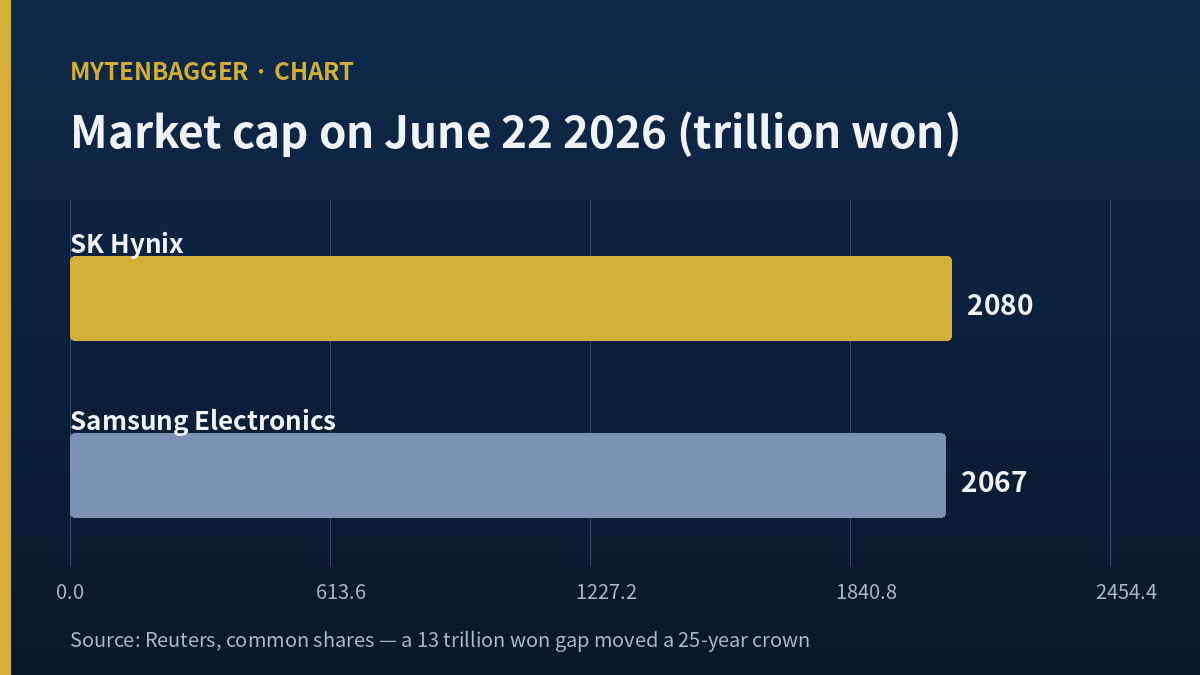
On June 22, the KOSPI scoreboard flipped for the first time in 25 years and 7 months. The KOSPI is the main board of the Korea Exchange, the rough equivalent of the S&P 500’s blue-chip tier for Korean equities, and Samsung Electronics had sat at the very top of it since November 2000. That day, SK Hynix passed it. According to Reuters, SK Hynix closed at a market value of roughly 2,080 trillion won ($1.35 trillion) against Samsung’s 2,067 trillion won on common shares, after a more than 340% rally in SK Hynix this year.
It helps to know how dramatic SK Hynix’s arc is, because it explains the premium the market is now paying. Per Reuters, this is a company that nearly collapsed under debt two decades ago and was almost sold to Micron in 2002; as recently as 2023 it posted a 7.73 trillion won annual operating loss in a memory downturn. It kept investing in HBM straight through that slump, and that bet is why it printed a record 23.5 trillion won operating profit in 2024 and now sits above both Samsung and Micron as the world’s most valuable memory chipmaker. The market is not only rewarding HBM; it is rewarding the purity of the bet. That same purity is the lens through which Samsung’s diversified business now reads as a discount rather than a strength.
I will be honest about my own reaction. For a moment that day, my hand moved toward the sell button. A 25-year bellwether losing its throne is symbolically heavy, and markets run on symbols. Then I stopped and asked myself a plain question: was I holding this because of the No.1 title, or because of the business underneath it? If it was the title, I should sell now. But the two things I had actually bought, the earnings power and the next memory cycle, had not changed in a single trading session. This entry is me working through that pause, line by line.
Three reasons I didn’t hit sell
Wipe the ranking off the table and look only at the company. What is left? My case for holding rests on three things, and if I had been holding only for the title I would have closed it long ago.
First, the earnings are a record, not a wreck. Samsung reported first-quarter 2026 revenue of 133.9 trillion won (about $87 billion) and operating profit of 57.2 trillion won (about $37 billion), at a 42.8% operating margin, with net income of 47 trillion won. All three were quarterly records, and it was the first time any Korean company cleared 50 trillion won of operating profit in a single quarter. A company that loses the market-cap crown while printing its best-ever profit is telling you something specific: the market is not pricing today’s earnings, it is pricing future AI leverage. That gap is what caught my eye, not the rank.
Second, HBM4 puts Samsung on the same starting line for the first time. In its Q1 release Samsung said it was the first in the industry to mass-produce and ship HBM4, the memory that sits next to Nvidia’s AI accelerators. Through the HBM3E generation Samsung was plainly behind SK Hynix. Per TrendForce, Samsung had priced its 12-layer HBM3E roughly 30% below SK Hynix, a sign of how weak its hand was. In HBM4, the same reporting says both vendors are supplying Nvidia at comparable prices, with 12-layer HBM4 expected to clear $600 a unit. Reaching parity without cutting price is, by itself, a change in Samsung’s bargaining position.
Third, only Samsung owns the full stack. Samsung is the one company on earth that designs and makes the memory, runs the foundry logic process, and does advanced packaging all in-house. As HBM shifts from a standardized commodity to customer-specific custom silicon in the HBM4E generation, the ability to design a customer’s logic die and package it end-to-end is a weapon SK Hynix does not have. The foundry side dragged in Q1 on seasonality, but it has reportedly booked work for Groq’s LPU and a Tesla A16 chip, which puts a floor under the non-memory recovery story. The foundry has also begun ramping its first-generation 2nm gate-all-around process, and any swing from loss toward break-even there would re-rate a division the market currently values at close to nothing. Being more than a pure memory maker is, in this stretch, an option rather than a liability.
The earnings and the next card did not change that day. The only thing that changed was the scoreboard.
Splitting Samsung’s results: the company print vs. the Street
With the bull case on the table, here are the figures. I have split them by source on purpose, because a company disclosure and a brokerage estimate are not the same kind of fact, and a forward number is only as good as the house that put its name on it.
| Item | Figure | Source |
|---|---|---|
| Q1 2026 revenue / operating profit | 133.9T won ($87B) / 57.2T won ($37B), 42.8% margin | Company release (April) |
| Q1 2026 net income | 47T won ($31B), record | Company release (April) |
| 2026 operating-profit estimate | 360T won (~$234B) | KB Securities (May 4) |
| 2026 operating-profit estimate | 371.9T won (~$242B), 71.5% chip margin | Mirae Asset (May 21) |
| 2026 operating-profit estimate (January) | 148T won (~$96B) | Eugene Investment (Jan 30) |
| Common close / preferred close | 354,500 won ($230) / 224,000 won ($145), June 22 | Korea Exchange, press |
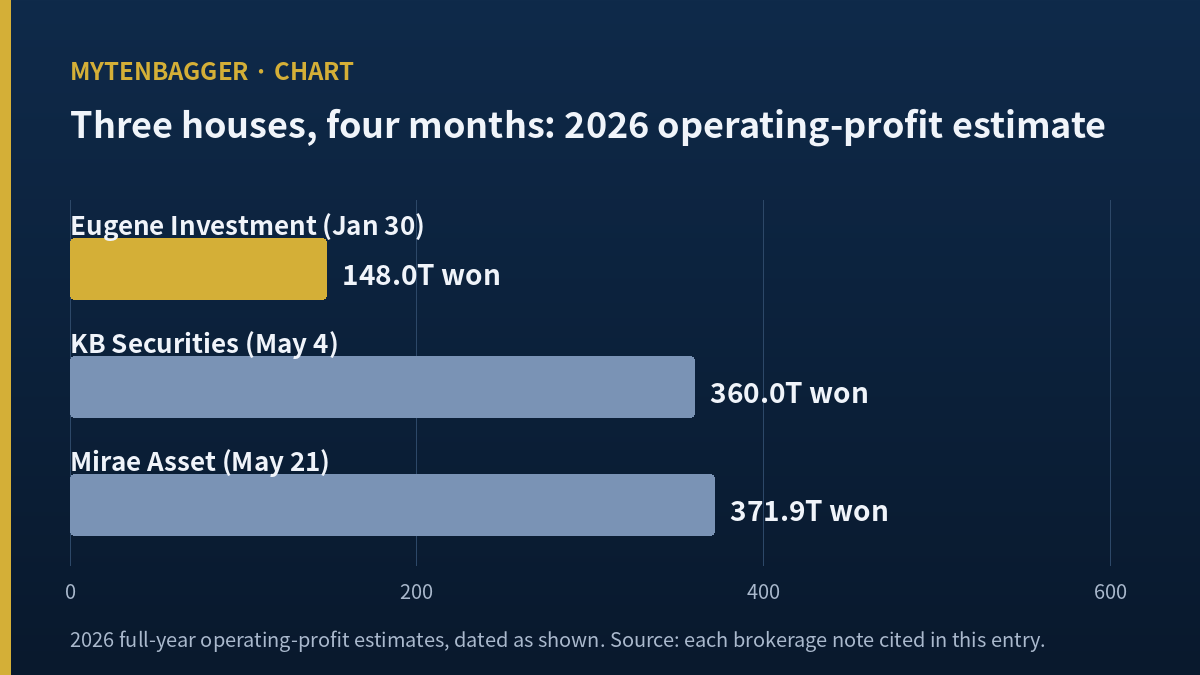
The thing that jumped out while I filled this in was the spread on the estimates. In late January, Eugene Investment modeled 148 trillion won of 2026 operating profit. By May, KB Securities was at 360 trillion and Mirae Asset at 371.9 trillion. The sell-side roughly doubled its number for the year in about four months, and Mirae lifted its target price from 400,000 to 480,000 won along the way. So the “left behind” mood and an estimate that doubled were happening on the same stock at the same time.
The near-term anchor sharpens it further. KB Securities models second-quarter operating profit of about 84 trillion won (roughly $55 billion) at a 50% margin, which would be another record stacked on the last one. When the conservative reading of a stock is “another all-time-high quarter,” the phrase “left behind” is carrying a lot of weight.
What I see that the “Samsung is finished” crowd doesn’t
This is where my read parts ways with the consensus mood.
One, “left behind” is a feeling, not a number. If the sell-side doubled its profit estimate in four months, then at least the people building the models are looking at the opposite of decline. KB Securities, in its early-May note, argued that 2027 memory supply will be even tighter than 2026, describing a market where there is effectively not enough product to sell. If the memory super-cycle is real, a story where one of the two giants reaps it and the other is left out is the unnatural version, not the obvious one.
Two, the HBM4 chapter does not start where the HBM3E chapter left off. Samsung’s HBM3E qualification at Nvidia slipped by several months on heat and speed problems, and that delay is the root of the last two years of “Samsung is behind.” HBM4 starts differently. Per TrendForce, Samsung built its HBM4 on a more advanced 1c DRAM and a 4nm logic base die, and Nvidia’s Vera Rubin platform is demanding data rates above 10 Gb/s, well over the 8 Gb/s JEDEC baseline. That same reporting describes Samsung as effectively clearing Nvidia’s HBM4 qualification at the 10 and 11 Gb/s tiers while SK Hynix was still optimizing for 11 Gb/s. None of that means Samsung has seized the lead. It means it is standing on the same line, which it was not a year ago.
Three, the preferred-share fight is its own tell. The headline “SK Hynix is No.1” counts common shares only. Samsung said in a statement to the press that any honest market-cap calculation should include preferred shares; on that basis its value was about 2,246 trillion won, still ahead of SK Hynix. A company bothering to issue that rebuttal tells me the crossover is closer to a price-and-supply event than a fundamental reversal. As Meritz Securities analyst Kim Sunwoo framed it to Reuters, the rise of customized AI memory changed the industry’s economics and let SK Hynix establish itself as the leader, a comment about positioning and mix, not about Samsung’s earnings collapsing.
Four, the peer math quietly helps Samsung where few people are looking: Micron. Micron is the third HBM supplier, and per TrendForce it has struggled to land HBM4 at Nvidia, likely relegated to mid-tier inference parts such as Rubin CPX and to LPDDR5X for Nvidia’s “Vera” CPU rather than the flagship Vera Rubin HBM4 socket. If Micron is effectively out of the top HBM4 tier, the volume it cannot serve does not disappear; it gets split between SK Hynix and Samsung. That is part of why reporting has Samsung’s global HBM share crossing 30% this year. It is better to be the number-two horse in a two-horse race than in a three-horse race.
A note on Samsung’s preferred shares
Since the preferred shares are at the center of that market-cap argument, let me spend a line on them. I do not treat Samsung’s preferred stock (005935) as a different company from the common; it shares the same cash flows. But on June 22 the preferred traded at 224,000 won ($145) against 354,500 won ($230) for the common, roughly a 37% discount. The quarterly dividend, set by the board, is the same 372 won on both lines. You are buying the same payout at a 37% lower price, so on raw dividend yield the preferred wins.
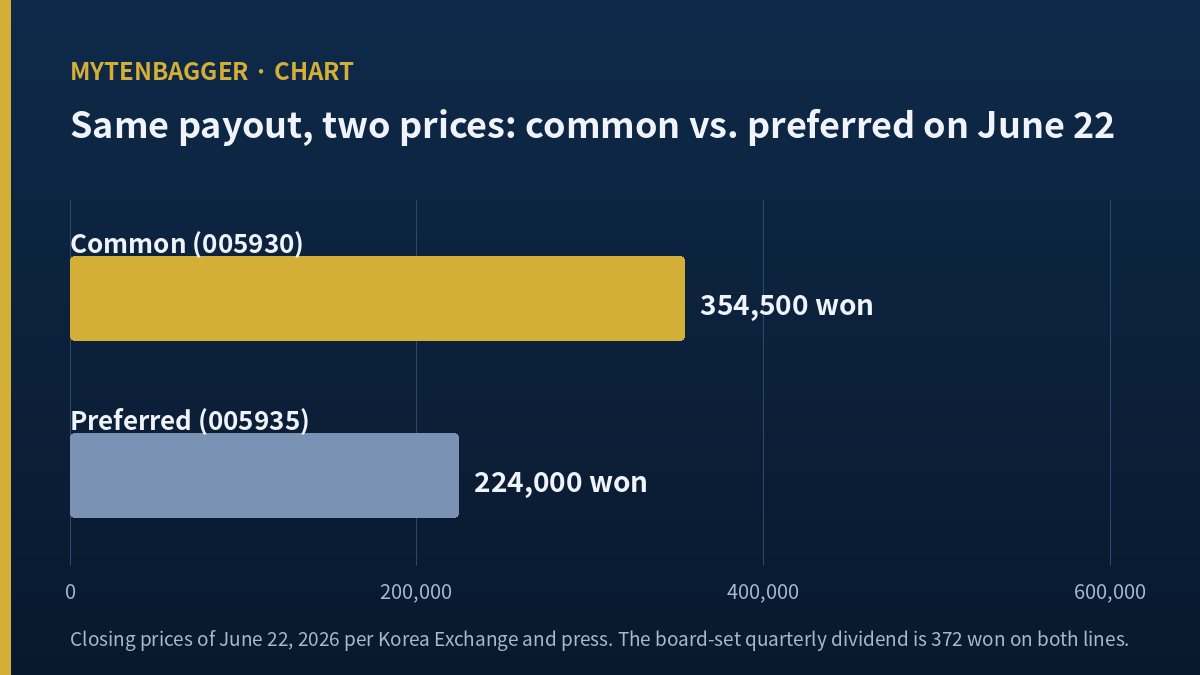
So my own framing is simple. If I want the dividend and the discount and I do not care about voting rights, the preferred is the rational entry. If I am betting specifically on the HBM4 catch-up story, the common is the more direct expression. They are two doors into the same wager, not two different companies, and I keep that distinction in mind rather than treating “Samsung preferred” as a separate idea.
One framing note for US readers: Korean preferred shares are not the fixed-income-style preferreds of Wall Street. They behave more like non-voting common stock that usually pays a slightly higher dividend and trades at a structural discount to the voting common. Samsung’s roughly 37% gap is wide even by that standard, a residue of years when sentiment was weak and the discount stretched. If you think the common re-rates on HBM4, the preferred has historically narrowed that gap on the way up, which makes it a second, quieter expression of the same thesis.
Two ways this plays out from here
I am not calling it one way. The fork runs through HBM4.
Scenario A, the catch-up shows up in the numbers. Samsung ships HBM4 12-layer to Nvidia in volume and pushes its share of Nvidia’s HBM4 above the high-20s where it starts the year. In the HBM4E and custom-HBM window, the full-stack turnkey advantage actually pays off. In that world the “left behind” story becomes a 2024-25 story, the doubled estimates get validated by results, and the No.1 spot goes back to trading hands. For that to happen the supply side has to cooperate: Samsung is reported to be lifting HBM output by roughly 50% in 2026, toward about 250,000 wafers a month, and the new Pyeongtaek P4 line has to ramp on schedule. If it does, the high-20s share is a floor rather than a ceiling. That is the path where my decision not to sell looks right.
Scenario B, the gap sets like concrete. HBM contracts run roughly a year, and per TrendForce’s projection SK Hynix still holds about 50% of 2026 HBM bit share while Samsung climbs only from 20% to 28%. If Samsung stays stuck in the high-20s all year and SK Hynix locks up HBM4E too, price competitiveness alone will not close the gap. Add a foundry loss that brokerages put in the trillions of won this year, and the “diversification discount” hardens in a market that only wants to pay for memory. There is a hard supply reason this can stick. Per TrendForce, Samsung’s 1c DRAM, the core die for its HBM4, was yielding around 60% earlier this year and ran at only about 60,000 to 70,000 wafers a month, roughly a tenth of its DRAM capacity; pushing monthly 1c output toward 190,000 wafers takes about a year even with the P4 build-out. And the longer-term hedge is not free: Samsung is racing hybrid bonding for 16-layer HBM4E by 2028, but prototype yields have been reported near 10%, while SK Hynix keeps stacking 16-high today with its proven MR-MUF process. Betting on the harder process is how Samsung leaps ahead, and also how it could stay stuck behind. In that world, second place is not an event, it is the new order.
There is also a macro version of the bear case I take seriously. Whenever a market’s most valuable company changes hands, someone notes that the handover itself has often marked a cycle top; the comparison circulating in Seoul is Cisco passing Microsoft as the most valuable US company in 2000, just before the dot-com unwind. I do not think a record memory quarter maps cleanly onto a profitless bubble, but I keep the analogy in view, because if the AI capital-spending cycle cools, both of these names correct together and Samsung’s record print will not shield it.
Notice that neither scenario assumes weak earnings. Samsung prints record profit in both. What splits them is not the size of the profit but whether AI memory pays Samsung a first-place premium or a second-place discount.
What would tell me I’m wrong on Samsung
If I am going to write down that I held, I owe the other side of the ledger too. Three things would change my mind.
One, if Samsung’s Nvidia-bound HBM4 share is stuck in the high-20s all year and SK Hynix again takes the bulk of the early HBM4E contracts, then my “same starting line” premise was wrong, and I would treat the parity as temporary. Two, the foundry and system-LSI side is running an operating loss some brokerages put near 4 trillion won (about $2.6 billion) for the year; if that loss widens instead of narrowing and there is no visible path to break-even into 2027, diversification stops being an option and becomes dead weight. Three, if the Q2 preliminary print due in early July, and the audited result after it, show a memory operating margin well below what the Street models (brokerages are penciling in roughly a 50% chip margin for Q2), then the super-cycle premise itself needs a re-examination.
If two of those three line up at once, I cut the position. If only one slips, I hold through one more quarterly print before deciding. Whether the market-cap ranking flips back is not on my list, because the ranking is an output of fund flows, not a cause. Capacity and yield, where Samsung’s 1c DRAM yield was reported near 60% earlier in the year, are the things I will actually be reading.
Where I land on Samsung for now
Samsung Electronics lost the crown on the same day it posted a record profit and started shipping HBM4, and analysts marked up their targets at that very moment. The market’s “left behind” and the sell-side’s doubling collide on one stock. I read that collision as an opportunity and did not sell, but if the HBM4 catch-up never shows up in hard share and margin numbers, that read is simply wrong. My next checkpoint is the Q2 preliminary release in early July. When it lands, I will lay the share and the margin back out and update this entry. Until then I am holding this as a position I believe in but have not added to at these levels, which is a different posture from one that says buy more.
Related reading