F&F Stock Paid 80 Million Dollars for a Shrinking Brand
F&F stock closed at 66,900 won on August 28, 2026 (a Friday), and the piece of news I kept coming back to was not the price. On August 13, 2026 (a Thursday), the company said it had bought the worldwide fashion trademark and intellectual property for Discovery Expedition from Discovery Communications of the United States, for USD 80 million. F&F had been renting that mark. Now it owns it. What held my attention is the revenue line sitting underneath the mark: by the tally a Korean trade outlet published, Discovery Expedition’s Korean sales have gone down in each of the three years to 2025.
What the purchase does and does not touch
| The item | Changed by the deal? |
|---|---|
| Who owns the Discovery Expedition mark worldwide | Yes, from August 13, 2026 |
| Whether a royalty is paid out for that mark | Company says yes; I could not confirm the amount |
| Korean demand for the brand (2022 to 2025) | No, and it fell every one of those years |
| The MLB license, which is the larger business | No, and its expiry year is not public |
Contents
What F&F Stock Bought on August 13, 2026
F&F Co Ltd trades on the KOSPI, the senior board of the Korea Exchange, under the ticker 383220. It is an apparel house that has built almost all of its scale on marks it does not own. Its largest business runs the MLB brand across Asia. Its second business runs Discovery Expedition, an outdoor line licensed out of a US media group. On August 13, 2026 the second of those two stopped being a rental.
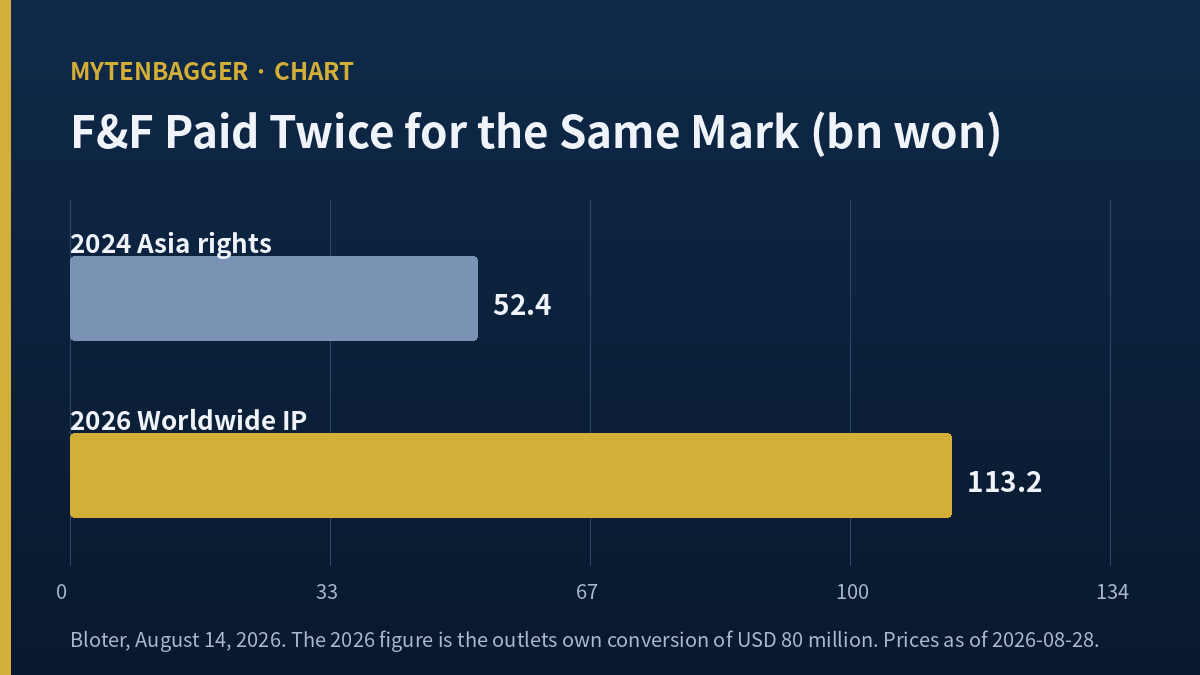
Aju Business Daily and the technology outlet Bloter both put the consideration at USD 80 million and converted it to about 113.2 billion won. I am quoting their conversion and not redoing it, because the exchange rate they used is theirs and not the one I use elsewhere in this piece. Bloter added a second figure I had not seen before: F&F had already paid about 52.4 billion won in 2024 for the Asian rights to the same brand. So the company has now paid twice for the same mark, once for a region and once for the world.
The company’s stated logic is that owning the IP removes a royalty and opens product categories a licensee cannot enter, such as cosmetics and beverages. That logic is sound on its face. My difficulty is with the second half of it, because a category door only matters if there is demand pushing on it.
The Brand’s Own Revenue Line, Four Years in a Row
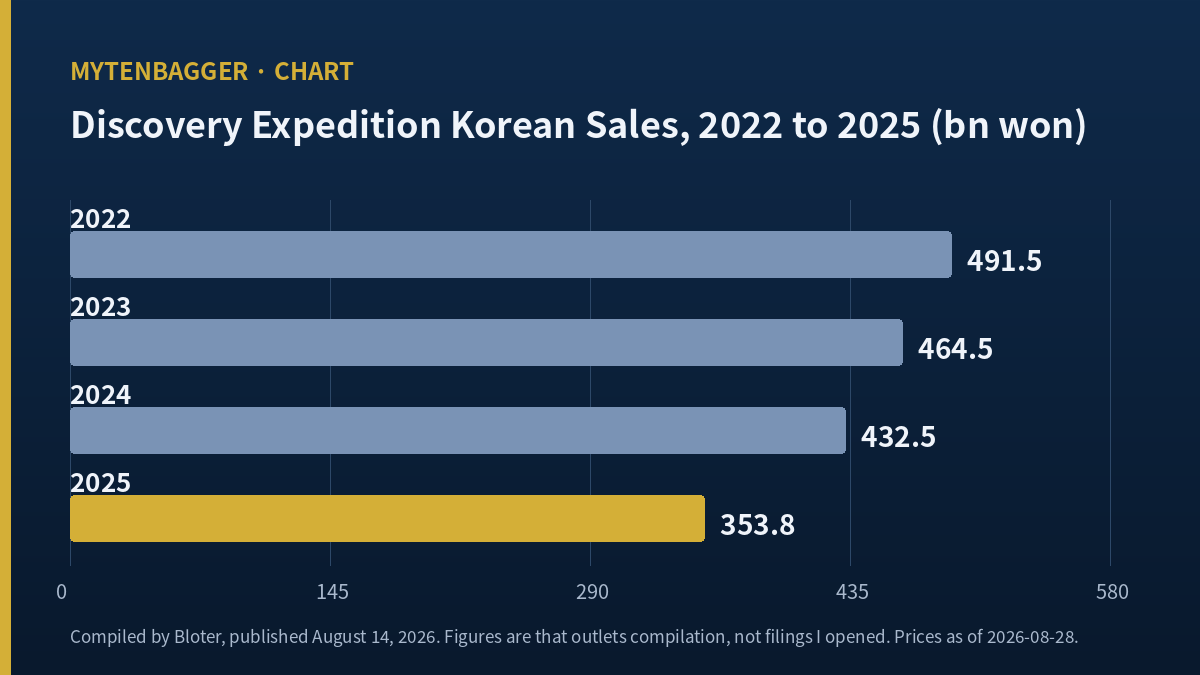
Here is the tally Bloter published on August 14, 2026 (a Friday) for Discovery Expedition’s Korean sales. I did not build these numbers; they come from that outlet’s compilation, and I am marking them as such, because they are not filings I opened myself.
| Year | Korean sales (bn won) | Change on prior year |
|---|---|---|
| 2022 | 491.5 | – |
| 2023 | 464.5 | -5.49% |
| 2024 | 432.5 | -6.89% |
| 2025 | 353.8 | -18.20% |
Percentage changes are my own arithmetic on the outlet’s figures. Three years end to end works out to -28.02% by my calculation. At roughly 1,377 won per dollar, the 2025 figure is about USD 257 million.
Three adjacent pairs sit inside that table and all three are negative, and the last one is more than three times the size of the first. The half-year that followed does not turn it around either: the same compilation puts the first six months of 2026 at 149.3 billion won, down 3.4 percent, with the June quarter alone at 63.2 billion won, down 4.6 percent. The rate of decline has eased. The direction has not changed.
There is a store-count figure alongside it that I found harder to read past. F&F had guided to about 100 Discovery Expedition doors in China by the end of 2025 and got to 25. The plan for the end of 2026 is about 40. I am recording that gap as reported and I have not confirmed what closed it, because the company’s own explanation for the shortfall is not something I found.
What Owning the Mark Changes and What It Does Not
I want to be precise about what I think the deal does, because it would be easy to be glib about it in either direction.
It removes a cash outflow. A licensee pays the mark’s owner a share of sales, and that share stops when the licensee becomes the owner. I could not find the royalty percentage F&F was paying, so I cannot size the saving, and I will not guess at it. It also lifts a legal limit on product categories, which is the part the company chose to emphasize in its own comments to the press.
What it does not do is add a single customer. The 353.8 billion won line for 2025 was earned under the same brand, in the same stores, with the same product. Ownership changes who collects the royalty on that line. It does not change the line. That is the whole of my hesitation, and it is why I watch this one and do not own it.
There is a second reading worth putting next to mine. If a brand is declining because the licensee could not move fast enough under contract terms, ownership is exactly the fix. Bloter’s own framing pushed back on that, saying that owning IP does not by itself bring demand back, and I find that the stronger of the two positions on the evidence I have. But I cannot test it until the September and December quarter reports are out.
F&F Stock’s June Quarter Sits Under That Purchase
The purchase landed two weeks after a quarter that the market did not like. On July 31, 2026 (a Friday) F&F reported consolidated June-quarter revenue of 399.6 billion won, operating profit of 86.5 billion won and net profit of 73.0 billion won. Those are the filing figures, and I pulled them from the half-year report on the Korean regulatory system under receipt number 20260814004123. At roughly 1,377 won per dollar that quarter is about USD 290 million of revenue and USD 63 million of operating profit.
Hanwha Investment and Securities analyst Lee Jin-hyeob wrote on August 3, 2026 (a Monday) that revenue came in about 3 percent under the market’s forecast and operating profit about 12 percent under it. The share price fell hard that day. I am not putting that day’s percentage into this piece, because the figures carried in the Korean press and the close in my own daily file do not agree, and I have not established which of them is the trading close.
The longer picture matters more to me here. F&F’s 2025 consolidated revenue was 1,934.0 billion won on operating profit of 468.6 billion won. Its 2023 revenue was 1,978.5 billion won on operating profit of 551.8 billion won. Both filings are on the Korean system, the 2025 one under receipt number 20260318001512. The company has not yet got back to the revenue or the profit it earned three years ago, and it now owns outright a brand that has been shrinking for the whole of that stretch.
At 66,900 won the company is capitalized at 2,562.7 billion won, or roughly USD 1.86 billion. That works out to 6.43 times trailing earnings and 1.32 times book, with a 23.2 percent return on equity and a 4.04 percent dividend yield, all on the vendor screen I use as of the August 28, 2026 close. Those are inexpensive multiples for that return. I was able to rebuild the earnings multiple and the return on equity from the filings before using them here. The price-to-book figure I could not, because the vendor’s book value per share matches neither of the two equity balances this company has reported for the current year, and I have not established which balance it uses.
F&F Stock Now Earns Less on Twice the Equity
The 23.2 percent return on equity is the number that carries the cheap multiples, so I went back four years of filings to see where it came from. Owners’ equity was 921.5 billion won at the end of 2022 and 1,878.7 billion won at the end of 2025, which is growth of 103.88 percent by my calculation. Operating profit over the same two year-ends went the other way, from 524.9 billion won to 468.6 billion won, a fall of 10.73 percent. The operating margin went with it, from 29.02 percent to 24.23 percent, both of those my own arithmetic on the filed revenue and profit.
Four annual filings, four different returns on equity
The return on equity recorded against those same four annual filings was 46.93 percent for 2022, 32.25 percent for 2023, 22.57 percent for 2024 and 21.33 percent for 2025. So the 23.2 percent on my screen, which is a trailing figure and therefore not the same measurement as any single one of those four, sits at the bottom of this company’s own recent range and not at the top of it. A screen that flags anything above 10 percent as strong will read this business the same way in 2022 and in 2025, and those were very different years for it.
F&F Stock Against Eight Apparel Names, Grouped by Who Owns the Mark
For the comparison I chose the grouping to match the subject of this piece: houses that own the marks they sell, and houses that rent them. The second group came out empty. Every listed apparel name of comparable size I could reach owns its principal brands outright, so the table below is entirely one group and F&F would be the only entry in the other. I am treating that emptiness as the finding, and I built the table anyway so the reader can see what the owning group is priced at.
| Company | P/E | P/B | ROE | As of |
|---|---|---|---|---|
| Ralph Lauren (RL) | 22.31 | 7.75 | 37.54% | Aug 30, 2026 |
| Deckers Outdoor (DECK) | 12.37 | 5.21 | 42.56% | Aug 30, 2026 |
| Lululemon (LULU) | 9.74 | 2.86 | 32.03% | Aug 30, 2026 |
| Columbia Sportswear (COLM) | 14.93 | 1.85 | 12.66% | Aug 29, 2026 |
| Levi Strauss (LEVI) | 15.20 | 3.61 | 25.40% | Aug 29, 2026 |
| Anta Sports (HKG 2020) | 13.46 | 2.50 | 22.51% | Aug 14, 2026 |
| Li Ning (HKG 2331) | 10.08 | 1.06 | 10.80% | Aug 26, 2026 |
| PVH Corp (PVH) | 22.65 | 0.71 | 3.32% | Aug 29, 2026 |
All eight rows from stockanalysis.com, each with the as-of date that page carried; the oldest and newest are 16 days apart. Anta Sports and Li Ning report in Hong Kong dollars and the rest in US dollars, which does not disturb these three ratios because all three are currency-neutral. I left Fast Retailing out because its page was six weeks older than the rest, and Skechers out because it stopped trading in September 2025. F&F’s own 6.43 and 1.32 come from a Korean vendor and I have not put its row inside this table, because that provider’s Korean snapshots have disagreed with my other sources before.
Reading across the eight, the group occupies a wide band on every measure I pulled, so I take only one thing from it. The lowest earnings multiple in the table is 9.74 and the highest return on equity is 42.56 percent, and none of the eight pairs a multiple as low as 6.43 with a return as high as 23.2 percent. That is a description of where F&F sits against companies that own what they sell. It is not on its own a reason to buy it.
A royalty line is the input I have gone longest without checking
A royalty line is a cost I have skimmed past for years in apparel names. I would read the margin, decide the brand was strong, and move on without asking who owned the brand or what the rental cost. Building the grouping above forced the question, and I found I could not answer it for the business that matters most here. F&F’s MLB license is the larger of its two, and I could not establish either the expiry year or the royalty percentage from any public source I could reach. I searched five different ways for it. That is not a small gap in a company whose scale rests on borrowed marks, and it took a table about somebody else’s brands for me to notice I had never looked.
Related reading: a cosmetics major measured against its own peer set, a convenience-store operator taken apart by asset turnover, three contract manufacturers ordered by borrowings, a drinks maker whose payout is decided one level up
Five Things That Argue Against Me on F&F Stock
- The brand tally is not mine. Every Discovery Expedition figure in this piece comes from one Korean outlet’s compilation. I did not rebuild those four annual numbers from segment disclosure, and if that compilation drew the brand’s boundary differently from the company, my three percentage changes move with it.
- Discovery Expedition is the smaller of the two businesses. The MLB line, in Korea and China, is where the bulk of group revenue is earned. A brand that has shrunk to 353.8 billion won of Korean sales cannot on its own settle what a 2,562.7 billion won company is worth.
- Owning the mark may be worth more than I am crediting. Cosmetics and food and drink licenses are real revenue lines for other apparel houses. I have no way to size that option, so I have valued it at nothing, and valuing something at nothing is a choice with its own error attached.
- The multiples are genuinely low. 6.43 times earnings with a 23.2 percent return on equity and a 4.04 percent yield is not what a broken business normally trades at. If the 2023 profit level comes back, my caution here will have cost me.
- There is a bigger unresolved item outside this piece. Korean deal press reported on July 31, 2026 (a Friday) that F&F holds a pre-emption right over TaylorMade, the golf equipment maker, and that a decision on exercising it was expected by the end of August 2026. I could not confirm an outcome as of the August 28, 2026 close, and an outcome either way would matter more to this company’s next twelve months than anything I have written above. If you are reading this after the decision is public, that news outranks this note.
Where I Stand on F&F Stock and What Would Make Me Rewrite This
I do not own F&F and I have placed no order in it. I am watching it. The reason is narrow and I want to keep it narrow: the company has just paid to own a brand whose own revenue line has gone down for three straight years, while the larger brand it depends on remains rented on terms I cannot see. Cheap multiples are what you get when a market is unsure whether the 2023 earnings level was a peak or a pause. I am unsure too, and I would rather say so than pretend the screen settled it.
My condition for scrapping this note is about what I am still able to observe, and it is not about the company’s results. If Discovery Expedition stops appearing as a separately visible Korean revenue figure, whether because the purchase folds it into a different reporting unit or because the outlet that compiles it stops doing so, then the observation this piece is built on cannot be rechecked by me or by anyone reading it. At that point I would not patch this note. I would write a different one, on a measure I can still see.
Basis and sources
Prices and multiples reflect the August 28, 2026 close as I checked them at the time of writing; August 29 and 30 were a weekend, so that Friday is the last trading session before this note. Korean won is the reference currency throughout, and dollar amounts are approximate, converted at roughly 1,377 won per dollar on that same date. The one exception is the 113.2 billion won figure for the IP purchase, which is the reporting outlet’s own conversion of USD 80 million and which I have quoted as they published it. Filing figures come from the Korean regulatory disclosure system, peer ratios from stockanalysis.com, and Korean-language reporting is attributed to the outlet that carried it.
Sources: Aju Business Daily on the IP purchase, August 13, 2026 · Bloter’s brand revenue compilation, August 14, 2026 · Etoday on the June-quarter results, July 31, 2026 · Seoul Economic Daily on the China revenue share, August 3, 2026 · Korea Economic Daily on the post-results session, August 3, 2026 · Fashionbiz on the shrinking Korean apparel market, February 26, 2026 · stockanalysis.com statistics pages used for the peer table