Why HD Hyundai Marine Engine Stock Fell 45% as Profit Surged
- I do not own HD Hyundai Marine Engine. It sits on my watch list and I am tracking it, not holding it.
- The earnings are exploding — Q1 operating profit up 217% year over year — while the stock has fallen roughly 45% from its spring high. Whether that gap is an overshoot or an early cycle-top signal is the whole question I am watching.
- If the structural margin shift (direct contracting) keeps showing up in quarterly numbers, I step in. If the order book starts cooling, I keep watching.
Here is a stock where the income statement and the share price are telling opposite stories, and I find that hard to ignore. HD Hyundai Marine Engine — ticker 071970 on Korea’s KOSPI exchange (the country’s main board, roughly Korea’s equivalent of the S&P 500) — just posted record quarterly profit. Its shares, meanwhile, are down close to half from where they traded in April. I have a personal rule about Korean shipbuilding-related names: I do not buy them at the top of the cycle, because I have been burned doing exactly that. The awkward thing about this one is that I cannot tell whether I am looking at the top of the cycle or the far side of it. This is a watch-list entry, written to work that question out in numbers. The short version: I have not bought it.
One housekeeping note for any US reader before the numbers, because access is the first practical question. This is not an ADR and it is not a US-listed name. So treat what follows as a research journal on a name most US readers can reach only with some effort, not a quick click.
Contents
HD Hyundai Marine Engine: earnings and price are diverging
Let me pin down the gap that made me stop, because the whole thesis lives in it. All conversions below use roughly KRW 1,440 to the US dollar, the rate that has been hovering through 2026; I will state KRW in parentheses so you can re-run the math at your own rate.
| Item | Figure | Note / source |
|---|---|---|
| Price / market cap | ~$45 / ~$1.5B (₩65,500 / ₩2.2T) |
52-wk ₩38,450–118,200 (~$27–82); ~45% below the high (Kiwoom, Jun 22) |
| Q1 2026 revenue / op. profit | ~$93M / ~$23M (₩133.5B / ₩32.6B) |
Op. profit +217% YoY, 24.4% margin, ~12% above consensus (Hyundai Motor Sec. May 12; Hana Sec. May 8) |
| FY2025 op. profit | ~$53M (₩75.9B) | +128.7% YoY; revenue ~$280M (₩402.4B), +27.4% (disclosure filings) |
| Order backlog (end-2025) | ~$756M (₩1,088.9B) | +47.3% YoY (DART regulatory filings / press tally) |
| Valuation (on current price) | P/E 14.6 / P/B 4.9 | ROE 41.4%, trailing EPS ₩4,867 (Kiwoom) |
| Brokerage targets (May) | ~$81–83 (₩117,000–120,000) |
Hyundai Motor Sec. ₩117k (May 12), Hana ₩120k (May 8) — set before the June drop |
Sources: Kiwoom data (price/valuation), company disclosure filings, Hyundai Motor Securities, Hana Securities | as of May–June 2026
Read the table top to bottom and it does not hang together the way you would expect. Operating profit up 217% year over year, an operating margin above 24%, an order backlog over $750 million — and a stock down roughly 45% from its spring peak near ₩118,000 (~$82) to about ₩65,500 (~$45). The trailing P/E has cooled to the mid-teens, well off the stretched multiple it carried at the high. Earnings and price moved in opposite directions. That divergence is the only reason this name is on my watch list at all.
There is one more layer once you zoom out. On Kiwoom’s trend data the stock is down about 15% over three months, but still up roughly 33% over twelve, and far above its 52-week low of ₩38,450 (~$27). So this is a pullback inside a longer uptrend, not a collapse. At the same time the current price sits below both its 60-day and 120-day moving averages (around ₩82,000 and ₩84,000), so the short-term tape still points down. Trend up, momentum down — that tension is the character of the price right now.
I also double-checked the price itself, and I am glad I did. One data source showed the stock in the ₩110,000s and another below ₩50,000, which made me suspect a stock split. Cross-checking against Kiwoom’s records, there was no split (the split flag came back clean). One aggregator was simply frozen on an April high-print; another was plainly wrong. The real story is not a split — it is a slide from the top. This is exactly the kind of thing that, left unchecked, ends up as a wrong number in the first paragraph.
The drawdown also did real work on the valuation, which matters for how a US reader frames the risk. Near the spring high, Hana Securities pegged the stock at roughly 27 times 2026 estimated earnings with a price-to-book around 5.5 — a rich multiple that left no room for a stumble. After the ~45% fall, the trailing P/E sits near 14.6 against a 41% return on equity. That does not make it cheap in any absolute sense — a high-single-to-mid-teens multiple on a cyclical at a cycle high can still be expensive if earnings have peaked. But it does mean the most obvious objection from two months ago, that the multiple was simply too high, has lost much of its force. What is left is the harder question of whether the earnings themselves are near a peak.
HD Hyundai Marine Engine: three reasons the earnings look real
A falling stock does not mean a falling business. I pulled the quality of the earnings apart three ways.
The middleman margin is disappearing
The most important change is structural, not cyclical. HD Hyundai Marine Engine is the former STX Heavy Industries, folded into the HD Hyundai group in July 2024. Until then it built part of the engine volume that its parent, HD Hyundai Heavy Industries, had won — essentially as a subcontractor. That work is now converting to HD Hyundai Marine Engine’s own direct contracts. As Hyundai Motor Securities analyst Baek Joo-ho framed it in a May note, when the same engine is built under a direct contract, the middleman margin disappears and the full revenue lands on the company’s own books, so profitability improves structurally. This is not just “selling more.” It is keeping more of each sale. And it showed up in the seasonally soft first quarter, when revenue still rose more than 20% over the prior quarter — Hana Securities described it as margin improving even in the off-season. Double-digit growth in a weak quarter tells me cycle demand is genuinely tight.
Layered on top is mix. Marine engines carry a two-to-three-year lag from order to delivery, so the revenue printing today comes from the higher-priced 2024–2025 order vintages. Hana Securities estimated that, as of end-2025, the revenue mix by order year ran roughly 6% from 2023 orders, 40% from 2024, and 54% from 2025 — meaning the bulk of revenue is the most recently, and most expensively, booked work. That average-selling-price tailwind has further to run.
Backlog and utilization are climbing together
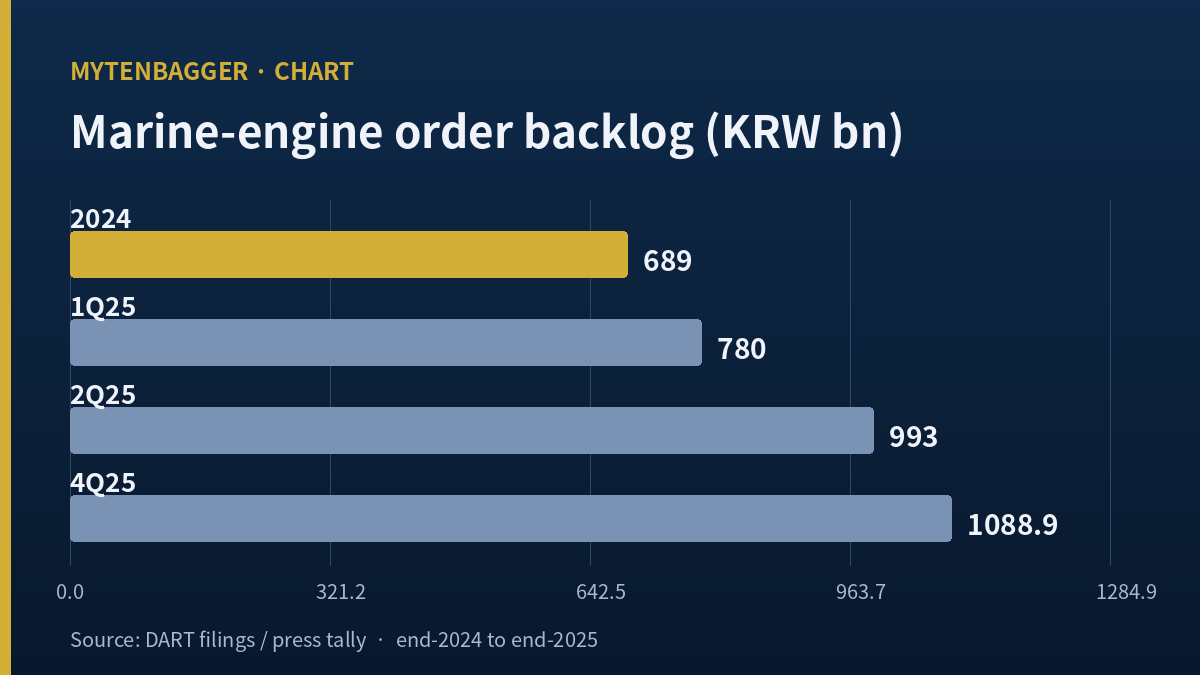
The second leg is visibility. The marine-engine order backlog grew from ₩689B at end-2024 to ₩780B in Q1 2025, ₩993B in Q2, and on to ₩1,088.9B (~$756M) by year-end — up 47.3% year over year, per regulatory filings and press tallies. Because engine makers recognize revenue at the point of delivery rather than over the build, that backlog is effectively a reservation book for several quarters of revenue ahead.
Utilization is stepping up in parallel. Per the company’s DART regulatory filings (the Korean equivalent of SEC disclosures), plant utilization moved from 64.6% at end-2024 to 86.1% in Q1 2025, 90.8% in Q2, and 92.6% by the fourth quarter. Nameplate capacity is 1.4 million horsepower, and the line can theoretically be pushed to 120%, so there is both headroom to run harder and idle land at the Changwon plant for expansion. SK Securities noted earlier in the year that, with Chinese orders rolling in, production slots were largely filled through the third quarter of 2027. Concretely, just three Chinese-shipyard orders early in 2026 totalled about ₩123B — roughly 40% of 2024 revenue (press tally).
Parts and turbochargers — a second engine
The third leg is the parts business bolted onto the core. By the fourth-quarter split, revenue ran roughly 77% marine engines and 23% engine parts, with parts gaining share. Demand for crankshafts, a core component, is firm, and turbochargers are being localized and scaled through contract production with Switzerland’s Accelleron (per Meritz Securities materials). Meritz analyst Bae Gi-yeon estimated the parts division at around ₩114B revenue (+32.7% YoY) with an operating margin in the mid-20s — a margin not far off the engine body itself. Sell an engine, and the parts that go into it plus the eventual aftermarket demand tend to follow, which is why some see the HD Hyundai group network effect opening up around 2027–2028. It is not the headline act today, but it is the kind of business that cushions a cycle when it cools.
HD Hyundai Marine Engine: the thing the market keeps confusing
Here is where I read this differently from the crowd. Korean marine-engine stocks have lately been swept up in an “AI data-center power engine” theme, on the idea that ship engines could serve as a backup power source for electricity-hungry data centers. Peel one layer back, though, and the fit is loose for this particular name.
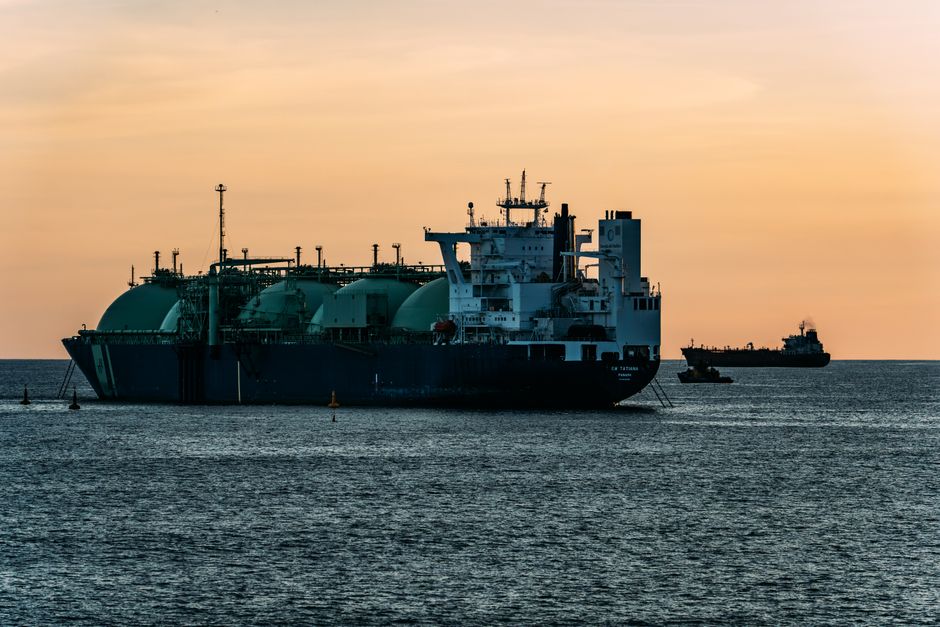
Korea’s marine-engine industry is led by a small set of players — HD Hyundai Heavy Industries, HD Hyundai Marine Engine, Hanwha Engine, and STX Engine (per Mirae Asset and trade press). What HD Hyundai Marine Engine builds is the main propulsion engine that moves the ship. What a data center wants is a power-generation engine — the four-stroke gensets in the world of Cummins, Caterpillar, and the gas turbines of GE Vernova — which is a different product category. Part of what stirred the theme was news that the parent, HD Hyundai Heavy Industries, won a large (~₩630B) order for power-generation engines from a US energy-infrastructure developer — but that is a different group engine division, not this company’s propulsion core. So buying HD Hyundai Marine Engine as a pure “AI power” play is aiming at the wrong target. The real driver I see here is not AI; it is the shipbuilding supercycle itself, plus the direct-contracting shift above. When the market gets excited about an AI keyword and then cools off, that can actually be the calmer entry window for someone watching only the core business.
The underlying demand is sturdy on its own. Tightening carbon rules have driven rapid adoption of dual-fuel (DF) engines; by the World Shipping Council’s count, the number of DF-powered container ships and car carriers roughly doubled in a single year. And while China has closed the gap on Korea in building ships cheaply, the engines remain a different story — Korean-made marine engines still command dominant demand, with Korea’s marine-engine and parts exports to China alone running about $1.29 billion in 2025, up 24% year over year (Korea International Trade Association data). A high-value component made in only a few places, with demand pushed along by regulation, is a structurally good place to sit.
Now the peer context a US reader actually needs. The world’s large two-stroke marine engines are not designed by the Korean builders at all — they are licensed from a handful of global designers: MAN Energy Solutions (now branded Everllence), Switzerland’s WinGD (owned by China’s CSSC), and Japan Engine Corporation. The Korean firms are the dominant licensed builders of those designs. Within Korea, after HD Korea Shipbuilding‘s group combination, the group holds roughly 80% of the engine-parts market and 70% of the marine-engine market — the clear number one, with HD Hyundai Marine Engine sitting inside that vertical chain (per the Korean antitrust regulator). The nearest domestic peer, Hanwha Engine, is bigger on the top line — about ₩130B (~$90M) operating profit in 2025, up 82% — and its average target price has been marked up over recent months. But Mirae Asset analyst Kim Joo-hee noted that the engine Hanwha licenses is a later entrant, with thinner margins and weaker pricing power. Same supercycle, different seat — and the seat decides the margin. That comparison is what convinced me HD Hyundai Marine Engine is quietly settling in as a mid-size-engine specialist inside the group chain, even if it will never be the biggest name on the dock.
HD Hyundai Marine Engine: three ways this plays out
With the stock already well off its high, honesty here means writing in probabilities, not conviction.
Base case — earnings catch the price up (45%)
Direct contracting and the ASP tailwind keep printing through 2026’s quarters, and the $750M-plus backlog converts to revenue on schedule. Hyundai Motor Securities sketched revenue rising from ₩402B in 2025 to ₩599B in 2026 and ₩747B in 2027 (~$280M to $416M to $519M). In that world, the spring drawdown was the normalization of an overheated multiple rather than a broken cycle, and earnings grind the price back. This is the path the data supports best, so it carries the most weight.
The market read the top early (35%)
The price falling first may be the market pricing a cycle peak before the income statement shows it. Three things could confirm it. First, new orders: the 2024–2025 surge in Chinese short-lead and speculative ordering drove engine prices sharply higher, and if that ordering normalizes, the ASP tailwind fades (Meritz flagged this too). Second, parent volume: HD Hyundai Heavy Industries volume has been propping up utilization, and as that rolls off, weak self-won orders would leave a gap. Third, the won: a favorable exchange rate has flattered margins, and a stronger won works the other way. Any one of these turning would validate the price action over the earnings.
The two tails (20%)
Best (~12%): direct contracting lifts margins faster than expected and the parts/aftermarket business opens up from 2027, and the stock re-rates as a structural grower rather than a cyclical. Worst (~8%): global newbuild ordering cools and engine orders follow it down — but with a backlog north of $750M cushioning several quarters, that would more likely show up with a lag than as a sudden shock.
HD Hyundai Marine Engine: what would get me to buy
Since this is a watch entry, let me write down the signals that would end the watching. Rather than fixing a price line, I track three operating metrics each quarter.
First, the quarterly operating margin. If direct contracting is real, the margin should hold in the 20s or climb. If it rolls over, the premise of the whole margin story is cracking. Second, new orders and the backlog. Once the backlog peaks and starts shrinking, I read that as the first sign the supercycle is cooling. Third, the self-won order share. Whether the company’s own contracts are filling the space left by departing parent volume is what decides how durable utilization is.
If those three line up in the same direction, I treat the current drawdown as an opening and scale in gradually. If the operating margin rolls over first and the backlog shrinks with it, I stay out even if the price keeps falling — because I have watched too many cyclical names where “cheap” was the trap. For now I am standing at that fork, giving it one more quarter.
So, do I step in here?
To wrap it up: HD Hyundai Marine Engine’s earnings quality has clearly improved. Direct contracting reshaped the margin structure, the order backlog cleared $750M, and utilization runs in the 90s. The stock, meanwhile, ran ahead and then fell roughly 45% from its spring high. To me that is one of two things — the market cooling an overheated price, or the market reading a cycle top before it shows in the numbers.
So I have not bought it. Not for lack of appeal, but because I want one more quarter of metrics to tell me which of those two it is. The next checkpoints are the Q2 results, the new-order disclosures around them, and the quarterly operating margin. If those numbers vote for the business, I move this name out of the watch column and into a buy journal. For now, it stays one square short of that — in the column where I just keep watching.