Doosan Fuel Cell Stock: The Korean Bloom Energy Trade I Hold
- I’ve held Doosan Fuel Cell stock (KOSPI: 336260) for a few years. It’s not a battery maker — it’s Korea’s #1 stationary fuel-cell company, generating electricity from hydrogen, and if you know the Bloom Energy trade, you already know the playbook it’s chasing.
- The real moat I see isn’t selling the cells — it’s the long-term service (LTSA) lock-in that follows each install. But that moat is anchored in Korea’s domestic hydrogen policy, and in the overseas data-center boom where the growth actually sits, Doosan hasn’t proven it yet.
- So I hold rather than add. The next checkpoints are the July 29 Q2 print, the government’s CHPS notice, and whether the US data-center order goes from “in talks” to signed.
Honest confession: when I first bought this, I bought a “hydrogen theme.” Years ago, when the hydrogen economy was the story, I took it for one reason — Korea’s #1 fuel-cell name. The reason I’m looking at Doosan Fuel Cell stock again today has nothing to do with that. What moves this stock now isn’t hydrogen policy; it’s the electricity shortage at AI data centers — a story I couldn’t have imagined back then. Same ticker, completely different thesis. This piece is the record of that re-examination.
One thing to clear up first, because it trips up a lot of people. Doosan Fuel Cell is not a battery company. A battery stores electricity and releases it; a fuel cell burns hydrogen to generate electricity. Generation, not storage. Miss that distinction and you’ll misread both the moat and the risk. For a US reader, the fastest mental model is this: Doosan is trying to be Korea’s Bloom Energy (NYSE: BE) — the same stationary-fuel-cell business that has become the hottest AI-power trade on the NYSE this year. Hold that comparison; I’ll come back to how far it actually holds.
Prices here are in Korean won, converted at roughly ₩1,535 to the dollar.
Contents
What Doosan Fuel Cell stock actually owns — the business
A generator business plus a maintenance business
Doosan Fuel Cell (336260) was spun off from Doosan Corporation in 2019 and is based in Iksan, in southwestern Korea. It does two things. First, it sells fuel-cell main equipment — hydrogen power units that go into power plants, industrial complexes, and buildings. Second, it runs the long-term service agreements (LTSA) on that equipment — the sale isn’t the end; the company periodically replaces and manages the finite-life core parts and gets paid for it.
The technology splits two ways. The older workhorse is the phosphoric-acid fuel cell (PAFC), with years of commercial-operation track record in Korean power generation. The newer push is the solid-oxide fuel cell (SOFC), where — via a partnership with the UK’s Ceres Power — Doosan began mass production in the second half of 2025. SOFC runs at higher electrical efficiency and is the higher-value category. On top of that, Doosan took full ownership of electric-and-hydrogen bus maker HyAxiom in 2024, giving it a channel to address the US market.
The single number I weight most in this structure: per Dealsite reporting, about 54% of first-half-2024 revenue of ₩118.2 billion (~$77M) came not from selling fuel cells but from maintenance. Selling the generator is the entry ticket; the real pie is the service revenue layered on top afterward. That structure feeds straight into the moat question.
The moat behind Doosan Fuel Cell stock — real, but with a border
The real moat: service revenue that compounds with the installed base
Selling a fuel cell once isn’t the end of the relationship. The core part — the cell stack — has a finite life and must be swapped every few years, and that swap is locked into a long-term service contract. As noted, more than half of revenue comes from there. In other words, the larger the installed base, the more the maintenance revenue compounds. A competitor can win a one-off new bid, but the servicing of Doosan units already deployed across the country stays with Doosan. There’s even a side stream from recovering platinum out of spent electrodes during that servicing. This is the real moat I see — unglamorous, easy to overlook, but sticky.
Here’s where the Bloom Energy mirror sharpens it, because the model is proven — just not by Doosan. Bloom’s edge isn’t a single sale either; it’s a contracted backlog around $20 billion and recurring service on a growing fleet, the same lock-in logic at a scale Doosan can only look up at. Per Simply Wall St via Yahoo Finance, Bloom expanded its Oracle partnership to a master services agreement for up to 2.8 GW of fuel-cell systems, lifting its contracted backlog to roughly $20 billion. The playbook works. Doosan is running the same one — a fraction of the size, and years earlier in the story.
The border: rooted in policy, and abroad it fights bare-handed
Now the honest part — a moat with borders drawn. A journal that only writes the bull case isn’t a journal.
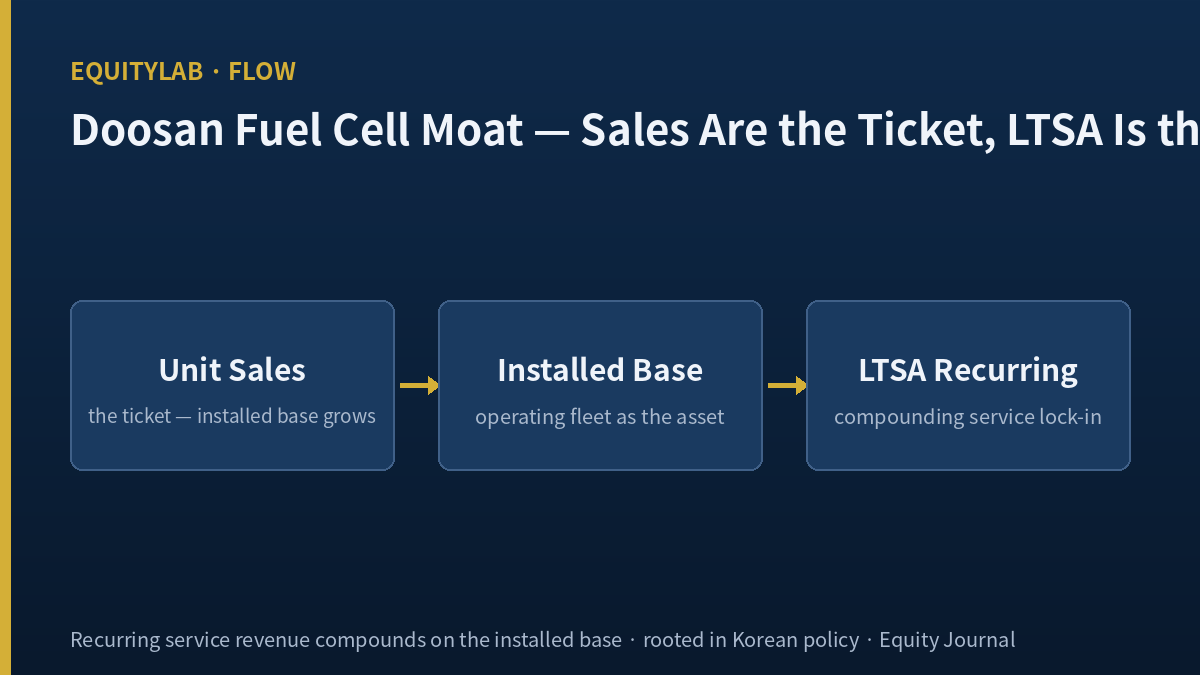
First, this lock-in rests on an installed base built inside Korea’s domestic policy market — CHPS, the Clean Hydrogen Portfolio Standard. If the government cuts auction volume, new installs shrink, and shrinking installs shrink the future service pie. The moat’s roots are wired into policy. Second, in the overseas data-center and SOFC arena that the market treats as the real growth key, Doosan has no moat yet. There it fights bare-handed against global heavyweights — America’s Bloom Energy, the UK’s Ceres Power (which is, awkwardly, also Doosan’s own SOFC partner). So my verdict is this: Doosan Fuel Cell’s moat is real at home, but unproven where the weight of the growth story lands. That one sentence is exactly why I’m holding (watching) rather than convinced (adding).
The order flow backs up that border. Per press compilations, Doosan’s annual new orders peaked in the 160-plus MW range in 2022, then slid over the following years, and in 2025 policy delays pushed bookings well below target as orders got deferred. First-quarter 2026 new orders came in only in the low double-digit MW range — weak near-term momentum. To hit the roughly 160–170 MW annual order target the company has laid out, the second half needs both domestic CHPS volume and overseas deals to land. The orders are in a “past the cliff, waiting for the rebound” phase — and half that rebound hangs on policy, the other half on overseas contracts that don’t exist on paper yet.
Doosan Fuel Cell stock and the numbers — where it sits now
| Metric | Value | Note |
|---|---|---|
| July 3 close | ~₩56,600 (~$37) | Down from the ₩80,000s in early June (volatile) |
| Market cap | ~₩3.7T (~$2.4B) | ~-48% from 52-week high of ₩108,900 |
| Q1 2026 revenue | ₩144.8B (~$94M) | +45.2% year over year |
| Q1 2026 operating result | -₩1.3B | Still a loss, but sharply narrower YoY |
| Dividend history | None | No payout since the 2019 listing (pure price story) |
Sources: exchange quotes (July 3 close); Q1 figures per Newsquest reporting (preliminary disclosure); dividend history per Korea Financial News. Off-high figure is a simple derivation. FX ~₩1,535/$.
The picture the table paints is simple: revenue is growing fast but the company still loses money. Per Newsquest reporting, Q1 2026 revenue rose 45.2% year over year to ₩144.8 billion, while the operating result was a ₩1.3 billion loss — though the loss narrowed sharply from a year earlier. There’s a painful backdrop. Per Korea Financial News, Doosan posted a ₩105.7 billion (~$69M) operating loss in 2025, its worst since inception — the combined weight of the HyAxiom acquisition, early SOFC missteps, and rising platinum costs. And yet the cumulative total shareholder return since the 2019 listing runs into four figures in percentage terms (Korea Financial News); since the company has never paid a dividend, that entire return came from the share price. Results and stock price running in opposite directions — the textbook story stock.
The current name for that story is the data center, and this is where the US comparison earns its keep. On June 29, the Korean government unveiled three “mega-projects” anchored on semiconductors, physical AI, and AI data centers. Per CNN, the package runs to more than $576 billion, with Samsung and SK Hynix building new fabs in the country’s southwest, framed as a push to narrow regional disparities beyond Seoul. Fabs and data centers resolve into enormous electricity demand. Where Hyosung Heavy catches that demand through grids and transformers, Doosan catches it as distributed on-site power beside the data center. But to be honest, the Korean mega-project is a demand backdrop for Doosan, not a direct catalyst. The real near-term catalyst is in the United States — and there, the evidence is loud.
Doosan Fuel Cell stock scenarios — the three branches I weigh
Deferred domestic volume drives the turnaround (45%)
Volume delayed by policy into 2026 gets booked as revenue, with early SOFC volume added on top. Revenue already jumped 45% in Q1, and if the Ceres-partnered SOFC line reaches commercial operation in the second half, the momentum carries. In this path, a swing to profit within the year comes into view. It’s the base case I weight most — but domestic policy volume itself shrinking is the risk that keeps the probability below half.
The US data-center order becomes real (30%)
This is the card that would re-rate the stock — and the reason the Bloom mirror matters. The US fuel-cell-for-data-center market has gone from pilot to primary in eighteen months. Per DatacenterDynamics, Bloom Energy signed a $5 billion partnership with Brookfield and a deal with utility American Electric Power for up to 1 GW of SOFCs to power AI data centers off-grid — with hyperscalers routing around multi-year grid-interconnection queues. It isn’t only Bloom: per its June 2026 SEC filing, FuelCell Energy announced an agreement for up to 380 MW of on-site power for data centers. Into that current, Doosan wants in. Per Newsquest reporting, Hana Securities analyst Yoo Jae-seon said Doosan’s PAFC technology validation for North American data centers is complete and talks are underway across multiple regions, with results expected within the year; Hana models 2027 revenue of ₩615 billion and operating profit of ₩30 billion. Per Korea Financial News, Meritz Securities argued the export pool — hundreds of MW to gigawatts — dwarfs the domestic tens-of-MW market. That’s why the market calls Doosan “Korea’s Bloom Energy.” But note the gap honestly: it’s “validation complete, in talks,” not a signed contract. Until the paperwork exists, this 30% is the value of expectation.
Policy shrinks and credit wobbles (25%)
The counter-case already has signals flashing. Per Korea’s Edaily, NICE Investors Service left the door open to a credit-rating downgrade on Doosan Fuel Cell, and this year’s planned general-hydrogen auction volume came in at 125 MW, down from a roughly 175 MW three-year average. Borrowings have surged, lifting interest costs. Per Korea Financial News, the government’s climate-and-energy ministry is reportedly weighing cutting general-hydrogen auction volume further, or abolishing that market entirely. If domestic policy volume falls while the US order slips, the losses and the debt load both run longer. This path is the biggest threat to my decision to hold.
What breaks my thesis
Three breakpoints, written in the order they answer. The fastest is the July 29 Q2 print — whether revenue growth continues and the loss narrows further onto a swing-to-profit track. If the loss widens instead, I re-examine the turnaround assumption itself. The second is the government’s CHPS notice: if general-hydrogen volume is actually cut or the market abolished, the domestic LTSA base I identified as the real moat loses future pie, and half my hold logic wobbles. The third, on the most open-ended clock, is whether the US data-center order crosses from “in talks” to “signed.” A real contract within the year lays the first brick of an overseas moat; silence past year-end forces me to mark down that 30% re-rating probability. The worst combination is all three going the same wrong way in the same quarter — and if that happens, moving from hold toward exit is on me.
So why do I hold instead of sell
Here’s the summary. Doosan Fuel Cell is Korea’s #1 stationary fuel-cell maker with a real moat in LTSA lock-in. But that moat is rooted in domestic policy and unproven where the growth weight lands abroad, and the company still loses money. That combination is too live in risk to add aggressively, yet the data-center optionality and the domestic #1 lock-in are too valuable to sell outright. The honest seat between the two is a hold. A ticker I first bought as a hydrogen theme and now hold as a data-center story — a thesis rewritten once — so I’ll grade it in order starting July 29. I keep the scorecard in this journal.
And the Bloom mirror is the frame I keep coming back to. One footnote worth remembering: Bloom’s US data-center deals mostly run on natural gas, because hydrogen is still too expensive at scale — while Doosan’s Korean base is a hydrogen-policy business. So “Korea’s Bloom Energy” running the US playbook wouldn’t just be a smaller Bloom; it might be a different fuel motion entirely. Even the original trades rich — per Simply Wall St, Bloom itself sits well above its analyst consensus target. Which is the whole reason I’m holding the Korean version, not chasing it.