EcoPro Earnings: Q2 Finance Costs Ran 2.7x Operating Profit
EcoPro earnings for April to June came to KRW 33.6bn (about $24.9m) in operating profit, while the finance costs line in the same period was KRW 91.2bn (about $67.5m), 2.7 times larger. That is the number I keep coming back to. EcoPro is the parent of a Korean battery materials group listed on KOSDAQ, Korea’s growth-company board, and at the October 2, 2026 close of KRW 89,100 its market value was about KRW 12.10tn, or roughly $8.96bn.
I am writing this because the headline story this summer was a recovery: operating profit up roughly twofold from a year earlier, lithium prices higher, an Indonesian nickel smelter now inside the consolidated numbers. All of that is real. But when I lined up the six-month report next to the press numbers, the line that told me the most was the one below operating profit, and the profit line itself had already been revised once.
What I set out to check
- How much did the group earn from operations between April and June?
- How much of that went to the cost of carrying its debt?
- Where did January to June net income of KRW 288.3bn come from, if operations made KRW 90.0bn?
- Why did the January to March figures change between April and May?
Contents
EcoPro earnings from April to June, in filed numbers
I start with the six-month report filed with Korea’s regulator in August, because it is the version that will not move again. Subtracting the January to March figures from the January to June totals gives me the April to June period on its own: revenue of KRW 821.5bn (about $608m), operating profit of KRW 33.6bn, and net income of KRW 51.8bn, of which KRW 50.7bn belonged to EcoPro’s own shareholders. Those are my calculations from the cumulative numbers.
The preliminary release on August 4 had slightly different figures. As reported by Asia Economy on August 4, the group printed revenue of KRW 820.8bn and operating profit of KRW 32.9bn, and operating profit was 41.7% lower than in January to March. The gap between the release and the report is small this time: revenue differs by 0.1% and operating profit by 2.1%. I use the report numbers in every ratio below and keep the release numbers only for the segment split, which the report does not give in the same form.
For readers who do not follow Korean battery names, a quick map. EcoPro sits on top of a group whose best-known member is EcoPro BM, a cathode maker that is itself one of the larger companies on KOSDAQ. A second subsidiary, EcoPro Materials, trades on KOSPI, the main board, and holds the precursor and Indonesian nickel business. A third, EcoPro HN, handles environmental equipment. EcoPro consolidates all of them, so its revenue line is mostly their revenue, and its operating profit is theirs plus whatever happens at the parent. Of the KRW 288.3bn of January to June net income, KRW 261.2bn, or about 91%, belonged to EcoPro’s own shareholders, with the remainder going to outside holders of the subsidiaries.
Six periods side by side make the pattern easier to see. Every figure below is a single three-month period that I derived from the cumulative totals in the regulator’s data, so treat the arithmetic as mine.
| Period (KRW bn) | Revenue | Operating profit | Net income | Finance costs |
|---|---|---|---|---|
| Jan to Mar 2025 | 806.8 | 1.4 | -10.8 | 55.2 |
| Apr to Jun 2025 | 931.7 | 16.2 | -38.0 | 140.2 |
| Jul to Sep 2025 | 959.4 | 149.4 | 173.9 | 9.5 |
| Oct to Dec 2025 | 715.1 | 46.8 | -230.8 | 157.4 |
| Jan to Mar 2026 | 818.3 | 56.4 | 236.5 | 74.1 |
| Apr to Jun 2026 | 821.5 | 33.6 | 51.8 | 91.2 |
Source: Korea’s regulatory disclosure system (DART) cumulative figures, consolidated. Single periods and the October to December row (full year minus nine months) are my subtraction.
Two points jump out. Operating profit was positive in all six periods, which is a real change from 2024, when the group lost money at the operating level for the full year. And net income moves around far more than operating profit does, swinging from a KRW 230.8bn loss in late 2025 to a KRW 236.5bn profit three months later. Whatever drives the bottom line here, it is not the plants alone.
The year-earlier comparison is the part that made headlines. A Korean outlet, Bloter, reported that operating profit roughly doubled on the year while revenue fell 11.9% (Bloter via Daum, August 4). Profit up, sales down. I accept that. My question is what was left after the group paid for its debt.
Where EcoPro earnings came from: three listed units and a remainder
EcoPro is a holding company. Most of what it reports is the sum of its listed subsidiaries plus whatever sits between them. The Asia Economy report broke the April to June release down by unit, and I added the pieces myself.
| April to June 2026 (release) | Revenue, KRW bn | Operating profit, KRW bn |
|---|---|---|
| EcoPro BM (cathode materials) | 576.7 | 18.0 |
| EcoPro Materials (precursors, Indonesian nickel) | 178.8 | -10.6 |
| EcoPro HN (environmental) | 51.5 | 5.8 |
| Sum of the three (my calculation) | 807.0 | 13.2 |
| Group total (release) | 820.8 | 32.9 |
Source: Asia Economy, August 4, 2026, citing the company release. Sum row and the difference below are my arithmetic.
The three listed units add up to KRW 13.2bn of operating profit. The group reported KRW 32.9bn. So KRW 19.7bn came from somewhere other than those three: the unlisted lithium unit, the parent itself, and consolidation adjustments between companies. The April 29 coverage of the January to March results named the lithium business, EcoPro Innovation, as one that turned around with revenue up 59% (TheElec call transcript). I could not find a disclosure that splits the KRW 19.7bn, and I am not going to guess how much belongs to lithium.
Analysts had expected more from the largest unit. A Korean report on August 3 listed eight brokerages that cut their price objectives on EcoPro BM after its results, and noted that its April to June revenue of KRW 576.7bn and operating profit of KRW 18.0bn fell short of the brokerage consensus by 13.1% and 23.9% (Daum, August 3). Year on year, that unit’s revenue fell 26% and its operating profit 63.2%. In other words, the parent’s operating profit doubled while its biggest subsidiary’s profit fell by almost two thirds. The difference came from the smaller pieces and the parent level. I could not find a named brokerage estimate for EcoPro itself for 2026, so I have no forward anchor for the group; the subsidiary is the only part with live coverage.
What the table does show is that the largest unit by revenue earned a small slice. EcoPro BM brought in about 71% of the three-unit revenue and earned KRW 18.0bn on KRW 576.7bn of sales. The nickel and precursor unit lost money in the quarter; Asia Economy reported that heavy rain in Indonesia temporarily cut the smelter’s run rate. Metal prices push this group’s sales around more than its plant capacity does, a point I ran into earlier with Sungeel Hitech, where revenue tracked lithium and cobalt prices more than anything the company built.
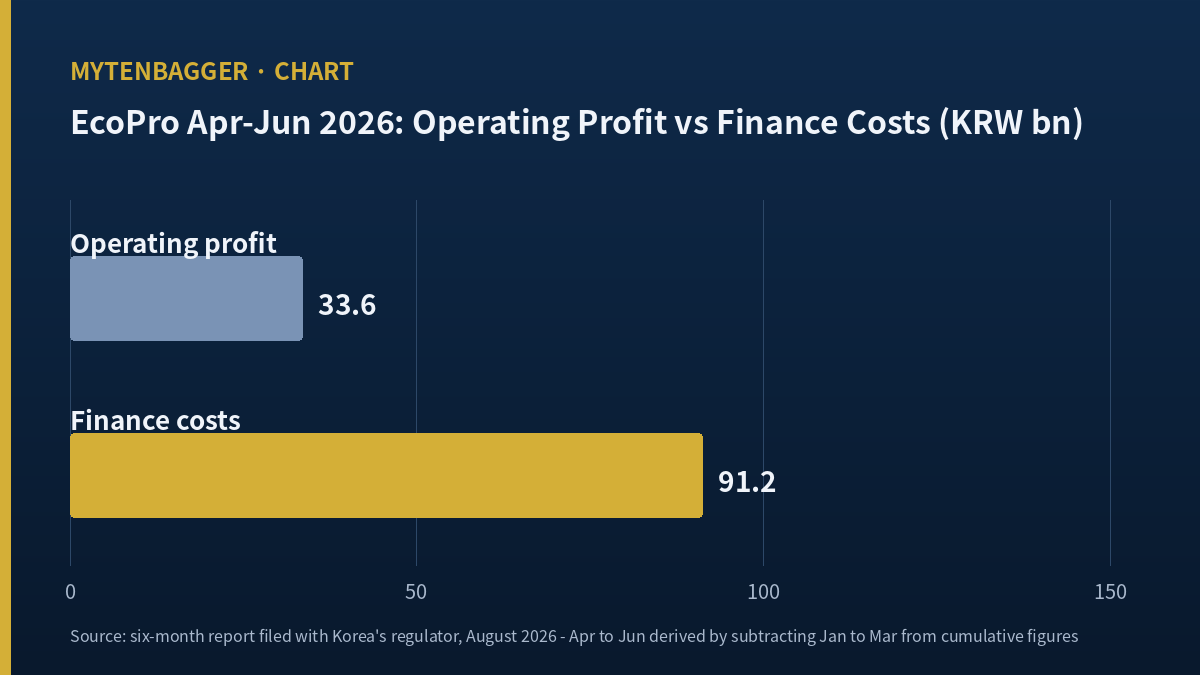
EcoPro earnings against finance costs
This is the part of the report that changed how I see the recovery. For January to June, the finance costs line I pulled from the regulator’s data was KRW 165.4bn (about $122m). Operating profit for the same six months was KRW 90.0bn. Finance costs were 1.84 times operating profit. Taking January to March out, the April to June period alone shows KRW 91.2bn of finance costs against KRW 33.6bn of operating profit, a ratio of 2.7.
The full year 2025 looked similar in kind. Operating profit was KRW 213.8bn and finance costs were KRW 362.3bn, 1.7 times larger. Net income for the year was a loss of KRW 105.5bn, and the loss belonging to EcoPro shareholders was KRW 149.8bn. So the pattern is not new to this year. What is new is that operating profit has come back while the cost of carrying the balance sheet has not shrunk to match it.
Part of the reason is plain from the cash flow. For January to June, operating cash flow was negative KRW 452.4bn and capital spending was KRW 262.9bn. The group is still spending on plants in Indonesia and Hungary faster than operations replace the cash. Total liabilities stood at KRW 6.34tn at the end of June, up from KRW 5.29tn six months earlier. Those balance sheet numbers come from the same filed data.
Funding a build-out this way is not unusual among Korean materials makers. When I went through SKC, its June share sale covered only about 38% of what the company had burned in free cash flow over three years. EcoPro’s group is in a similar position: new equity at the subsidiary, a heavy spending plan, and a profit line that has not yet caught up with the money spent.
The six-period table adds a wrinkle I did not expect. Finance costs were KRW 9.5bn in July to September 2025 and KRW 157.4bn in the next three months. Debt does not swing like that from one period to the next. A line that moves from 9.5 to 157.4 most likely carries items such as currency translation on dollar loans or derivative revaluations alongside interest. Adding all six periods together smooths some of that noise: finance costs of KRW 527.7bn against operating profit of KRW 303.7bn, a ratio of 1.74. That is less dramatic than the 2.7 for April to June, and I trust it more, because it covers eighteen months of currency moves in both directions.
I should be careful on one point. The regulator-data line I used takes pure interest expense when a company reports it and falls back to total finance costs when it does not. Total finance costs can include foreign exchange losses and derivative losses as well as interest. I have not opened the note that splits EcoPro’s line, so I call it finance costs throughout, and I do not claim all of KRW 91.2bn is interest on loans.
Net income that operating profit does not explain
If finance costs were larger than operating profit, how did the group report January to June net income of KRW 288.3bn (about $213m)? Almost all of it was recorded in January to March, when net income reached KRW 236.5bn on operating profit of KRW 56.4bn. That quarter’s net income was 4.2 times its operating profit. In April to June the relationship looked more ordinary: KRW 51.8bn of net income on KRW 33.6bn of operating profit.
The company’s explanation for the January to March jump, as carried in the April 29 coverage, was that the Indonesian smelter Green Eco Nickel entered the consolidated numbers, together with a rise in lithium hydroxide prices from $10.3 to $18.5 per kilogram (SBS Biz via Daum, April 29). Those reasons fit operating profit. They do not, on their own, explain a net income line four times larger than operating profit. When a company takes control of an entity it already partly owned, reporting rules can produce a one-time gain on the old stake. That would fit the pattern. I have not found the note that confirms it, so I treat the source of the January to March net income as unconfirmed.
Here is where I misjudged at first. When I saw net income of KRW 288.3bn for six months, my first reaction was that the recovery story was understated and that the stock had fallen too far. I had the January to March operating profit of KRW 60.2bn from the April release in my head. When I checked the filed quarter, that figure had become KRW 56.4bn, 6.3% lower, while net income moved the other way, from KRW 219.4bn in the release to KRW 236.5bn in the filing, 7.8% higher. Revenue moved by only 0.5%. The release and the filing told the same direction, but the one number I was leaning on had changed under me, and the number that went up was the one operations do not explain. I now read the group’s preliminary releases as a first draft and wait for the filing.
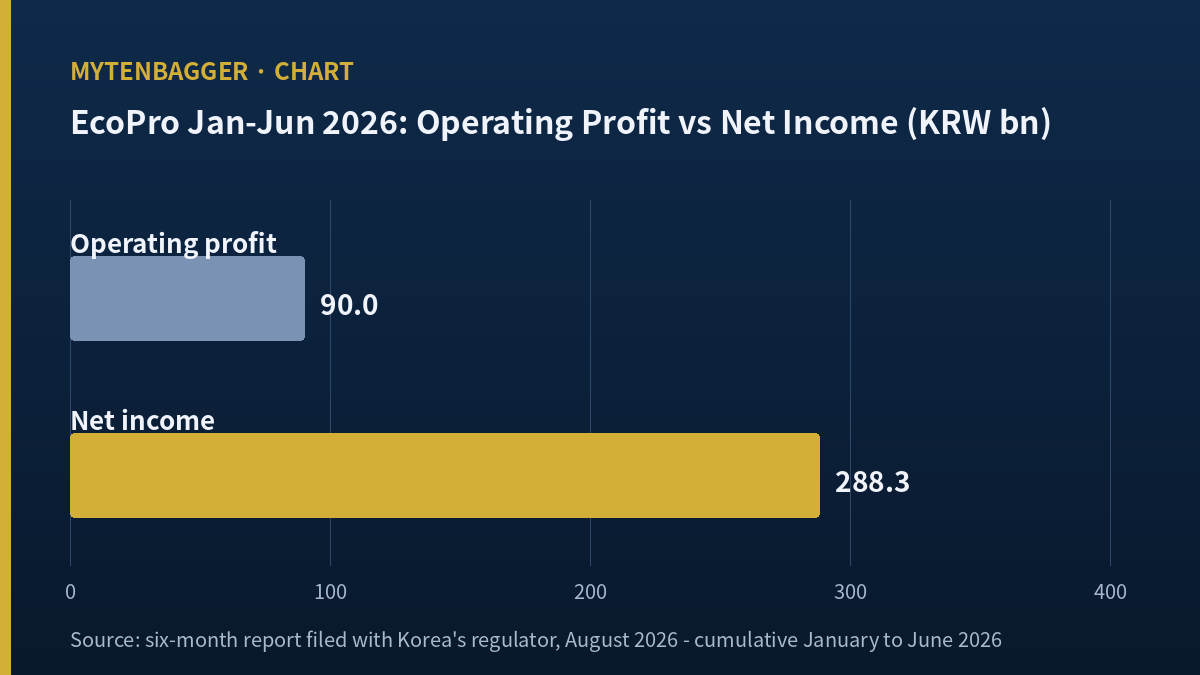
EcoPro earnings next to Albemarle
For a global comparison I picked one lithium producer that reported the same April to June period and printed its finance costs on the face of its income statement: Albemarle (NYSE: ALB), the US lithium and specialty chemicals company. I am comparing a single ratio, finance costs divided by operating profit for the period ending June 30, 2026. I am not comparing valuation multiples, growth, or profitability, because the two companies sit at different points of the chain and report under different rules.
Albemarle’s second quarter 2026 release shows net sales of $1,743.3m, operating income of $452.9m, and interest and financing expenses of $30.9m. Its financing cost was 6.8% of operating income, and the expense was 38% lower than a year earlier. EcoPro’s equivalent figure for the same three months was about 272%. Both companies benefited from higher lithium prices. One of them kept most of the benefit; the other passed it on to its lenders and more.
The more useful part of Albemarle’s release is the year-earlier column. In April to June 2025, its interest and financing expenses were $49.9m and its operating income was $47.5m. Financing costs were 105% of operating income. One year later the ratio was 6.8%. The change came almost entirely from operating income rising nearly tenfold as lithium prices recovered, while the expense fell 38%. So Albemarle stood a year ago roughly where EcoPro stands now, and climbed out mainly through price, with a modest help from lower costs. That gives me one concrete picture of what a way out looks like. It also shows how much of the improvement depends on a commodity price that neither company controls.
I would not push the comparison further. Albemarle mines and refines lithium itself, while EcoPro is a holding group still building a nickel smelter and a European cathode plant. The ratio tells me where each company stands in its spending cycle more than it tells me which business is better.
Why my reading of the results could be wrong
- The finance costs line may be inflated by items other than interest, such as currency losses on dollar debt. If most of the KRW 91.2bn was a one-off foreign exchange loss, the gap between operating profit and the cost of debt is much smaller than the 2.7 ratio suggests.
- Management said at the August call that results should improve from the July to September period, with the Indonesian smelter returning to normal and the Hungarian plant ramping (MTN, August 4). If operating profit climbs fast while finance costs stay flat, the ratio could fall below one within a year.
- The subsidiary EcoPro BM is raising KRW 886.1bn in new shares, with subscription on October 15 and 16 and new shares listing on November 5. That money pays for the Indonesian and Hungarian projects, so less of that spending needs new borrowing, which would slow the growth of finance costs from the other end.
- The one-time gain I suspect in January to March may not exist. If the net income came from something recurring, such as a stake that keeps paying, my caution about the bottom line is misplaced.
The EcoPro earnings checkpoints I will use
I stay on the sidelines. The July to September report is due by November 16, 2026, and two numbers in it will tell me whether the recovery is reaching shareholders.
- Finance costs for July to September below operating profit for the same three months. Until that happens, the operating recovery is mostly paying for the balance sheet.
- Net income for July to September within a reasonable distance of operating profit minus finance costs. If net income again runs far above operating profit, I want the report to say why before I give it any weight.
To make the first checkpoint concrete, I worked out the bar. Over the six periods in the table, finance costs averaged about KRW 87.9bn per three months (KRW 527.7bn divided by six, my calculation). Operating profit has cleared that level once over the same six periods, in July to September 2025, at KRW 149.4bn. The other five periods came in between KRW 1.4bn and KRW 56.4bn. So the bar is not out of reach; the group has done it before. What it has not done is do it twice in a row. If July to September 2026 comes in above roughly KRW 88bn of operating profit and finance costs stay near their average, I would treat that as the first sign that the recovery is reaching the bottom line through operations instead of through one-time items. If operating profit stays in the KRW 30bn to KRW 60bn zone of the last two periods, the debt keeps taking the larger share, whatever the headline growth rate says.
The dates matter here. EcoPro BM fixes the final price of its new shares on October 12, existing shareholders subscribe on October 15 and 16, and the new shares list on November 5. The July to September report follows by November 16. If the third-quarter numbers arrive after the subsidiary has its new money, I will also look at whether group finance costs start to level off, since less of the Indonesian and Hungarian spending should need fresh loans from that point.
The stock fell hard after June 30 and has recovered part of the drop since, closing at KRW 89,100 on October 2. A lot of that move had to do with the subsidiary’s share sale, which is a separate story. On the results alone, my view is simple. Operating profit is back, but at this stage of the build-out it is not yet large enough to carry the cost of the money that built the plants. I will look again when the third-quarter report shows whether that has changed.
Share prices are the Korea Exchange regular-session close on October 2, 2026. Dollar figures are approximate, converted at KRW 1,350.6 per dollar, the Seoul close on the same date as reported by Seoul Shinmun. Single-period figures are my subtraction of reported cumulative totals.