IBK Stock: A 5% Dividend Yield That Went Nowhere for a Year
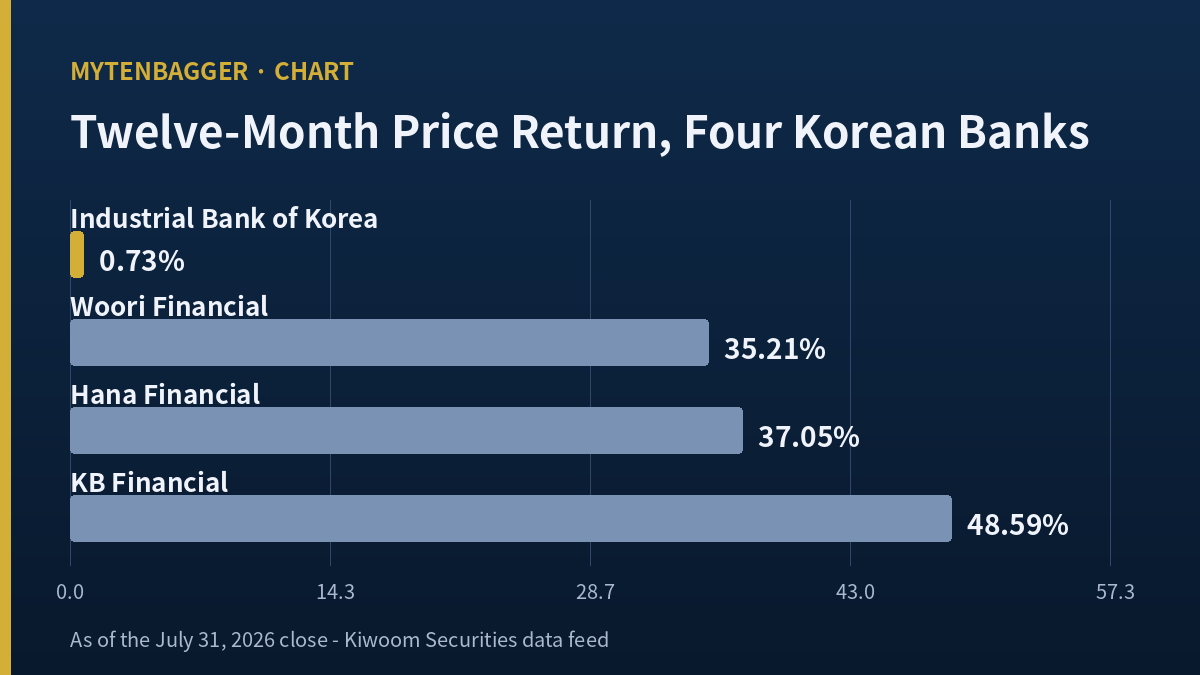
Last weekend I put four Korean banks on one screen and looked at exactly one row: the twelve-month price return. KB Financial +48.59%. Hana Financial +37.05%. Woori Financial +35.21%. And IBK stock — the ticker for Industrial Bank of Korea — up 0.73%. Same sector, same rate environment, same government reform program. One of them stood still for a full year, and it happened to be the one paying the fattest dividend of the four. I did not think that was ordinary neglect. I thought it was a rule I had not read yet, and this week I went looking for it.
· Name: Industrial Bank of Korea (KOSPI: 024110), close of July 31, 2026 — ₩20,650, about $14.50
· Market value: ₩16.47 trillion, roughly $11.6 billion
· Multiples: 6.07x earnings · 0.45x book · 7.7% return on equity · 5.07% dividend yield
· My position: none. I have not bought a single share.
· What I am watching: whether the first quarterly dividend in the bank’s history — ₩210, record date July 31, 2026 — pushes the annual dividend total past a specific line
· What kills my thesis: if the year-end dividend is cut by roughly the amount of this interim payment, the annual total goes nowhere and this entire article was wrong
Dollar figures throughout use the July 31, 2026 Seoul close of ₩1,424.0 per US dollar, as reported by Korean financial daily MoneyToday.
Contents
Why IBK stock alone sat still while its peers re-rated
First, a quick word for readers outside Korea. KOSPI is the main board of the Korea Exchange — the senior market where the country’s large caps list, roughly analogous to the NYSE in structure though far smaller in aggregate value. KOSDAQ is the separate junior board for smaller and growth names. Industrial Bank of Korea trades on KOSPI under 024110. It is not a commercial holding company like its three peers below; it is a policy bank, established by statute to lend to small and medium enterprises, and the Korean government is its controlling shareholder.
Here is the screen I was looking at. All prices are the July 31, 2026 close. Dividends per share are fiscal 2025 figures from DART, Korea’s regulatory disclosure system.
| Bank | Close (Jul 31) | P/B | Yield | FY25 DPS | DPS change | 12-mo price |
|---|---|---|---|---|---|---|
| KB Financial | ₩168,500 | 1.05 | 2.59% | ₩4,367 | +37.6% | +48.59% |
| Hana Financial | ₩125,400 | 0.77 | 3.27% | ₩4,105 | +14.0% | +37.05% |
| Woori Financial | ₩33,600 | 0.68 | 4.05% | ₩1,360 | +13.3% | +35.21% |
| Industrial Bank of Korea | ₩20,650 | 0.45 | 5.07% | ₩1,048 | −1.6% | +0.73% |
Sources: price and multiple data from a Kiwoom Securities feed refreshed to the July 31, 2026 close; dividends per share from DART filings — KB ₩4,367 versus ₩3,174 the prior year, Hana ₩4,105 versus ₩3,600, Woori ₩1,360 versus ₩1,200, IBK ₩1,048 versus ₩1,065. The DPS change column is my own calculation from those two values.
Read that table down the columns and the cheap name is obvious. Industrial Bank of Korea has the lowest price-to-book and the highest yield in the group. Read it across the rows and the result inverts completely. KB Financial, the most expensive bank with the smallest yield, delivered nearly fifty percent. The ordering that actually held was not the size of the dividend. It was the growth of the dividend: KB +37.6% and a +48.59% stock, Hana +14.0% and +37.05%, Woori +13.3% and +35.21%, IBK −1.6% and +0.73%.
I stopped on that for a while. If the market paid for the change in the payout rather than the level of it, then investors were not buying these as income names at all. They were sorting them by some other criterion, and I wanted to know what the criterion was.
The 210-won dividend that I refuse to call cosmetic
On July 28, 2026, alongside its first-half results, Industrial Bank of Korea declared the first quarterly dividend in its corporate history: ₩210 per share, about $0.15, with a record date of July 31. On a ₩20,650 share that single payment is a 1.02% yield by my arithmetic. Multiplied across 797,423,729 shares outstanding, the cash going out is roughly ₩167.5 billion, or about $118 million — again my own calculation. Against the bank’s annual earnings that is not a dramatic number, and read as a headline it looks like a token.
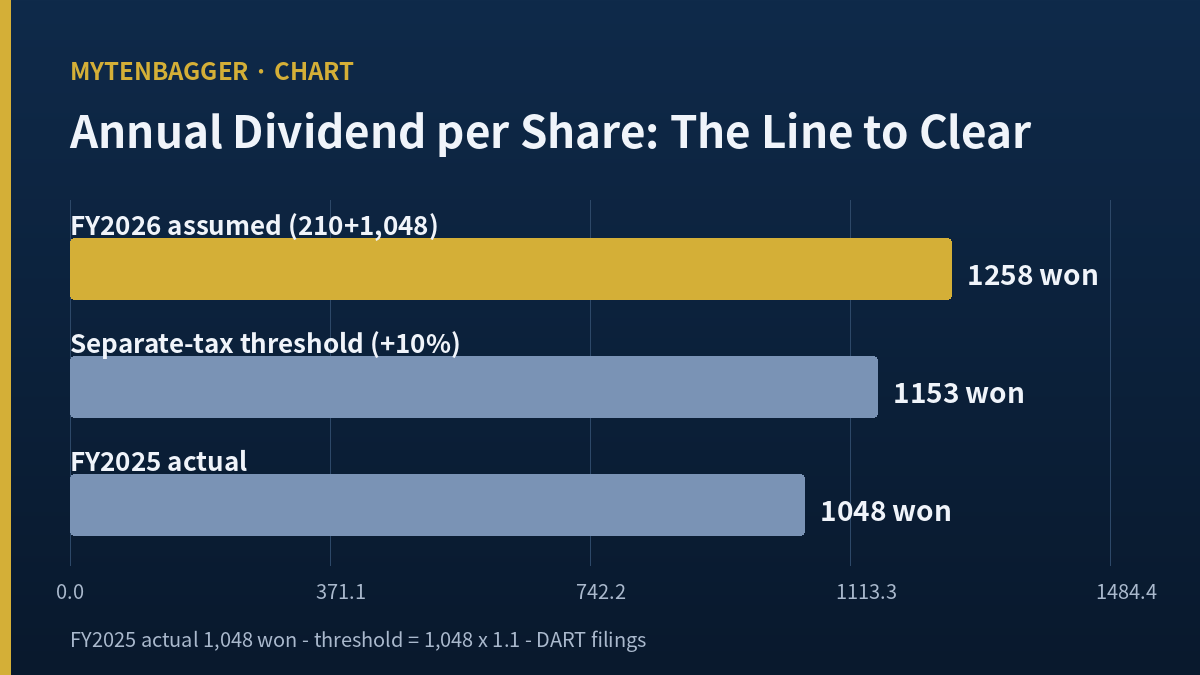
Then I added it to the annual total, and my reading changed. Fiscal 2025 dividends were ₩1,048 per share. Suppose the company holds its year-end dividend at that same ₩1,048 and simply stacks this ₩210 interim on top: the fiscal 2026 total becomes ₩1,258, or +20.0% year over year. Even if the year-end payment shrinks, there is real room. Ten percent growth requires ₩1,152.8 in total (₩1,048 × 1.1), which leaves a year-end payment of ₩943 as the break-even. All three of those figures are mine, derived from the disclosed dividend history.
Why ten percent is the number that matters
Korea introduced separate taxation of dividend income for payments made on or after January 1, 2026, running for three years through 2028. Instead of dividends being swept into a resident’s global income at high marginal rates, qualifying dividends are taxed on their own progressive schedule — 14%, 20%, 25% and 30% by bracket. But the shares have to be issued by a company that clears one of two gates: a payout ratio of 40% or more, or a payout ratio of 25% or more combined with total dividends rising at least 10% from the prior year. The framework is laid out in KB’s published guide to the regime, in Korean.
Industrial Bank of Korea is nowhere near the 40% gate. The Kiwoom-sourced data puts its fiscal 2025 consolidated payout at 30.8%; Korean technology outlet Bloter reported in March 2026 that the separate-basis payout runs around 35%. Either way that first door is shut. The second door — 25% plus ten percent growth — is a different matter, because a payout in the low thirties clears the 25% condition comfortably. Everything therefore comes down to that single variable: total dividends up ten percent.
Now go back to the last column of my table. KB at +37.6%, Hana at +14.0% and Woori at +13.3% had already cleared that line on their fiscal 2025 numbers. Industrial Bank of Korea, at −1.6%, had not. I have not found a cleaner single variable to explain the twelve-month spread across those four names. I want to be careful here: this is a correlation across a sample of four, not a demonstrated mechanism. But four out of four lining up in order is not nothing, and I have been unable to argue it away.
The other side: IBK stock is not backed by improving earnings
The dividend arithmetic flatters the case, so I want the unflattering half on the page before I go further. First-half 2026 net profit at Industrial Bank of Korea was ₩1.443 trillion, about $1.01 billion, down 4.4% from a year earlier. The second quarter alone came in at ₩689.5 billion, roughly $484 million, down 0.7%. Those figures come from Korean weekly Weekly Hankooki’s report on the July 28 release.
Break it apart and the lending business is fine. Second-quarter interest income rose 10.7% to ₩2.085 trillion, about $1.46 billion, and net interest margin improved four basis points to 1.59% from 1.55%. The damage is entirely on the non-interest line, which fell 55.1% to ₩146.2 billion, roughly $103 million. Kiwoom Securities analyst Kim Eun-gap, writing on July 28, attributed a meaningful piece of that to ₩12.6 billion in cumulative first-half foreign-exchange translation losses, and argued the item could reverse if the won strengthens — his comments were carried by Korean outlet MoneyToday.
Asset quality is mixed rather than clean. The delinquency ratio was 0.94%, one basis point better than the prior quarter’s 0.95% but worse than the 0.91% of a year earlier. The non-performing loan ratio improved ten basis points to 1.27%, while the credit cost ratio rose five basis points to 0.46%. Given that this is a bank whose loan book is deliberately concentrated in small and medium enterprises, I weight the delinquency trend more heavily than the NPL improvement.
The genuinely strong line in the release was share. SME loan balances reached ₩270 trillion, about $190 billion, up ₩8.1 trillion or 3.1% since year-end, and the 24.6% market share is the highest since the bank began tracking the series. The policy mandate still works as a growth engine for the balance sheet. Why it fails to convert into share price is the subject of the next section.
What actually caps IBK stock — the same fact cuts both ways
The controlling shareholder of Industrial Bank of Korea is the Republic of Korea, through the Ministry of Economy and Finance, together with two related parties. Korean data provider WiseReport puts that combined stake at 68.54%, with the National Pension Service holding a further 5.45% and free float at just 31.19%. Foreign ownership sits at 13.49% on the same WiseReport basis — the Kiwoom feed shows 13.62%, and I treat the small gap as a timing artifact and read it as “around 13%.” Either figure is a different order of magnitude from KB Financial at 79.2%, Hana at 68.33% and Woori at 46.03% on the Kiwoom data.
The valuation footprint of that ownership structure is clearest against book. Book value per share is ₩45,716, roughly $32.10, against a ₩20,650 close — the shares change hands at 45% of stated net assets. The stock sits 30.1% below its 52-week high of ₩29,550 by my calculation, and still under its 120-day moving average of ₩22,132. Against that, the 5.07% dividend yield stands 232 basis points above the Bank of Korea’s policy rate of 2.75%, again my own arithmetic. As a spread for owning the equity instead of the government paper, that is not a bad starting point.
Meritz Securities analyst Cho A-hae initiated coverage on July 28 and made government ownership the centerpiece of a positive view: because the Ministry of Economy and Finance needs the revenue, the payout has unusually high visibility, and on current prices the yield is the highest in her banking coverage. She modeled a 5% dividend yield for 2026 against a 4% coverage average. Korean financial wire Newspim summarized the note.
And in the same note I read the opposite sentence. Cho judged that raising the payout ratio above 35% would be difficult under current capital ratios. The government’s presence is why the dividend will not be cut, and the government’s presence is also why the dividend cannot be raised much. One fact produces both the floor and the ceiling. A payout decided outside the company is not a banking-only structure. Hite Jinro has held its dividend at 700 won a share for two straight years while the holding company keeps the pen, and the total payout has grown larger than the 41.1 billion won it earned. Layered on top is a tiered payout framework keyed to a CET1 ratio of 11.50%, plus the standing public mandate to expand SME credit — reported by Bloter in its March 2026 piece on Korea’s dividend tax thresholds.
So watch frequency, not payout ratio
Accept that constraint and the thing worth monitoring changes. The route to a 40% payout runs straight into capital regulation and ministry negotiation. The route through more payment dates goes around both. A bank can hold its payout ratio in the low thirties and still grow total dividends simply by paying more often within the year. IBK adopted quarterly dividends in 2026 and made the first payment this July. Kim at Kiwoom expects the number of quarterly payments to increase next year.
Yuanta Securities analyst Woo Do-hyung had flagged the same mechanism earlier, on July 9, reading the move to quarterly payments as evidence of shareholder-return intent while explicitly leaving the ministry-negotiation uncertainty on the table. He raised his valuation from ₩22,000 to ₩25,500 on the view that a twelve-month forward price-to-book of 0.47x could recover toward the 0.6x prior peak, per Newspim’s report brief.
Three Korean brokers rate IBK stock on three different grounds
| House · analyst | Dated | Level published | Basis of the call |
|---|---|---|---|
| Kiwoom · Kim Eun-gap | Jul 28, 2026 | ₩30,000 | Non-interest recovery on a stronger won · 35% payout modeled for 2026 · more quarterly payments ahead |
| Meritz · Cho A-hae | Jul 28, 2026 | ₩29,000 | Ministry revenue need drives payout visibility · highest yield in coverage · but above 35% seen as unlikely |
| Yuanta · Woo Do-hyung | Jul 9, 2026 | ₩25,500 | 0.47x forward book re-rating toward the 0.6x prior peak · ministry-negotiation risk noted |
All three carry a buy rating. What caught my attention was not the spread between the published levels but the difference in what each rests on. Kiwoom leans on earnings, through a currency reversal. Meritz leans on the dividend, through the controlling shareholder’s fiscal appetite. Yuanta leans on the multiple, through book-value normalization. That these three arguments do not contradict each other is precisely what unsettles me. If a stock has three independent bull cases from named houses and still returned 0.73% over twelve months, the market has heard all three and declined to pay for any of them.
My explanation is the one from earlier. What got paid for in this sector was neither earnings nor yield but dividend growth that clears a statutory threshold. That growth was absent from the fiscal 2025 record, and the fiscal 2026 record does not exist yet. I think the reason this name is cheap is not that it is undervalued. It is that it is unconfirmed, and those are different problems with different resolutions.
How the global comparison actually reads
The obvious international parallel is Japan. Mitsubishi UFJ Financial Group closed July 31, 2026 at $22.45 with a market value of about $252 billion, having run its 52-week range from $13.62 to $23.25, and trades on a trailing 23.19x earnings with a 1.97% yield. That is roughly twenty-two times the market value of Industrial Bank of Korea at less than half the dividend yield. Japanese megabanks spent years stuck below book and re-rated once payout discipline and buybacks became credible — the template Korean bank bulls have been invoking since the value-up program launched.
What I take from the comparison is a caution rather than a destination. MUFG did not re-rate because it was cheap; it re-rated because the capital-return policy changed in a way investors could verify quarter after quarter. Industrial Bank of Korea trades at 0.45x book and pays more than twice MUFG’s yield, and it has still gone nowhere — because the verification step has not happened yet. The ₩210 interim payment is the first piece of evidence that it might. One quarter is not a policy, and I am not going to treat it as one. I have since watched that missing verification get priced far more harshly at a Korean shipper, where a 50% discount for an unpublished payout policy removed KRW 2,788 from the valuation, against a KRW 2,035 share price.
There is a structural difference worth stating alongside that parallel, because it cuts against the easy read. MUFG is a commercial group answering to dispersed private shareholders; Industrial Bank of Korea answers to a ministry that is simultaneously its owner, its regulator’s peer, and the author of the SME credit mandate that shapes its loan book. That is not a governance problem to be fixed on the way to a re-rating — it is the institution’s purpose. Any thesis on this name that quietly assumes the policy role will fade is assuming away the company. Mine does not. My argument is narrower: that within an unchanged policy mandate, paying the same money more often is a lever the ministry has already shown it will pull.
A second contrast is worth noting because it runs the other way. In late July, Korean brokers cut their published levels on electrical-equipment and growth names, citing among other things a higher cost of equity as domestic rates rose. The Bank of Korea lifted its policy rate from 2.50% to 2.75% on July 16, 2026, the first increase in three and a half years. A higher discount rate punishes companies valued on distant earnings. A bank takes that same rate straight into its margin — IBK’s net interest margin had already ticked up four basis points before the hike landed, and the increase should show from the third quarter. The offset is that SME borrowers pay more, which is why I keep coming back to the delinquency line.

Buying IBK stock: the conditions I wrote down, in date order
I have not bought. A 5.07% yield and 0.45x book are attractive numbers, but they were roughly as attractive twelve months ago and the stock returned 0.73% in the interval. That table is my evidence that cheapness on its own does not cause anything. So I built my entry conditions around the calendar rather than around a price. In order:
This is where I learn whether ₩210 was a single gesture or a cadence. If a second payment lands, the path to ten percent annual growth is close to arithmetically settled. That is where I intend to open a small starter position.
Step 2 — January to February 2027: the FY2026 final dividend declaration
One line tells me whether the annual total cleared ₩1,153 (₩1,048 × 1.1, my calculation). Above it, the separate-taxation qualification is met. Below it, my premise was wrong. This is the real grading day for everything above.
Step 3 — every quarter: the 0.94% delinquency ratio against a 1% line
If credit costs cross that line they eat the dividend capacity before shareholders see it. Even with steps one and two satisfied, a break here stops me from adding.
Step 4 — price: 0.5x book
The waypoint toward the 0.6x prior peak Yuanta’s Woo described. For me price is what I check after the first three lines confirm, not before.
If I have to attach probabilities, my subjective split is roughly this: a bit over half (call it 55%) that a second quarterly payment arrives and the annual total clears ten percent growth; around 30% that the interim is offset by a smaller year-end payment and the total goes sideways; the remaining 15% that capital or credit pressure forces the dividend plan itself to retreat. These are my instincts, not a model, and I will overwrite them the moment October’s numbers exist.
One more thing, because leaving it out would be dishonest. I abandoned my first hypothesis while writing this. I had planned to file the whole thing under “policy bank, can’t do value-up, therefore ignored” — the standard Korean market explanation. Building the table killed it. That explanation cannot tell me why the line got drawn between −1.6% and +13.3% specifically. Being a policy bank is a constant; the twelve-month return gap is a variable, and you cannot explain a variable with a constant. Swapping in dividend growth made all four rows fall into place at once.
Where I might be wrong is equally clear. The alignment between dividend growth and price could be coincidence; building a rule from four observations is thin evidence, and foreign ownership (around 13% for IBK against 79.2% for KB Financial) or the return-on-equity gap (7.7% against 10.0%) might carry more explanatory weight than I am giving them. My counter is that both of those variables looked much the same a year ago, which is why I still weight the statutory threshold. In late October I will reopen this page and write the second quarterly dividend number into it.
Related reading: Shinhan
Sources · Weekly Hankooki — IBK second-quarter results · Newspim — Meritz Securities note · Newspim — Yuanta Securities note · MoneyToday — Kiwoom Securities commentary · KB — separate taxation of dividend income · StockAnalysis — MUFG overview · Price, multiple and dividend source data from a Kiwoom Securities feed at the July 31, 2026 close and from DART filings. Korean-language sources are cited as reported; quotations are my paraphrase from the Korean, not English originals.