Hana Micron Stock Owns Two Thirds of the Equity It Reports
Even after Hana Micron stock delivered the best quarter in the company’s history, the figure I ended up staring at was on the other statement. Not the operating profit line that doubled. The equity line underneath it, and specifically the part of that line addressed to somebody who is not an ordinary holder of the shares.
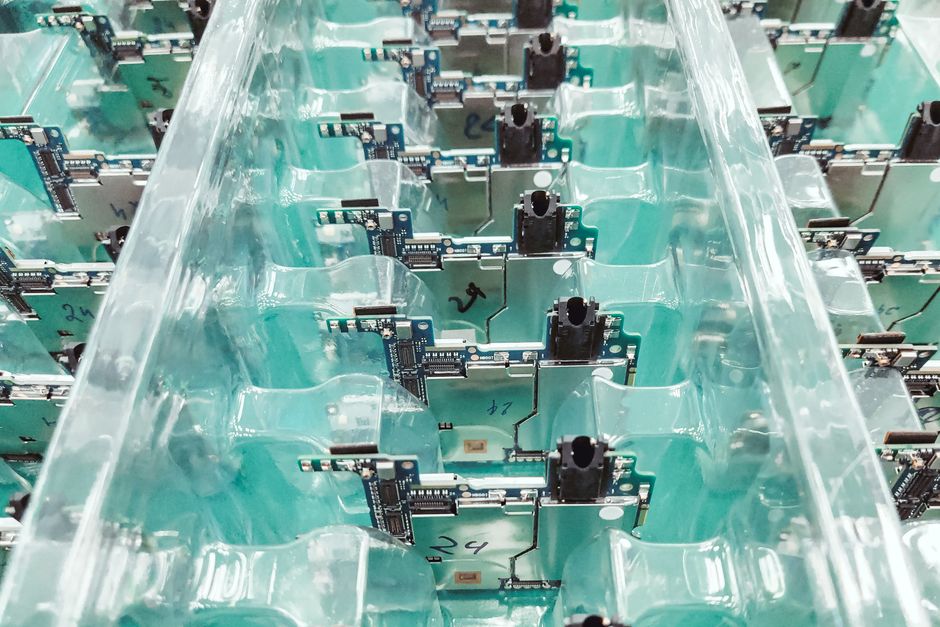
Hana Micron (KOSDAQ: 067310) is a Korean semiconductor back-end company. It does not design chips and it does not make wafers. It takes finished die, packages them, tests them, and ships them onward, mostly for the two large Korean memory makers. KOSDAQ is Korea’s junior exchange, the venue for mid-cap technology names that sit outside the KOSPI blue chips, and it is where most of the country’s packaging and equipment suppliers are listed.
The company consolidates three production bases: the domestic operation, a Vietnamese subsidiary, and a Brazilian one. Consolidation means the full revenue and the full operating profit of those units appear in the group numbers. It does not mean the company owns all of them outright, and that distinction is the whole of this entry.
oooooooooooooooooooooooooooooooooo……………..
o controlling shareholders 66.79 percent
. non-controlling interests 33.21 percent
one character is about two percent (band drawn by me)
Contents
Hana Micron Stock and the Equity Behind the Consolidation
I want to be precise about what I am claiming, because the claim is small and easy to overstate. I am not saying the company misreports anything. Minority interest is an ordinary line under Korean IFRS and under US GAAP alike. What I am saying is that when I read a valuation multiple off a screen, I am reading a ratio whose bottom half sometimes counts the whole group and sometimes counts only my slice, and on this particular company the difference between those two is a third.
The reference price throughout this entry is the close on Friday, September 11, 2026, at 34,400 won. I am writing on Saturday morning in Seoul, so the last trading session is Friday, and every ratio below uses that one price. Korean won is the reference currency here; I convert to dollars once, for the market capitalization, and nowhere else.
At that price and at 66,490,869 shares outstanding, the company is worth about US$1.6973 billion by my calculation, using 1,347.63 won to the dollar, the Friday close on the Seoul market.
What the Second Quarter Actually Showed
Consolidated revenue for the three months to June 2026 came to 683.2 billion won, up 101 percent against the same quarter a year earlier. Consolidated operating profit came to 142.3 billion won, up 371 percent. The operating margin moved from 8.9 percent to 20.8 percent. Both the revenue and the profit were records for the company (Newspim, Korean press, August 28, 2026).
For a back-end packaging house, a margin above twenty percent is unusual. The business is normally a volume business with thin pricing power, sitting between the chipmaker that owns the design and the customer that owns the end product. Twenty percent says something went right at the price level as well as the volume level.
The company’s own account of the quarter points at the two overseas units. Brazil benefited from rising memory prices flowing into its output. Vietnam had moved onto a different contract structure, one that protects a margin instead of exposing it to spot pricing, and its volumes expanded alongside memory demand. The domestic operation contributed through non-memory packaging and test volume.
I am deliberately keeping the per-subsidiary revenue figures out of this entry. What matters for this entry is simply the direction: most of the quarter’s revenue was earned outside Korea, by units the group consolidates.
The full year before this one sets the starting point. Revenue for 2025 was about 1.53 trillion won, up 22.7 percent, and consolidated net income was 65.6 billion won against a loss of 11.2 billion won in 2024 (Butler, a Korean financial data screen, figures as displayed in September 2026). So the company swung from a loss to a profit, and then doubled a quarter’s revenue on top of that.
Hana Micron Stock Rests on a Balance Sheet in Two Names
Here is the half-year balance sheet, in billions of won, as displayed by Valueline, a Korean statement aggregator (source, retrieved September 12, 2026).
| Period | Assets | Liabilities | Total equity | Controlling | Non-controlling |
|---|---|---|---|---|---|
| December 2022 | 1,409.04 | 920.83 | 488.21 | 264.11 | 224.10 |
| December 2023 | 1,725.09 | 1,180.70 | 544.38 | 309.05 | 235.33 |
| December 2024 | 1,944.64 | 1,338.82 | 605.82 | 371.61 | 234.21 |
| December 2025 | 2,017.83 | 1,365.16 | 652.67 | 398.76 | 253.91 |
| June 2026 | 2,435.66 | 1,608.45 | 827.20 | 552.51 | 274.69 |
Assets minus liabilities closes to total equity in every row, which is the first thing I check on an aggregator screen. Controlling plus non-controlling closes to total equity as well.
The June 2026 split is 66.79 percent controlling and 33.21 percent non-controlling, both by my calculation from the two columns above. One third of the capital standing behind the consolidated revenue is not answerable to the share I would be buying.
The non-controlling line is where I lost an hour on this company, and the reason is embarrassing in an ordinary way. For two years I treated that line as a rounding item on Korean mid-caps, because on most of the names I look at it is one or two percent and it changes nothing. I had never opened it on a company whose overseas units were the engine. When I finally read the column here, the number was large enough that my instinct about what the equity meant had been wrong the whole time, and nothing on the price screen had ever told me so.
The minority share has been falling for three and a half years
Run the same division down the table and a trend appears. December 2022: 45.90 percent. December 2023: 43.23 percent. December 2024: 38.66 percent. December 2025: 38.90 percent. June 2026: 33.21 percent. All five by my calculation.
Four and a half years ago, nearly half of the group’s equity was outside the controlling interest. Today it is a third. That is a meaningful improvement for anybody holding the listed shares, and I did not expect to find it. The direction of this ratio is the most favorable single fact I turned up about the company, and I want it on the record before I start arguing with myself about it.
The absolute amount kept rising
The share fell. The amount did not. Non-controlling interests went from 224.10 billion won in December 2022 to 274.69 billion won in June 2026. What shrank the percentage was the controlling side growing faster, from 264.11 to 552.51 billion won over the same span, and not any reduction in what the minority holds.
That matters because the two interpretations imply different futures. If the ratio improved because outside partners were bought out, it keeps improving. If it improved because the parent’s retained earnings grew quickly during an upcycle, then a downcycle reverses it mechanically. From the table alone I cannot tell which, and I did not find a disclosure that settles it.
Leverage moved in the useful direction too. Liabilities over total equity was 188.61 percent in December 2022, peaked at 220.99 percent in December 2024, and stood at 194.45 percent in June 2026, all by my calculation. For a company that has been building capacity on three continents, that is not alarming, and it is not comfortable either.
Hana Micron Stock and Two Book Values on One Screen
Book value per share is where the minority line stops being an accounting curiosity and starts changing a number I would actually quote.
Take the June 2026 controlling equity of 552.51 billion won and divide by 66,490,869 shares. The result is 8,309.56 won per share by my calculation, and against Friday’s close that gives a price-to-book of 4.14 times.
Now open the vendor screen. It shows a book value per share of 6,007 won and a price-to-book near 5.99 times. Those are not errors. They are the December 2025 controlling equity, which by my arithmetic works out to 5,997.21 won per share, close enough to the displayed figure that the basis is obvious once you look for it. The screen is telling the truth about a balance sheet six months older than the one the company has since filed.
So the same company on the same Friday has a price-to-book of 4.14 or of roughly 5.99, and the entire difference is which balance sheet date the lower half of the ratio came from. I use the June figure and label it, because using the older one without saying so would make the company look more expensive than the filed statements support.
I have written up a Korean equipment maker where the multiple problem ran the other way, with the lowest forward multiple in its peer group and the lowest return to go with it. That entry is the record of sorting eight chip equipment makers and finding the cheapest one was also the weakest. The lesson there was that a low multiple can be correct. The lesson here is narrower: before I argue about whether a multiple is low, I have to know what it divided.
Amkor Technology, Indexed to One
The natural global comparison for a Korean back-end packaging house is Amkor Technology (NASDAQ: AMKR), the largest US-listed outsourced assembly and test provider. It does the same work at far greater scale, for a broader customer set, and it reports in dollars.
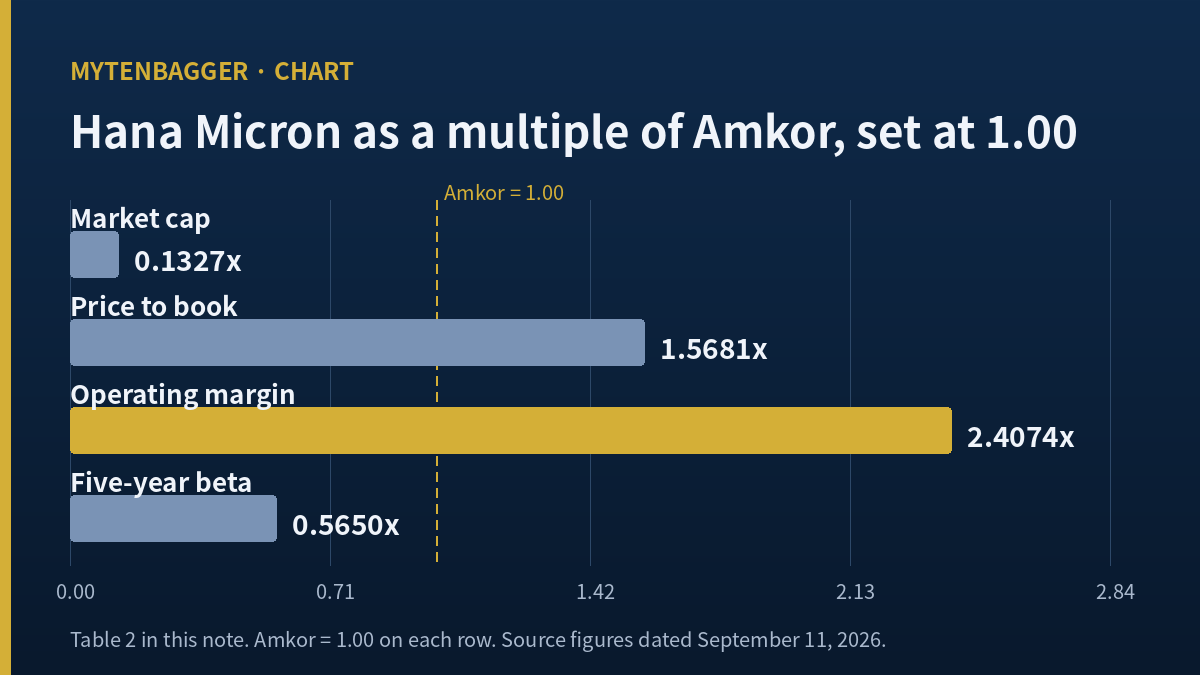
I have presented peer comparisons a number of ways in this journal and I did not want another two-column table of raw values, because raw values across two currencies invite the reader to compare things that are not comparable. So this time I set Amkor at one and expressed the Korean company as a multiple of it. The base values sit in the prose so nothing is hidden.
Amkor, from its statistics page on September 11, 2026: share price US$51.49, market capitalization US$12.79 billion on 248.45 million shares, price-to-book 2.64, book value per share US$18.75, trailing revenue US$7.46 billion, trailing net income US$555.45 million, earnings per share US$2.23, return on equity 12.51 percent, operating margin 8.64 percent, profit margin 7.45 percent, annual dividend US$0.33 for a 0.65 percent yield, five-year beta 2.23, and a twelve-month price change of +107.95 percent (stockanalysis.com).
| Measure | Amkor | Hana Micron |
|---|---|---|
| Market capitalization | 1.00 | 0.1327 |
| Price to book | 1.00 | 1.5681 |
| Operating margin, latest quarter against Amkor trailing | 1.00 | 2.4074 |
| Five-year beta | 1.00 | 0.5650 |
Four lines, and they do not point the same way. The Korean company is about an eighth of Amkor by market value, carries a book multiple about half again as high, earned a margin in its latest quarter roughly two and a half times Amkor’s trailing margin, and moves with about half the beta. Hana Micron’s own beta is 1.26 and foreign ownership stands at 19.62 percent, both from the Korean vendor screen on September 11, 2026.
What I left out of the table
Amkor’s earnings multiples are on that statistics page and I did not index them. Two reasons. The second is more substantive. Amkor’s margin is a trailing twelve-month figure across a full cycle, while the 20.8 percent I used is a single quarter at what may be a cyclical peak. Indexing those two against each other already stretches the comparison further than I like, and doing the same with earnings multiples, where the Korean company’s trailing and forward figures differ by a factor of six, would produce a ratio that says nothing.
I also left out return on equity, despite having both numbers. Amkor’s 12.51 percent is a trailing figure against a stable equity base. Any return I computed for Hana Micron would divide a half-year profit into an equity base that grew 26.7 percent in the same half year, and I would be reporting an artifact of the growth, so I left the row out.

Buying Hana Micron Stock From a US Account
There is no American depositary receipt for this company. There is no over-the-counter line I could verify. Buying it means buying the KOSDAQ listing in Korean won through a broker with direct Korean market access, which not every US retail broker offers, and I am not naming one because the coverage changes and I have not tested them.
The index route does not help here either, and the reason is narrow enough to state plainly. Broad Korea funds such as the large MSCI Korea trackers are built around the two memory makers, the automotive complex, and the financial holding companies. A mid-cap back-end packaging house whose profit swing comes from Brazilian pricing and a Vietnamese contract renegotiation does not carry enough index weight for a rebalance to buy it on my behalf. If this thesis works, it works because somebody deliberately bought the line, and if it fails, no passive flow cushions it.
The governance record a US buyer would want
In 2025 the board proposed splitting the company into an investment entity and an operating entity, a structure that in Korea usually precedes a holding company conversion. An extraordinary meeting approved it in July 2025. Minority shareholders objected that the structure favored the controlling family, a Korean court suspended the effect of that meeting on July 28, 2025, and the company withdrew the proposal the following day (Bizwatch, Korean press). The matter was closed by a court-brokered settlement disclosed on January 19, 2026, under which the minority holders dropped their suit and the company undertook not to execute the split (Sisaweek, Korean press).
I raise it on this side of the journal only because a US reader coming to Korean mid-caps should know that this pattern exists and that minority holders here have occasionally won. I have not assigned it a discount, and the numeric detail of the episode sits in the Korean entry.
Numbers I Did Not Use
The filed half-year report
Every income statement figure above came from press coverage of the company’s disclosure; I did not open the filed report itself. The revenue and operating profit lines appear identically across several outlets, so I used them. Net income for the quarter I never found in a form I trusted, so no net income figure for 2026 appears anywhere in this entry.
The ownership detail of the subsidiaries
I could not establish what percentage of the Brazilian and Vietnamese entities the parent holds, nor who the outside partners are. The 33.21 percent is the aggregate on the consolidated balance sheet. I cannot say how it divides between the two countries, and that division would change how I read the trend.
Convertible bonds and treasury shares
Disclosure titles covering convertible bonds and a treasury share disposal turned up in the search index, but the filing pages would not load, so I have no amounts and no share counts. Every per-share figure in this entry assumes 66,490,869 shares. If that count is stale, the book value per share and the price-to-book above are both wrong, and I would rather say so than bury it.
One thing I did check, and it held
Assets minus liabilities equals total equity in all five rows of Table 1, and controlling plus non-controlling equals total equity in all five as well. Ten closures, no residual. Whatever else is uncertain here, the table I built the argument on is internally consistent.
Twelve Objections to My Case on Hana Micron Stock
| # | The objection |
|---|---|
| 1 | Minority interest is normal in any group with partly owned subsidiaries, and pricing the parent on consolidated figures is standard practice everywhere. |
| 2 | The minority share fell from 45.90 to 33.21 percent. Dwelling on the level while the trend runs my way is selective reading. |
| 3 | The improvement may be cyclical. Retained earnings at the parent grew fast in an upcycle, and a downcycle would push the ratio back up without anything changing. |
| 4 | A 20.8 percent operating margin in back-end packaging is very likely a peak, and peak margins do not survive contact with the next pricing cycle. |
| 5 | Leverage at 194.45 percent is still high for a company committing to further capacity expansion on three continents. |
| 6 | Using the June book value flatters nothing, but it does make the stock look cheaper than the widely quoted screen figure, and most market participants are looking at the screen figure. |
| 7 | Indexing a single quarter’s margin against a trailing twelve-month margin is a comparison I have objected to elsewhere and then made anyway. |
| 8 | Amkor is roughly eight times the size and serves a different customer mix. Scale differences of that order usually mean the two businesses are not substitutes for each other in a portfolio. |
| 9 | Beta at half of Amkor’s looks defensive until you notice this stock’s own twelve-month range, which is wide enough that a low beta says more about correlation than about risk. |
| 10 | The governance episode ended in a settlement. Continuing to price a settled matter is double counting. |
| 11 | Brazil and Vietnam carry currency, tariff, and power-cost exposures that a Korean-won income statement absorbs silently, and I have quantified none of them. |
| 12 | The root of my own case is weakest here: the entire argument rests on one aggregator’s rendering of a balance sheet I never opened in its filed form. If the controlling and non-controlling columns are mapped differently from the filing, the 33.21 percent moves and the piece goes with it. |
Where Hana Micron Stock Leaves Me
I am flat, watching, and my position is unchanged by the record quarter. What changed is the question I am carrying forward. I came to this company expecting to think about packaging margins and I left thinking about a column on the balance sheet that I had been ignoring on every company I look at.
Two conditions would end this reading. The first: if the December 2026 balance sheet shows the non-controlling share rising back above 38 percent while consolidated equity keeps growing, then the improvement was the parent outrunning its partners in a good year, and the trend I described was arithmetic. The second: if the group buys out any material part of the outside interest and the price-to-book on the June basis moves above five without a corresponding rise in the controlling equity per share, then I am paying for the consolidation twice and the case closes on its own.
Korea Zinc is the entry in this journal where record profit and a governance question sat on the same page and the discount held. That one is the record of a Korean industrial that posted its best numbers into a halved share price. This company’s governance episode ended differently, in a settlement, and its numbers are climbing while that company’s were falling. The common thread is narrower than it looks: in both cases the reported profit belonged to the group, and the question was who else had a claim on it.
A consolidated number can be right about the total and silent about whose it is. Nothing on the price screen distinguishes the two, and I had to open a statement to find out which one I had been reading.
Prices and ratios in this entry reflect the Friday, September 11, 2026 close as checked at the time of writing. The dollar conversion is approximate, at roughly 1,347.63 won per dollar on that same date, and Korean won is the reference currency throughout. Balance sheet figures are as displayed by a Korean statement aggregator and were not read from the filed report. Income statement figures come from Korean press coverage of the company’s disclosure. No analyst report was read in full for this entry.