Alteogen Stock: The 2% Royalty That Capped a KOSDAQ Leader
Two percent. That single number erased billions of dollars of market value in one session on January 21, 2026, and six months later it is still the number holding Alteogen stock down. I have kept this name on my watchlist since 2024 and I have never owned a share of it. The reason I have not bought is precisely those two percentage points.
The three numbers I keep pinned to this name
① Royalty rate: 2% of net sales — the market had been modelling 4–5%
② Sales milestones: $1.0 billion total, tied to cumulative sales, mostly uncollected
③ Ex-rights date for a 30% bonus issue: August 5, 2026 — every published sell-side valuation predates it
Alteogen (KOSDAQ: 196170) closed at ₩308,500 on July 31, 2026, for a market capitalisation of ₩16.53 trillion, or about $11.6 billion at the ₩1,424.0 onshore close that day (converted, my calculation). That makes it the largest company on the KOSDAQ — Korea’s secondary exchange, roughly analogous to the Nasdaq in structure and in its tilt toward biotech and technology names, and entirely separate from the blue-chip KOSPI board where Samsung Electronics and Hyundai Motor trade. The shares sit 45.8% below their 52-week high of ₩569,000 (my calculation) and are down 37.0% over twelve months. That is an unusual chart for a company that just posted its best year ever.
Contents
What Alteogen stock lost on January 21
The business model is easy to state. Alteogen licenses ALT-B4, a recombinant human hyaluronidase platform that converts intravenous biologic drugs into subcutaneous injections, to large pharmaceutical partners and collects upfront payments, development and sales milestones, and running royalties. There is almost no factory and almost no salesforce. That is why the operating margin for 2025 came in at 49.5% — revenue of ₩215.9 billion (about $152 million converted), operating profit of ₩106.9 billion, net income of ₩145.2 billion, on Kiwoom Securities’ compiled figures.
A platform like that is worth whatever two variables say it is worth: how big the partner drug gets, and what percentage of that drug’s sales flows back. The first variable has been debated publicly for years. The second sat behind a confidentiality clause.
It came out on January 21, 2026. According to BioSpectator, a Korean biotech trade publication, Merck’s own disclosure documents showed the royalty on subcutaneous Keytruda at 2% of net sales. Alteogen shares fell more than 20% that day. The company issued a statement saying that “detailed milestone and royalty terms are confidential” and that it had “consistently maintained a policy of non-disclosure since the contract was signed” — a translation of the Korean-language statement, and notably not a denial.
This is where I part company with the consensus. Most of the market still argues about conversion — what share of Keytruda patients switch from IV to subcutaneous. Money Today’s TheBio desk reported the partner target as 30–40% of all Keytruda patients within 18 to 24 months of launch. I think that debate is half beside the point. Once 2% was confirmed, conversion stopped being the variable that sets the ceiling and became the variable that sets the speed of arrival at a ceiling already fixed.
Run it. Keytruda sells roughly ₩40 trillion a year — about $28.1 billion converted — as Money Today’s TheBio framed the figure. If the top end of the conversion target is fully achieved, subcutaneous sales reach around ₩16 trillion. Two percent of that is ₩320 billion a year, or about $225 million (my calculation). Royalty income carries almost no cost of goods, so treat nearly all of it as pre-tax profit. Divide today’s ₩16.53 trillion market capitalisation by ₩320 billion and you get 51.7 times (my calculation) — the multiple that applies after the conversion target is completely met. That is the arithmetic that has kept me out.
Why Alteogen stock walked away from a KOSPI listing
On July 16, 2026, the company announced two things in a single day: it deferred its long-anticipated transfer to the KOSPI main board, and it declared a 30% bonus issue — 0.3 new shares for every share held.
Moving the KOSDAQ’s largest company up to the KOSPI had been treated as a matter of scheduling for years. Management shelved it. Money Today’s TheBio quoted chief executive Jeon Tae-yeon explaining, in a passage I am paraphrasing from the Korean, that after weighing the current capital-market environment and the government’s KOSDAQ revitalisation policy, remaining a flagship KOSDAQ innovator was judged more consistent with shareholder value at this point in time.
The language is diplomatic; the numbers attached to it are not. Per the same report, Alteogen’s projected weight in the KOSPI 200 index had shrunk to roughly 0.3%, about 69% below the prior year’s estimate, and an outside analysis put the net passive outflow from a transfer at roughly ₩360 billion — about $253 million converted. In plain terms, the money that would leave as KOSDAQ 150 trackers sold exceeded the money that would arrive from KOSPI 200 trackers buying. For anyone holding the shares as an index-event trade, the announcement itself was the bad news.
The bonus issue reads as the sweetener. The funding source is ₩8.095 billion of share premium reserve. The record date for the new shares is August 6, 2026, which puts the ex-rights date at August 5. The new-share listing was originally set for August 20 and was pushed to August 26 in a corrective filing dated July 20. Some 16,068,790 new common shares and 122,037 redeemable convertible preferred shares will be issued.
A bonus issue creates no value. It slices the same pie thinner. But taking a ₩308,500 share down to roughly ₩237,000 on a theoretical ex-rights basis (my calculation) does widen retail access, and for a company that has just committed to staying on a retail-heavy board, that liquidity is not nothing. I read the pair of announcements not as a decision that lifts Alteogen stock but as a consolation payment offered in exchange for staying put. That is not cynicism — it is the reason I expect disappointment rather than a re-rating on the other side of August 5.
Where the cash actually lands: milestones, not royalties
So what is holding the valuation up? Not the royalty. The milestones.
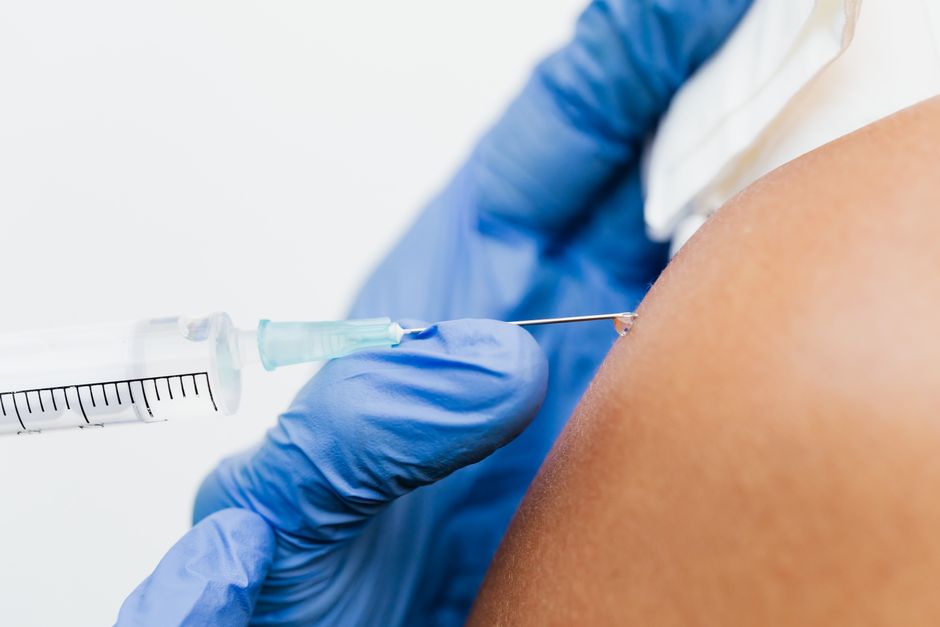
Take the figures Money Today’s TheBio published on July 13, 2026. Subcutaneous Keytruda — marketed in the United States as Keytruda Qlex since September 2025 — recorded $168.5 million in WAC-based sales in June alone, on 33,053 prescriptions. That is up from $2.2 million and 439 prescriptions in the launch month, a better than seventyfold increase in nine months, and it now accounts for roughly 9% of total Keytruda product revenue. Nothing about that ramp is disappointing.
Then multiply by 2%. Annualising June simply gives about $2.02 billion; a 2% royalty on that is $40.4 million a year, or roughly ₩57.6 billion (my calculation, at ₩1,424.0 on July 31, 2026). Against a ₩16.53 trillion market capitalisation, that is 0.35% (my calculation). The royalty stream currently flowing does not begin to explain the valuation.
Something else does. Per BioSpectator, the Keytruda SC agreement carries $1.0 billion in total sales milestones — around ₩1.48 trillion as BioSpectator converted it at the January exchange rate — released as cumulative-sales thresholds are crossed, with royalties running to the patent expiry in early 2043. Kim Sun-a of Hana Securities, a Korean sell-side analyst, estimated that a $500 million cumulative threshold could trigger one payment during the second or third quarter and a $1 billion threshold another in the fourth. Daishin Securities opened coverage on May 20; as of Money Today’s TheBio report on July 20, its house estimate was roughly ₩300 billion of milestone income this year tied to Keytruda SC sales. Both are Korean sell-side estimates, not company guidance — Alteogen keeps its milestone and royalty terms confidential, so no company-issued number exists to compare them against.
The practical conclusion is that Alteogen’s 2026 income statement is not a royalty story at all. It is a timing game between lumpy milestone recognitions and new licensing upfronts. That is the real reason this name resists quarter-by-quarter judgement.
The second quarter showed the income statement’s bare face
That lumpiness arrived immediately.
| Period | Revenue | Operating result | Source |
|---|---|---|---|
| FY2025 | ₩215.9bn | +₩106.9bn | Kiwoom compiled |
| Q1 2026 | — | +₩39.3bn | Korean press, on the filing |
| Q2 2026 | ₩12.2bn | −₩6.7bn | Korean data vendor flash tally |
First-quarter operating profit of ₩39.301 billion — about $27.6 million converted — was down 35.6% year on year, as reported by the Korean outlet Digital Today from the company’s filing. The second quarter swung to an operating loss of ₩6.73 billion (roughly $4.7 million) on ₩12.2 billion ($8.6 million) of revenue, on a Korean data vendor’s flash tally. I want to flag that clearly: the second-quarter pair is a preliminary tally, not an audited half-year filing, and I am treating it as directional rather than final. The direction, though, is not ambiguous. The upfront from the Biogen agreement disclosed on March 25, 2026 — up to $579 million in total value, about ₩867.5 billion, including a $20 million signing payment — landed in the first quarter. The second quarter had no comparable lump to recognise.
It is worth holding the 2025 base year next to that loss, because the contrast is the whole point. Revenue grew 109.9% and operating profit grew 320.8% year on year in 2025, on Kiwoom’s compiled figures, and return on equity came in at 39.4%. Those are not the growth rates of a company in trouble; they are the growth rates of a company whose revenue arrives in discrete lumps and happened to receive several of them in one twelve-month window. A licensor with this structure will print spectacular years and loss-making quarters out of the same underlying business, and averaging across them is the only honest way to read it.
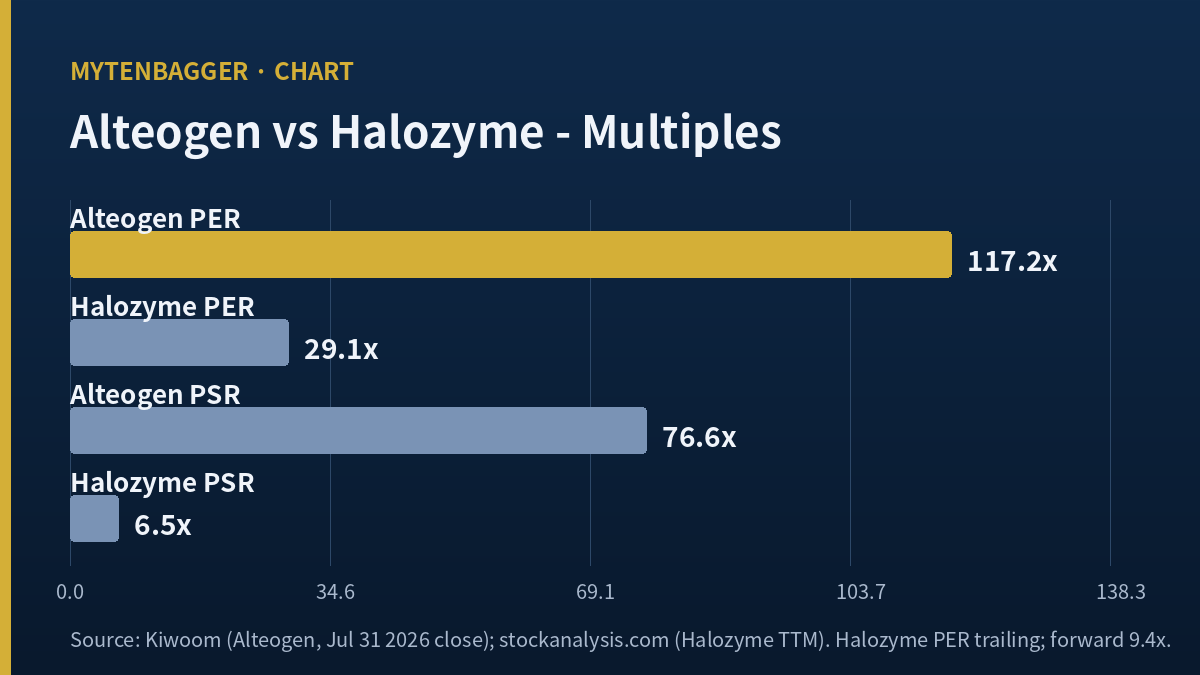
A trailing price/earnings multiple of 117.2 and a price/book of 37.3 sit on top of that structure, on Kiwoom’s compiled 2025 figures. A company printing a quarterly operating loss while carrying a 117x multiple is a company the market is pricing on its contract pipeline rather than its earnings. I do not think that is illegitimate. I do think it means the shares are unusually exposed to any stretch of silence on new deals.
Alteogen stock versus Halozyme: same technology, a 12x gap
Comparing this company to other Korean biotechs produces nothing useful. The genuine comparable is listed on the Nasdaq. Halozyme Therapeutics (NASDAQ: HALO) runs ENHANZE, its own recombinant human hyaluronidase platform, does the same IV-to-subcutaneous conversion for the same kind of partner, and is currently in litigation against Alteogen’s ecosystem.
| Metric | Alteogen | Halozyme (HALO) |
|---|---|---|
| Market capitalisation | ~$11.6bn (converted) | $9.79bn |
| Revenue | ~$152m (FY2025, converted) | $1.51bn (TTM) |
| Net income | ~$102m (FY2025, converted) | $349m (TTM) |
| P/E | 117.2x | 29.1x trailing / 9.4x forward |
| P/S | 76.6x | 6.5x |
Alteogen figures are Kiwoom’s compiled data converted at ₩1,424.0 on July 31, 2026 (my calculation); Halozyme figures are from stockanalysis.com against a July 31 close of $82.54. Halozyme books ten times the revenue and carries the smaller market capitalisation. On price/sales the gap is 11.8 times (my calculation).
I do not read that entire gap as excess. Halozyme’s royalty base is mature and growing slowly; Alteogen’s Keytruda and Enhertu programmes are only now converting into revenue, and its partner roster — Merck, Daiichi Sankyo for subcutaneous Enhertu in November 2024, AstraZeneca across two agreements worth up to $1.35 billion signed in March 2025, and now Biogen — is genuinely deep. But a 12x price/sales premium is the market saying that several years of contracts will all land on schedule. One slip has a long way to fall.
On the patent front the recent run of news has gone Alteogen’s way. Pharm Edaily, a Korean pharmaceutical outlet, reported on May 16, 2026 that the US Patent Trial and Appeal Board declined to institute Halozyme’s inter partes review against the ALT-B4 manufacturing patent, US Patent No. 12,221,638, finding the cited prior art insufficient to establish a reasonable likelihood of invalidity. On June 17, partner Merck won a UK patent suit against Halozyme. On July 23, the District Court of The Hague rejected Halozyme’s application to bar sales of Keytruda Qlex in Denmark and Sweden.
The other side of that ledger has to be stated plainly. On December 5, 2025, a German court granted Halozyme a preliminary injunction that halted in-scope launch activity for subcutaneous Keytruda in Germany, on European Patent No. 2,797,622 from Halozyme’s Mdase family. Merck’s response was that it considers “Halozyme’s patent to be invalid globally and their allegation of infringement to be without merit,” but the order went against them. As of the July 23 reporting, litigation is live in the United Kingdom, the Netherlands, France, Switzerland, Sweden, Denmark and Germany; multiple post-grant reviews remain pending at the PTAB; and fifteen infringement suits sit in the US District Court for the District of New Jersey. Seo Geun-hee of Samsung Securities noted in the same coverage that the PTAB’s May reasoning is likely to extend to related patents, while adding that the outcome of the remaining reviews and the federal court rulings will be the decisive variable for competition in subcutaneous platforms.
How I would buy Alteogen stock, and what would tell me I am wrong
Start with what the Korean sell-side has published. Daishin Securities initiated coverage on May 20, 2026 at a ₩500,000 valuation. Seo Geun-hee at Samsung Securities opened at Buy on July 16 with a ₩450,000 valuation. I do not use either number as printed. Both were struck against the pre-bonus share count. Adjusting for the 0.3-share allotment by dividing by 1.3 gives roughly ₩384,600 and ₩346,200 respectively (my calculation). Those are the figures to hold against the quote screen from August 5 onward. Miss that and you will convince yourself there is 60% of headroom left when the arithmetic says otherwise.
A word on access, because this one is genuinely awkward for a US-based holder. Alteogen has no American depositary receipt. There is no US-listed line to buy. If your thesis is specifically about ALT-B4, the ETF route will not express it.
Here is my position. I have watched Alteogen stock for well over six months without buying, and I am still flat. It is not that I doubt the technology; ALT-B4 looks to me like a legitimate candidate for the category standard. My problem is that the technology’s share of the economics is fixed at 2%, while the price assumes a much larger share.
So I have written down, in order, what has to happen before I start.
First I let the August 5 ex-rights date and the August 26 new-share listing pass. I want to see how retail supply behaves when 16.07 million new shares hit the tape. I have watched short-lived spikes into bonus issues before, and that is not a place I buy.
Then I wait for a milestone to actually appear in the income statement. Whether Hana Securities’ estimated second- or third-quarter first payment materialises, and whether Daishin’s ₩300 billion full-year figure gets even half filled. The second quarter showed me what this company looks like in a period without a deal. I want the mirror image — the earnings power of a period with one — expressed in a filed number.
Third, I watch for the name after Keytruda. At BIO USA on June 25, chief executive Jeon Tae-yeon said the company had already signed two agreements this year and saw room for more, per Korean press coverage. The March Biogen deal is one of those. If a third name lands in the second half, this company gets reclassified from a Keytruda derivative back into a platform. If it does not, it stays a 2% royalty licensor.
And here is the condition that would tell me I have been reading this wrong. If the third-quarter milestone arrives at the estimated scale and a fourth-quarter payment is confirmed on top of it, then the 2%-ceiling argument I am leaning on will have been short-sighted — a thin royalty paired with thick milestones still produces cash flow, and I will start scaling in against the ex-rights-adjusted level. If the third quarter passes with no milestone and no new agreement, a 76x price/sales multiple has nothing underneath it, and I take the name off the watchlist entirely rather than wait for a fourth quarter to prove it.
The 2% is public information now. What the market has not yet priced is when that 2% turns into an absolute number large enough to matter. My working answer is that it happens somewhere between August 26 and the third-quarter print, and until then I am running the numbers rather than the order ticket.
Sources
- FiercePharma — German court grants Halozyme a preliminary injunction against Keytruda SC (Dec 5, 2025)
- FiercePharma — AstraZeneca signs Alteogen deal worth up to $1.35B (Mar 17, 2025)
- stockanalysis.com — Halozyme Therapeutics (HALO) statistics and valuation
- PR Newswire — Halozyme sues Merck for patent infringement over subcutaneous Keytruda
- Seoul Economic Daily (English) — Alteogen wins patent defense as US rejects Halozyme’s invalidation bid (May 18, 2026)
- Seoul Economic Daily (English) — Alteogen partner MSD wins UK patent suit against Halozyme (Jun 17, 2026)
- Seoul Economic Daily (English) — Injunction denied again, Alteogen eases patent risk (Jul 23, 2026)
- Asia Business Daily (English) — Alteogen prevails in US PTAB defense as Halozyme’s petition is denied
- Money Today TheBio (Korean) — Keytruda Qlex commercial ramp and sales-milestone expectations (Jul 13, 2026)
- Money Today TheBio (Korean) — KOSPI transfer deferred, 30% bonus issue declared (Jul 16, 2026)
- BioSpectator (Korean) — Company statement on the Keytruda SC royalty disclosure (Jan 21, 2026)
Price, market capitalisation and multiples are as of the July 31, 2026 close on Kiwoom Securities’ compiled data. Unless otherwise noted, dollar conversions use ₩1,424.0 per USD — the onshore Seoul session close on July 31, 2026, cross-checked against Newspim and Money Today — and are my own calculations. Figures sourced with their own conversion (the Biogen contract value, the BioSpectator milestone total) keep the rate stated at the time. Second-quarter 2026 figures come from a Korean data vendor’s preliminary flash tally, not an audited half-year filing.
Related reading
- Celltrion Stock: Record Earnings, 52-Week Low
- Samsung Biologics Stock: Why I Watch Valuation, Not Tariffs