Hansol Chemical Stock: The Forecast on My Screen Is Undated
The 2026 earnings estimate on my screen is 15,287 won a share, and nobody is currently standing behind it. I know that because the same screen says so. One block up the page, in the consensus box, the vendor prints a sentence: no opinion has been issued in the last three months. Then it prints the estimate anyway, and a forward multiple built on top of it, and three valuations from three brokerages, and none of those three has a date attached.
That is the whole of what follows. I went looking at Hansol Chemical stock because a Korean chemical maker that sells hydrogen peroxide and deposition precursors into memory fabs should be one of the better-covered mid-caps on the exchange. What I found instead was a page full of forward numbers whose authors have all gone quiet, and one number that could be dated, written on a day when the stock was 37.40% higher than it closed on Monday, September 14, 2026.
Contents
The 2026 Forecast Printed Next to Hansol Chemical Stock
Hansol Chemical trades on the KOSPI, the main board of the Korea Exchange, under 014680. The KOSPI is the larger of Korea’s two boards, the one that holds Samsung Electronics and Hyundai Motor; the KOSDAQ is the smaller, growth-tilted venue. Korean cash equities trade from 09:00 to 15:30 Seoul time, which is to say the market is shut while most of North America is awake.
The vendor page I used is the FnGuide company monitor, which Korean retail investors treat roughly the way a US investor treats a broker research tab. It prints, for 2026, an estimated 15,287 won of earnings per share and an estimated multiple of 13.08x. The reported figure beside it is 12,993 won, which at Monday’s 200,000 won close works out to 15.39x. A forward twelve-month line extends the series to 17,473 won and 11.45x.
Read on its own, that is an ordinary picture of a company the market expects to earn more next year than last. Three multiples stepping down in order, which is what a growing business looks like on a screen.
The sentence the same page prints about coverage
The consensus box carries a line I have learned to read carefully: no investment opinion has been submitted within the last three months. On a page dated September 14, 2026, that pushes the most recent published view back past mid-June.
The estimate does not vanish when coverage lapses. It sits there with the same typography it had when someone had just filed it. A reader who glances at 13.08x and moves on has no way of telling whether that figure was written last week or last spring, because the page gives the figure the same weight either way.
The One Figure That Carries a Date
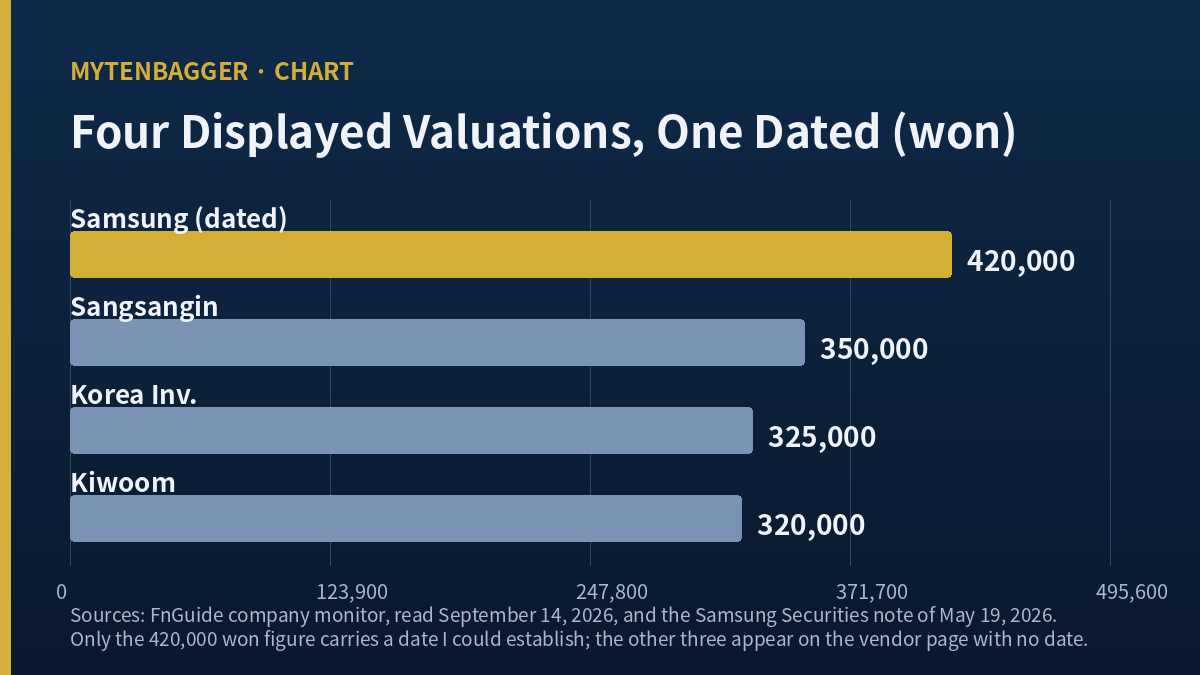
Four valuations are visible to me. Three of them appear on the vendor page with a house name attached and nothing else: Sangsangin Securities at 350,000 won, Korea Investment & Securities at 325,000 won, Kiwoom Securities at 320,000 won. I could not establish when any of the three was written.
The fourth I found by opening the document itself. Samsung Securities published a note on May 19, 2026, signed by analyst Lee Jong-wook, carrying a BUY and a 420,000 won valuation. The note prints the price it was written against: 319,500 won, the May 18, 2026 close.
| House | Figure (won) | Date I could establish |
|---|---|---|
| Samsung Securities (Lee Jong-wook) | 420,000 | May 19, 2026 |
| Sangsangin Securities | 350,000 | none |
| Korea Investment & Securities | 325,000 | none |
| Kiwoom Securities | 320,000 | none |
| Hankyung consensus figure | 312,500 | page dated September 10, 2026 |
Sources: FnGuide company monitor and Hankyung Markets consensus page, both read September 14, 2026, plus the Samsung Securities note linked above. The Hankyung page is dated; the figure it prints is an average whose constituent notes I did not see.
The closing price inside the dated note
That 319,500 won is the most useful number on this page, and it took a PDF to get it. Between May 18 and September 14, 2026, the stock fell 37.40%. The 420,000 won figure was written against a share price that no longer exists, in a week whose news I cannot reconstitute from a September screen.
I am not saying the figure is wrong. A valuation written in May can be right in September; that is what a twelve-month view is for. I am saying that the page which displays it alongside three undated siblings gives me no way to tell which of the four, if any, has been revisited since the stock fell to 200,000 won. Korean sell-side coverage lapses quietly. The screen does not put a line through anything.
What the Quarters Did While the Estimates Sat Still
The business did not stand still during those four months, which is what makes the silence worth writing about.
The Samsung note itself printed the first quarter of 2026: revenue of 231.9 billion won (about 173 million dollars), operating profit of 44.4 billion won and net profit of 41.3 billion won. For the second quarter, Investing.com’s company page shows revenue of 247.54 billion won (about 185 million dollars) and earnings of 4,670 won a share, filed on August 27, 2026. The FnGuide page adds that first-half revenue rose 11.1% against the same period of 2025.
Put the two quarters together and the half came to 479.44 billion won of revenue, which back-solves to roughly 431.5 billion won in the comparable half of 2025. I am flagging that as my own arithmetic; the company did not publish the comparison.
The annual series, from Alphasquare’s summary page, runs like this:
| Year | Revenue (bn won) | Operating profit (bn won) | Net profit (bn won) |
|---|---|---|---|
| 2025 | 883.97 | 156.23 | 148.13 |
| 2024 | 776.36 | 128.83 | 124.89 |
| 2023 | 771.65 | 124.14 | 108.69 |
| 2022 | 885.47 | 185.99 | 166.98 |
Two things stand out to me. Revenue in 2025 had still not passed the 2022 figure, and operating profit in 2025 was well under the 2022 number even after two years of recovery. Whatever the 2026 estimate of 15,287 won assumes, it assumes a company climbing back toward a peak it set four years ago, and not one breaking new ground. The stock’s own range says something similar: 346,500 won at the top of the last twelve months, 175,000 won at the bottom, and Monday’s close nearer the bottom.
Two Vendors Disagree About Hansol Chemical Stock Earnings
Here is where it gets awkward for anyone who wants a single forward multiple. FnGuide prints a 2026 estimate of 15,287 won. Hankyung Markets, reading the same market, prints 16,225 won. The second is 6.14% above the first.
At Monday’s close those two produce forward multiples of 13.08x and 12.33x. That difference is not enormous, and I would not build a case on it. What interests me is that neither vendor tells me how many houses sit inside its average or when the most recent of them filed. One page at least admits the coverage gap in words; the other simply prints an average and a 312,500 won consensus figure and leaves it there.
I ran into a sharper version of this problem at KCTech, where two named houses published 2026 forecasts that differed by a factor of 2.3 and both were current. That piece was about live disagreement, and I refused to pick between two people who were each willing to sign their work. This one is the opposite case: the figures agree closely enough, and the problem is that I cannot find anybody currently willing to sign them.
Numbers I looked at and left out
I did not use the January 2026 round of notes, in which three houses put figures between 300,000 and 325,000 won with 2026 operating-profit forecasts clustered around 212 to 230 billion won. Those are older than the May note and the business has reported two quarters since. I also left out the 2026 and 2027 revenue and profit lines from the Samsung note, because the units in the copy I read were ambiguous enough that I could not tell hundreds of millions from billions, and a forecast I cannot scale is a forecast I cannot use.
And I left out the second-quarter net profit figure. The per-share number is published; turning it into a profit total means choosing a share count, and this company retired shares twice during the year. That choice belongs in a different piece.
Entegris, Where the Estimate Gets Refreshed
I wanted one comparison, and I picked it on a single criterion: a company whose annual profit is under three times this one’s, and whose market value is more than twelve times it.
Entegris (NASDAQ: ENTG) supplies materials and handling systems into the same fabs. Its trailing net profit is 305.5 million dollars, which at 1,341.59 won to the dollar is about 409.9 billion won, or 2.77 times what Hansol Chemical earned in 2025. Its market value is 19.93 billion dollars against roughly 1.609 billion dollars here, which is 12.39 times. Profit differs by a factor under three; value differs by a factor over twelve.
Some of that gap is quality, some is currency, and a lot of it is the multiple. Entegris trades at 65.11x trailing earnings and 29.09x forward, against 15.39x and 13.08x here. I am not going to argue those two sets of multiples should meet. What I want to record is the other difference, which is the one this piece is about: the Entegris consensus figure of 173.36 dollars, implying 32.95% of upside, is a number that gets rewritten by somebody every few weeks. I watched the stock fall 7.10% to 130.40 dollars at 12:12 p.m. Eastern on Monday, September 14, 2026, with the US session still open while Seoul had been closed for hours, and I am confident that move produced published notes within a day.
Why that comparison and not a cheaper one
The easy version of this section would have lined up two forward multiples and called the Korean one inexpensive. I have come to distrust that move, because a forward multiple is a quotient of a price that updates every second and an estimate that updates when someone feels like it. Comparing two such quotients compares four things at once, two of which have different refresh rates.
So I put the refresh rates side by side instead of the multiples. On one screen somebody is visibly keeping the estimate current; on the other I cannot see anyone doing so. That is a real difference between two markets, and it survives whatever happens to either share price this week.
Reaching Hansol Chemical Stock From a US Account
There is no ADR for this company, so a US-resident reader cannot buy it on a domestic exchange. I am not naming a broker because the ones offering KRX access change their terms often and I have not verified any of them this month.
The index route deserves a caveat specific to what I have been arguing. My subject here is the age of a published estimate. Buy the index and you inherit roughly two hundred companies whose coverage depth varies enormously, from names followed by twenty houses to names followed by none, and the weighting says nothing about which is which. You do not get better estimates by buying more of them. You get an average of estimates whose ages you will never audit.
Foreign investors already hold 43.16% of this company, which is high for a Korean mid-cap. Whatever the coverage gap costs, it has not kept overseas money out.
For readers who follow Korean chemical and materials names, I wrote about Hansol Paper, a company in the same group, in August. That piece compared one company’s return against a benchmark over a fixed window and found two answers pointing opposite ways. The window was the problem there. Here the window is fine and the problem is the authorship.
Twenty-One Arguments Against My Own Reading of Hansol Chemical Stock
- Every ratio in this piece is my own division of published figures. None of it is proprietary and none of it required anything a reader could not repeat.
- “No opinion in three months” is a line on one vendor’s page. Notes may exist that the vendor does not index.
- Korean brokerages publish a great deal that never reaches English-language aggregators. My conclusion about coverage may be a conclusion about my own reach.
- I established the date of exactly one note. Three houses may have refreshed their figures last week and I would not know.
- I read the Samsung note through a public PDF rendering instead of a research terminal, and I may have missed a revision page.
- The 319,500 won figure is printed inside that note. I did not check it against an independent price history.
- The 37.40% decline is my own division of that May figure into Monday’s close.
- Monday’s 200,000 won close is itself contested. One screen printed 198,000 won for the same date. I used 200,000 won because the market value shown alongside it reconciles to that price exactly.
- Two vendor estimates differing by 6.14% is a small sample of vendors.
- Neither vendor discloses how many houses sit inside its average, so the two figures may rest on different populations instead of different views.
- The 312,500 won consensus figure is an average I did not decompose.
- First-quarter figures came from a brokerage note. I did not open the company’s filing.
- Second-quarter revenue and per-share earnings came from a data aggregator, and the filing went unopened there too.
- The 431.5 billion won prior-year half is my back-solve from a rounded growth rate and inherits that rounding.
- The annual series comes from one screen whose valuation columns I judged unreliable elsewhere. I used only the profit-and-loss rows.
- The comparison with 2022 ignores four years of cost inflation and any change in business mix.
- Entegris is a US filer reporting in dollars under different accounting, and I converted at a single day’s rate.
- That rate, 1,341.59 won, is the September 11, 2026 close. I could not obtain a September 14 quote and did not delay writing for one.
- The Entegris price I used was struck mid-session, with the US market open while I worked, so it is not a closing quote.
- “Estimates get refreshed more often over there” is an impression formed from one company’s coverage, not a measured comparison of two markets.
- And the whole piece rests on reading two screens attentively. Attentive reading is not research. I have never spoken to anyone at this company.
My Position on Hansol Chemical Stock and What Would End It
I own none of it and I have no order working. My rule for names outside the top hundred by market value on this exchange is to watch and write, and this one sits outside that line. The rule was set before I opened the page.
That said, I will say plainly what I think, because this is my own journal and hedging it would be dishonest. A supplier of process chemicals into memory and foundry lines, earning through a downcycle and retiring its own shares while doing it, is the kind of business I expect to be worth more in three years than it is now. I hold that view on the business. I hold no view at all on the 2026 estimate, because I cannot find its author.
The condition I am watching is narrow and dated: a note published after September 14, 2026 that carries both a house name and a 2026 earnings figure. One such note ends this piece. If the new figure lands near 15,287 won, the silence was simply nobody having anything to add, and I was reading dust as absence. If it lands far from it, then the screen spent a quarter showing me a number the market had already moved past.
Three ways a sentence in this piece can die
My sentences here end in different ways, and sorting them by what someone would have to produce to kill them turns out to sort them by how long they last.
Some die if I redo the arithmetic. The 37.40% decline, the 6.14% gap between two estimates, the 2.77 and 12.39 multiples against Entegris: anyone can open the same pages and settle these in a minute. These are the sentences I am most confident about, and they are the cheapest to knock down.
Some die if a vendor edits a page. “The estimate has no date” stops being true the moment either screen prints a filing date beside its forward figures. Nothing about the company needs to change. Somebody at a data provider has to decide that the date is worth a column.
Some die only if a brokerage publishes. Whether 15,287 won still reflects what analysts think, whether the three undated valuations have been withdrawn or reaffirmed, whether anyone intends to cover this name at all through the second half: no amount of reading settles any of it. I wrote those sentences most tentatively, and they will outlive the others by a wide margin.
Prices and multiples reflect the Monday, September 14, 2026 close as I checked them while writing, so live quotes will differ. Dollar figures are approximate, converted at about 1,341.59 won per dollar, the September 11, 2026 close, the most recent I could obtain. Korean won is the reference currency throughout. The Entegris quote was taken mid-session on September 14, 2026, not at a close.