BNK Financial Trades 57% Below Book Value: What Explains the Gap
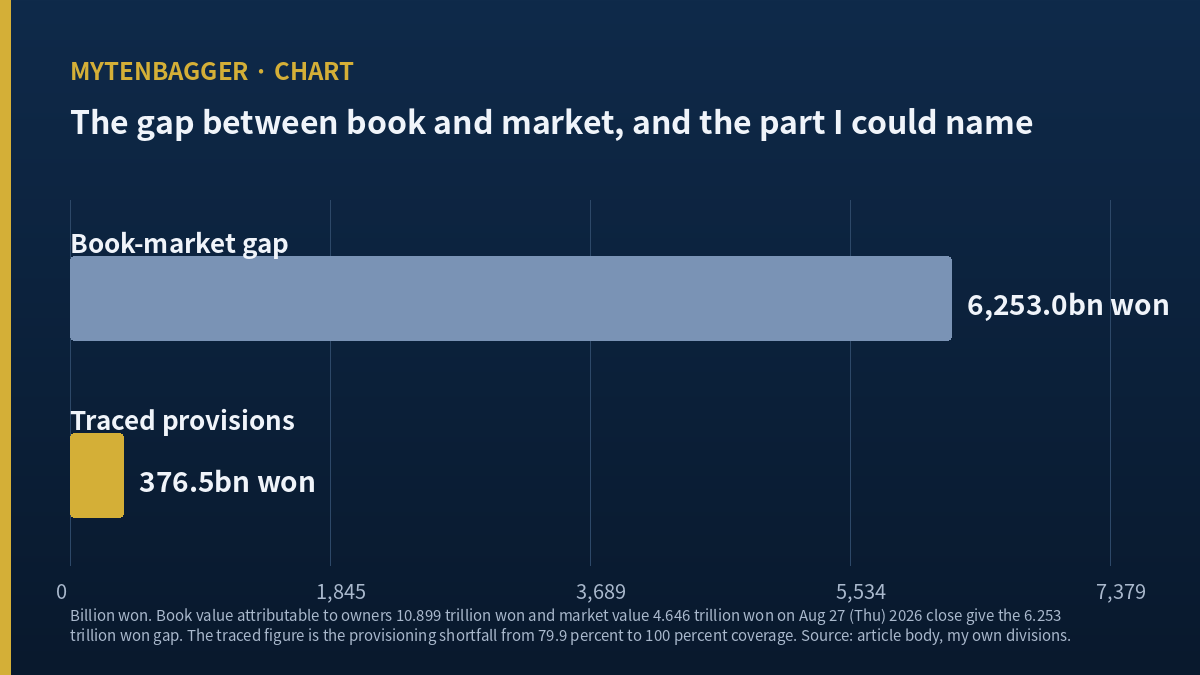
One subtraction opened my file on BNK Financial stock. Book value attributable to owners of BNK Financial Group was 10.899 trillion won on June 30, 2026. Market value at the August 27 (Thu) close was 4.646 trillion won. The difference is 6.253 trillion won, and I spent the rest of the session trying to attach specific figures to pieces of it. I got to 6.02 percent. That number, and what it leaves open, is why I am writing this down.
Book value attributable to owners: 10.899 trillion won, consolidated, June 30, 2026 quarterly filing.
Market value: 4.646 trillion won, from the August 27 (Thu) close of 14,970 won and 310,327,321 shares outstanding (my multiplication).
The gap: 6.253 trillion won, or 57.38 percent of book (my division).
What I could put a figure to: 376.5 billion won of provisions the group has not yet booked against its bad loans, which is 6.02 percent of the gap (my division). The other 93.98 percent stayed open.
Contents
What BNK Financial stock is, for readers outside Korea
A holding company for two provincial banks, listed on the KOSPI
The KOSPI is the main board of the Korea Exchange, the larger of the country’s two equity markets and the one where established industrial and financial names list. BNK Financial Group trades there under the code 138930. It owns two commercial banks: Busan Bank, anchored in the port city of Busan, and Kyongnam Bank, anchored in South Gyeongsang Province, which includes the shipbuilding and machinery towns of Changwon, Gimhae and Geoje.
The word “regional” carries a different weight in Korea than it does in the United States. An American regional bank competes across several states against other regionals. A Korean provincial bank competes inside one province against the nationwide branch networks of the four large Seoul-based groups plus two internet-only banks. The customer base is the local economy, and the local economy is a specific set of factories. So when I read this company I end up reading a province.
How I got to 4.646 trillion won
Korean won is the reference currency throughout this piece. For scale only: at 1,384.80 won per dollar, the Seoul close on August 26 (Wed), the market value works out to roughly 3.35 billion dollars. I checked the currency market one day before the equity close I am using, because the August 27 (Thu) foreign exchange close was not published anywhere I could reach at the time of writing. Prices and multiples here reflect the August 27 (Thu) close as I saw it, so live quotes will differ.
The one piece of the gap I could put a figure to
Coverage of 79.9 percent, and what 100 percent would cost
At the end of the second quarter of 2026 the group carried 1.873 trillion won of loans classified substandard or below, and had set aside provisions equal to 79.9 percent of that amount. NH Investment and Securities, a Korean brokerage, described that ratio as low among Korean financial holding companies and argued the group should provision to 100 percent.
So I did the arithmetic. Moving from 79.9 percent to 100 percent means booking another 20.1 percent of 1.873 trillion won, which is 376.5 billion won. Against the 6.253 trillion won gap between book and market, that is 6.02 percent. Against market value it is 8.10 percent. Against the 411.8 billion won the group earned for its owners in the first half of 2026, it is 91.43 percent. All four of those are my own divisions.
Nobody expects a bank to book that in one quarter, and I do not model BNK Financial stock that way. What the figure does is give one piece of a very large discount an actual size. Everything else I looked at stayed qualitative.
Capital sitting at the floor of the company’s own band
The group’s common equity tier one ratio was 12.14 percent at the end of the second quarter, down 16 basis points from the previous quarter and down for three consecutive quarters. Management has stated a target band of 12.0 to 12.5 percent, which leaves 14 basis points of room above the floor (my subtraction). Total capital stood at 13.48 percent.
Set against that, the company has committed to a total shareholder return ratio of 50 percent by 2027, with 2026 guided around 45 percent. Chief financial officer Kwon Jae-jung said publicly that heavy reliance on the banking subsidiaries makes early achievement difficult, and the group said an updated value-up plan would come with third-quarter results. Korea’s value-up program, launched by the exchange to push listed companies toward higher returns on equity and larger payouts, is the frame those commitments sit in. I wrote about how a different Korean bank funds that promise in my Woori Financial piece, and the starting position there was not this one.
The 94 percent of the gap I could not price
Earnings fell, and the two banks fell differently
First-half profit attributable to owners came in at 411.8 billion won, down 13.45 percent from 475.8 billion won a year earlier by my own division. The second quarter alone was 200.4 billion won against 309.2 billion won, down 35.19 percent. I built those single-quarter figures myself by subtracting the prior cumulative filing, because Korean quarterly disclosures report flow items on a year-to-date basis.
Broken out, Busan Bank earned 201.2 billion won in the first half, down 20.1 percent, and Kyongnam Bank 155.0 billion won, down 2.2 percent. Those two add to 356.2 billion won, which matches the banking segment total the company published. Reversing the percentage changes gives declines of about 50.6 billion won at Busan and 3.5 billion won at Kyongnam, so 93.53 percent of the banking segment’s lost profit sat at one of the two banks. The company attributed much of the group-level decline to 98.4 billion won of one-off real estate fund items, and said normalized profit rose 8.2 percent to 455.8 billion won. That is the company’s own arithmetic, published through Korean trade press, and I could not find a split of it by subsidiary.
Asset quality moved the other way at the other bank
Kyongnam Bank’s substandard-and-below loans rose 19.9 percent quarter on quarter to 511.1 billion won, with corporate bad loans up 24.3 percent and its bad-loan ratio crossing 1 percent for the first time in 2026. Busan Bank’s fell 9.9 percent over the same quarter. Group bad loans fell 4.1 percent in total, the group ratio eased to 1.46 percent and the delinquency rate to 1.34 percent.
So the consolidated line improved while one of the two banks deteriorated. Reversing the 19.9 percent gives roughly 426.3 billion won at the prior quarter, an increase of about 84.8 billion won in three months, equal to 54.71 percent of what that same bank earned in the whole half (all three my own calculations). Kyongnam’s 511.1 billion won is 27.29 percent of the group total. Whether that is a turn or a wobble is the question the next filing answers.
The province, in the same quarter, both ways
South Gyeongsang Province posted the only export decline among Korea’s seventeen provinces and metropolitan cities in the second quarter of 2026, down 520 million dollars, with general machinery exports down 387 million dollars. Construction orders in the province fell by 1.885 trillion won, the largest drop nationally. Retail sales fell 2.7 percent and machinery output 4.5 percent, per provincial reporting of national statistics.
The same province, the same quarter, also grew manufacturing output 3.2 percent against a national 2.0 percent, lifted shipbuilding exports by 665 million dollars, and raised its employment rate 0.4 percentage points to 63.7 percent. The Bank of Korea’s July 2026 regional economic report described the south-eastern region as flat for the first half. Unsold completed housing in the province stood at 3,402 units in April 2026, second highest nationally, concentrated in Changwon, Gimhae and Geoje. Busan’s net population outflow in the second quarter was 2,596 people, smaller than the 3,704 a year earlier, with the 20 to 24 age bracket turning to net inflow.
I could not convert any of that into a share of 6.253 trillion won. It is context for the discount, not a measurement of it.
Sector-wide, and worse than sector-wide
Korea’s five provincial banks averaged a 1.33 percent delinquency rate in the second quarter of 2026, against 0.79 percent at the end of 2024, with combined first-half profit down 11.3 percent and provisions up 19.2 percent, according to Korean sector reporting. BNK’s own first-half decline of 13.45 percent is steeper than that average. Both facts belong in the same paragraph.
Where BNK Financial stock returns sit against global peers
Sorting fourteen banks by which return band they fall inside
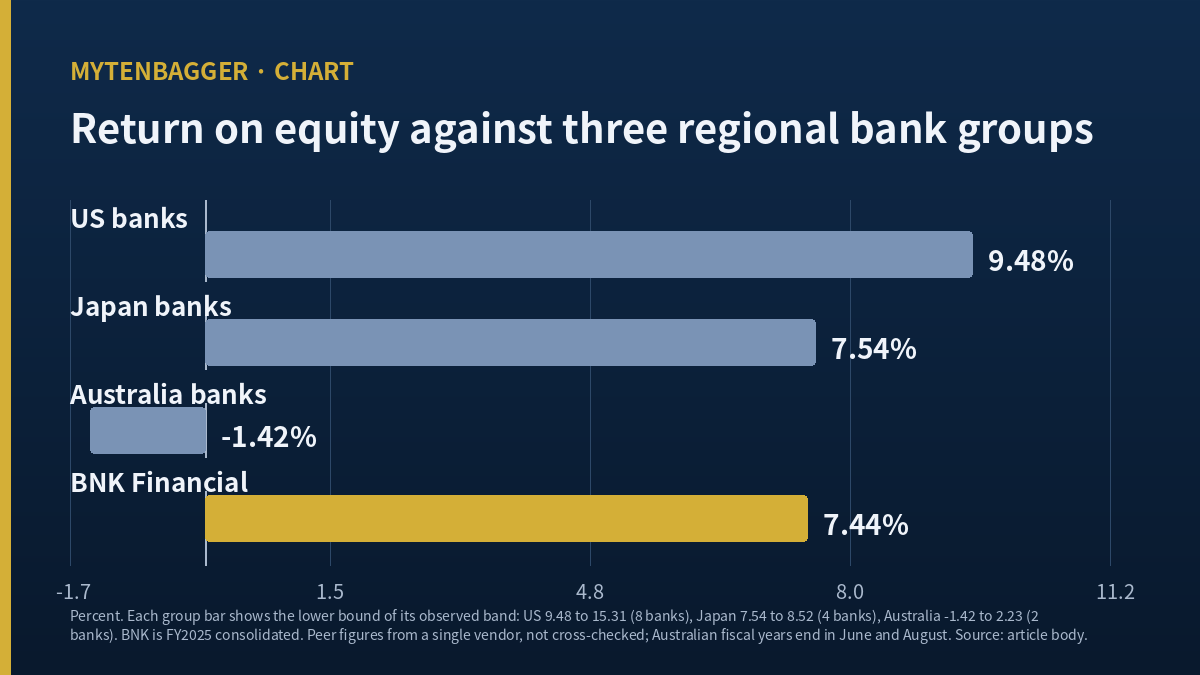
I pulled the most recent completed fiscal year for fourteen listed banks that do roughly what this one does: lend to a defined geography instead of a whole country. The column I added is not a rank. It is the band each region’s group occupies, because the point of the table is that these three groups barely overlap.
| Bank | Ticker | FY end | Revenue (m, local) | Net income (m, local) | ROE | Return band group |
|---|---|---|---|---|---|---|
| Cullen/Frost | NYSE CFR | 2025-12-31 | 2,191 USD | 635.47 USD | 15.31% | US 9.48 to 15.31% |
| Zions Bancorporation | NASDAQ ZION | 2025-12-31 | 3,313 USD | 884 USD | 13.51% | US 9.48 to 15.31% |
| Regions Financial | NYSE RF | 2025-12-31 | 7,056 USD | 2,061 USD | 11.65% | US 9.48 to 15.31% |
| First Horizon | NYSE FHN | 2025-12-31 | 3,354 USD | 956 USD | 10.94% | US 9.48 to 15.31% |
| Comerica | NYSE CMA | 2025-12-31 | 3,266 USD | 691 USD | 10.15% | US 9.48 to 15.31% |
| Huntington Bancshares | NASDAQ HBAN | 2025-12-31 | 7,692 USD | 2,087 USD | 10.10% | US 9.48 to 15.31% |
| M&T Bank | NYSE MTB | 2025-12-31 | 9,185 USD | 2,699 USD | 9.80% | US 9.48 to 15.31% |
| KeyCorp | NYSE KEY | 2025-12-31 | 7,007 USD | 1,686 USD | 9.48% | US 9.48 to 15.31% |
| Fukuoka Financial Group | TSE 8354 | 2026-03-31 | 440,787 JPY | 85,428 JPY | 8.52% | Japan 7.54 to 8.52% |
| Yokohama Financial Group | TSE 7186 | 2026-03-31 | 387,982 JPY | 106,523 JPY | 7.96% | Japan 7.54 to 8.52% |
| Chiba Bank | TSE 8331 | 2026-03-31 | 321,928 JPY | 94,063 JPY | 7.83% | Japan 7.54 to 8.52% |
| Shizuoka Financial Group | TSE 5831 | 2026-03-31 | 344,933 JPY | 90,469 JPY | 7.54% | Japan 7.54 to 8.52% |
| Bank of Queensland | ASX BOQ | 2025-08-31 | 1,648 AUD | 133 AUD | 2.23% | Australia minus 1.42 to 2.23% |
| Bendigo and Adelaide Bank | ASX BEN | 2025-06-30 | 1,915 AUD | minus 97.1 AUD | minus 1.42% | Australia minus 1.42 to 2.23% |
Eight American banks, four Japanese, two Australian: fourteen rows, which is the count I intended. BNK Financial Group itself reported a return on equity of 7.44 percent for the 2025 fiscal year on a consolidated basis, and the market data screen I use shows 7.6 percent on its own trailing convention. On either figure the company falls below the American band and lands at or just under the Japanese one. That placement felt like the most useful single sentence I produced about this company all session.
Three cautions belong with the table. All fourteen peer rows come from one vendor, stockanalysis.com, and I failed to cross-check them against a second source. The two Australian banks close their books in June and August, so their year does not line up with the December and March closers. And Bank of Queensland’s revenue line is stated after loan loss provisions, which the others are not. I left all three in the table rather than dropping the rows, because a reader can adjust for a disclosed inconsistency and cannot adjust for a hidden one.
Eight Korean brokerages, all constructive, split on the figure
Eight named Korean brokerage notes carry a buy view. Grouped by the valuation each attached: four sit at 23,000 to 24,000 won (Samsung, NH Investment, Meritz, Kiwoom), two at 25,000 to 25,500 won (Heungkuk, Hanwha Investment), two at 26,000 won (BNK Investment, Daol). Divided by the August 27 (Thu) close of 14,970 won, those bands are 1.54 to 1.60 times, 1.67 to 1.70 times, and 1.74 times. The two most recent notes, both dated July 29 (Wed), moved down: Meritz’s Cho A-hae from 26,000 to 24,000 won, and Samsung’s Kim Jae-woo from 24,000 to 23,000 won. Hanwha Investment’s Kim Do-ha moved up on June 8 (Mon), from 24,000 to 25,500 won. One of the two houses at 26,000 won is BNK Investment Securities, which is a subsidiary of the company it is covering, and I weigh that note accordingly. Full-year 2026 owner profit estimates range from 835.0 billion won at Kiwoom to 883.0 billion won at Hanwha Investment. A consensus of 869.7 billion won appeared in July 14 (Tue) reporting without a compilation date, so I kept it out of my reasoning. I took a similar approach to sell-side dispersion in my Meritz Financial piece.
What holders of BNK Financial stock are paid to wait
The 2025 fiscal year dividend was 735 won per share, which is 4.91 percent of the August 27 (Thu) close by my division. The second-quarter interim dividend was 150 won per share, up 25 percent year on year, totalling 46.03 billion won, with a record date of August 12 (Wed) and payment on August 27 (Thu). The close I used for every ratio in this piece happens to be the day the cash landed.
The group bought 59.87 billion won of its own shares in the first half against a 60 billion won plan, roughly 3.49 million shares, or 1.12 percent of shares outstanding by my division, and said they would be cancelled during the third quarter. Reporting split on whether that meant August or the quarter generally, and I could not confirm execution as of August 27 (Thu). The dividend record runs from 300 won in 2018 to 735 won in 2025, but two of those eight years, 2020 and 2023, were cuts. A yield built on a payout that has been reduced twice in eight years reads differently to me than the same yield on an unbroken record. I made a version of that point about a Korean policy bank in my IBK piece.
Two multiples, and why I built one of them myself
The screen shows a price-to-earnings ratio of 5.82 times. My own count gives 6.19 times, and the 0.37-times difference has a cause. Multiplying the screen’s book value per share of 34,780 won by shares outstanding gives 10.793 trillion won, which is the December 2025 owner equity figure, not the June 2026 one. The screen’s denominators are stale by two quarters. So I summed owner profit across the four quarters from the third quarter of 2025 through the second quarter of 2026, got 751.0 billion won, and divided the market value by that instead.
Price against the June 2026 book gives 0.4262 times. The twelve-month price return is positive 2.25 percent while the six-month return is negative 33.47 percent; dividing one by the other implies the first half of that year returned positive 53.69 percent. The August 27 (Thu) close sits at 64.95 percent of the 250-session high of 23,050 won, 35.05 percent below it, and 9.67 percent above the 250-session low of 13,650 won. Every figure in this paragraph is my own calculation from adjusted closing prices.
My position on BNK Financial stock, and what would break it
I am watching. Three things keep me out. The unbooked provision figure of 376.5 billion won equals 91.43 percent of a half-year of owner profit, and I do not know how it will be spread. Capital has fallen for three straight quarters to 14 basis points above the floor of the company’s own band, while the payout commitment rises. And the one-off explanation for the earnings decline was given at group level, so I cannot tell how much of Busan Bank’s 50.6 billion won shortfall was operating and how much was a fund settlement.
What pulls the other way is real and I will not pretend otherwise. A 4.91 percent yield, a rising quarterly dividend, a cancellation queued, and a price at 42.62 percent of book. I am not negative on this company. I want three specific gaps filled first, and I have written down what they are so that I can check myself against this page later.
The way this reading fails
I attached a figure to 6.02 percent of the gap and then treated the remaining 93.98 percent as something the market got wrong. That is backwards if the market is pricing something I did not trace: a slower province, a structural cost disadvantage against the nationwide groups, a payout that has been cut twice in eight years. A discount I can only partly account for is evidence about my own work before it is evidence about the price.
The third-quarter filing is due by November 15, which falls on a Sunday, so it lands from November 16 (Mon). Three numbers decide whether my reading holds: whether Kyongnam Bank’s 511.1 billion won of bad loans falls, whether coverage rises off 79.9 percent, and whether the capital ratio moves back into the band. The updated value-up plan arrives with the same filing, and the buyback cancellation should be confirmable by then.
Six things I could not confirm
- How the 98.4 billion won of one-off items split between the two banks. This is the largest hole in the piece.
- The banking segment’s 356.2 billion won plus non-bank profit of 172.6 billion won comes to 528.8 billion won, against 411.8 billion won attributable to owners. I could not itemize the 117.0 billion won difference beyond holding company costs, minority interests and consolidation entries.
- One report gives net interest margin of 2.11 percent in the first quarter and 2.06 percent in the second while also stating a 4 basis point decline, which does not reconcile by 1 basis point. Rounding is the likely cause; I could not confirm it.
- Credit ratings and outlooks from the Korean rating agencies for this issuer.
- Whether a reported regulatory review of the group’s chairman selection process, described in May 2026, reached any conclusion.
- Shares outstanding and major shareholder positions come from a vendor screen; I could not match them against the primary filing.
Subtraction is the easy half
Subtraction. That is what I did first, and it took one line: book minus market, 6.253 trillion won. The difficulty was never the arithmetic. It was that a number that large arrives looking like an answer, and I spent the session discovering it was a question with one small piece filled in.
I have caught myself doing this before with cheap-looking Korean financials, treating a wide discount as evidence about the market rather than as a list of things I have not checked. What changed this time is that I wrote the unexplained share down as a percentage, 93.98, and put it in the same box as the part I could account for. A remainder I have to look at every time I reopen this page is harder to ignore than one I never wrote down.
- JB Financial ROE: What Each Won of Assets Earns at the Bank
- Iljin Electric Orders Tilt Toward Heavy Electrical Equipment