HD KSOE Stock: A $22 Billion Stake Inside a $17 Billion Company
I had two quote screens open side by side this morning. On the left, HD Hyundai Heavy Industries — Korea’s flagship shipbuilder, a stock I started buying into its recent slide and wrote about here. On the right, the company that owns 69% of it. HD KSOE stock closed today at ₩353,500, about $233 at the ₩1,520-per-dollar rate I verified earlier this week, and that puts the whole company at roughly ₩25.0 trillion, or $16.5 billion (my arithmetic from the share count — I’ll show the work below). Here is the part that made me put my coffee down: the stake in that one listed subsidiary, marked at today’s market price, is worth about $22.2 billion. Buy the parent and you are, on paper, paying $16.5 billion for a $22 billion holding — and getting an unlisted shipyard with 96.65% ownership thrown in. I ran all of that math today, and I still did not press the buy button. This journal entry is about why.
Where I landed today
The 29% drawdown from the April closing high (my calculation from daily closes) looks to me like a story premium being handed back — Canada picked a German yard for its $39 billion submarine program, and Korean naval dreams deflated — not like earnings damage: the Q2 consensus sits near $935 million in operating profit, up 49% year over year per Korean press tallies, and the order book already covers about 70% of the full-year goal. I’m still not buying. A holding-company discount this wide does not close on its own — it needs the buyback that management calls “under review” to become an actual filing — and my portfolio already carries this exact shipbuilding cycle through the subsidiary. I set three dated gates instead.
Contents
HD KSOE Stock Gave Back 29% — The Chart First
Some scaffolding for readers new to Korea. HD KSOE — HD Korea Shipbuilding & Offshore Engineering — trades on the KOSPI, the Seoul main board that plays roughly the role the S&P 500’s exchange universe plays in the U.S. It is not the yard that welds steel; it is the intermediate holding company that sits above HD Hyundai Heavy Industries and the unlisted HD Hyundai Samho, under the HD Hyundai group umbrella. When you buy this ticker, you are buying claims on shipyards, one layer up. Above it sits HD Hyundai, the group’s listed top holding company, which owns 35.05% of HD KSOE per the same affiliate disclosure I cite below — so this is the middle layer of a three-story chaebol structure, the kind of architecture American markets mostly dismantled decades ago and Japanese markets are dismantling now. That context matters for everything that follows: the discount I am about to measure is not an exotic mispricing, it is the standard tax this structure pays, and the whole investment question is whether anything has changed that would shrink the tax.
Why would anything change? Korea’s Value-up program is the answer bulls give, and it deserves a fair hearing rather than an eye-roll. Modeled openly on the Tokyo Stock Exchange’s governance campaign — the one that helped drag Japanese cross-holding conglomerates out of decades of book-value purgatory — it pushes listed companies to publish return-on-equity and shareholder-return plans and shames the laggards. I have written about it repeatedly on this site because it keeps being the hinge variable for exactly this kind of stock: banks, insurers, and holding companies whose problem was never earnings but allocation. The honest scorecard so far is mixed. Financial holding companies re-rated hard; industrial holdcos mostly have not. HD KSOE’s 142% shareholder-return year, which I detail below, is what a company trying to answer the program looks like. Whether the market pays for the answer is a separate question — and that, not the shipbuilding cycle, is the actual bet a parent-level buyer is making.
The tape, from Naver Finance confirmed daily closes: HD KSOE stock ran from ₩344,000 ($226) at the end of March to a closing high of ₩479,000 ($315) on April 27 — a 39% climb in under a month, by my math. From there it bled all the way to ₩338,000 ($222) on July 21, a 29.4% retracement that gave back essentially the entire spring rally. Today, July 22, it bounced 4.6% to ₩353,500 ($233). One green day does not change a trend, so I am treating the bounce as noise until proven otherwise.
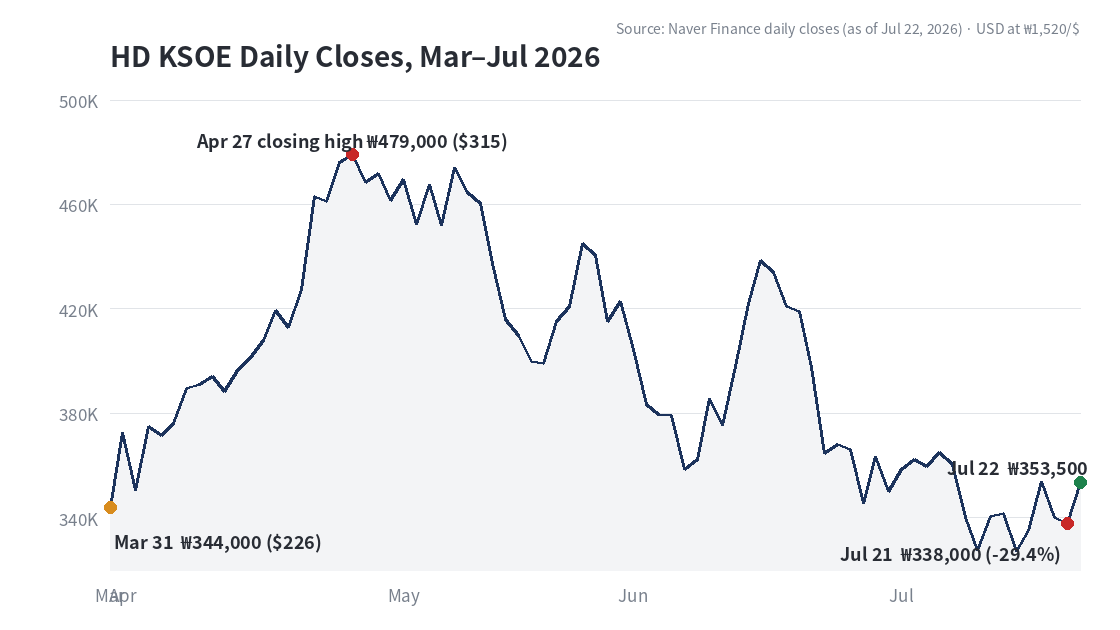
What makes this correction interesting is that the industry data went the other way. In a July 17 note relayed by a Korean daily, Samsung Securities analyst Han Young-soo observed that Korean shipbuilding shares had fallen about 17% year-to-date “even as order indicators stayed unexpectedly strong,” and attributed the slide to market-wide multiple compression and profit-taking rather than anything sector-specific. The numbers he cited: global newbuild orders up 88% year over year in the first half — a record — and Korean yards already at 81% of last year’s full-year intake. Fundamentals pushing up, positioning pushing down. So the real question is what pulled the trigger on the positioning.
The Trigger Was a Submarine, Not the Shipyards
On July 6, Canada named Germany’s ThyssenKrupp Marine Systems the preferred builder for its next-generation submarine program — twelve 3,000-ton boats, worth up to C$60 billion including three decades of maintenance, roughly ₩60 trillion or $39 billion at current won rates, per Korean newswire coverage. Hanwha Ocean and HD Hyundai Heavy had bid jointly; the reporting says Korea scored well on price, delivery, and technology, but Ottawa’s tilt toward European defense partnerships won out. Four days later, NH Investment & Securities cut its objectives across all three big Korean shipbuilders — HD Hyundai Heavy by 17% to ₩830,000 ($546) — with analyst Jung Yeon-seung writing that commercial orders were running ahead of plan but that “meaningful wins outside merchant ships” were now needed, while also raising his risk-free-rate assumption from 3% to 3.4%. Around the same time, Korean outlets reported that Sangsangin Investment & Securities trimmed its number on HD KSOE itself, citing a delayed entry into the U.S. naval market. I could not access the full note, so I am carrying the headline, not the details.
Set that against what the commercial business actually did. Per a Korean financial daily’s tally of company disclosures, HD KSOE booked six product carriers from a Middle Eastern owner for about $309 million on July 9, lifting the year’s running total to $16.03 billion across 139 vessels — 68.8% of the $23.31 billion annual goal, crossed barely halfway into the year. That goal itself was set 29.1% above last year’s, which makes the pace more impressive, not less. By July 13, three very large ammonia carriers had pushed the ratio to 70%. My reading of the whole sequence: the market did not sell the shipbuilding business. It sold the submarine premium that had been stacked on top of the shipbuilding business.
Which way are the earnings numbers pointing?
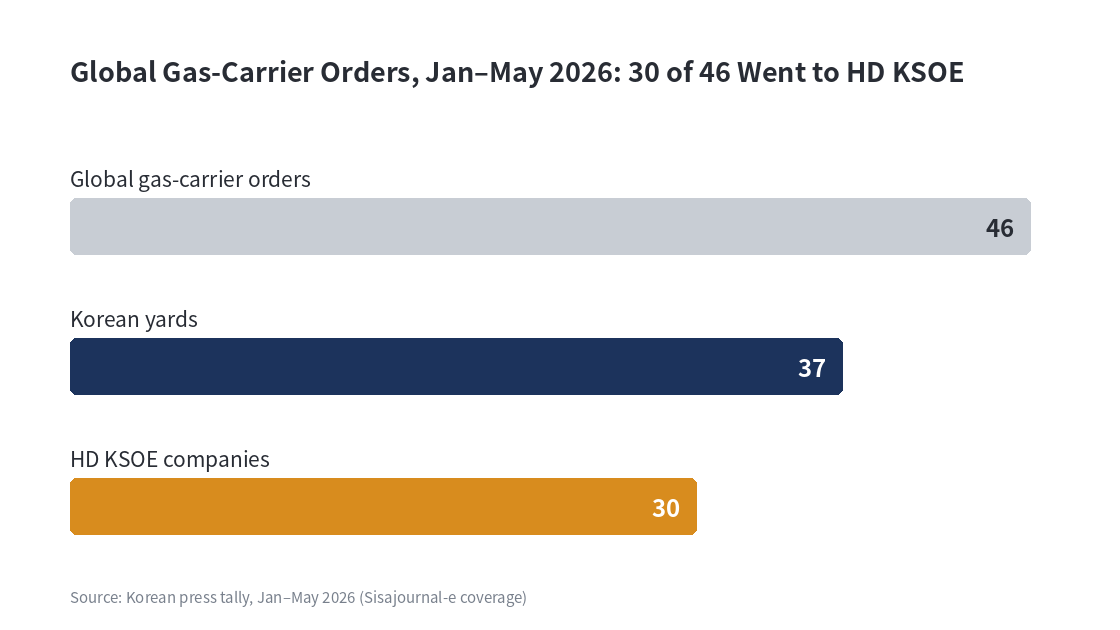
First quarter is already on the board. As relayed by a Korean shipping trade outlet summarizing SK Securities analyst Han Seung-han’s report, consolidated revenue came in at ₩8.14 trillion ($5.4 billion), up 20.2%, with operating profit of ₩1.36 trillion ($892 million), up 57.8% and 14.8% above the street. For Q2, a July 13 consensus tally in the Korean press puts operating profit at ₩1.42 trillion ($935 million), up 49% year over year; an earlier consensus piece frames it as ₩8.63 trillion ($5.7 billion) in revenue at a 16.5% operating margin. The drivers cited are structural to this cycle: cheap boom-era backlog has burned off, high-priced LNG and gas carriers are hitting the revenue line, and — because contracts are dollar-denominated while costs are largely in won — an exchange rate hovering near ₩1,500 fattens the won-based P&L. The full-year consensus sits at ₩5.64 trillion ($3.7 billion) in operating profit, which would be up more than 44% from last year’s ₩3.90 trillion (my percentage, computed from the two reported figures). And within the January-May global gas-carrier market, Korean yards took 37 of 46 orders — 30 of them landing at HD KSOE companies, per the same Korean reporting.
HD KSOE Stock Math: A $22B Stake vs. a $16.5B Market Cap
Now the part that is specific to this ticker rather than to the cycle. Because HD KSOE is a holding company, its value ultimately resolves into the marked and unmarked value of its stakes. All of the following is my own arithmetic from today’s closes and official filings, so check it before you trust it. HD Hyundai Heavy closed at ₩464,500 ($306); multiplied by its roughly 105 million shares outstanding, that is a market cap near ₩48.8 trillion ($32.1 billion). The parent’s stake, per the company’s own affiliate disclosure page (as of January 1, 2026), is 69.23%. That single line item is therefore worth about ₩33.7 trillion — $22.2 billion. HD KSOE’s own market cap: ₩25.0 trillion, $16.5 billion. The listed stake alone is 1.35 times the price of the whole parent, and the 96.65% of unlisted HD Hyundai Samho — plus engine and energy affiliates — comes on top of that, priced by the market at less than zero.
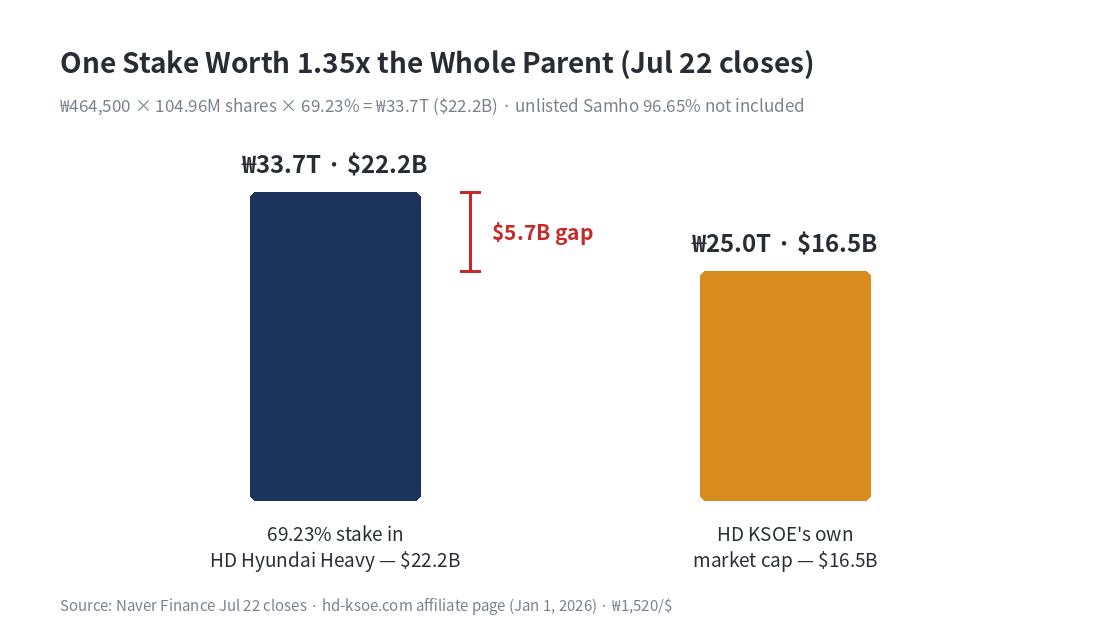
The unlisted piece is not decorative. Last year the group reported ₩3.90 trillion in consolidated operating profit while HD Hyundai Heavy alone reported ₩2.04 trillion ($1.34 billion); simple subtraction says Samho and the other consolidated units generated on the order of ₩1.9 trillion ($1.2 billion) — my back-of-envelope from two filed numbers, ignoring consolidation adjustments, so treat it as a sketch rather than an audit. One structural note that changed these ratios recently: HD Hyundai Heavy absorbed its mid-size sibling HD Hyundai Mipo in a merger announced in August 2025 and completed December 1, 2025. New shares issued to Mipo holders diluted the parent’s stake down to today’s 69.23% — but left it holding a bigger, broader subsidiary.
Multiples tell the same story from another angle. On the indicator data I work with, trailing earnings multiples run about 11.5x for HD KSOE, versus roughly 30x for HD Hyundai Heavy and 35x for Samsung Heavy — trailing-year figures, so all three compress if 2026 estimates land. Three doors into the same order boom, and the market charges thirty times earnings at the yard doors and eleven times at the holding-company door. If what you believe in is the cycle itself, the cheap entrance is obvious. But if money keeps refusing to walk through it, you owe yourself an explanation before calling it free.
So here is the honest counter-case. Holding-company discounts are not a market error you simply harvest. The same profit gets counted once in the subsidiary’s price and again in the parent’s, and markets correct that double-counting with a discount everywhere on earth — Japan’s cross-shareholding conglomerates traded that way for decades until the Tokyo exchange’s governance push started forcing unwinds, and Korea’s own Value-up program is the domestic cousin of that campaign. Dividends climb from subsidiary to parent through tax and time. The flows chasing the naval-and-America story sit in the subsidiary, not the parent — Samsung Securities’ sector pick is HD Hyundai Heavy, not HD KSOE. I also tried to pull verified current multiples for global comparators like Mitsubishi Heavy and the U.S. naval yards and could not confirm them from sources I trust today, so I am deliberately not quoting any — the qualitative point stands without them. “Cheaper than its stake” is a fact; it is not, by itself, a reason. A discount needs a hand to close it.
What Could Move HD KSOE Stock: Dividends and Buybacks
The nearest such hand is the company’s own capital-return program. Per Korean coverage of the company’s May disclosure, HD KSOE returned 142% of parent-only net income to shareholders for fiscal 2025 — blowing through its own 30% floor — with a 40.1% payout ratio and 16.3% ROE against a 12% Value-up goal it hit early. The year-end dividend was ₩12,300 per share ($8.09), a roughly 3.5% yield on today’s close by my math. Management has flagged the start of intra-year quarterly payouts and says share buybacks and cancellation are “under review.” It also raised its 2026 revenue goal to ₩36.1 trillion ($23.8 billion) and set a 2035 ambition of ₩10 trillion in annual naval revenue.
I find the plumbing of that dividend more interesting than the headline. Total payout at ₩12,300 across the share count is about ₩870 billion ($572 million) — my multiplication. But the listed subsidiary’s own dividend, ₩5,661 per share on a 69.23% stake, sends only about ₩410 billion ($270 million) upstream (again my math, from filed dividend histories). Structurally, the rest has to come from the unlisted side — Samho and the parent’s own coffers. The asset the market refuses to price is, as I read it, funding half the cash the parent pays out. That is why I treat this dividend as a real cash stream rather than a shadow of the subsidiary’s share price. The trajectory is loud too: per filing history, the payout jumped from ₩5,100 ($3.36) to ₩12,300 in a single year — up 141% by my math — though nothing guarantees that slope, which is exactly why year-end direction is one of my gates below.
For the sell-side view, carried over from Korean-language reports with that caveat: SK Securities’ Han Seung-han raised his objective from ₩550,000 to ₩640,000 ($421) in May, built on a 2028 book-value estimate of ₩290,255 ($191) per share at 2.2x; Kiwoom Securities carried ₩600,000 ($395) in an April note. Both predate the July submarine decision and NH’s higher rate assumption, so read them as pre-correction marks, not fresh ones. What I take from them is not the level but the architecture: a meaningful slice of those valuations leans on a U.S. naval market that exists in bill drafts, not contracts. The SHIPS Act and related U.S. shipbuilding-cooperation legislation were expected by SK Securities to clear Congress in the second or third quarter; every month of slippage bleeds story premium, and passage would restore it. Either way it is a variable I do not control, which is precisely why I refuse to pay for it in advance.
I Own the Subsidiary; the Parent Waits Behind Three Gates
Full disclosure of my own book first: in an earlier journal here I started buying HD Hyundai Heavy into its 32% one-month drop, and I am keeping that position. Adding the parent would double my exposure to one cycle — same orders, same margins, same risks, counted twice in my account the way holdco earnings get counted twice in an index. The only independent return stream the parent adds is the discount itself narrowing. So before I add a second layer, I want evidence that the narrowing mechanism is actually switched on. Three gates, in calendar order.
Gate one: the Q2 print, expected in late July or early August. I want the consensus ₩1.42 trillion ($935 million) operating profit and a margin holding near 16% — a modest sequential step up from Q1’s ₩1.36 trillion, note, not some heroic leap that invites disappointment — and, more than either, the promised quarterly dividend turning into a dated, sized schedule. Numbers near consensus plus a concrete payout calendar unlocks half my hesitation. Gate two: the U.S. Congress in August-September. If naval-cooperation legislation actually passes and group yards start signing American work, I will watch where the evaporated premium re-forms — at the subsidiary, or finally at the parent. Gate three: year-end. Whether “under review” becomes a buyback-and-cancellation filing, and which direction the ₩12,300 dividend moves. The day a cancellation filing hits the wire is, as I see it, the day this discount starts closing.
Two branch conditions sit alongside those gates. The first is currency. The Q2 margin consensus quietly assumes the won stays weak near ₩1,500 — dollar contracts, won costs. If the won snaps back below ₩1,400, earnings estimates get shaved even with every yard running full and every contract intact. I would score that as a half-miss, not a broken thesis: an FX-driven shortfall says nothing about the backlog, while a volume- or pricing-driven shortfall says everything, and I want to be disciplined enough in August to tell the two apart before reacting. The second is positioning. On the indicator data I track, foreign investors hold about 33% of HD KSOE against roughly 14% of HD Hyundai Heavy. My reading — and it is a reading, not a fact — is that patient sum-of-the-parts money already found the cheap door years ago and is sitting inside it, while the faster money chasing submarines and headlines crowds the expensive one. That would explain both why the parent fell less violently in this correction and why it rallies less explosively when the story is hot: the register of shareholders is the discount, expressed as people.
One American-reader housekeeping note. Note the currency wrinkle cuts both ways here: a weak won fattens the company’s dollar-contract earnings while shrinking the dollar value of your won-priced shares, so you are making two bets, not one. My kill conditions, stated plainly: an operating margin sinking to single digits in Q2 would break the “cheap backlog is gone” premise, and any retreat from last year’s shareholder-return level would gut the only catalyst thesis I have — either one sends me back to rewrite this entry rather than average into it. And to be clear about what my waiting is: it is event-gated, not price-gated. Another 10% dip does not make me buy; three open gates at a higher price might. I have watched enough holding companies stay cheap for years to know that cheapness, alone, is not a plan. I did the math today, I liked the math, and I closed the wallet anyway. Next check-in: the Q2 release.