Hyundai Steel Stock and the Quarter Its Bar Mill Carried
Contents
Hyundai Steel Stock Rose After a Quarter That Missed
Hyundai Steel stock closed at 28,900 won on Monday, August 10, 2026, which works out to about $20.41 at the exchange rate I use throughout this note. The company reported second quarter consolidated results a week earlier, on Monday, August 3. Revenue was 6.1073 trillion won ($4.31 billion). Operating profit was 57.7 billion won ($40.7 million). Korean press covering the sell side commentary put the consensus at 74 to 76 billion won, so 57.7 divided by 74 gives 0.7797 and 57.7 divided by 76 gives 0.7592. The company came in 22.03 percent under the low end of that range and 24.08 percent under the high end.
And the shares are up anyway. Kiwoom data as of August 10 shows one month at plus 10.52 percent, three months at minus 32.56 percent, and twelve months at minus 21.68 percent. The price sits above its 20 day moving average and below both the 60 day and the 120 day. I read that combination as people who already know the quarter was bad buying what comes next, so I spent this session working out what “next” is actually made of.
I did not buy the shares. The interesting part is that I did not skip them because the quarter was weak. Profitability improved in a place I had not expected. My problem is that the place where it improved and the place the third quarter story depends on are two different pieces of equipment inside the same company.
What I verified and what I could not (as of August 10, 2026, no position, no order placed)
| Status | Item | Whose number this is |
|---|---|---|
| Verified | Q2 operating profit 57.7bn won, down 43.3 percent year on year; net profit 12.1 billion won ($8.5 million) turned positive | Company release |
| Verified | Long products: selling price up 60,000 won per ton, input cost up 30,000 won per ton | Sell side compilation |
| Verified | Flat products: selling price up 40,000 won per ton, input cost up 45,000 won per ton | Sell side compilation |
| Could not close | What this company itself pays into the Louisiana project | Company statement and equity share differ by a factor of two |
| Could not close | The size of the August auto sheet price increase | Company said only that talks are in a final stage |
What Actually Earned Money in the Second Quarter
Before I go further, two pieces of ground clearing for anyone reading this from outside Korea. Hyundai Steel trades on the KOSPI, the senior board of the Korea Exchange, under the code 004020. The reporting currency is the Korean won and I convert at 1,416.10 won per dollar, the Seoul market close on Friday, August 7, 2026. That rate is one business day earlier than my price date, because the August 10 closing rate was not available to me while writing. The morning quote that day sat about 0.41 percent below the rate I use.
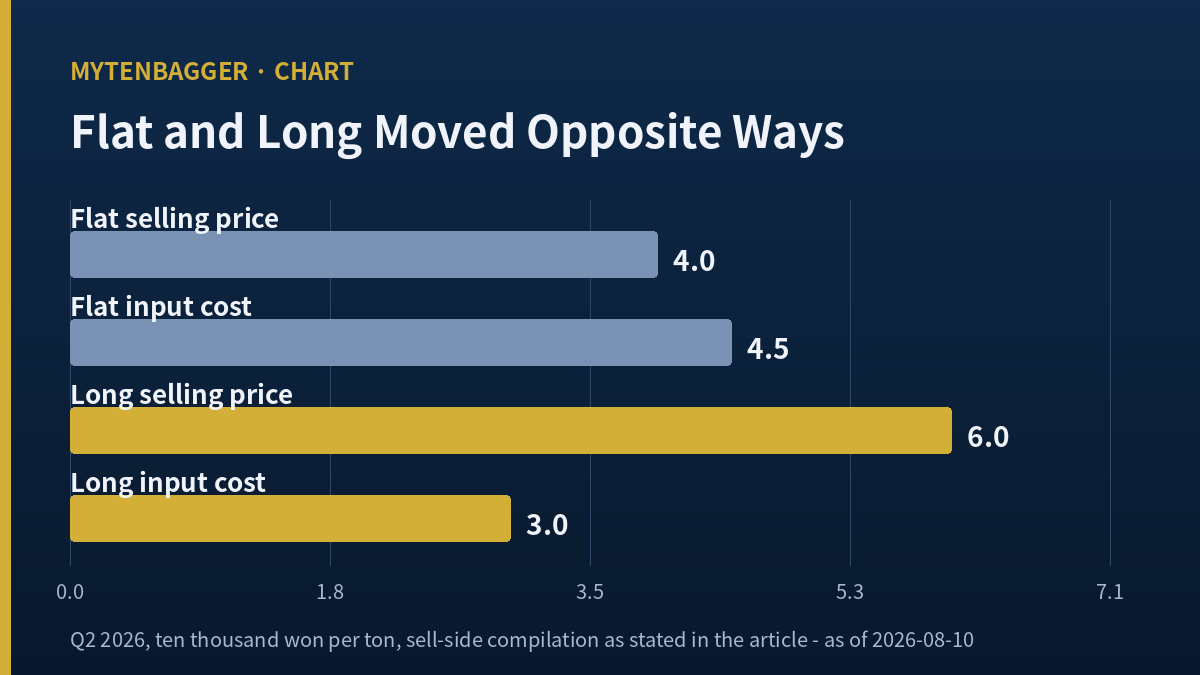
Now the part that made me open this company at all. The sell side compilation broke the second quarter into two divisions and they moved in opposite directions.
| Second quarter 2026 | Flat products | Long products |
|---|---|---|
| Main equipment | Blast furnace | Electric arc furnace |
| Selling price change | plus 40,000 won per ton | plus 60,000 won per ton |
| Input cost change | plus 45,000 won per ton | plus 30,000 won per ton |
| Difference between the two | minus 5,000 won per ton | plus 30,000 won per ton |
| Where the Q3 price increase story sits | Auto sheet and shipbuilding plate | Nothing pending |
In dollar terms the long products division raised its price by about $42.37 per ton while its input cost went up about $21.18 per ton. The flat products division raised its price by about $28.25 per ton against an input cost increase of about $31.78 per ton. One division earned roughly $21 a ton of new margin and the other gave back about $3.50.
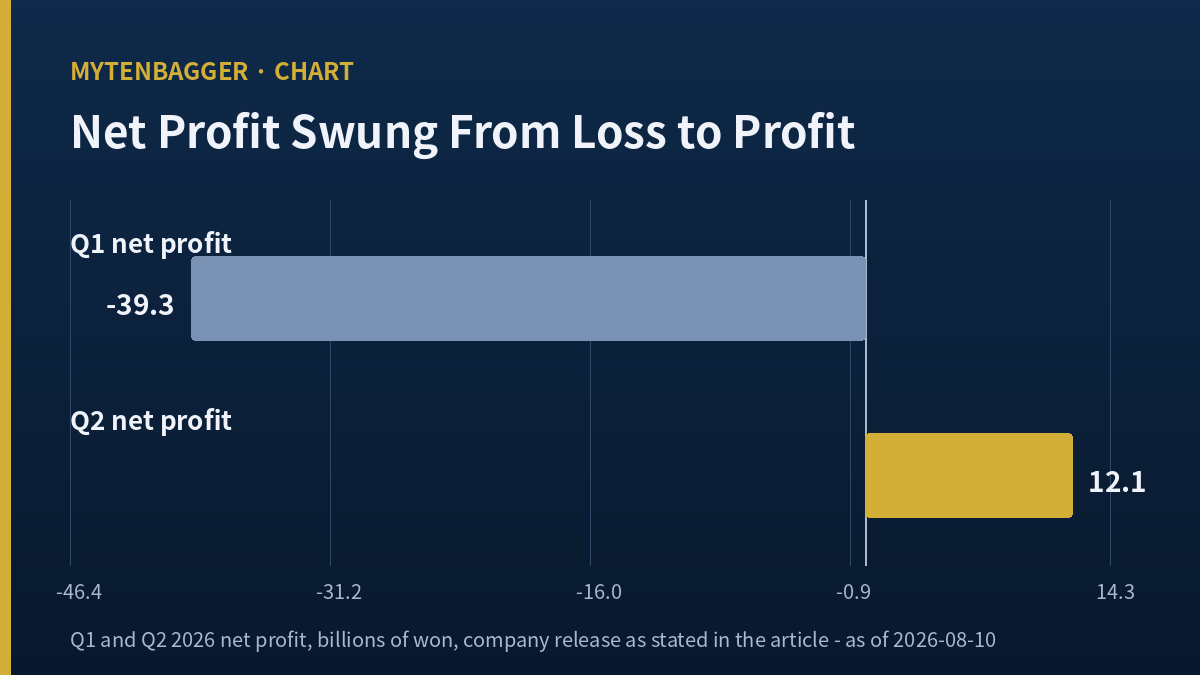
The company’s own explanation points the same way. In its results briefing, Hyundai Steel said the improvement came from higher long products volume and higher product prices. Non consolidated sales volume was 4.421 million tons, up 158,000 tons from the previous quarter. Net profit swung from a 39.3 billion won loss in the first quarter to a 12.1 billion won profit in the second.
So the sentence I can defend about the second quarter is narrow and specific. The electric arc furnaces earned it. The blast furnaces did not.
The Third Quarter Case Rests on a Different Furnace
Here is the part I keep returning to. The improvement case for the third quarter, as the same Korean compilation lays it out, has four components: an August auto sheet price increase, an expected domestic auto sheet rise of at least 50,000 won per ton, a push to raise shipbuilding plate prices, and stabilizing raw material costs. In its own briefing the company said second half auto sheet negotiations were in a final stage and that it expected application from August, and that it was pushing plate increases to reflect higher input costs.
Auto sheet is flat product. Shipbuilding plate is flat product. Both come off the blast furnace side, which is the division whose spread narrowed in the quarter just reported.
I am not saying the case is wrong. If those increases hold, flat product spread turns. What bothers me is the sequencing. The second quarter demonstrated pricing power in long products. The third quarter estimates assume pricing power in flat products. The second thing has not been demonstrated, and the place it would be demonstrated is the third quarter income statement itself. Until then, the third quarter numbers are not a continuation of an improvement I can already see. They are an improvement that has to start somewhere else.
One detail sharpens this. At the January 30, 2026 conference call covering full year 2025 results, the company described current shipbuilding plate prices as being at an abnormal level given raw material and labor input costs, and said it was pushing for increases. That is a statement of intent, and read the other way it is also a statement that the increase had not gone through by then. A company saying it is still pushing on the same line item more than six months later is itself information.
Hyundai Steel Stock and the Louisiana Number I Could Not Close
The Louisiana electric arc furnace mill is a 2.7 million ton per year integrated plant with total investment of $5.8 billion, which converts to about 8.2134 trillion won at my rate. Korean trade press reporting on June 8, 2026 put groundbreaking at the end of 2026, first operation in 2029, and the site in the Donaldsonville area of Louisiana. The equity split reported there is Hyundai Steel 50 percent, POSCO 20 percent, Hyundai Motor 15 percent, and Kia 15 percent.
And here is a number I failed to close. What the company said it would pay and what its equity share implies differ by roughly a factor of two.
| Item | Value | Source and date |
|---|---|---|
| Total project investment | $5.8 billion | Korean trade press, June 8, 2026 |
| Equity split | Hyundai Steel 50 percent, POSCO 20 percent, Hyundai Motor 15 percent, Kia 15 percent | Korean trade press, June 8, 2026 |
| Incentives secured | $2.6 billion, or 44.8 percent of total | Korean trade press, June 8, 2026 |
| What the company said it pays | About $1.5 billion, “considering our equity share” | Conference call, January 30, 2026 |
| What 50 percent of the total implies | $5.8 billion times 0.50 equals $2.9 billion (my arithmetic) | Multiplying the two sources above |
I am not averaging these and I am not quietly taking the newer one. Both go in with their sources attached, and neither feeds any calculation in this note. The gap itself is the useful part. A $1.5 billion commitment and a $2.9 billion commitment produce very different pictures of the balance sheet strain at a company whose entire 2025 operating profit was 219.2 billion won, or about $154.8 million. On the call the company said internal cash generation should cover the program through 2028 without damaging its financial structure. I could not determine which of the two figures that judgment assumes.
The incentive package is worth stating in full, because anyone modeling this as pure cash outflow is missing close to half of it. Korean trade press listed a $100 million state cash grant, land valued at about $100 million, roughly $100 million in quality jobs grants, $1.6 billion of property and sales tax relief over 32 years through a payment in lieu of taxes arrangement, and more than $300 million of electricity discounts over ten years.
For scale on the spending itself: the company guided to annual capital expenditure in the two trillion won range ($1.41 billion) for 2026 through 2028, up from a prior 1.6 to 1.7 trillion won. Two trillion won is 9.12 times the entire 2025 operating profit of 219.2 billion won. Net borrowings are expected to stay around seven trillion won ($4.94 billion) this year and next before targeting a level below six trillion won once the investment burden eases.
Hyundai Steel Stock While Domestic Lines Stand Idle
On the same conference call the company said it had suspended part of its Incheon plant. The reason given was that domestic rebar demand had fallen from 10 million tons to 7 million tons, a 30 percent decline, and that idling low utilization lines saves fixed cost. Its 2026 sales targets were still set higher: 11.833 million tons of flat products and 5.515 million tons of long products, up 114,000 and 205,000 tons respectively.
This is where my own view wobbles, and I would be dishonest to leave it out. The long products that carried the second quarter are tied to domestic construction demand, and by the company’s own account that demand is down by nearly a third. A wider spread on fewer tons does not necessarily produce more money. I treat this as the weakest link in my reading. “The electric arc furnaces earned it” is a fact about one quarter. It is not evidence that they will keep earning it.
So the company is running two directions at once. It is standing down electric arc furnace capacity in Korea while building an electric arc furnace mill in the United States. I have looked at this industry from the other side before: I started buying a Korean shipbuilder during a sharp drawdown, and that is written up in my HD Hyundai Heavy Industries note. Standing where the ships get built and then standing where the plate gets sold made it easier to see why a plate price increase can stay in the “pushing for it” state for so long.
Nucor Is the Company Hyundai Steel Stock Is Paying to Become
For the global comparison I did not pick a competitor or a customer. I picked the company Hyundai Steel is spending $5.8 billion to turn into. Nucor Corporation (NYSE: NUE) is the American electric arc furnace steelmaker, and an electric arc furnace mill in Louisiana producing long and flat product for the North American market is a description of Nucor’s existing business.
Nucor closed at $272.63 on Friday, August 7, 2026, the same date as my exchange rate. The displayed figures were a market capitalization of $62.09 billion, trailing twelve month revenue of $36.10 billion, trailing net income of $2.88 billion, earnings per share of $12.52, a trailing price to earnings multiple of 21.77 and a forward multiple of 12.85, an annual dividend of $2.24 for a 0.82 percent yield, 227.74 million shares outstanding, and a 52 week range of $131.32 to $280.11. I checked two of those against each other: 272.63 divided by 12.52 gives 21.78 against the displayed 21.77, and 12.52 times 227.74 million gives $2.85 billion against the displayed $2.88 billion, a 1.0 percent difference that I read as rounding in the published earnings per share.
| Measure | Nucor | Hyundai Steel | Multiple |
|---|---|---|---|
| Market capitalization | $62.09B | $2.72B | 22.8x (my arithmetic) |
| Annual revenue | $36.10B (TTM) | $16.05B (FY2025) | 2.25x (my arithmetic) |
| Price to sales | 1.72 (my arithmetic) | 0.17 (vendor display) | 10.1x |
| Net margin | 7.98 percent (my arithmetic) | 0.006 percent (FY2025) | not meaningful |
| Dividend payout | 17.9 percent (my arithmetic) | not computable, negative EPS | not meaningful |
The line that stays with me is the first two rows read together. Nucor sells 2.25 times the revenue and carries 22.8 times the market value. The revenue bases are not identical in construction, since Nucor’s is trailing twelve months and Hyundai Steel’s is the 2025 fiscal year, and I flag that instead of smoothing it. Even allowing for that, the gap between 2.25 and 22.8 is the whole argument about what a steel company is worth when it converts revenue into profit and when it does not. Nucor turned 7.98 percent of revenue into net income last year. Hyundai Steel turned 1.4 billion won of 22.7332 trillion won into net income, which is 0.006 percent.
Buying this from a US brokerage account
The usual mechanics apply and I will keep them short. I found no American depositary receipt for this company. Direct access to Korean listed shares runs through a broker with KOSPI market access such as Interactive Brokers, settles in won, and trades on Korea Exchange hours. The two commonly held Korea index products, EWY and FLKR, are large capitalization vehicles and a company with a $2.72 billion market value is not a meaningful weight in either.
What is specific to this company is the substitute problem, and it runs the wrong way. The nearest listed American proxy for the Louisiana thesis is Nucor. But Nucor is a direct beneficiary of the Section 232 tariff regime that Hyundai Steel is spending $5.8 billion to build around. If you buy the American electric arc furnace steelmaker because you like that story, you are not holding a substitute for the Korean company. You are holding the party on the other side of the policy that is driving the Korean company’s capital spending. The two positions do not hedge each other and they do not stand in for each other. They point in opposite directions on the same tariff.
That asymmetry does not appear anywhere on a broker screen, which is why I am writing it down.
What Would Move Hyundai Steel Stock Off My Watch List
My position is no position. The market capitalization of 3.8566 trillion won ($2.72 billion) puts this outside the KOSPI top 100, and I rarely take a buy stance in that range.
Two things that would bring me back
First, flat product spread turning positive in the third quarter. The second quarter figure of minus 5,000 won per ton is the marker, and whether the August auto sheet increase actually landed is decided there. Second, long product volume holding the second quarter pace. Non consolidated volume of 4.421 million tons is the marker, and the question is whether falling domestic rebar demand cuts into it.
What would tell me I read this wrong
If the third quarter comes in above the lower sell side estimate of 111.3 billion won ($78.6 million) while flat product spread is still negative, then reading this company’s earnings through divisional spread is the wrong method and I throw the whole frame out. I prefer to hang that judgment on a number somebody else published instead of on the direction of my own argument, because it leaves me less room to talk myself out of being wrong later.
For context on how I handle a wide gap between sell side valuations and the market price, I worked through that at length in my Doosan Enerbility note. On the Korean steel sector itself I have written once before, on POSCO Holdings, and that piece turned on lithium instead of the steel business.
Questions and Notes on Hyundai Steel Stock
Why did the shares rise on a weak quarter
I cannot answer that definitively. What is verifiable is that five named Korean brokerages kept buy ratings on the basis of third quarter improvement. Hanwha Investment and Securities, Hana Securities, Mirae Asset Securities, Daishin Securities and iM Securities all set valuations between 40,000 and 50,000 won, which is $28.25 to $35.31, against a share price of $20.41. Those are their numbers and I have not adopted any of them. It is also verifiable that net profit swung from a 39.3 billion won loss to a 12.1 billion won profit. The one month window that produced plus 10.52 percent contains both the results release and the research notes, so decomposing the move is beyond what I can support. When something cannot be decomposed I would rather say so.
Does a price to book ratio of 0.20 make this cheap
Shareholders’ equity of 19.4833 trillion won ($13.76 billion) against a market value of 3.8566 trillion won ($2.72 billion) looks that way arithmetically. Book value per share is 146,001 won, about $103.10, against a share price of $20.41. But this is a company whose 2025 net profit was 1.4 billion won and whose full year operating margin was 0.964 percent. When assets do not generate returns, the multiple can stay low for a long time. I read the number as a measure of how much operating leverage exists if margins recover, not as evidence of cheapness.
How damaging is the 50 percent US steel tariff
It is not simple. Korean press reported in May 2026 that Korean steel exports to the United States ran at about 1.7 times the prior year level even with the tariff in place, and the US Commerce Department’s final antidumping determination on Korean hot rolled steel, published in the Federal Register on May 18, 2026, set Hyundai Steel’s margin at 1.49 percent, against 1.22 percent for POSCO and POSCO International. That is the same rate as the January preliminary determination. Meanwhile the Louisiana mill exists precisely to produce inside the tariff wall. The tariff is a cost and it is also the justification for a $5.8 billion capital program.
Is the dividend a reason to own this
Dividend per share went 1,000 won in 2022, 1,000 won in 2023, 750 won in 2024, and 500 won in 2025 according to Korean regulatory filings, so it is half what it was three years ago. The current yield is 1.77 percent and 500 won is about $0.35 per share. The company announced the reduction alongside the capital spending increase. If the investment cycle really runs through 2028 as management describes, I could not construct a reason for the dividend to recover first.
Which vendor figures did you refuse to use
Interest coverage of 0.09 does not reconcile with operating profit of 219.2 billion won. Operating cash flow, free cash flow, and EBITDA displayed as 26 trillion, minus 29 trillion, and 1.5689 trillion won cannot all be right when annual revenue is 22.7332 trillion. The raw payout ratio of 62.6 percent is positive while earnings per share is negative 52 won. I excluded all of those and said why. Shareholders’ equity was blank, so I reconstructed it from book value per share times shares outstanding.
The Order I Put These In
Three things are established about this company right now. Electric arc furnaces earned the second quarter. The third quarter case sits with the blast furnaces. And the company is building 8.2 trillion won of electric arc furnace capacity in the United States that starts up in 2029.
If I assign each of those a different weight, the first gets the largest, because it happened. The second gets roughly half, because five institutions are looking the same direction at something that has not happened yet. The third gets almost nothing at the August 10, 2026 close, since putting the cash flows of a plant that has not broken ground into a 2026 share price is not how I work.
What survives that sorting is a single sentence. I am waiting to see what number the August auto sheet increase prints on the third quarter income statement. Until that number exists, the rebound in front of me is expectation running ahead of evidence, not evidence itself.
Share price and vendor indicators are Kiwoom data at the Monday, August 10, 2026 close. Dollar conversions use 1,416.10 won per dollar, the Seoul foreign exchange market close on Friday, August 7, 2026, which is one business day before the price date; the August 10 closing rate was not available while writing, and the morning quote that day was about 0.41 percent below the rate used (Newsis). Shareholders’ equity, all dollar conversions, the divisional spread differences, the consensus shortfall, the third quarter growth rates, the incentive percentage, and every Nucor ratio marked as such are my own arithmetic. Korean language sources are summarized in my own words and not quoted. Sources: Newspim second quarter results roundup, ftoday sell side commentary compilation, Ferrotimes conference call coverage, The Guru on the Louisiana incentive package, The Guru on the antidumping determination, Financial News on exports to the United States, stockanalysis.com for Nucor, Hyundai Steel investor relations share information
Related reading