Doosan Enerbility Stock: Price Halved, Targets Twice as High
Doosan Enerbility stock printed a 52-week high of ₩139,200 (about $101) in early May and now trades in the low ₩70,000s (about $51). Roughly half of it is gone. Yet the average price objective from Korean brokerages sits near double that level. I read this gap as “the orders are real, the profit is still a shadow,” and I am watching — not holding — until the backlog starts arriving as operating profit and cash. (FX throughout: ~₩1,380/$.)
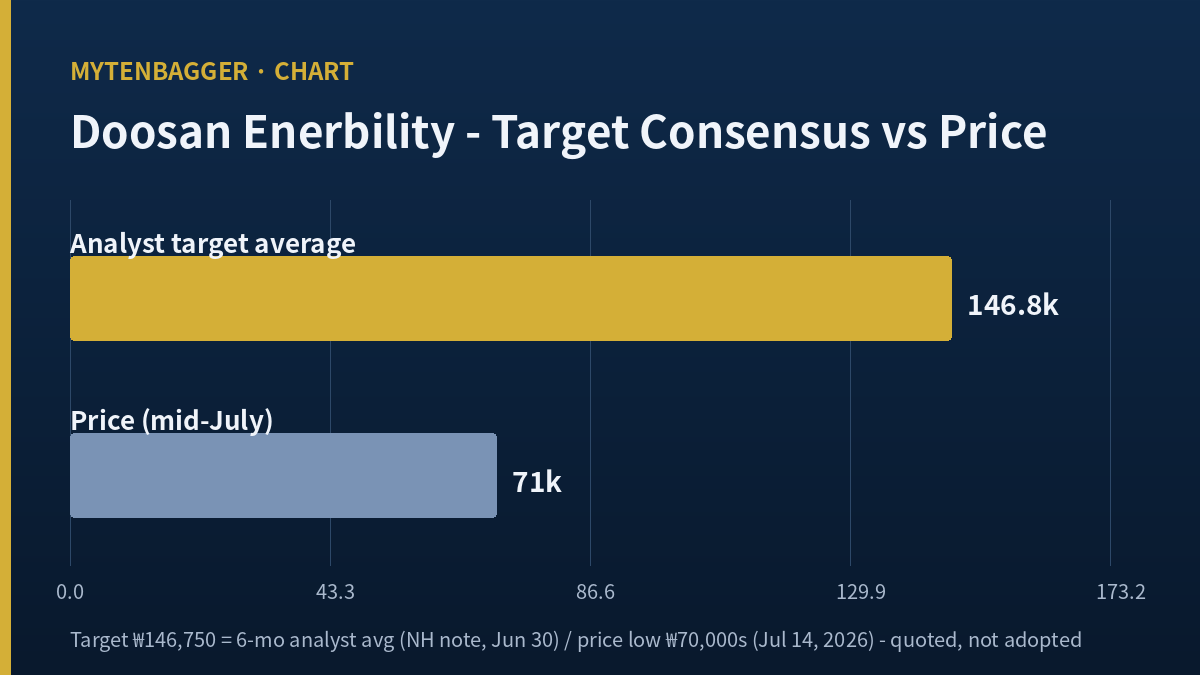
Two numbers look wrong side by side. One: Doosan Enerbility stock has fallen about 29% in a single month, from that early-May high of ₩139,200 (roughly $101, exchange data) to the low ₩70,000s by mid-July. Two: the six-month average brokerage price objective, cited in NH Investment & Securities’ June 30 report (Korean sell-side), is ₩146,750 (about $106). The market folded the price in half; the sell-side still calls for double. I think those two numbers sharing one screen are the whole story here. Anyone typing “Doosan Enerbility stock” into a search box is really asking the same thing: if the objective is double, is this the bottom — or does the market know something?
Let me admit something first. When the nuclear-and-power theme was running hot, I filed this name away as a “theme stock” and let it drift past me. In hindsight that was half wrong. It took the Czech order printing as an actual number for me to reopen the file. So today I accept the substance of the company. I just have not opened my wallet on the stock. Acknowledging a business and buying it are two different sentences for me.
Contents
Why Doosan Enerbility stock and its targets split in two
A stock trading near half of its consensus objective is not common. Usually the two sit within a few tens of percent of each other. Doosan Enerbility stock is at roughly half. Two forces opened that gap.
First, the sell-side valuation hangs on “future profit,” not “profit today.” Mirae Asset Securities (Korean sell-side) initiated coverage on January 12 with a BUY and a ₩105,000 objective, and the method was to pull 2034 expected EBITDA forward and discount it. The picture assumes an order pipeline through 2034 of roughly ₩79tn in large nuclear (Team Korea and Westinghouse-bound), ₩53tn in gas turbine and EPC, and ₩20tn in SMR. In other words, the objective itself is a value that drags the 2030s into the present.
Second, the market is discounting that “time.” Foreign and institutional profit-taking piled up from the ₩130,000s in early May, and on July 8 renewed Middle East geopolitical tension broke the ₩80,000 line (Korean market press, July 8). The stronger a stock’s growth story, the more its price swings on discount-rate variables like rates and geopolitics. Today’s price is down not because the company got worse, but because the discount rate that pulls the future into the present is swinging.
The objective is a bet that 2034 shows up; the price is a doubt that it shows up on time. I wait somewhere in between, for the doubt to turn into confirmation.
Three reasons I keep Doosan Enerbility stock on watch
First reason: the orders are real, but the income statement has not caught up
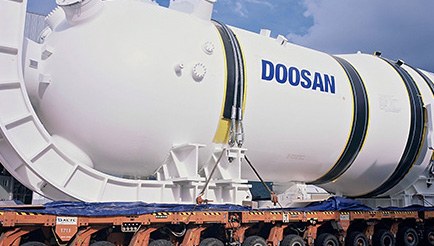
I do not doubt the substance of the order book. If anything, the opposite. Doosan is the Team Korea partner responsible for major equipment and construction in KHNP’s roughly $18.6bn (CZK 407bn) Dukovany project, signed in June 2025, which builds two APR-1000 units with construction targeted for 2029, and Czech industrial participation is set to rise from an initial 30% toward 60% by completion (World Nuclear News; The Korea Times; Seoul Economic Daily). Doosan’s own main-equipment supply contract of about ₩5.6tn was signed in December 2025 (Korean press), and that Europe entry — proven with an actual signature rather than a memorandum — is what made me reopen the file. A main-equipment scope on a large reactor is not a trading contract; it is a multi-year revenue annuity that only starts recognizing once steel is cut. As of Q1 2026, the order backlog stood at ₩24.13tn, and Q1 new orders were ₩2.79tn, up 61.9% year on year (Korean financial press).
The problem is that those orders have not yet arrived as profit. On the trading metrics (Kiwoom data, as of July 14), trailing-twelve-month ROE is about 1.1% and operating margin about 4.5%. A large plant takes years from winning an order to booking it as revenue, and working capital goes out first, which is why both operating and free cash flow sit in negative territory and the debt ratio is around 130%. This negative cash flow is a front-loaded-project feature, not proof of distress. But it does mean the balance sheet is carrying leverage until the backlog turns into earnings and cash. A stock buys the future of profit rather than profit itself — but I am the kind who wants to see that future become one line on the income statement and cash flow statement.
Second reason: a growth axis still tied to domestic policy
The company rests on three axes: nuclear, gas turbines, and SMR. Of these, gas turbines monetize first, riding the surge in AI data-center power demand. Daishin Securities (Korean sell-side) raised its H-class gas turbine unit forecast from 12 to 16 after Q1, and IBK Investment & Securities lifted its objective to ₩160,000 (Korean financial press, post-Q1). Doosan’s domestically developed H-class model is already winning orders and stands directly in the path of that data-center demand. So far, smooth sailing.
What nags at me is domestic new nuclear and SMR. Korean financial press on June 19 laid out the watch points, and the Yeongdeok large reactor and the Gijang SMR are still stuck at the “policy stage.” For the domestic side to fill the next slot in the order relay, policy has to become an actual award — and that conversion speed is a variable the company cannot control. The SMR-dedicated plant in Changwon is being built with roughly ₩800bn of capex toward a 2028 completion (Korean press), and the company has widened its SMR opportunity through cooperation with U.S.-based NuScale Power. But a plant standing up and actual volume showing up are two different things. When the company raised its nuclear-division revenue guidance from ₩6.5tn to ₩11.3tn in August 2025 (Doosan Enerbility), SMR was a core basis — yet the point where that revenue actually books is pushed into the late 2020s. I file this axis under “high expectation, distant clock.” The Changwon plant is a real, bricks-and-mortar commitment to that clock; what it is not, yet, is a signed volume backlog. Those are separate lines in the story, and I keep them separate.
Third reason: the valuation band already touched its ceiling once
That same June 19 Korean analysis judged that in the ₩130,000s, both PER and PBR had pierced the top of their historical bands. As foreign and institutional holders took profit at that high, retail stepped in to defend — an inverted flow. One detail I found telling: the piece placed a March 2026 purchase by five executives in the ₩107,000s next to today’s below-₩90,000 retail psychology. When I see that kind of temperature gap I tend not to rush. If even the insiders’ entry was already above today’s level, it tells me the sense of “cheap” is calibrated differently for different people on this name.
Doosan Enerbility stock by the numbers
These are the figures I laid out in a sheet and stared at for a while. The temperature gap between orders and earnings jumps out.
| Item | Value | Source / basis |
|---|---|---|
| Market cap | ~₩46.9tn (~$34bn) | Kiwoom data, Jul 14 |
| Order backlog | ₩24.13tn | Q1 2026, Korean financial press |
| Q1 revenue / op. profit | ₩4.26tn / ₩234bn | Q1 2026, +13.7% / +63.9% YoY |
| ROE / op. margin | 1.1% / 4.5% | TTM, Kiwoom data |
| 52-week high / current | ₩139,200 / low ₩70,000s | high early May, current mid-July |
| Avg. analyst objective | ₩146,750 (~$106) | 6-month avg, cited in NH Jun 30 report |
Sources: Kiwoom trading data · Korean financial press · NH Investment & Securities June 30, 2026 report | Basis: July 2026 · FX ~₩1,380/$
Read the table and a ₩24tn backlog and a 1.1% ROE belong to the same company. Q1 revenue and operating profit jumped double- and triple-digit percentages, so the direction is right. But the absolute level of margin is still low. The direction of growth is confirmed; the size has not arrived. That spot — direction yes, size not yet — is exactly where I chose watching over conviction on Doosan Enerbility stock.
The gap is a disagreement about time
Here is my differentiated read. People see a gap between objective and price as “who is right and who is wrong.” I see it as a matter of time, not of right and wrong. The objective drags a 2030s order pipeline into present value. Mirae applied a 26.4x target EV/EBITDA — the 2026 average of global peers GE Vernova and Mitsubishi Heavy — which says the sell-side prices Doosan not as a Korean machinery name but on the yardstick of a global nuclear-and-turbine growth stock. The market, meanwhile, recalculates every day whether that future arrives on time and in order. A single flare-up in the Middle East knocking the price under ₩80,000 is evidence the market is discounting that future very cautiously.
Seen this way, the price sitting at half the objective can be a “cheap” signal or a “this takes a long time” signal — both are true at once. So I do not react to price alone. I watch for the real triggers that would pull the clock forward: profit recognition on large orders, the domestic policy-to-award conversion, and the turn in cash flow. Korean sell-side work (Shinhan) has noted that Doosan’s valuation correlates tightly with the size of new orders — which, flipped around, means that if order momentum cools, the multiple cools with it. And the bull case has its own logic: NH’s June 30 note leaned on a policy and order news-flow into the second half — a U.S. Department of Energy loan for a nuclear supply chain, then Korea’s U.S.-investment announcements from July onward — that the sell-side has already written into the objective. I do not think that view is wrong. But “a flow of news is likely” and “profit has arrived” are different kinds of evidence. The first is expectation; the second is confirmation. A watch journal like mine leans on the second.
How a US peer reframes Doosan Enerbility stock
This is where a global peer earns its place. Look at GE Vernova (NYSE: GEV), the closest US comparable across gas turbines, grid and nuclear. It hit a record $1,174.86 on June 30, 2026, and traded at roughly 63x forward earnings and about 43x forward EV/EBITDA, on a backlog of about $163bn with gas-turbine slots booked into 2031 (TIKR; Yahoo Finance). The point I take from this is not “GEV is expensive too.” It is that the global power-equipment supercycle commands premium multiples everywhere, so a rich multiple on Doosan is not a Korean anomaly.
The real difference sits one line lower. GEV is converting its backlog into rising and positive free cash flow — its 2026 FCF guidance was raised, and Q1 2026 EBITDA nearly doubled year on year. Doosan’s cash flow is still negative. Same supercycle, different stage of cash conversion. That single contrast is why I watch Doosan’s cash-flow inflection rather than react to its price. When I compare the two, Mitsubishi Heavy included, I keep landing on the same sentence: the theme is shared, but the cash is not yet. Neither back-of-envelope math nor a Korean sell-side model changes that — only a print of positive cash flow does.
It helps to be concrete about what “cash conversion” means for a company like this. A plant builder recognizes revenue over the life of a project, often on percentage-of-completion, and it spends working capital — procurement, fabrication, on-site labor — well before milestone payments and advances catch up. That is the mechanical reason Doosan’s operating cash flow is negative today even as the backlog swells: money goes out first. GE Vernova sits on the other side of that curve. Its installed base of more than 7,000 gas turbines throws off high-margin service revenue that funds the growth, and its 2026 free-cash-flow guidance was raised rather than cut. So the honest way to frame the peer gap is not “one is cheap and one is expensive.” It is that the market has already watched GE Vernova cross from cash-out to cash-in, and it has not yet watched Doosan do the same. My whole watch reduces to that crossing. The day Doosan’s cash flow statement turns, the story I have been filing under “expectation” moves into the column marked “confirmation,” and I change my mind in public, on this page.
Three paths I map from here
The path I weight most (about 50%)
Orders keep stacking, profit conversion progresses gently, and the price swings hard between roughly ₩70,000 and ₩100,000 on geopolitics and rates. This is my base, the one the data supports best. On this path I am in no hurry. I just check, quarter by quarter, whether operating margin climbs one step at a time, and whether the H-class gas turbine line — the axis that monetizes first — keeps adding units, since that is the part of the story that can print cash before the nuclear projects do.
The path where I stop watching and step in (about 30%)
Q2 or second-half results show gas-turbine and nuclear revenue recognition ramping, and operating cash flow turns positive. Add domestic large nuclear or SMR crossing from policy stage into an actual award, and the next slot in the order relay is filled. If that combination shows up, I end the watch and begin scaling in gradually. That is the outcome where the double gap gets judged as “the market reacted late.”
Where I could be wrong, or it falls further (about 20%)
The order relay pauses, a subsidiary like Doosan Bobcat drags consolidated earnings on a weak end-market, or geopolitics and rates press growth stocks broadly and unwind the re-rating. Mirae added ₩3.5tn of subsidiary value (Bobcat, Fuel Cell and others) to its objective, and that is double-edged: if Bobcat’s construction and agriculture cycle turns down, that ₩3.5tn flips from support to ballast. On this path the objective itself starts drifting down with a lag.
Where my thesis breaks
Even watching needs discipline. I write down the points at which I have to re-judge this name, in the order the answers arrive. First to answer is Q2 results, due late July to August: whether operating margin rises from Q1, and which way operating cash flow turns. Once cash flow starts turning positive, that is the signal the backlog has begun arriving as profit.
Next is domestic-award conversion: whether the Yeongdeok large reactor and Gijang SMR move from policy stage to actual contracts, which decides the durability of the order story. A single overseas win — a U.S. SMR or another European reactor — printed as a contract adds weight to the thesis.
Third is the direction of the objective-versus-price gap. If the sell-side objective holds or rises while the price starts following up, the market is closing the lag; if the objective starts getting cut, the story itself has cracked. Once the first two signals confirm, this third one reveals its direction on its own. Order matters. I read earnings and cash flow first, and leave the verdict on the gap for after.
Doosan Enerbility stock: where I land
To pull it together: I see the substance — the ~₩5.6tn Czech contract, the ₩24tn backlog, the nuclear-gas turbine-SMR trio, the power supercycle as a whole — as real. On that, honestly, my expectation runs high. But on the stock, I am still not holding. Margin and cash flow have not caught the backlog, and the double gap between objective and price reads to me first as “it takes time,” not “it is cheap.” What I wait for is one thing: the first quarter where orders become numbers on the income and cash flow statements. When that comes, I end the watch. I once dismissed this name as pure theme; this time I may be too cautious, too early, ahead of the earnings. The next print will tell me. I am waiting for that day’s numbers.
Related reading
- Samsung C&T Stock: 29% Drop, Stakes Worth Twice the Cap
- Doosan Stock: A 59% Crash, Then a 30% Limit-Up to End July
- Hyundai E&C Stock: The Nuclear Clock Points to 2027, My Read
- Hanil Cement Stock Paid Out 99% of a Profit That Halved