Kakao Pay Stock: Liabilities Tripled, Equity Barely Moved
I went looking at Kakao Pay stock (KRX: 377300) because its profit line had just turned, and I came away thinking about the other side of the balance sheet. Between the close of the 2022 fiscal year and 30 June 2026, this company’s total assets went from KRW 3.33 trillion to KRW 6.86 trillion. That is a doubling in three and a half years, and for a payments and brokerage group growing at 25 percent a year it looks like exactly what you would want to see.
Then I split the growth into its two halves. Liabilities went from KRW 1.42 trillion to KRW 4.82 trillion. Shareholder equity went from KRW 1.91 trillion to KRW 2.04 trillion. The first number is 3.39 times what it was. The second is 1.07 times what it was.
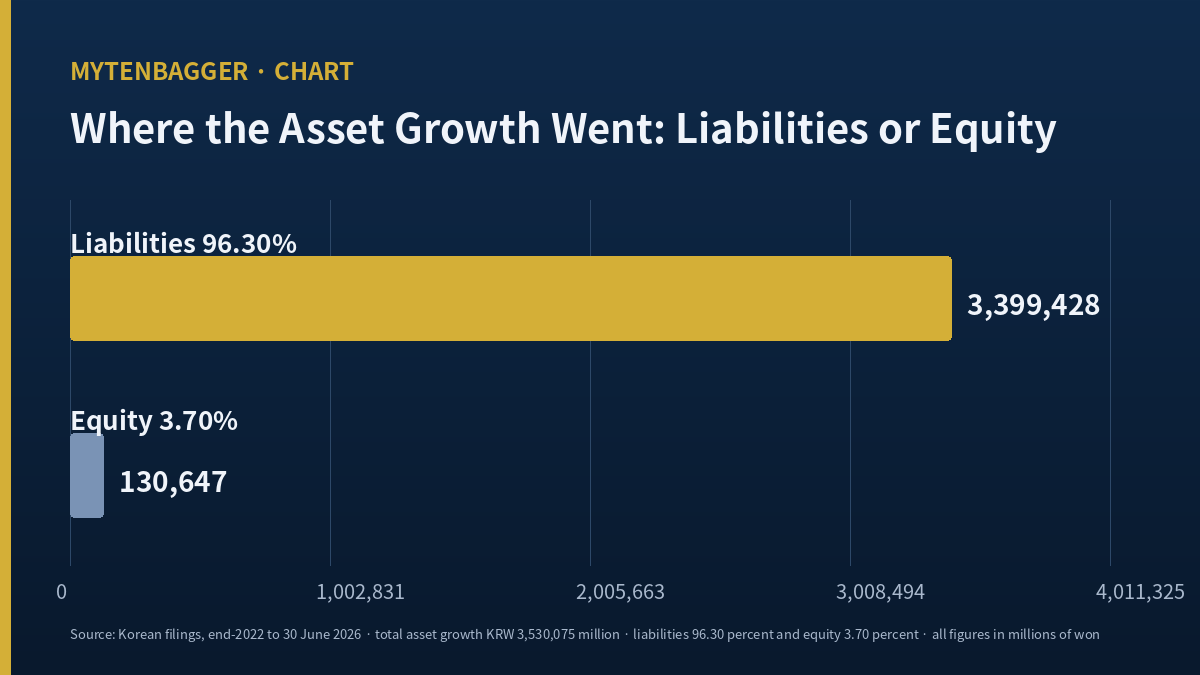
Of the KRW 3,530,075 million the asset side gained over that stretch, KRW 3,399,428 million arrived as liabilities and KRW 130,647 million arrived as equity. That is 96.30 percent and 3.70 percent. The debt-to-equity ratio the Korean filings report moved from 74.59 percent at the end of 2022 to 236.54 percent at 30 June 2026, and it did so in six straight steps without a single reversal.
None of that is fraud or even surprise. A brokerage subsidiary holding client cash, and a payments float sitting between merchants and users, both land on the liability line by construction. But it does change what the return figures mean, and it is the reason I did not use the return on equity number the screens print without rebuilding it first.

Contents
Kakao Pay stock rests on a balance sheet that doubled
Here is the ladder I built from the Korean regulatory filings. Amounts are in millions of Korean won, all on a consolidated basis, and the ratio in the last column is total liabilities divided by total equity as the filings state it.
| Period end | Total assets | Total liabilities | Total equity | Debt ratio |
|---|---|---|---|---|
| 31 Dec 2022 | 3,331,529 | 1,423,304 | 1,908,224 | 74.59% |
| 31 Dec 2023 | 3,966,486 | 2,031,711 | 1,934,775 | 105.01% |
| 31 Dec 2024 | 4,414,712 | 2,503,903 | 1,910,808 | 131.04% |
| 31 Dec 2025 | 5,339,580 | 3,388,674 | 1,950,906 | 173.70% |
| 31 Mar 2026 | 6,002,947 | 4,015,020 | 1,987,927 | 201.97% |
| 30 Jun 2026 | 6,861,604 | 4,822,732 | 2,038,871 | 236.54% |
Source: Korean regulatory filings (half-year report receipt number 20260814003101 for the June 2026 column). I checked the last row myself: 4,822,732 divided by 2,038,871 gives 236.539 percent, which confirms the published ratio is built on consolidated equity and not on the parent-only figure.
At the exchange rate I am using for this piece, the 30 June 2026 column translates to roughly USD 5.08 billion of assets, USD 3.57 billion of liabilities and USD 1.51 billion of equity. The stock itself closed at KRW 47,300 on Friday 4 September 2026, about USD 35.03, giving a market value near KRW 6.40 trillion or USD 4.74 billion on 135,272,727 shares.
Two things follow from the ladder, and I want to keep them separate because they are not the same claim. The first is arithmetic: the equity base that shareholders own has grown 6.85 percent in three and a half years, so any return computed against it is being measured against a plate that has stayed almost still. The second is a matter of judgment: whether that is good or bad depends entirely on what the liabilities are, which is the next section.
Where Kakao Pay stock’s extra KRW 3.4 trillion came from
This company reports as a group, and a single payments app is the wrong mental model for it. The consolidated entity includes a securities arm and an insurance arm alongside the payments business, and the Korean sell-side note I read on the second-quarter results split the top line by segment: financial services up 75 percent year over year, platform services up 44 percent, payment services up 13 percent. The analyst at LS Securities put the financial-services jump down to brokerage trading volume and a broader insurance portfolio (Financial News, 5 August 2026, in Korean).
A brokerage arm growing that fast puts client deposits and settlement balances on the parent’s consolidated liability line. So does a payments float. I take the direction of the liability growth as consistent with the segment mix reported, which is a weaker statement than saying I traced it. I did not open the notes to the financial statements and identify which liability accounts carry the KRW 3,399,428 million, and I am not going to pretend otherwise.
What I can check is whether the borrowing costs behave like a company that has taken on debt in the ordinary sense. Interest expense for the first half of 2026 was KRW 3,043 million against operating profit of KRW 90,847 million. Operating profit was 29.85 times the interest line. For a company whose reported debt ratio just crossed 236 percent, that is a very small interest bill, and it points away from the leveraged-borrower reading and toward the client-balance reading. The database field describing how that ratio is built came back marked unknown, so I computed the 29.85 myself, and it belongs to me as a division I performed, with no claim to being a published metric.
Six quarters, five steps up in operating profit
The income statement over the same stretch went the other way, and I want it on the page because it is the strongest thing anyone can say for this company right now. Single-quarter figures, in millions of Korean won, reconstructed by me from the cumulative filings:
- 2025 Q1: revenue 211,904, operating profit 4,411
- 2025 Q2: revenue 238,289, operating profit 9,328
- 2025 Q3: revenue 238,350, operating profit 15,801
- 2025 Q4: revenue 269,828, operating profit 20,826
- 2026 Q1: revenue 300,286, operating profit 32,244
- 2026 Q2: revenue 335,078, operating profit 58,603
Six quarters, and the operating profit line does not fall once. From 4,411 to 58,603 is 13.29 times across five steps. Revenue rises in every quarter too. On a full-year basis the top line went from KRW 615,362 million in 2023 to KRW 766,235 million in 2024, up 24.52 percent, and then to KRW 958,371 million in 2025, up 25.08 percent.
The second-quarter release itself was reported in the Korean press as consolidated revenue of KRW 335.08 billion (up 40.6 percent year over year), operating profit of KRW 58.60 billion (up 528.2 percent) and net profit of KRW 49.60 billion (up 251.2 percent), with KRW 40.04 billion of that net profit belonging to holders of the listed parent (CBC News, 4 August 2026, in Korean). My reconstruction from the filings and the press figures agree to within a rounding step at the million-won level, which is as close as two independent routes get.
So the picture is a company whose earnings are compounding fast on an equity base that is not compounding at all. That combination is not a contradiction. It is what a platform financial business looks like when it scales on other people’s balances. But it does mean the multiple you pay is being applied to a profit stream produced by a capital base you do not proportionally own more of each year.
Kakao Pay stock and the cash flow statement disagree
The first half of 2026 was the most profitable six months in this company’s listed life. Cumulative operating profit was KRW 90,847 million and cumulative net profit was KRW 84,296 million. Cash from operations over the same six months was negative KRW 56,590 million. Capital expenditure was KRW 9,418 million, so free cash flow came to negative KRW 66,008 million, about negative USD 48.9 million.
The two quarters inside that half went opposite ways. The first quarter produced positive operating cash of KRW 55,676 million. The second quarter, the record-profit quarter, produced negative KRW 112,266 million. The swing between them is KRW 167,942 million, and it happened while quarterly operating profit was rising from 32,244 to 58,603.
For most manufacturers I would treat that as a warning about working capital. Here I do not, and the reason is the same balance sheet I have been describing. When client deposits and settlement balances move, they move through the operating section of the cash flow statement, and a quarter in which those balances happen to fall will show operating cash going out even though nothing about the business has weakened. The honest version of this observation is that I cannot separate the two effects from the summary statements, so I am holding the negative cash figure open as a question, and I decline to use it as evidence.
What I do treat as evidence is the pairing. A business that prints record earnings and negative operating cash in the same six months is a business whose reported profit and whose cash generation are being driven by different mechanics. That is a fact about how to read this company, and it applies whichever way the deposit flows resolve.
Kakao Pay stock next to four payment companies
I put together a peer table, and the first thing to say about it is what it does not contain. There is no price-to-earnings column. The reason is that in my Korean-language piece on this same company I built a ladder showing that this stock’s trailing multiple lands anywhere between 39.95 and 141.44 depending on which four quarters you divide by. Putting one of those three numbers into a comparison table and letting it sit next to peers computed on a settled basis would be presenting a choice as a fact. So the column is missing on purpose.
| Company | Revenue (TTM) | Net margin | Return on equity | Price to sales | Source and date |
|---|---|---|---|---|---|
| Kakao Pay (KRX 377300) | KRW 1.14tn | 9.75% | 5.59% | 5.60 | Assembled by me, 4 Sep 2026 |
| PayPal (NASDAQ PYPL) | USD 34.13bn | 14.36% | 24.50% | 1.38 | stockanalysis.com, 4 Sep 2026 |
| Block (NYSE XYZ) | USD 25.04bn | 1.43% | 1.61% | 2.00 | stockanalysis.com, 4 Sep 2026 |
| Adyen (AMS ADYEN) | EUR 2.58bn | 43.55% | 21.27% | 12.54 | stockanalysis.com, 4 Sep 2026 |
| GMO Payment Gateway (TYO 3769) | JPY 87.83bn | 27.35% | 21.79% | 7.17 | stockanalysis.com, 15 Jun 2026 |
Caveats that belong with this table. Revenue is stated in each company’s own reporting currency with no conversion, because converting four currencies through one exchange rate would add error without adding information. The four peer rows come from the same statistics pages on one site, so they share whatever definitional choices that site makes. The Tokyo row is stamped 15 June 2026, eighty-one days older than the rest, and I left it in with the date visible, in place of dropping the row. My own row I built by hand: trailing revenue of KRW 1,143,542 million and trailing net profit of KRW 111,498 million from the four most recent quarterly filings, return on equity computed against the average of the December 2025 and June 2026 consolidated equity balances.
The row that matters for my reading is the return column. Three of the four peers sit between 21 and 25 percent. Block sits at 1.61 percent. This company sits at 5.59 percent. And the reason is visible in the ladder above: an equity base that has moved 6.85 percent in three and a half years while profits multiply produces a rising return only if the profits get large enough, and they have not yet.

Reaching Kakao Pay stock from a US brokerage account
This company trades on the main Korean exchange and, so far as I could establish, has no US-listed depositary receipt. That is different from the situation with several other large Korean names where a receipt exists even if it barely trades.
Those are broad-market vehicles, and I did not verify this specific company’s weight in either of them, so I cannot tell you how much of one you would need to own to get meaningful exposure. What I can say is structural: the group this company belongs to is listed in Korea as several separate companies, and a broad Korea fund gives you a blend of them, which is a different thing from this one balance sheet. If the balance sheet is the thing you find interesting, the blend is not a substitute for it.
One more practical note. The Korean disclosure calendar puts the third-quarter report’s statutory deadline on Sunday 15 November 2026, which in practice means the filing lands on Monday 16 November 2026 or later. That date matters for everything in the last section of this piece.
Numbers behind Kakao Pay stock that I checked and did not use
The dividend fields, all of them
The data screen I use marks dividends as undisclosed and leaves dividend per share, dividend yield and streak all empty, but one field named as a raw payout ratio still holds the value 26.6. I could not establish what that 26.6 divides by, and this company has not paid a dividend since listing. I used none of the dividend fields.
The enterprise value cluster
The same screen carries an enterprise value field holding 23.86, an EBITDA field holding nothing, a three-year revenue growth rate holding nothing, and a net borrowings field holding nothing. I could not establish what unit the 23.86 is denominated in, and without EBITDA there is nothing to pair it with anyway. For a company whose liability side is largely client balances, an enterprise value built on the usual net-debt formula would be misleading even if the field were populated, so I dropped the whole cluster and said nothing about capital structure valuation in this piece.
Related reading: the group’s internet bank and its Nubank-level multiple, the parent company and the premium sitting in its shares
I found the counter-case after the thesis was written
A clause in a draft bill is what undid my comfort with this piece, and I found it after the balance-sheet ladder was already built and the conclusion already drafted. That is the wrong order and I want to record it.
I had spent the research phase inside the financial statements, which is where I am most comfortable, and I had a clean structural reading before I went looking for anyone who disagreed with me. When I finally did go looking, what I found was not a disagreement about the accounting at all. It was a legislative proposal that would decide whether this company gets to participate in the business that its share price has been trading on since January. My ladder had nothing to say about that, and a reader who only had my ladder would have been missing the larger question. The fix is procedural: find the opposing case first and draft the thesis second. A counter-case discovered late gets read as an objection to answer, when what it should be is evidence weighed alongside everything else.
The draft law may hand this business to banks
Korean policymakers have been working on a digital asset framework act that would establish won-denominated stablecoins. One structure under discussion would require issuance through a consortium in which banks hold 50 percent plus one share (Blockmedia, 22 July 2026, in Korean). If that structure survives into law, a non-bank operator’s role in the business narrows considerably. The bill itself has been stalled for more than a year over exactly this question of who may issue, alongside a separate fight about ownership limits on digital asset exchanges (Sisa Journal, 20 July 2026, in Korean).
The price has already been trading on that legislation
On Friday 23 January 2026 this stock closed limit-up, gaining 29.89 percent to KRW 67,800 after a presidential lunch the previous day at which won stablecoins and tokenized securities were discussed (EBN, 23 January 2026, in Korean). Nothing in the financial statements moved that day. If the balance sheet is what you are examining, you are examining something the market has lately been setting aside.
There is a data-handling problem I did not price
A Korean legal commentary published on 14 May 2026 tied a sharp fall in the shares to a regulatory finding about customer credit information being passed abroad without consent, and wrote that the customer, who owns the data, was never once asked whether it could go to an overseas company (Money Today, 14 May 2026, in Korean, my paraphrase of the Korean text). The shares moved more than ten percent in one direction or the other on three consecutive sessions that week, which is the sort of week that leaves a mark on how a stock is held. I did not establish whether a penalty followed or how large it was, and that gap sits underneath everything else I have written here.
Where I stand on Kakao Pay stock, and what ends it
I do not own this and I placed no order. The business is improving on every income-statement line I can find, and I am not going to pretend the six-quarter operating profit run is anything other than good. What keeps me out is that the improvement is landing on a capital base that has stayed put, and I want to see the return figure lift before I pay a platform price for a platform return.
Three lines end that position, and each one names the period it gets judged in, because a condition without a stated measurement window quietly turns into an argument later:
- Measured at the 30 September 2026 balance sheet date, if the debt ratio prints above 260 percent, the liability growth has outrun the story I have told about client balances and I need to reopen the question and not accept the structural explanation.
- Measured over the second half of 2026 as a whole, if cash from operations is negative for a second consecutive six-month period, the pairing stops being a timing quirk in my mind and starts being a characteristic.
- Measured across any rolling twelve months ending in 2027, if total equity grows less than 3 percent while net profit stays positive, then the earnings are not reaching the balance sheet and the return figure will not lift no matter how good the quarters look.
The first two get judged from the third-quarter filing due after Monday 16 November 2026. The third needs a full year and I have written the start date into my own file so the next version of this note is checking the same thing I meant today.
Prices and multiples reflect the Friday 4 September 2026 Korean close, checked at the time of writing; 5 and 6 September were non-trading days, so this is the most recent settled session. Dollar conversions are approximate, at roughly KRW 1,350 per dollar on that same date, and Korean won is the reference currency throughout. Financial statement figures come from Korean regulatory filings; per-share arithmetic, growth rates and the return calculation are my own unless stated otherwise.