The KOSPI Selloff Hit My Portfolio Hard: Why I’m Still Buying
The KOSPI selloff has my Korean holdings down double digits. But I read this as two chip names shaking the index, not the index breaking — so I’m averaging down in tranches instead of selling. The exact conditions that would flip my thesis are spelled out below.
A month ago I enjoyed opening my brokerage app. In early June the KOSPI — South Korea’s benchmark index, the rough equivalent of the S&P 500 for the Korean market — pushed past 8,800 and the market’s total value cleared ₩7,000 trillion for the first time. Most of my positions were green. Today the same screen is a wall of red. I’ll be honest about it, because that’s the point of keeping this journal in public: my Korean accounts are down double digits right now, and my main account is the deepest in the hole. The drop from the June high is sitting there as an unrealized loss I look at every morning.
So the question every KOSPI selloff searcher is typing — “do I dump this now?” — is one I ask myself daily. This entry is the answer I gave myself. The short version: I didn’t dump. I actually added to a few positions on the way down. Below I lay out why I made that call, and the specific conditions under which I’ll admit it was wrong.
Contents
What the KOSPI selloff actually was — two stocks, not one market
The first thing I checked wasn’t the index level. It was what, exactly, was falling. Look only at the headline number and it reads like the whole Korean market is collapsing. Break it into pieces and the picture changes.
Take the worst single session. On July 2, the KOSPI closed down nearly 8%. According to Bloomberg’s reporting on the July 2 rout, SK Hynix lost almost 15% and Samsung Electronics fell about 9% in that one day, and together the two chipmakers shed roughly $290 billion in market value. That is not a broad-based panic. That is two names doing almost all of the damage. CNBC’s coverage of the same session noted that Samsung and SK Hynix now make up around half of the KOSPI’s total weight — up from roughly a quarter at the end of last year — with SK Square, SK Hynix’s largest shareholder, dropping more than 13% alongside them.
That concentration is the whole story. When two stocks are half your index, a move in either one drags the entire benchmark before the other nine-hundred-plus listed companies get a vote. So when semiconductors correct, the KOSPI looks far sicker than the median Korean stock actually is. I’ve watched this in my own accounts: the ones heavy in chips are much redder than the ones that mix in power-equipment and consumer names. Same “KOSPI selloff,” very different damage depending on what you hold.
The KOSPI selloff by the numbers — what I actually verified
To avoid selling on emotion, I made myself look at the data on both sides.
The index has been a roller coaster, not a straight line down. In June the KOSPI cratered and then, per Yahoo Finance’s recap of the June whipsaw, rebounded 8.18% the next session — its strongest one-day recovery of 2026 — after global chip stocks bounced overnight. Volatility has been violent enough that the Korea Exchange imposed an intraday trading suspension on June 23 as the index fell sharply from a record high. Then, right after the July 2 plunge, KED Global (citing Yonhap) reported the KOSPI snapping back 5.8% to 8,088.34 on July 3, with Samsung up 8.2% and SK Hynix up nearly 11%. A near-10% drop one day, a sharp rebound the next. That amplitude tells me the market has no conviction on direction — it’s positioning, not a settled verdict.
The flow data leans clearly toward the exits. Foreign investors have been the drivers of this selloff, cutting exposure to semiconductors and large-cap tech in a coordinated retreat, and as I write this on July 8 they are again net sellers on the KOSPI. On top of that, leveraged single-stock ETFs tied to Samsung and SK Hynix have been amplifying every move in both directions, which is part of why the swings are this large. When capital enters a market thematically — chasing one sector story — it tends to leave the same way. I don’t take that lightly; it’s the main reason I’m sizing my buys small.
Set against that, the forward picture still points up. South Korea keeps posting strong chip export data, which means the operational health of the sector is intact even while the share prices convulse — companies are still shipping and order books aren’t collapsing. And the KOSPI has still nearly doubled since January, one of the best-performing markets in the world this year. The domestic policy backdrop is heavy too: Seoul has laid out a national semiconductor push in which Samsung and SK Hynix are expected to invest a combined ₩800 trillion (about $580 billion). None of that guarantees the bounce continues. But it fits my read that this drawdown is about flows and sentiment, not broken earnings. There’s also a near-term hook for U.S. readers specifically: CNBC noted SK Hynix is set to begin trading American depositary receipts on the Nasdaq around July 10, widening U.S. access to the very name sitting at the center of this drawdown just as it trades at a discount to where it was two weeks ago.
Why I read this KOSPI selloff as a dip — the AI-capex supplier thesis
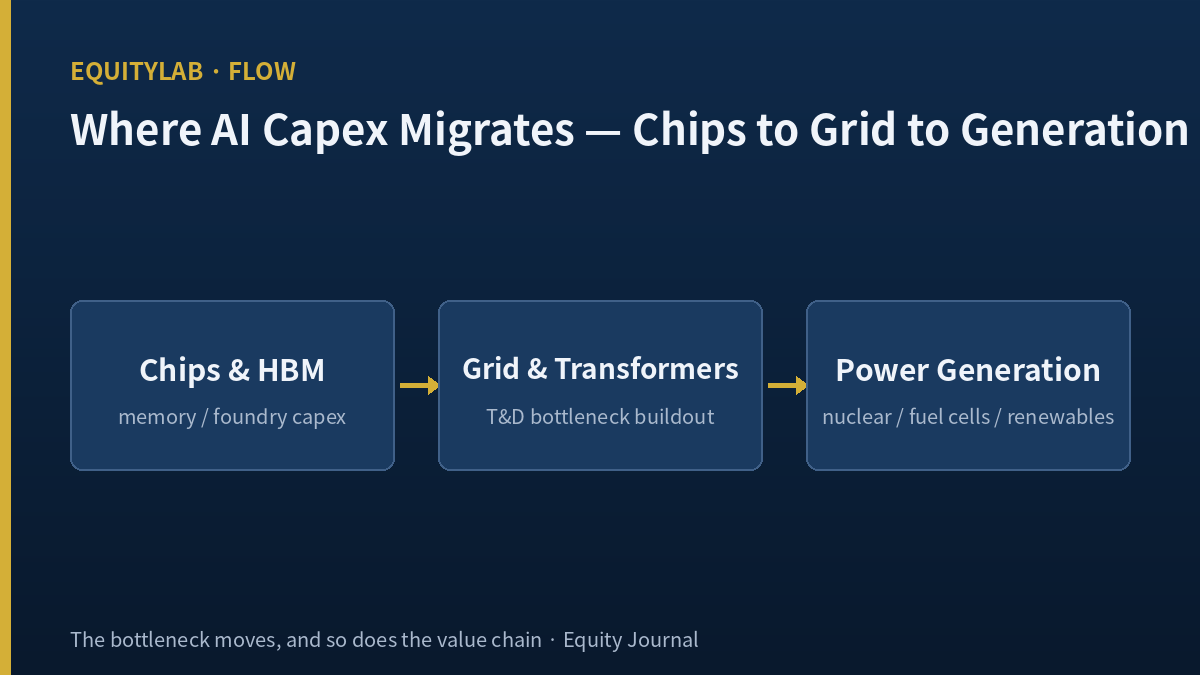
Here is the core of my bet. I don’t think of Korea as a country that *uses* AI. I think of it as a country that *absorbs AI capex into manufacturing profit* — a supplier to the buildout rather than a consumer of it. I’ve put real money behind that framing.
Hyperscaler data-center spending is expanding largely independent of the consumer economy, and it doesn’t stop at GPUs and memory. The physical bottleneck keeps migrating — into the power grid, transformers, generation equipment, and energy storage. Korea is one of the few supply chains that holds memory chips, grid and power equipment, and nuclear and power-plant gear all at once. That is exactly why I hold power-equipment names alongside the chips, not just the chips.
This isn’t only my hunch. SK Group, the parent of SK Hynix, has laid out plans to build AI data centers across the country in phases — starting around 5 gigawatts and scaling toward 15 gigawatts — which is a direct tell that the buildout runs straight through electricity and grid capacity, not just silicon. When the demand for AI compute shows up as demand for power infrastructure, the supplier of that infrastructure gets paid. I positioned in that layer ahead of time, and nothing in this correction has damaged the earnings case for it.
I’ll own a mistake too. Back in early June when the index was tagging 8,800, I underestimated the size of the volatility this concentration could produce. I knew intellectually that a market this top-heavy comes down as fast as it goes up, but I didn’t hedge it in my position sizing. My accounts being down double digits is the price of that error, and I’m logging it as a lesson to carry into the next cycle rather than pretending I saw it coming.
There’s a peer comparison that sharpens the point. Through this same turbulence, Japan’s Nikkei held up better than the KOSPI, because Japan’s tech exposure is spread across a wider range of industries while Korea concentrates its risk in a handful of memory names. That contrast cuts both ways for me: it’s the reason the KOSPI absorbs chip shocks harder, but it’s also why the non-chip Korean supply chain — the power and grid layer I’m leaning into — can behave differently from the semiconductor headline once the crowded chip trade finishes unwinding. Most people react to a selloff like this by selling everything Korean. I think the unwind of the chip crowding can actually be the window where money rotates back toward the profitable names outside memory.
Two scenarios — when this KOSPI selloff is a dip, and when it isn’t
I’m not in the business of selling certainty. I’m in the business of publishing my own bet, so I write both branches.
If it’s a dip
If the semiconductor earnings cycle hasn’t rolled over — if DRAM and HBM conditions and the margin curves at Samsung and SK Hynix hold — then this is an overshoot manufactured by crowding. Once foreign selling calms within a few weeks and the leveraged-ETF unwind exhausts itself, the index re-tracks its earnings path. In that world, the shares I’ve been adding down here simply lowered my average cost. This is the scenario I weight more heavily, and it’s why I’m actually buying rather than just talking about it.
How I’m buying matters as much as whether. Not one big lot — small adds spread across several weeks, a little more on the days the index falls harder, with the weight tilted toward power-equipment over chips. My chip exposure is already large, and adding more there would just make my own book as hostage to two stocks as the index is. There are confirmations I’m watching for: a few sessions of foreigners flipping from net sellers to net buyers, and the retail-cash drawdown flattening out. Neither is in yet, so I’m in no rush — I only add in slices.
If it isn’t
If instead this is a cycle top, the story is different. If chip earnings guidance actually starts getting cut, if foreign outflows harden from a blip into a multi-week trend, and if forced selling keeps building, then the index grinds lower on the logic of flows rather than fundamentals. In that case the anchor of my “supplier” thesis — semiconductors — is the thing cracking, and I stop averaging down and shift toward trimming. The concentration is double-edged: with two names at roughly half the index, they lift the whole market single-handedly on the way up, but they drag the entire thing down with the same force the moment earnings expectations bend. That’s why this selloff is genuinely unsettling, and why I refuse to ignore this branch. Hope with no downside plan is just gambling.
My thesis-breaking conditions
So I draw the lines in advance. When the signals below start overlapping, I retire the “dip” read.
One is a clear downshift in the next-quarter results and guidance from Samsung and SK Hynix versus expectations. Another is foreign net selling on the KOSPI hardening into a multi-week trend rather than a single bad print. The last is retail cash draining and forced selling getting worse instead of stabilizing. There’s always one or two of these blinking at any given time, so I keep buying while they flicker separately. What scares me is the week all three light up together. When that shows up, I stop adding first, and only then does it become a question of how much to cut. My next checkpoint is Q2 earnings season.
What I’m doing right now
To sum it up: I read this KOSPI selloff as the unwind of a chip-concentration crowding, not the collapse of the index. My accounts hurt, but the case for my “AI-capex supplier” thesis hasn’t broken yet, so I chose to add in slices on the dip rather than sell. This is a record I keep mainly for myself, and it’s my judgment — not something I’d tell anyone else to copy. Plenty of people will look at the same screen and read it differently, and what they do with it is entirely their call.
I check the three breakpoints above every morning, right alongside the account balance. The day those lines give way, I’ll come back to this journal and write plainly that I changed my mind.
Related reading