Samchully Share Retirement Left EPS Exactly Where It Was
On March 31, 2026 the Samchully share retirement took 428,248 shares out of existence. That is 10.5607% of the 4,055,114 shares the company had issued up to that date, and the market value attached to the batch was about 56.5 billion won, or USD 41.6 million at the October 1, 2026 Seoul close of 1,358.4 won to the dollar. Reported earnings per share did not move by one won. I spent most of a morning working out why both of those statements are true at once, and the detour took me somewhere I did not expect: the five screens I read count this company’s shares five different ways.
So this piece does not grade the retirement. What I counted is the set of places where a number that includes the retirement sits next to a number that does not, inside one screen. For each place I decided whether the treatment makes the company look cheaper or less cheap than my own arithmetic says. I found fifteen such places and ten of them lean the same way. The screens write Samchully up as more expensive than it is. The headline price-to-earnings number of 4.63 times becomes 3.90 times when I use the reported earnings per share and the October 1 close.
Where I stand: watching. The Samchully share retirement moved no reported per-share figure, and I sorted the fifteen screen entries that look as if it did by the direction they push.
Ten entries that make the company look less cheap
Kiwoom earnings per share of 27,498 won divides by a count that still contains the 428,248 retired shares. The reported number is 32,566 won. / Kiwoom price-to-earnings of 4.63 times comes out of that figure. Using the shares that draw a dividend it is 3.90 times. / Kiwoom book value per share of 491,062 won uses owners’ equity as of December 31, 2025. As of June 30, 2026 it is 527,288 won. / Kiwoom price-to-book of 0.26 times comes out of that. With June-end equity it is 0.24 times. / Kiwoom shows 127,300 won as the current price. The October 1 regular-session close was 126,900 won. / Kiwoom market capitalization of 461.7 billion won and the dividend screen’s 471.9 billion won. At the October 1 close it is 460.2 billion won. / The dividend screen’s price-to-earnings of 4.73 times is frozen on the September 23 close. / Chickstock book value per share of 463,610 won divides by a count that includes treasury stock that draws no dividend, and it yields price-to-book of 0.28 times. / Kiwoom payout ratio of 10.9%. The reported payout ratio is 9.2%. / Kiwoom operating margin of 3.03% is the full-year 2025 number. Over the most recent four quarters it is 3.2232%.
Three entries that make the company look cheaper
Investing shows market capitalization of 445.1 billion won, computed on the 3,424,114 shares that draw a dividend. On the listed count it is 460.2 billion won. / Kiwoom net income of 131.3 billion won is the consolidated total. The owners’ portion is 111.5 billion won, and a price-to-earnings figure built on the consolidated line drops to 3.50 times. / Kiwoom shows seven consecutive years of dividend increases. The dividend per share has been fixed at 3,000 won since 2017 and no year raised it.
Two entries I could not point in either direction
TradingView prints 0 for price-to-earnings and gives a 52-week range of 524,000 won to 38,900 won. The low end is from 2003. / The dividend screen shows a current price of 0 won and a debt-to-equity ratio of 0.0%, Kiwoom shows an enterprise value entry of 1.62 and a raw payout ratio of 50.7%. I could not identify the numerator and the divisor behind any of these four, so all four stayed out of the body.
Contents
What the Samchully Share Retirement Actually Removed
Samchully is a Korean city gas distributor listed on the KOSPI, the senior board of the Korea Exchange, where the large established industrial and financial issuers trade. The junior board is the KOSDAQ. The company sells piped natural gas to households and businesses in the Seoul metropolitan area, runs district energy plants, and has been adding unrelated businesses: it bought 100% of the seaweed producer Sunggyung Food for 119.5 billion won, or USD 88.0 million, in February 2026.
The retirement went through two gates. The board resolved it on March 5, 2026, and the 60th annual general meeting confirmed it on March 20 at the company’s Yeouido head office. Execution was set for March 31. Korean press put the market value at about 56.5 billion won, using the closing price of the day before the board resolution. Dividing 56.5 billion won by 428,248 shares gives 131,933 won a share, or USD 97.12. The October 1 close of 126,900 won sits 3.8148% below that.
The percentage itself is written differently in different places. Money Today and Asiae both put it at 10.6% of issued shares. Smart Today used 10.5% in the headline and 10.6% in the body. My own division of 428,248 by 4,055,114 gives 10.5607%. Rounding up and truncating explain the gap, so neither printed figure is an error, but I use my own number in the body and note the published ones beside it.
Before the retirement the company held 631,000 treasury shares, 15.5606% of its issued stock. After removing 428,248, the remaining 202,752 shares are earmarked for employee compensation through 2031 according to the filing. Against the post-retirement listed count of 3,626,866 shares that is 5.5903%.
Do the three counts explain one another?
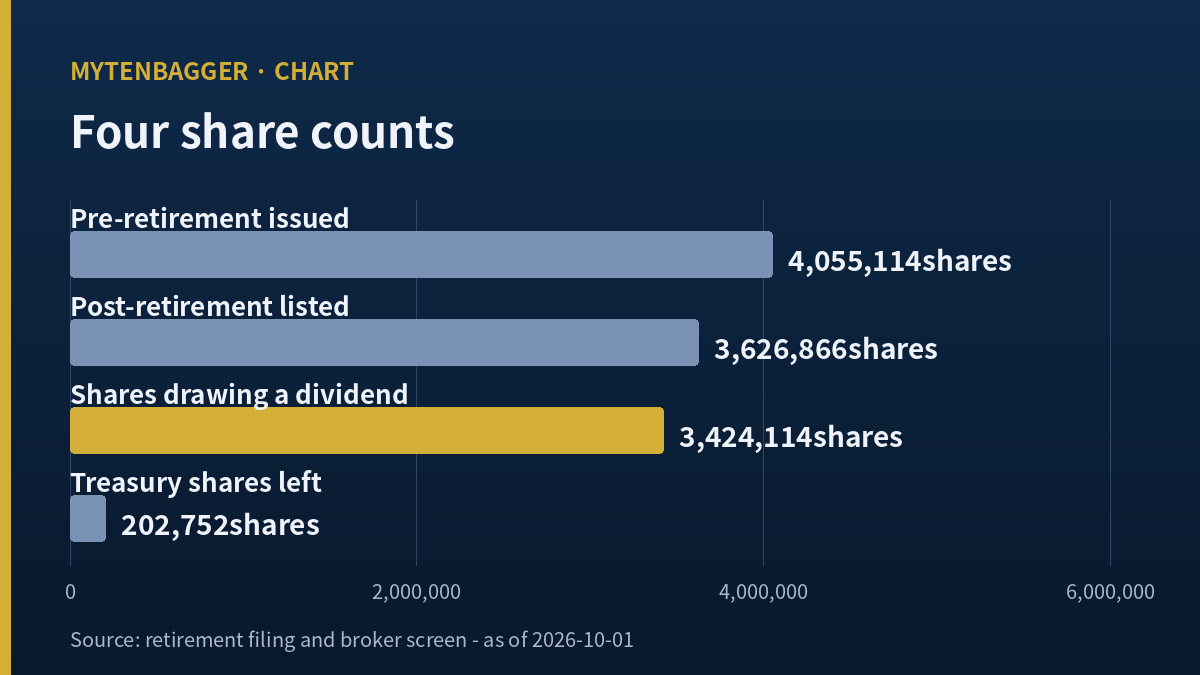
They do, and I checked each subtraction before using any of them. Take 4,055,114 and remove 428,248 and you get 3,626,866, which is the listed share count Kiwoom prints, exact to the share. Take 631,000 and remove 428,248 and you get 202,752, which is the remaining treasury holding in the filing. Take 4,055,114 and remove 631,000 and you get 3,424,114. The 2025 cash dividend of 10.272 billion won divided by 3,000 won a share gives 3,424,000 shares, a gap of 114 shares that comes from the dividend total being printed to the nearest million won. Multiply 3,424,114 by 3,000 won and you get 10,272,342,000 won, which rounds down to 10.272 billion.
| What it is | Shares | Where it comes from |
|---|---|---|
| Issued before retirement | 4,055,114 | Listed count after plus shares removed |
| Shares retired | 428,248 | March 20, 2026 shareholder resolution |
| Listed after retirement | 3,626,866 | Kiwoom screen, updated October 1, 2026 |
| Treasury stock remaining | 202,752 | Filing, held for employee awards to 2031 |
| Shares that draw a dividend | 3,424,114 | Listed count minus treasury stock |
Why the Samchully Share Retirement Could Not Move Reported Earnings per Share
This is the part a non-Korean reader may want spelled out, because the accounting is the whole answer. Treasury stock in Korea draws no dividend and carries no vote while the company holds it, and it is excluded from the weighted average share count that sits under reported earnings per share. Retiring treasury stock therefore reduces the issued count without touching the divisor. For Samchully that divisor was 3,424,114 shares before March 31 and 3,424,114 shares after it.
Equity behaves the same way. Treasury stock is a deduction inside the equity section, and retiring it removes that deduction while cutting paid-in capital or retained earnings by the same amount. Both sides move together, so total equity does not change. Samchully’s paid-in capital fell from 20.276 billion won to 18.134 billion won, a drop of 2.141 billion won or USD 1.58 million, and that amount came out of another equity line. The divisor under book value per share also stayed at 3,424,114 shares.
Put together: this retirement changed neither reported earnings per share nor reported book value per share. The company said it decided on the retirement to lift per-share value and improve shareholder returns. Hana Securities wrote that the stock would likely be re-rated if the dividend moved to a consolidated footing or if a dividend-per-share policy were set out. I am not arguing with either statement. I am saying that the changes I can verify with numbers are three: the listed share count, paid-in capital, and the ratio of treasury stock to issued shares.
What does a finished retirement look like on the exchange?
Shares bought for retirement do not always get retired, which is worth checking separately. I ran into the opposite case earlier this year when Hyundai Department Store had bought 232,460 shares for retirement that were still sitting inside the company when the dividend was declared. Samchully took 26 days from resolution to execution, and the listed count came down from 4,055,114 to 3,626,866 in fact and not only in intent. By that test this one is finished. The screens, though, only took half of it in.
What the Samchully Share Retirement Does to Earnings per Share
Owners’ net income for 2025 was 111.505 billion won, or USD 82.1 million. One profit number, several divisors, several answers. Divide by the pre-retirement issued count of 4,055,114 and you get 27,497.6 won. Divide by the post-retirement listed count of 3,626,866 and you get 30,744.4 won. Divide by the 3,424,114 shares that draw a dividend and you get 32,564.9 won. The reported earnings per share is 32,566 won, one won away from mine, and the weighted average treatment accounts for that.
The 27,498 won Kiwoom prints is effectively the first of those. Multiply 27,498 won by 4,055,114 shares and you get 111.5075 billion won, which is 0.0023% away from the reported owners’ net income of 111.505 billion. In other words Kiwoom still has the 428,248 shares that disappeared in March 2026 inside its divisor. The paid-in capital entry on the same screen, 20.3 billion won, is also 4,055,114 shares at a par value of 5,000 won, which comes to 20.276 billion. And yet the market capitalization on that same screen uses the post-retirement count of 3,626,866 shares.
Outside screens produce their own numbers. Investing prints 39,153.51 won and TradingView prints 39,200 won, and both sit where the most recent four quarters of owners’ net income, 134.062 billion won, divided by 3,424,114 shares lands: 39,152.32 won. Chickstock prints 33,391 won, and I could not find the pair of inputs that produces it, so Chickstock earnings per share stayed out of my judgment entirely.
I have taken a single screen number apart in this lane before. In Korea Gas Corporation’s case the gap was between earnings and cash, with a 14.2 trillion won receivable growing alongside reported profit. Here the gap is between earnings and the share count underneath them.
| Source | Earnings per share | Book value per share | Divisor used |
|---|---|---|---|
| Kiwoom screen | 27,498 won | 491,062 won | 4,055,114 for earnings, 3,424,114 for equity |
| Chickstock screen | 33,391 won | 463,610 won | Unidentified for earnings, 3,626,866 for equity |
| Reported in filings | 32,566 won | 491,049 won | 3,424,114 both, equity at December 31, 2025 |
| Investing screen | 39,153 won | Not shown | Four most recent quarters over 3,424,114 |
| My own arithmetic | 32,565 won | 527,288 won | 3,424,114 both, equity at June 30, 2026 |
Which equity date sits under book value per share?
Kiwoom’s 491,062 won is December 31, 2025 owners’ equity of 1,681.408 billion won over 3,424,114 shares, which gives 491,049 won. Chickstock’s 463,610 won is the same equity over 3,626,866 shares, which gives 463,598 won. Two screens using one equity figure and two different divisors, and the Chickstock version puts the 202,752 treasury shares that draw no dividend inside its count.
Both are also six months behind. Owners’ equity at June 30, 2026 was 1,805.494 billion won, USD 1.33 billion, and over 3,424,114 shares that is 527,288 won a share, or USD 388.17. The October 1 close of 126,900 won against that gives price-to-book of 0.2407 times. The distance to the Kiwoom entry is 7.70%, running from 0.2407 times up to 0.2592 times. Total equity at the same date was 2,015.871 billion won, and owners’ equity of 1,805.494 billion plus non-controlling interests of 210.377 billion closes on it exactly.
The Samchully Share Retirement Leaves Three Price-to-Earnings Numbers at One Close
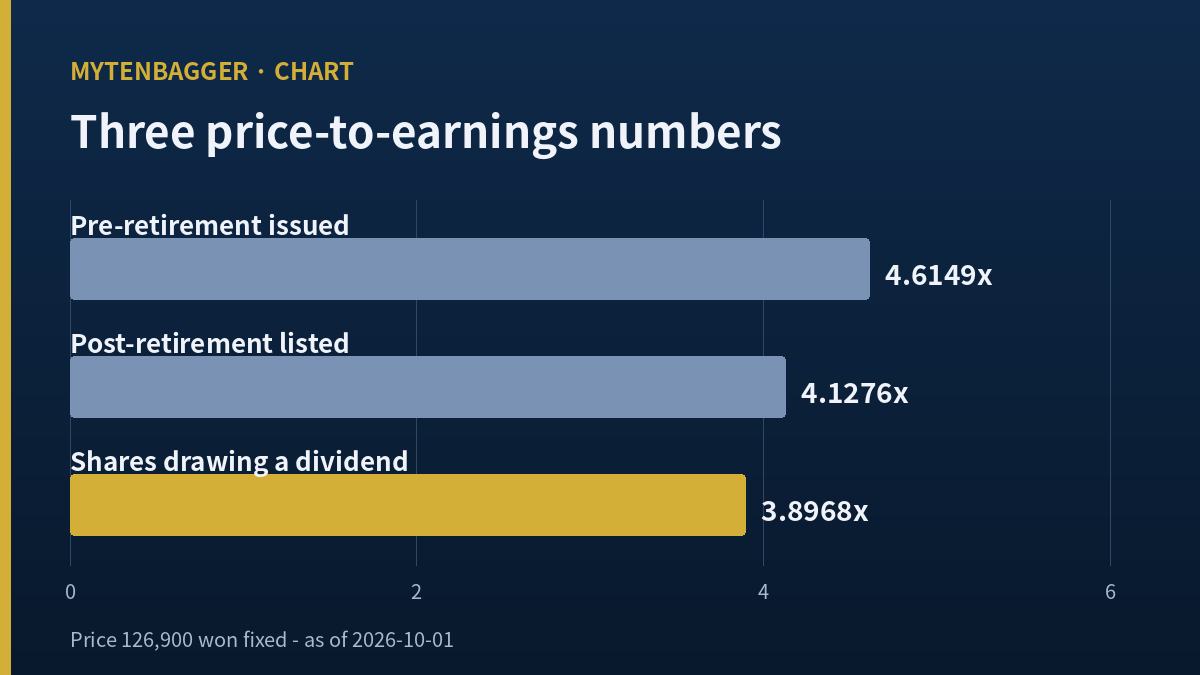
I held the October 1 regular-session close of 126,900 won fixed and changed only the divisor. On the pre-retirement issued count the figure is 4.6149 times. On the post-retirement listed count it is 4.1276 times. On the shares that draw a dividend it is 3.8968 times. Kiwoom’s 4.63 times sits with the first of those, since 127,300 won over 27,498 won is 4.6294 times. Beside the third sit Chickstock at 3.92 times, Investing at 3.33 times, and the Naver figure of 3.83 times that Kiwoom carries as a cross-check entry. The distance between the two is 18.43%, running from 3.8968 times up to the 4.6294 times Kiwoom shows.
Market capitalization scatters the same way. Kiwoom multiplies 127,300 won by 3,626,866 shares for 461.7 billion won. The dividend screen on the same server uses the September 23 close of 130,100 won for 471.9 billion won. Chickstock uses the September 29 close of 131,000 won for 475.1 billion won. Investing multiplies 130,000 won by 3,424,114 shares for 445.1 billion won. My own figure, the October 1 close on the listed count, is 460.249 billion won, or USD 338.8 million. TradingView’s 425.61 billion won divided by 126,900 won implies 3,353,901 shares, which is none of this company’s counts, so I dropped it.
Even the closing price differs by host. My daily series puts the October 1 regular-session close at 126,900 won with an open of 127,800, a high of 129,100, a low of 125,300 and volume of 4,836 shares. Kiwoom’s 127,300 won falls inside that range without being the open, the high, the low or the close; the screen timestamp is 16:54 on October 1, after the session ended, and I could not identify which venue or which trade it came from. Hankyung carries a September 30 intraday screen on a 20-minute delay at 128,900 won. Chickstock has September 29 at 131,000 won, Investing has 130,000 won and TradingView has 129,400 won, and the last two give no date at all.
The Hankyung screen holds right numbers and wrong ones side by side. Its high of 131,200 won and low of 128,100 won agree with my September 30 bar to the won, and the 2,100 won decline it shows implies a prior close of 131,000 won, which agrees with my September 29 close. Then it gives volume as 4,113 thousand shares. The turnover on the same screen, 531 million won, divided by 128,900 won comes to about 4,120 shares. The unit is shares, not thousands of shares. I met the same unit entry at the same vendor on my previous piece, so this is the second instance.
Counting a single quarter on its own is something I have done in this lane too. For KEPCO KPS the oddity was seventeen straight profitable quarters with four of them showing negative operating cash, which is a different kind of gap: there both numbers were right and the question was which one to build a multiple on. And when SK Gas showed an interest coverage ratio of 0.35 built on a finance-cost line that mixed interest with derivative and currency losses, the problem was what the numerator contained. Here it is what the divisor contains.
Which entries held up when I recomputed them?
Several did, and they are worth naming because they are the control group for everything above. Return on equity of 6.8% is 2025 owners’ net income of 111.505 billion won over the average of 2024 and 2025 owners’ equity, 1,630.443 billion won, which gives 6.8389%. Interest coverage of 6.5 times is first-half 2026 cumulative operating profit of 138.218 billion won over interest expense of 21.262 billion won, USD 15.7 million, for 6.5007 times. The debt-to-equity ratio of 119.64% is June 30, 2026 total liabilities of 2,411.802 billion won over total equity of 2,015.871 billion won. The three-year revenue change of negative 3.05% a year runs from 5,789.104 billion won in 2022 to 5,275.461 billion won in 2025.
The 250-session high of 161,900 won and low of 107,600 won agree to the won with the 52-week high and low Hankyung prints and the 52-week range Investing prints. Among the entries I read, this is the one place three hosts wrote the same number. The October 1 close of 126,900 won sits at 78.3817% of the 161,900 won high and 17.9368% above the 107,600 won low.
April Through June Operating Profit Fell 3.98 Percent
Set the retirement aside and look at what the business earned, quarter by discrete quarter. Operating margin was 2.6567% from April through June 2025, 2.4897% from July through September, 0.7425% from October through December, 6.0874% from January through March 2026, and 2.4250% from April through June 2026. This is a city gas distributor, so the heating quarter carries the year: 79.6951% of the 138.218 billion won of first-half 2026 operating profit came from January through March.
Revenue from April through June 2026 was 1,157.299 billion won, USD 852.0 million, up 5.1902% from 1,100.197 billion won a year earlier. Operating profit over the same months was 28.065 billion won, USD 20.7 million, down 3.9823% from 29.229 billion won. Revenue up and profit down, so the discrete operating margin slid from 2.6567% to 2.4250%. On a cumulative first-half footing the picture improves: revenue of 2,966.814 billion won is 1.8025% higher, operating profit of 138.218 billion won is 9.5977% higher, and owners’ net income of 124.863 billion won, USD 91.9 million, is 22.0486% higher. The running total got better while the second quarter on its own got worse.
| Period | Revenue | Operating profit | Margin |
|---|---|---|---|
| April to June 2025 | 1,100,197 | 29,229 | 2.6567% |
| July to September 2025 | 914,848 | 22,777 | 2.4897% |
| October to December 2025 | 1,446,330 | 10,739 | 0.7425% |
| January to March 2026 | 1,809,515 | 110,153 | 6.0874% |
| April to June 2026 | 1,157,299 | 28,065 | 2.4250% |
Sunggyung Food was consolidated from the first quarter, according to Hana Securities. Yet revenue from January through March 2026 of 1,809.515 billion won is 0.2521% below the 1,840.86 billion won of a year earlier. An acquired company came in and the combined top line still shrank, and I could not split out how much of that came from lower gas volumes and how much from anything else.
What does the one published estimate assume about the second half?
I found exactly one named 2026 estimate. Hana Securities analyst Yoo Jae-sun put a buy opinion and a 160,000 won valuation on the stock on June 11, 2026, with 2026 revenue of 5.9 trillion won, USD 4.34 billion, and operating profit of 178.8 billion won, USD 131.6 million. Against 2025 that is revenue rising 11.8386%, from 5,275.461 billion won to 5.9 trillion won, and operating profit rising 12.0090%, from 159.63 billion won to 178.8 billion won. His 0.3 times target multiple on book value was set by taking the 0.36 times twelve-month trailing average of five Korean city gas companies and discounting it 15%. This is a June view and I do not read it as a current one.
I subtracted to see what that estimate needs from the second half. Revenue of 5.9 trillion won minus the first-half 2,966.814 billion won leaves 2,933.186 billion won, USD 2.16 billion, to come. Second-half 2025 revenue was 2,361.178 billion won, USD 1.74 billion, which is full-year 5,275.461 billion minus first-half 2,914.283 billion. So the second half has to be 24.2255% larger. The first half grew 1.8025%. On operating profit the distance is shorter: 178.8 billion minus 138.218 billion leaves 40.582 billion won against 33.516 billion won a year earlier, which is 21.0825%.
Having one named 2026 estimate is a coverage gap and I am stating it as one. I widened the date window to twelve months, moved from the financial dailies out to wire services and trade press, and tried the company name, the ticker and the principal business line on their own. No second named estimate came back. So this piece carries one estimate and opens up its second-half arithmetic, and stops there.
A Peer That Bought the Same Proportion as the Samchully Share Retirement and Kept It
To get a sense of the size of this retirement I went outside Korea for one comparison. Tokyo Gas, listed in Tokyo, filed on March 25, 2025 to buy back 35,000,000 of its own shares, a quantity the filing puts at 9.36% of issued stock, for up to 120 billion yen, with the authority running to September 30, 2025. As of the filing the company had 388,893,859 shares issued and held 15,025,167 in treasury. Nothing in that document sets out a retirement.
I am comparing two things only. The first is the treasury holding: 3.8636% at Tokyo Gas, 15.5606% at Samchully just before execution. The second is that both companies dealt with a similar proportion of their stock, and one stopped at buying while the other went through to retirement. I am not comparing multiples, scale or margins. The two businesses have different mixes and different tariff mechanics, and that comparison is beyond what my inputs can carry.
One more thing fell out of the comparison. Tokyo Gas’s 9.36% is 35,000,000 shares over 373,868,692, which is issued stock less the 15,025,167 held in treasury, and that division gives 9.3616%. Samchully’s published 10.6% is 428,248 shares over 4,055,114, a count that still contains treasury stock. Apply the Tokyo Gas method to Samchully and you get 428,248 over 3,424,114, which is 12.5068%. The same phrase points at different share counts in the two filings, which means the thing this piece counted inside one company also holds across a border.
Figures I Set Aside in the Samchully Share Retirement Count, and Five Objections
First, what I did not use. Kiwoom’s enterprise value entry of 1.62 is a ratio of some amount I could not identify. The raw payout ratio of 50.7% implies profit of roughly 20.26 billion won behind a 10.272 billion won dividend, which matches neither the consolidated 131.326 billion nor the owners’ 111.505 billion nor the parent-only 54.075 billion. The dividend screen’s current price of 0 won and debt-to-equity ratio of 0.0% went out as well. So did Chickstock’s earnings per share of 33,391 won, TradingView’s price-to-earnings of 0 and its 52-week range of 524,000 won to 38,900 won. The free float count of 3,627,000 shares is 134 shares above the listed count, so I kept it out of anything about ownership. I also dropped every change-rate and moving-average series, because the venue tag on the daily series I received mixes krx with unknown and the two are not comparable.
Now the objections. Five of them, and for each one I write why I am not attaching a probability. A probability would read as evidence, and the inputs I hold cannot produce one.
One. That the screens write the company up as expensive does not make the company cheap. Price-to-earnings of 3.90 times and price-to-book of 0.24 times may already carry the fact that retail gas distribution is a regulated margin business with an operating margin near 3%. I attach no probability because what I know about how that regulated margin is set comes from press coverage and not from the regulatory documents. Two. The point that a retirement does not move per-share figures is correct in accounting terms, yet there may be a separate signaling effect in having permanently removed everything above the employee award tranche. I attach no probability because the company has no earlier retirement in my sample to measure such an effect against. Three. The second-quarter decline is one off-season quarter, and the annual operating profit has cleared 100 billion won for three consecutive years. I attach no probability because the July to September numbers are not out yet. Four. My statement that first-quarter revenue shrank with an acquisition inside it may mean gas volumes fell by more than the acquisition added, and I could not separate the two effects. That inability is itself the reason. Five. A July 2026 assessment questions whether unrelated diversification is consuming the core business’s cash: The Value News wrote that if the new businesses only burn cash, the stable core ends up carrying the cost of unrelated expansion. I attach no probability because I have not seen quarterly profit and loss for the food, automotive and restaurant segments.
What the Samchully Share Retirement Count Looks Like After November 16, 2026
My position is watching. Market capitalization of 460.2 billion won puts this company outside the KOSPI top 100, so I do not take a trading stance on it. What I do instead is narrow the list of things I will count at the next periodic filing. The statutory deadline for the Q3 2026 report is November 15, and the day I check is November 16.
First, whether the discrete July to September operating margin sits above 2.4897%, last year’s figure for the same months, which I use as the off-season comparison. Second, whether cumulative nine-month revenue is on the path the Hana estimate needs, since a second half that has to be 24.2255% larger shows its direction in the nine-month total alone. Third, whether the 202,752 treasury shares are still there. The filing says they are held for employee awards through 2031, so if the count is lower I will go read the disposal notice.
I sorted the fifteen entries in this piece in advance by what a single day can do to them. Four are recalculated automatically on November 16: the numerators under earnings per share and book value per share roll forward to nine months, the operating margin period changes, and the interest coverage window lengthens. The other eleven stay exactly as they are. If Kiwoom does not take the 428,248 retired shares out of its divisor, earnings per share stays small. If the two screens do not pull equity forward to June 30, book value per share stays on December 31, 2025. If Chickstock does not remove treasury stock, book value per share stays divided by the listed count. The side that can fix those eleven is the side that builds the screens, and the filing will not touch them. Four numbers land in my hands on November 16, and recomputing eleven entries with them is still my own work that day.
Sources
- Money Today, Samchully retires 10.6% of its treasury stock, March 20, 2026 (Korean press)
- Asiae, Samchully’s annual meeting approves a 56.5 billion won retirement, March 20, 2026 (Korean press)
- Smart Today, Samchully retires all treasury stock beyond the employee award tranche, March 5, 2026 (Korean press)
- Etoday, Hana Securities sees a record year for Samchully after the Sunggyung Food purchase, June 11, 2026 (Korean sell-side, as reported)
- The Value News, conglomerate study 74 on the Samchully group, July 29, 2026 (Korean press)
- Hankyung Markets, Samchully quote screen, September 30, 2026 intraday on a 20-minute delay
- Chickstock, Samchully price and financial screen, September 29, 2026 close
- Investing.com, Samchully quote screen, no date given
- TradingView, Samchully symbol page, no date given
- MarketScreener, Tokyo Gas equity buyback filing, March 25, 2026 entry for the March 2025 filing
- Financial figures come from the consolidated statements and dividend filings lodged with Korea’s Financial Supervisory Service, retrieved through a database. The 2025 annual report carries filing number 20260312000794 and the 2026 half-year report carries 20260813001184. Price and ratio entries are Kiwoom data as of 16:54 on October 1, 2026, and the daily bar is the KRX regular session close of 126,900 won on October 1, 2026.
- Steel and Metal News, USD/KRW 1,358.40 on October 1, 2026 at the 15:30 onshore Seoul close. Money Today and ChosunBiz printed the same number.