Samsung Stock Fell 9% on a $58B Record Quarter: Why I Bought
- Samsung stock dropped more than 9% into a record ₩89.4 trillion ($58.4B) quarter after a Meta-driven AI scare. I read that as narrative damage, not earnings damage.
- The record landed five days after the panic and cleared consensus. I’ve been buying the drop in tranches in the low-$190s (₩290,000s).
- If DRAM/NAND contract prices actually roll over, or Big Tech capex cuts show up in the numbers, I stop and rethink.
A month ago Samsung stock traded above ₩360,000 — roughly $235. It felt rich to me then, and I sat on my hands. Less than a month later it was in the ₩290,000s, about $190. On July 2 it lost 9.06% in a single session to ₩286,000, and the KOSPI — South Korea’s benchmark stock index — fell 7.89% that day. That move followed an overnight rout in the US, where Micron dropped 10.4% and SanDisk 10.5%. This was not a Samsung-specific beating — it was the whole memory complex.
The trigger was Meta. On July 1 it said it would sell spare AI compute as a cloud business, and the market read that as a sign Big Tech had over-built AI capacity. A memory demand peak-out fear latched on immediately. A Morgan Stanley note published the day before Samsung’s print had already warned that the chipmaker pullback was not over, pointing to expectations that large cloud operators would soon tighten capital spending, according to Reuters.
My arithmetic ran the other way. Selling spare compute also means the memory that runs that compute has already been bought. Sentiment cracked; the demand data did not. So I treated the drop as an opportunity and started adding. What follows is the record I’m leaving of why.
Contents
Why I’m buying the Samsung stock drop: three reasons
I split the sell-off into three questions. Here’s how each one landed for me.
First: the earnings rebutted the narrative in hard numbers
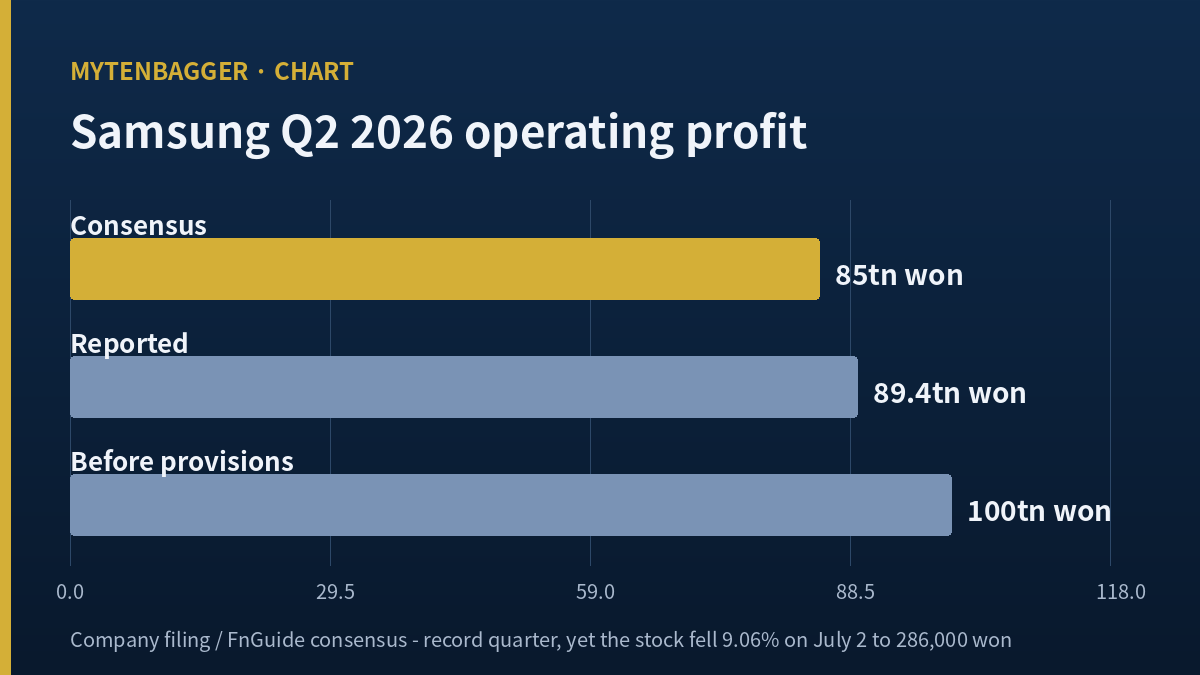
My biggest reason is the July 7 preliminary print itself. Samsung guided to Q2 revenue of ₩171 trillion (about $112B) and operating profit of ₩89.4 trillion — $58.4 billion. That is the largest single-quarter operating profit any technology company has ever reported, ahead of both Nvidia’s and Apple’s prior records for the period, and it was Samsung’s third consecutive record quarter. Operating profit rose roughly 1,810% year on year off a depressed ₩4.7 trillion base, and about 56% over the prior quarter.
It also cleared the bar. Operating profit beat the FnGuide analyst consensus of roughly ₩84 trillion by about 6% — a genuine beat, per TechTimes. What makes the timing matter is that this number arrived just five days after the “memory demand is peaking” fear swept the tape. The quarter everyone feared was a top turned out to be a record. The pricing underneath it was the engine: contract DRAM prices rose about 44% quarter on quarter and NAND about 53%, according to Citi Research. When the product is repricing that hard, “demand is rolling over” is a difficult story to tell.
The trajectory matters as much as the level. This ₩89.4T followed ₩57.2 trillion in Q1 2026 — itself a record at the time — so the sequence reads ₩57T then ₩89T, not a one-off spike. Under the hood, Samsung has been closing its HBM gap on SK Hynix: it cleared Nvidia’s qualification for 12-layer HBM3E in September 2025, ending a long run of thermal setbacks, and has since moved to unveil its next-generation HBM4. Access to the customer whose spending sets the sector’s pace is the difference between watching this cycle and being paid by it.
Second: the supply-demand structure hasn’t loosened
Most of the sell-side still reads this cycle as tight. Nomura pushed back on the peak-out call directly, arguing the second half could bring the largest supply-demand mismatch on record rather than a top. The macro backs it: South Korea’s June semiconductor exports jumped 199.5% year on year to $44.8 billion, and the country’s total monthly exports crossed $100 billion for the first time. Those are not numbers you print into fading demand.
The clearest confirmation is a US peer. Micron has said its high-bandwidth memory is effectively sold out through 2026, backed by roughly $100 billion in binding multi-year AI-memory contracts. When the major memory makers are sold out ahead and locking in prices, a sudden demand air-pocket is hard to model. New memory lines don’t reach volume until 2028 on the sell-side’s own timeline, so this year’s and next year’s supply is physically capped while AI data-center demand keeps arriving.
What’s different this cycle is visibility. Those long-term agreements carry volume commitments and pricing floors — unusual for a business that has historically whipsawed on spot pricing. When memory makers can point to locked volumes and price floors stretching out multiple years, the “it’s just another cyclical top” reflex weakens. That’s the read I’m underwriting.
Third: what fell was flows, not fundamentals
Samsung had run up nearly 150% over the prior twelve months, so by the time the record landed a blockbuster was already in the price. On the July 2 drop, foreign investors were already nine sessions into a selling streak, and a sell-side sidecar — a brief automatic pause on program sell orders — triggered minutes after the open. That’s the signature of mechanical de-risking after a big run, not a fundamental break.
The reaction to the record itself made the point. Shares closed 6.9% lower on the print. “The stock had priced in a historic quarter for months… it acts more like confirmation, and confirmation is what people sell into,” eToro analyst Zavier Wong told CNBC. It didn’t help that rival SK Hynix launched a US share offering the same week, with the stock due to begin trading Friday — analysts noted the timing pulled capital that might otherwise have gone to Samsung. SK Hynix itself closed about 6% lower the same day, which tells me this was memory-wide de-risking rather than a Samsung verdict. There was also a housekeeping overhang: Samsung recently committed roughly ₩400 trillion to a new chip hub in southwestern Korea, and some investors read that spending as a drag on the headline. Honestly, I’m not fully at ease adding here. But the evidence points this way, so this is where I stand.
Samsung stock vs the $58B quarter — the gap in numbers
Here’s the picture I keep in front of me. Every figure carries its source and as-of date.
| Metric | Value (USD / KRW) | Source · basis |
|---|---|---|
| Q2 operating profit | $58.4B / ₩89.4T (+1,810% YoY) | Samsung preliminary guidance (Jul 7) |
| Q2 revenue | ~$112B / ₩171T | Samsung preliminary guidance (Jul 7) |
| Consensus operating profit | ~$55B / ₩84T | FnGuide consensus (via TechTimes) |
| Underlying OP (ex-bonus, est.) | ~$69B / ₩106T | Est. excl. ~₩17T provision (Seoul Economic Daily) |
| Close, Jul 7 | ~$193 / ₩296,000 | Korea Exchange (Jul 7) |
| 52-week high (Jun 18 close) | ~$237 / ₩362,500 | Korea Exchange |
| 12-month avg. price target | ~$307 / ₩470,290 | Investing.com (36 analysts, 36 buy / 0 sell) |
Sources: Samsung preliminary guidance, Korea Exchange, FnGuide, Investing.com | As of: July 7, 2026 | Won figures converted at ≈₩1,530/$, the rate implied by Samsung’s own $58.4B disclosure.
Two rows hold my attention. The first is that $58.4B and ~$193 printed in the same week: a stock that was near $237 on June 18 sits around $190 the week its most profitable quarter ever is confirmed. The second is the target column — 36 analysts rating it buy, none selling, an average target near $307. I don’t adopt brokerage targets as my own. But the fact that the consensus target sits well above the current price is market information worth recording.
One more thing I sat with. Samsung’s 52-week range runs from about $39 to $245 (₩60,200 to ₩374,500) — a sixfold spread low-to-high in a single year. That’s the fingerprint of a business rerated from the bottom of the memory cycle into a supercycle. The analyst band shows the same rerating in motion: the average target near $307, with individual reads as low as ₩210,000 ($137, Eugene, back in January) and as high as ₩670,000 ($438, Nomura). The spread is wide — that’s real uncertainty — but the whole band has been marching up through the first half. I’m not treating any of those as my target; I’m noting where the market’s eye level has moved.
I’ll flag the one genuine blemish, because a journal that only lists positives isn’t worth keeping. Revenue of ₩171 trillion actually came in below the roughly ₩173 trillion consensus — the beat was on profit and margin, not the top line. That’s part of why a record print still couldn’t lift the stock: the mix confirmed the bull case on memory pricing but handed momentum buyers no fresh top-line surprise to chase at an elevated price.
The most profitable quarter in tech history and a stock roughly 18% off its high are on the same screen. I’m betting on the physical side of that gap.
What the market is under-weighting: the ₩106T behind the ₩89T
Most coverage ran one headline: “record ₩89 trillion profit, stock falls anyway.” But the ₩89.4 trillion number itself hides a detail the market under-weighted.
To me that’s the real size of the quarter. Samsung pulled future labor cost forward and still printed $58B. The market saw “why is a $58B quarter down?” and largely skipped that the $58B is a $69B result with a bonus charge pressed on top of it. Sitting with a spreadsheet of quarterly operating profit and re-running that provision line, I read this not as a peak signal but as an earnings level that just stepped up a tier. Meritz Securities, which had called the quarter above consensus, likewise put the chip division’s pre-provision profitability well above the ₩100 trillion mark — a level that would have been unthinkable a year ago, when memory was a drag rather than the engine.
I’m not stretching that into “₩106T times four equals ₩400T a year” — bonus charges don’t repeat every quarter and there’s seasonality, so I don’t push it that far. But the underlying power of this quarter is bigger than the surface number, and while the market digested ₩89T as already-known good news, I chose to count the profit it papered over too.
The peer read. This is where the US comparison sharpens it, because Samsung isn’t the only memory maker the market is pricing for a top. Micron — the closest US-listed memory pure-play, which fell in the same July 1 rout — is up about 241% in 2026, has joined the trillion-dollar club, and sits on roughly $100 billion of binding multi-year AI-memory contracts with its HBM effectively sold out through 2026, yet trades at only about 6.5x forward earnings (GuruFocus, as of July 6). Kiwoom’s Han Ji-young pegged Korean large-cap chip names at a forward P/E in the low-7x range after the drop. So both the US and the Korean memory leader sit at a mid-single-digit-to-7x forward multiple while earnings set records. That’s the market applying a cyclical peak-out multiple to two companies at once. If the cycle is really mid-stream rather than topping, that’s the mispricing I’m leaning into — and unlike Micron, a memory near-pure-play, Samsung also carries foundry and mobile optionality that isn’t in the price at 7x.
Samsung stock: the three paths I see
A journal that only records conviction isn’t a journal. Here’s where I could be wrong, with my own rough probabilities.
The path I weight most (~55%)
Supply stays behind demand into at least 2027, and this drop turns out to be a sentiment reset of an overheated June rally. With new memory lines not reaching volume until 2028, this year’s and next year’s supply is capped while AI data-center demand keeps building. In that world, the SK Hynix US listing on July 10, Samsung’s full divisional report on July 30, and SK Hynix’s Q2 on July 29 re-confirm the earnings, and the stock works back toward its June high near $237. It’s the path the data supports most heavily — the record-earnings trend since Q4 2025 plus a physical supply cap doing the work together. For a US-based holder, the cleanest read-through is the memory group as a whole: Micron, SK Hynix, and Samsung tend to move on the same demand signal, so a confirmation from any one of them usually lifts the others.
Where I’m wrong (~30%)
This isn’t a stretch. The Meta-born “over-investment” worry becomes real Big Tech capex cuts, and DRAM/NAND contract prices turn from today’s mild wobble into a clear downtrend. Lee Kyoung-min of Daishin flagged that a small month-on-month dip in June DRAM and SSD export prices is already feeding peak-out worries. If that becomes a trend, the spine of my thesis bends. Concretely, I watch whether Micron’s or SK Hynix’s next calls mention customer inventory adjustments or order push-outs, and whether Big Tech’s second-half capex guidance turns from raise to hold-or-cut. If those stack up, it’s the physical side cooling, not sentiment — and then I’m wrong. Morgan Stanley flagged exactly this the day before the print, warning the chip pullback wasn’t over as large cloud operators move to tighten capital spending. If that call proves right and the hyperscalers guide capex flat-to-down into year-end, the memory bid that drove this entire rerating thins out — and a 7x forward multiple stops looking cheap and starts looking merely fair.
Everything else (~15%)
To the upside, the second-half mismatch widens toward Nomura’s record-gap scenario and memory pricing power runs hotter than expected. To the downside, an Apple price hike or a delay to OpenAI’s listing timeline stacks onto AI-investment nerves and freezes sentiment for another leg down. I put low odds on both.
Where my thesis breaks
I don’t draw a stop-loss on price. Instead I write down, in advance, the conditions under which this earnings story falls apart.
The first signal is pricing. If DRAM and NAND export prices move past today’s mild dip into two or three straight months of clear decline, that’s physical evidence the shortage is starting to clear. The second is capex. If Big Tech’s AI build-out spending actually shrinks versus plan — visible in results and guidance — the floor under memory demand thins. These two answer in different places: pricing shows up first in the monthly export statistics, capex in quarterly results and calls.
So I read the export prints first and Big Tech capex second. If the faster-moving pricing signal starts to wobble, I stop adding rather than press. If a capex cut then stacks on top of it, I rewrite the thesis outright. The earliest checkpoints are SK Hynix’s late-July results and Samsung’s own July 30 call.
Samsung stock: where I’ve landed
So here’s the record. I didn’t reach for Samsung at the June high, but I’ve been adding in tranches in the low-$190s (₩290,000s) since the Meta-driven drop. The case is the record ₩89T ($58B) print, the ~₩106T ($69B) underlying profit once the bonus charge is stripped out, and a supply shortage I expect to run into 2027 — against a stock the market prices at a peak-out multiple, right alongside Micron. If export prices roll over in a trend, or Big Tech spending actually contracts, I stop or step back. I’m sizing this in tranches rather than a single lot precisely because the 30% path is live and the checkpoints are close.
The checkpoints are clear: the SK Hynix US listing on July 10, Samsung’s full Q2 report and call on July 30, and SK Hynix’s Q2 on July 29. Those three tell me whether my read holds or breaks over the summer. That’s how I see it. How would you read the gap?
Primary and secondary sources I checked for this journal: Samsung’s Q2 2026 preliminary earnings guidance (Samsung Global Newsroom), CNBC on the 1,800% profit jump and AI-spending fears, Yahoo Finance on the record quarter and 7% drop, TechTimes on the ₩106T underlying figure, The Next Web on Citi’s DRAM/NAND pricing, The Motley Fool on Micron’s run, and GuruFocus on Micron’s forward P/E.
The holder's-view update on the same quarter lives here: Samsung's Record $58B Profit and a 9% Crash: Why I Held — that post is why I hold; this one is why I bought more.
Related reading