SK Hynix Nasdaq ADR: Why I’m Holding Into the Re-Rating
- I hold SK Hynix (000660.KS), and the July 10 Nasdaq ADR debut under ticker SKHY is the single event I’m most bullish on for this name.
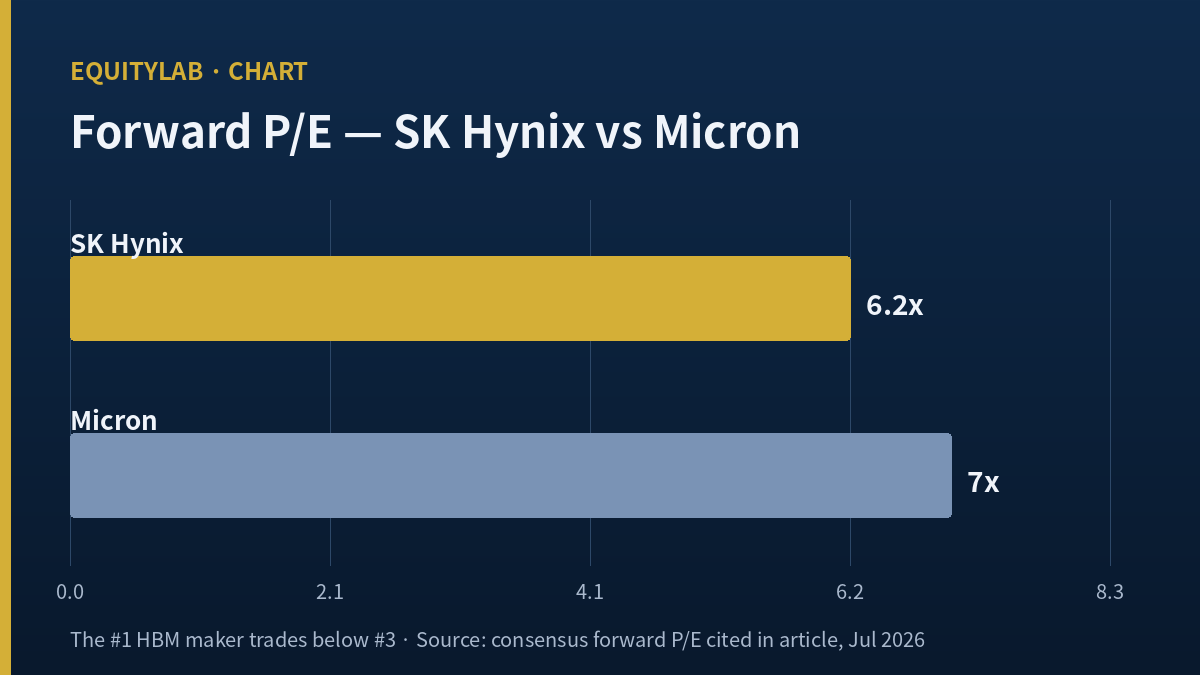
- This isn’t a hunch. The world’s #1 HBM maker trades at a forward P/E of about 6.2x versus Micron’s 7x, roughly $1.5B in fresh ETF demand is expected, and for the first time US money can price it against Micron on the same exchange. I think that gap closes.
- If the ADR opens at a discount or the July 29 earnings margin disappoints, I recompute the re-rating thesis. Those are my breakpoints.
If you landed here by searching SK Hynix this week, you probably saw the drop first — the stock fell around 25% over a few sessions as AI sentiment cooled. I saw it too, and then I closed that tab and kept a different one open: July 10, the SK Hynix Nasdaq ADR debut. While the market stares at the red, the card I’m actually watching on this name is the listing. This entry is why I’m leaning into an event most people are looking straight past.
Contents
Why the SK Hynix Nasdaq ADR is a re-rating event — the Micron yardstick
My whole case reduces to one line: until now, American investors basically couldn’t own this stock. As Fortune put it, betting on SK Hynix has been difficult if not impossible for most US investors — owning the Korea-listed shares means off-hours trading, and the alternative was thinly traded, unsponsored over-the-counter ADRs. Micron, meanwhile, sits on the S&P 500 as this year’s second-best performer. Same memory supercycle, two completely different pools of capital pricing it.
That gap is quantified. Per Bloomberg data cited by Fortune, SK Hynix trades at about 6.2x forward earnings; Micron is around 7x after its 14% tumble last week, and was above 11x as recently as June 22. The Seoul Economic Daily ran the same comparison on the July 6 close and got 7.42x for SK Hynix against 9.44x for Micron — a wide gap either way. The takeaway is identical: there is no fundamental reason the #1 memory maker should trade below the #3. I read that inversion as a pure artifact of the “Korea discount” — the access friction of a Korea-only listing — and the ADR is the tool that removes it.
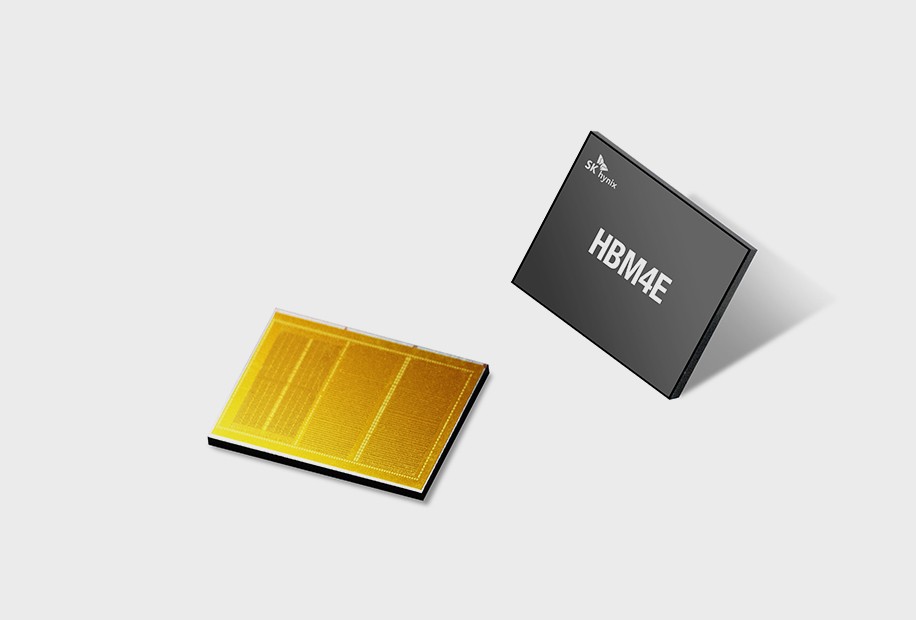
Why lean on “number one”? Because HBM is the heart of this cycle. It’s the fast memory stacked next to an AI accelerator, and without it Nvidia’s GPUs starve. CNBC quoted Counterpoint’s MS Hwang saying SK Hynix holds about 60% of the HBM market, and — in his words — it has the best product at the lowest cost, so its operating margin is the best; what else do you need. Micron is closing the gap, but “first mover and share leader” is a position that should command a premium, not sit at a discount to the third player. I don’t think that inversion survives contact with a US listing.
Then the mechanical demand stacks on top. Wall Street bulls, per Fortune, point to the deeper capital pool, regular-hours trading, and eventual Nasdaq-100 addition as reasons to be optimistic. The Invesco QQQ Trust alone, which tracks the Nasdaq-100, runs about $482 billion in assets — and index inclusion forces the passive funds tracking it to buy mechanically. Korean brokerage estimates put fresh ETF demand around $1.5 billion. That’s why I keep saying I’m bullish on data, not on a feeling.
Here’s a second-order point most people miss, and it makes me more confident, not less: the listing may lift Micron too. An Investing.com analysis argued that once the “Korea discount” is erased, the valuation ceiling for the whole memory group shifts up — two industry leaders trading on the same exchange makes comparative analysis easier and drags the entire peer set higher. I don’t own this as a Micron call, but it tells me the re-rating logic isn’t wishful: a US analyst with a Micron book is independently arguing the same mechanism I’m betting on. When the bear-case peer and I agree on the direction, I take the read more seriously, not less.
The #1 memory maker trades below the #3. If that inversion is just the “Korea discount,” then the ADR that erases it is the catalyst. That’s my one-line thesis for holding into this listing.
SK Hynix Nasdaq ADR: the scale and the earnings behind the bet
The listing itself is historic. SK Hynix expects to begin trading July 10 on the Nasdaq Global Select Market under the ticker SKHY, raising roughly $28-29 billion by issuing 17.79 million new shares, with 10 ADRs representing one Korean common share. Per TradingKey, that would be the largest-ever IPO by a foreign company on a US exchange, topping Alibaba and Saudi Aramco, and the second-largest share sale globally behind only SpaceX’s June 2026 record. Cornerstone interest runs deep — Baillie Gifford, Coatue Management, and Situational Awareness Partners signaled interest in up to $7 billion of ADRs, about a quarter of the deal. Per BigGo Finance, the proceeds go entirely into domestic capacity: ₩31 trillion to the first Yongin cluster fab, ₩19 trillion to the Cheongju P&T7 advanced-packaging fab, and ₩12 trillion to EUV lithography. As Crypto Briefing noted, this is actually SK Hynix’s second, more ambitious attempt at tapping US capital markets — a detail I read as a company that has wanted this re-rating for a while, not one improvising a listing into a hot tape.
| Item | Figure | Source / note |
|---|---|---|
| ADR debut | July 10, “SKHY” | Nasdaq Global Select; 10 ADR = 1 share |
| Raise | ~$28-29B | largest-ever foreign IPO in US |
| Forward P/E (SK Hynix) | ~6.2x | Micron ~7x (Bloomberg, via Fortune) |
| HBM market share | ~60% | Counterpoint, via CNBC |
| 2026E net income | ~$144B (₩221T) | +415% YoY; Q2 report July 29 |
Source: Fortune, CNBC, Seoul Economic Daily, TradingKey | As of: July 2026
The earnings underneath are what make the bet more than a listing trade. Per Fortune, the market projects SK Hynix to deliver ₩221 trillion (~$144 billion) in 2026 net income on ₩355 trillion (~$231 billion) in sales — up 415% and 265% from 2025. It reports Q2 on July 29, just three weeks after the debut. Korean sell-side consensus runs near ₩64.8 trillion in Q2 operating profit at a roughly 76% operating margin — a manufacturing margin that reads like a typo until you remember Q1 already printed 72%. AI server memory, HBM above all, is what builds that structure. I see that margin as the real fuel for the re-rating: when a US investor sets SK Hynix next to Micron and sees “cheaper and more profitable,” the gap has to compress on logic alone.
The sell-side hasn’t blinked through the drop either. Per TradingKey, UBS keeps a Buy with a ₩3.2 million target, flagging HBM4 and potential buybacks; Korean houses like KB peg 2026 operating profit near ₩280 trillion. Those are their numbers, not my target — I don’t set price targets in a journal. But sell-side estimates holding firm through a 25% sell-off tells me this correction is about sentiment, not a break in the fundamentals.
SK Hynix Nasdaq ADR — the three paths I’m weighing
My base case: a premium forms and pulls the home shares up (50%)
The ADR trades at a premium. There’s a template: per Bloomberg data via Fortune, Taiwan Semiconductor’s ADRs have averaged more than a 21% premium to the home shares over the past year and sit near 13% now. HSBC analysts, per a listing explainer, suggested SK Hynix’s ADR could be worth roughly 20% above its IPO price from day one — not because the ADR is cheap versus the Korean share, but because global institutional demand that was structurally suppressed by the Korea-only listing finally has a door. If a premium forms, arbitrage — sell the pricier ADR, buy the cheaper home share — feeds buying back into the Korean line, and the Micron-yardstick re-rating migrates to the home shares. Fortune notes this is the same playbook hedge funds ran on Alibaba’s issuance, so the mechanism isn’t theoretical. That’s the path I weight most.
Where I could be wrong: peak-out buries the re-rating (35%)
Honestly, this one nags at me. That 25% drop wasn’t nothing — AI-bubble fear and memory-price-correction worry are real and circulating. Memory fabs carry high fixed costs, so when prices rise, profits explode; when supply outruns demand, that same leverage works in reverse, fast. As one listing risk note flagged, just three years ago a demand slump pushed both SK Hynix and Micron into losses. A listing catalyst doesn’t cancel a cycle worry — if the doubt about the industry is bigger than the enthusiasm for the ADR, the re-rating gets buried. This is a whole-cycle risk, not an SK Hynix-specific one.
The other tail: the premium just doesn’t show (15%)
The ADR opens at parity or a discount. As a Nasdaq listing guide noted, if it opens at or below the IPO price, that signals more caution among global investors than the Korean rally implied, and low first-session volume would undercut the whole valuation-gap thesis. Full convertibility between ADR and home share is still unclear, and that ambiguity is exactly what determines whether a premium persists or arbitrages away. There’s also a governance wrinkle worth naming: at least one US investor, per Fortune, plans to sit the offering out over ADR governance differences even while expecting peers to pile in — a reminder that “everyone wants it” and “everyone will buy it on day one” aren’t the same thing. I’m watching the first two sessions closely rather than assuming the premium.
Where the SK Hynix Nasdaq ADR thesis breaks
The bigger the expectation, the more clearly I write the exit. The fastest answer comes on day one and week one. If the ADR opens at a discount instead of a premium, or the first week’s volume is thin, the first button of my “re-rated on the US yardstick” logic never fastens, and I trim the weight on the re-rating thesis immediately. Next is the July 29 Q2 print: if that ~76% operating margin doesn’t show up in real numbers, half the “cheaper and more profitable than Micron” case wobbles. Last, on the longest fuse, is whether DRAM price gains actually roll over and whether the Nasdaq-100 and SOX index additions proceed on schedule. If the first two miss and price gains crack on top, that’s when I stop expecting and recompute the position size itself. I fix the order on purpose — I want this list making the call, not the euphoria or the disappointment of listing day.
So I keep the listing tab open, not the sell-off tab
It comes down to one line. SK Hynix is the #1 HBM maker yet has worn a cheaper multiple than Micron purely because it was Korea-listed, and the July 10 ADR debut is the event that changes the yardstick. Fresh ETF demand, index inclusion, an ultra-high margin — my reasons for holding are these data points, not a mood. There’s a neat symmetry here too: the same US listing that could re-rate the shares I own is also the first clean way many American readers can own this name at all, which is exactly the kind of demand unlock the thesis rests on. So I’m still long through the drop, and I’m weighting the picture after the listing more than the one before it. Of course peak-out could bury the re-rating, and I’ve written that down at 35% — putting the hope and the hedge on the same page is the job of a journal. How the premium prints on day one, how the margin lands on the 29th — those two dates will grade me in order, and I’ll keep logging the result right here.
Related reading
- Samsung Stock Fell 9% on a $58B Record Quarter
- ISTE Stock Has Come In at Half Its Own IPO Forecast Twice