Sungwoo Hitech First Half Results: One Quarter Went the Other Way
- (2021 to 2025) Revenue grew 30.881%, and 94.13% of that gain was already on the books by the end of 2023.
- (2026 first half) Operating margin 5.4463% against 5.6152% a year earlier, a loss of 0.1690 points.
- (the two quarters inside it) Q1 lost 0.4603 points and Q2 gained 0.1104 points, so the half-year figure is an average and not a direction.
Five years of growth at this company happened in two of them. I own no Sungwoo Hitech stock and I have no order working, and the reason I spent a morning on the numbers anyway is the sentence I just wrote. Between 2021 and 2025 revenue at this Korean body-panel maker went from 3,348.59 billion won to 4,382.67 billion won. That is a gain of 1,034.08 billion. Of that gain, 973.40 billion had already arrived by the close of 2023.
So 94.13% of a five-year expansion belongs to the first two years of it. Everything after that is a line that has barely moved. KOSDAQ, where the shares trade, is Korea’s junior market, roughly what the Nasdaq composite is to the NYSE in listing profile though far smaller in capital.
Contents
Where Sungwoo Hitech stock got its five years of growth
I put the year-by-year figures into one table before writing anything, because the story I expected going in was a cyclical one and the table said something else.
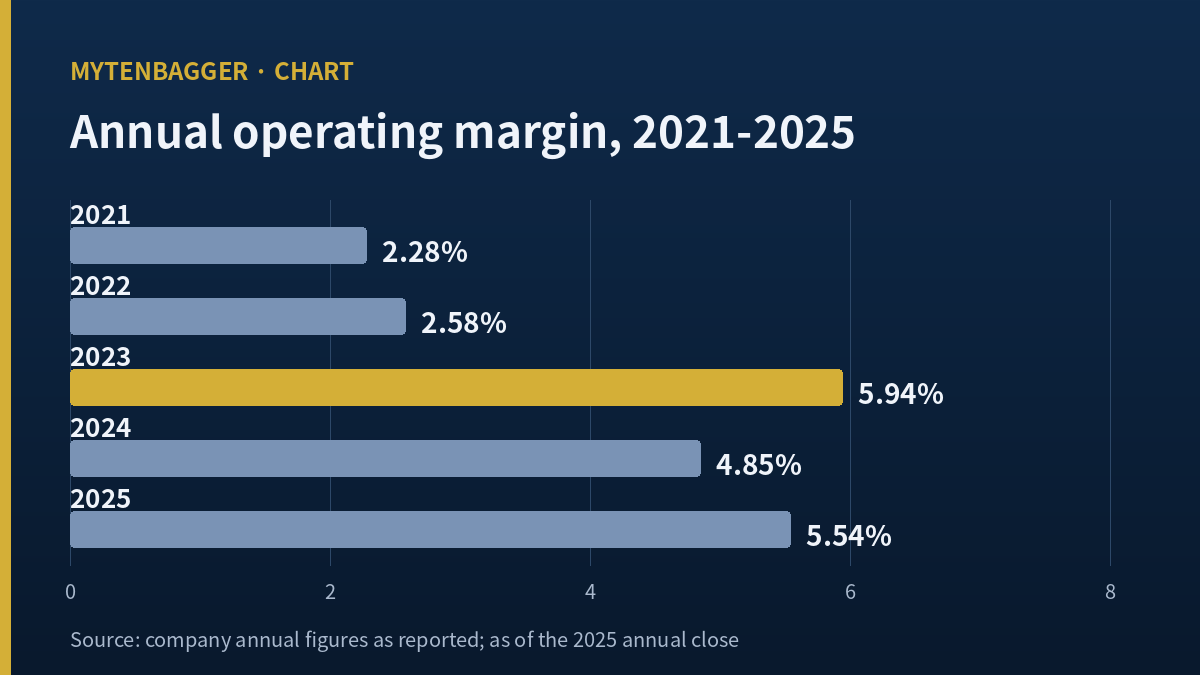
| Year | Revenue (bn won) | Operating profit | Operating margin |
|---|---|---|---|
| 2021 | 3,348.59 | 76.35 | 2.28% |
| 2022 | 3,976.78 | 102.79 | 2.58% |
| 2023 | 4,321.99 | 256.73 | 5.94% |
| 2024 | 4,245.09 | 205.88 | 4.85% |
| 2025 | 4,382.67 | 242.68 | 5.54% |
Source: Hankyung Markets company financials page for 015750, five-year table | As of the 2025 annual close | The margin column is mine, worked out from the two columns to its left
The figures come from the five-year table on the company’s Korean market data page, and I have converted the units from millions of won to billions so the columns read at a glance.
Two things sit in that table. Revenue added 29.069% in two years and then 1.404% in the two years after. Operating profit added 236.254% in the same first stretch and then gave up 5.473% in the second. And the operating margin made a single step in 2023, up 3.3553 points against 2022, and has stayed within about a point of that step ever since.
I checked the margin column myself before taking the published version: 242.68 divided by 4,382.67 is 5.5373%, which rounds to the 5.54% on the page. The same holds for every other year in the table. That matters because it tells me the two columns I am dividing belong to each other.
Added across the whole five years, the company sold 20,275.12 billion won of product and kept 884.43 billion won of it as operating profit. That is 4.3621% over the period. The single-year figures swing from 2.28% to 5.94%, a spread of more than two and a half times, so the five-year average describes none of the individual years. I am putting it here to show the scale of the business; it says nothing about any single year.
For what the company actually makes, the useful background is that it produces body structures and formed panels for carmakers, with an industry profile listing its main customer as the Hyundai and Kia group and manufacturing sites in Korea, Mexico, India and central Europe. That profile is dated 2014, which is old enough that I use it for the outline of the business and not for any current figure.
The step of 2023 and what has held it
A margin that more than doubled and then stopped moving
From 2.58% to 5.94% is not a small improvement in a business that sells stamped and formed steel structures to carmakers. In that trade a point of margin is a year of work. The company took more than three points in one year and has held the level for three years since, through a revenue line that went nowhere.
I do not know what produced the step, and I want to say that plainly before I lean on anything. The candidates are obvious enough: pricing renegotiated with the customer, a mix change toward structures that carry more value, the end of a steel-cost squeeze, or the maturing of overseas sites that had been in start-up losses. I could not open a document that settles it, so I am treating the step as a fact and its cause as unknown.
Why a held margin is more interesting than a rising one
A rising margin invites a story about operating leverage. A held margin on flat revenue is harder to explain away, and it is the thing I would want to own if I owned any Sungwoo Hitech stock at all. Three years at roughly five percent on a revenue line that has not grown means the improvement was structural or that something has been quietly offsetting a decline. Those two readings point opposite ways, and the 2026 half-year gives the first real test of which one is true.
Two quarters inside one half of Sungwoo Hitech stock
What the company released for the first half
For the six months to June 2026 the company reported revenue of 2,196.0 billion won, operating profit of 119.6 billion won and net profit of 47.3 billion won. Against the same six months of 2025 those are changes of minus 0.3%, minus 3.3% and minus 26.9%. Korean reporting on the release led on a different angle, that the operating profit placed tenth among all KOSDAQ companies for the half.
The second quarter on its own was revenue of 1,126.0 billion won and operating profit of 65.1 billion won, changes of minus 2.4% and minus 0.5%. Subtract one from the other and the first quarter of 2026 was revenue of 1,070.0 billion won and operating profit of 54.5 billion won. I then found the same 54.5 billion figure in a quarterly filing record dated May 15, 2026, which is the only cross-check in this entry where two independent sources produced the identical number.
The split that the half-year figure hides
Now the margins. The 2026 half ran at 5.4463%. Working the prior-year values back out of the published percentage changes puts the 2025 half at 5.6152%, so the half lost 0.1690 points.
The second quarter of 2026 ran at 5.7815% against 5.6711% a year earlier. That quarter gained 0.1104 points. Which means the first quarter carried the whole of the decline and more: 5.0935% against 5.5537%, a loss of 0.4603 points.
The half says down. The quarter closest to today says up. A half-year number that contains two opposite quarters is an average, and I will not read an average as a direction.
There is a second way to cut the same two quarters, and it agrees with the first. Set the year-ago comparison aside and put the two 2026 quarters next to each other. Revenue went from 1,070.0 billion won to 1,126.0 billion, a gain of 5.234%. Operating profit went from 54.5 billion to 65.1 billion, a gain of 19.450%. The margin moved 0.6880 points in three months, from 5.0935% to 5.7815%, and profit grew almost four times as fast as the sales that carried it.
That sequential read is weaker evidence than the year-ago one, because the first and second quarters of a car-parts year are not interchangeable and I have no seasonal series long enough to adjust for it. I am including it because it is the only other arrangement of these four published figures that exists, and it points the same way. Two cuts agreeing is not proof. Two cuts pointing opposite ways would have stopped the entry here.
The other piece of context in the release is the ranking. Tenth place by half-year operating profit across the whole of KOSDAQ is a strange position for a supplier whose shares sit where these do. KOSDAQ is a market of small growth names, and a heavy manufacturer placing that high on a profit table while trading at a fraction of its own book equity tells me the market is pricing this company on something other than the profit it is currently earning. What that something is, I have not established.
I have made the opposite mistake in the other direction before, and I wrote about it when a supplier’s swings in profit turned out to be driven by input costs and not by anything the company chose. That entry is here: a battery maker whose profit moved eleven times as hard as its revenue. The lesson I took then applies here in reverse. When revenue holds still, the thing worth watching is whichever line is still moving.
Two other suppliers I have written up sit either side of this one. A tire maker whose group profit came in under its owner profit is the case where the gap between an operating line and what reaches the parent turned out to matter more than the operating line itself. And a thermal-systems supplier that nearly doubled its share base to cut debt is the case where flat profit became falling profit per share without any operating change at all. I looked for both patterns here and found neither in the figures I could open.
What the half-year headline for Sungwoo Hitech stock leaves out
A quarterly split is where I have been lazy for years
A quarterly split is the piece of work I have skipped more often than any other, and this entry is where I noticed the pattern in myself. When a Korean company releases a half, the headline percentages are all first-half against first-half. I have taken those percentages as the description of the period and moved on, dozens of times. They are not a description. They are two quarters added together and then compared with two other quarters added together.
Here the addition hid a sign change. If I had stopped at minus 3.3% on the operating line I would have written that the margin is slipping, and the most recent three months say the opposite. The correction I am making is small and mechanical: when a half is published, subtract the quarter that was published before it and look at both pieces separately before writing a sentence about direction.
How much of this is my own work
I should be exact about which figures the company published and which ones I worked out by hand. Published: the half-year and second-quarter revenue and operating profit, and the four percentage changes. Worked out by me: every 2025 comparison figure, the first-quarter split, and all six margin percentages.
The percentage changes I worked backward from are rounded to one decimal place, so my 2025 figures carry the rounding with them. At minus 0.3% on revenue, the true change could be anywhere from minus 0.25% to minus 0.35%, which puts the 2025 half somewhere between about 2,201.5 and 2,203.7 billion won. That range does not move the direction of the quarterly split, and I checked that it does not, but it does mean the second decimal place in my margins is decoration.
How I read Sungwoo Hitech stock against its own record
Doubling the 2026 half gives 4,392.0 billion won for the year, which would be 0.213% above 2025. A fourth year in the same place. Against that, the second quarter is running at a margin the company has not held since its best year. Those two facts do not contradict each other, and together they describe a business that has stopped growing and has not stopped earning.
In dollars at the September 22, 2026 close of 1,358.2 won, the half was about 1.617 billion dollars of revenue, 88.06 million dollars of operating profit and 34.83 million dollars of net profit. For an American reader the useful anchor is that this is a mid-size tier-one body-structure supplier with more revenue than its market value by a wide margin, in a market where that is ordinary.
A peer I named and did not price
For an overseas comparison I am naming Gestamp Automocion, the Spanish body-structures group listed in Madrid. I chose it from an unusual place: this company’s own list of joint-venture partners, where a list of competitors would have been the obvious source. The two have operated together in India supplying the same Korean carmaker. My reason for choosing it is that a partner in one country and a rival in another is the most honest kind of peer for a business like this.
The mechanical obstacle to going further is that the Spanish group reports in euros on a European disclosure timetable with a different segment structure, so any margin I lined up against the Korean figures above would be comparing two definitions and calling the difference performance. That is the error I most often see in peer tables, including in some I wrote before I knew better.
I have put no figures from that company into this entry. The relationship I am relying on appears in a company profile dated 2014, and I did not check whether it still stands in 2026, so naming is as far as I am willing to go.
Numbers I left out of this Sungwoo Hitech stock entry
The net line, and why I stopped at the operating line
Net profit for the half fell 26.9% while operating profit fell 3.3%. That gap is the loudest thing in the release and I am deliberately not building on it, because everything that explains it sits below the operating line in documents I did not open: interest, currency effects on overseas units, and tax. I can see that the gap widened. I cannot say what widened it, and a journal entry that guesses at that would be worth less than one that says so.
I also left out every valuation multiple. Three sources give three different book multiples for this company and I could not settle which equity figure each one divides by, so none of them appear above. One thing I did check and it held: the share base is exactly 80 million shares at three sources, and the September 22 close multiplied by it matches one source’s market value to the won.
Two of those three book multiples differ by only a hundredth and the third by more, which is the pattern I have seen when one source uses the parent’s equity and another uses the full group equity. I could have picked the arrangement that suits the entry and moved on. I did not, because a multiple chosen for its convenience is the fastest way to write something I cannot defend a quarter later.
Fifteen ways I could be wrong about Sungwoo Hitech stock
- Every 2025 comparison figure here is my own reversal of a rounded percentage and was never published as such.
- The second decimal place in all six of my margin percentages is inside the rounding error and should be ignored.
- The first-quarter split assumes the half and the quarter were compiled on the same accounting perimeter. I did not confirm that.
- One good quarter is one quarter. A single 0.1104 point gain is well inside the noise of a supplier business.
- I do not know what produced the 2023 margin step, so I cannot say what would end it.
- A margin held on flat revenue can also mean volumes are falling and price is holding, which would be a worse situation than the one I described.
- Korean auto suppliers carry heavy exposure to one or two customers. I did not open a current document on customer concentration.
- The company runs manufacturing sites in several countries and some of them are losing money. None of those unit-level figures are in the numbers above.
- A July filing committed group capital to one overseas unit. That decision is outside every figure in this entry and could change the group’s interest burden.
- No brokerage has published a forward estimate for this company that I could find, so there is no outside view to test mine against.
- The documents that ranked highest in my searches were automatically generated write-ups that keep their figures behind a paywall, which is not a substitute for an analyst.
- I read the half-year figures in Korean press reporting on the release. I did not open the filing itself.
- The net profit decline of 26.9% is unexplained in this entry and it is larger than anything I did explain.
- KOSDAQ’s junior-market listing carries a liquidity and index-inclusion difference I have not quantified here.
- The September 22, 2026 close goes stale the moment the market opens on September 23.
Three conditions that end my Sungwoo Hitech stock thesis
- If the third quarter of 2026 comes in below 5.0935% on the operating margin, then the first quarter was the trend and the second quarter was the exception, and my reading of the split was wrong.
- If nine-month revenue is more than 1.404% below the same nine months of 2025, the flat line has become a declining one and the margin question stops being the interesting one.
- If the third-quarter operating margin holds above 5.54% while revenue stays flat, the 2023 step is structural and I should have been looking at this company as a holding and not as a watch item.
All three are answered by one document. The statutory deadline for the Korean third-quarter report is November 16, 2026, and the first two lines of its income statement settle every one of them.
The order in which they get answered matters more than their number. The revenue line appears first in any reading of that statement, so the second condition resolves before the other two. If revenue has broken down, I stop looking at the margin question entirely, because a margin defended on shrinking volumes is a different subject from a margin held on steady ones. Only if the revenue line holds does the third-quarter margin become the thing that decides whether the second quarter of 2026 meant anything.
There is a fourth outcome I am not writing a condition for, because I would not know how to act on it. If revenue holds, the margin holds, and the net line keeps falling faster than the operating line, then the thing that decides this company’s earnings has moved somewhere I have not opened. That is not a thesis breaking. That is a thesis that was never addressing the right line.
Where I stand today
I hold none of this and I have no order working. The company is not expensive on any arrangement of its own figures that I trust, and it is not growing on any arrangement of them either. What it is doing is earning at a level it reached three years ago and has not given back.
What I am waiting for is not a number the company will choose to publish in a headline. It is the third line of a quarterly income statement that will settle whether the quarter I found was the start of something or a single good three months. That document has a deadline of November 16, 2026, and until it lands I keep this one on the watch list and my hands off the keyboard.
Prices and figures reflect the September 22, 2026 close. Dollar equivalents are approximate, converted at roughly 1,358.2 won per dollar on that date. Annual figures are as of the 2025 annual close and half-year figures are as of June 30, 2026.
Related reading
- Why HLB Shares Hit Their Low on the Day of the FDA Rejection
- Shinheung SEC Debt: Interest Costs Run 3.4x Its Profit