Hyundai Marine & Fire Insurance Earnings: Margin and Solvency
Hyundai Marine stock — Hyundai Marine & Fire Insurance, Korea Exchange 001450. Close of 52,400 won on Friday, August 28, 2026. That is the highest close in the 260 trading sessions I pulled. Market value about 4.467 trillion won, roughly 3.25 billion US dollars.
The two lines — contractual service margin of about 9.89 trillion won as of June 30, 2026, and a K-ICS solvency ratio of 209.0% at the end of the second quarter. Neither has a column on any US insurer’s filings.
Where I stand — watching. I am tracking whether the two lines above stay legible to me, not whether the price goes up.
I keep a working sheet of insurers. It has columns for price to book, return on equity, dividend yield, and combined ratio. Those four columns have carried every insurer I have looked at for two years.
Then I added a Korean name to it, and two of the numbers that actually decide what this company is worth had nowhere to go.
Hyundai Marine stock is not obscure. It is a top-five name in Korean non-life insurance, listed since 1989, and foreign investors hold 39.42% of the register. My sheet simply had no row shape for it. This piece is about the two columns I had to build, and about what my old four columns kept getting wrong in the meantime.

Contents
The two lines that decide Hyundai Marine stock have no US column
Korea adopted IFRS 17 for insurance contracts in 2023. The United States did not. American insurers report under US GAAP, which was reworked for long-duration contracts on a separate track and produces a different set of primary lines.
That divergence has a practical consequence for anyone screening across both markets. Two of the figures Korean analysts lead with when they discuss this company do not exist as concepts in the filings of Travelers or Chubb. They are not merely labeled differently. The line is absent.
The first is contractual service margin, or CSM. The second is the K-ICS ratio, Korea’s solvency capital measure. I will take them one at a time, then rebuild the peer table around what they imply.
The first line: a margin that is booked before it is earned
Under IFRS 17, when an insurer writes a profitable contract it does not recognize the expected profit at once. It parks that profit on the balance sheet as contractual service margin and releases it into earnings across the life of the contract. CSM is therefore a stock of future profit already contracted for, sitting where a US reader would expect to find nothing at all.
Where the 9.89 trillion won figure comes from
Korean outlets covering the August 14, 2026 results put the company’s CSM balance at roughly 9.89 trillion won as of June 30, 2026. Financial Today reported 9.89 trillion won; HuffPost Korea reported 9.8944 trillion won. New-business CSM for the first half came to 950.9 billion won.
I want to be careful about the second derivative here, because I could not settle it. The year-end 2025 figure is reported two ways as well: EBN put it at 8.902 trillion won on February 24, 2026, while Financial Today’s August piece implies 8.98 trillion won. Depending on which pair I use, the first-half increase is either 916.6 billion won or 983.7 billion won. I am not going to publish a change figure I cannot reconcile, so I state the level and stop there.
A rule change moved this line, and it moved in opposite directions across companies. In 2026 Korea’s regulator tightened its actuarial supervision guidance — the loss ratios and expense assumptions insurers must apply when they build these balances. Financial Today reported on August 19, 2026 that the revision raised Hyundai Marine’s CSM by roughly 440 billion won, while cutting the balances of two larger competitors.
I have deliberately not reproduced those two competitor figures. As reported they run to trillions of won, which is large enough that I would want the original filings before repeating them, and I could not open those filings. What survives verification is the direction: the same rule change pushed this company’s balance up and its peers’ balances down, because the assumptions being corrected differed by book.
That is the first thing my four-column sheet could not have told me. A regulatory assumption change is not a market event, it does not appear in price to book, and it moves the single largest forward-profit line on a Korean insurer’s balance sheet.
The second line: a solvency ratio a Korean regulator wrote
The other line is K-ICS, the Korean Insurance Capital Standard. It replaced Korea’s older risk-based capital regime in 2023 and measures available capital against required capital on an economic basis.
209.0%, and where it sits among the top five
The company reported 209.0% at the end of the second quarter of 2026, up 1.8 percentage points from 207.2% at the end of the first quarter. IB Tomato’s August 24, 2026 piece traced the path: 179.8% in the third quarter of 2025, 190.1% at year end, 207.2% in the first quarter of 2026, then 209.0%.
The same reporting attributes the repair to duration matching, not to capital raising. The asset-liability duration gap moved from negative 1.7 years in the third quarter of 2025 to positive 0.7 years, with assets at 10.7 years against liabilities at 10.0 years. A 50 basis point rise in rates now moves the ratio by positive 0.7 points, against negative 4.4 points on the year-end 2025 basis.
Level is a different question from direction. Newsway’s June 19, 2026 comparison of the five largest Korean non-life insurers at the end of the first quarter put Samsung Fire at 270.1%, Meritz Fire at 240.6%, DB Insurance at 232.1%, Hyundai Marine at 207.2%, and KB Insurance at 185.9%. Improvement was fastest here. The absolute level was second lowest of the five.
A US reader has no instinct for whether 209.0% is comfortable, and neither do I without the local reference. That is exactly the problem. The number is meaningful only against a threshold a Korean regulator set, and it does not travel.
Hyundai Marine stock in a peer table that mixes four rulebooks
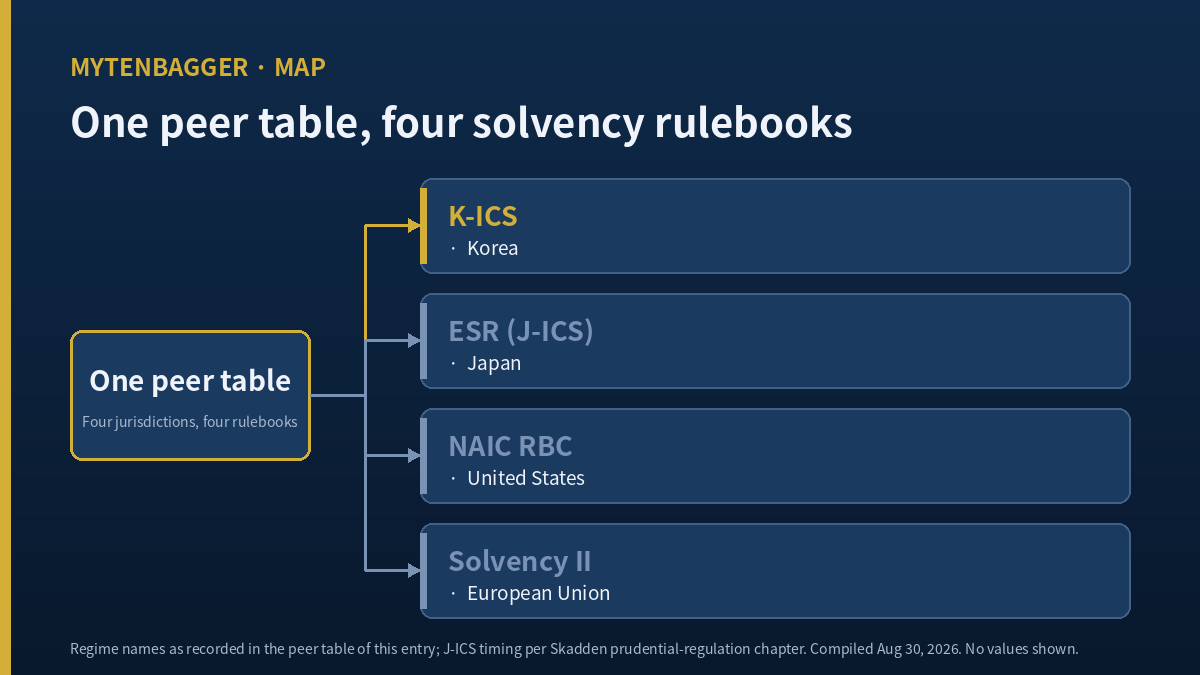
So I rebuilt the peer table with a column I have never used before: the solvency regime each company actually reports under. My entry rule for this table was that a company qualifies only if I can name the rulebook its capital position is measured against.
| Company | Listing | FY end | Solvency regime | P/E | P/B | ROE | Vendor as-of |
|---|---|---|---|---|---|---|---|
| Hyundai Marine & Fire | KRX 001450 | Dec 31 | K-ICS | 4.59 | 0.90 | 20.6% | Aug 28, 2026 |
| Samsung Fire & Marine | KRX 000810 | Dec 31 | K-ICS | 13.92 | 1.06 | 10.33% | Aug 14, 2026 |
| DB Insurance | KRX 005830 | Dec 31 | K-ICS | 5.52 | not shown | not shown | Jun 4, 2026 |
| Tokio Marine Holdings | TYO 8766 | Mar 31 | ESR (J-ICS) | 26.57 | 1.72 | not shown | Aug 17, 2026 |
| Sompo Holdings | TYO 8630 | Mar 31 | ESR (J-ICS) | 8.74 | 1.03 | 13.51% | Jun 26, 2026 |
| MS&AD Insurance Group | TYO 8725 | Mar 31 | ESR (J-ICS) | 8.02 | 1.28 | 17.84% | Jun 27, 2026 |
| Travelers | NYSE TRV | Dec 31 | NAIC RBC | 9.91 | 2.33 | 26.51% | Aug 29, 2026 |
| Allstate | NYSE ALL | Dec 31 | NAIC RBC | 5.20 | 2.09 | 46.11% | Aug 29, 2026 |
| Chubb | NYSE CB | Dec 31 | NAIC RBC | 12.03 | 1.74 | 14.82% | Aug 29, 2026 |
| Cincinnati Financial | Nasdaq CINF | Dec 31 | NAIC RBC | 8.12 | 1.58 | 21.48% | Aug 29, 2026 |
| Allianz SE | ETR ALV | Dec 31 | Solvency II | 14.46 | 2.48 | 19.61% | Aug 23, 2026 |
Peer multiples from stockanalysis.com statistics pages, with each row’s stated as-of date in the last column. The subject row is the exception: its P/E, P/B and ROE are from a Korean vendor on the August 28, 2026 close, because the same US vendor served three different market values for this company on three of its own pages. Japan’s economic value-based solvency regime is described by Skadden’s 2025 prudential-regulation chapter, which records first required reporting for fiscal years ending March 31, 2026 and the retirement of the older solvency margin ratio.
Read the last column before the numeric ones. The Japanese rows close their books on March 31 and the Korean and Western rows on December 31, so a Japanese multiple here is priced against earnings that closed nine months later in the calendar than a Korean one. On top of that, the vendor’s own as-of dates span June 4 to August 29. This table has two separate consistency problems inside it and I would rather name both than let a reader treat the columns as a same-day comparison.
There is a third problem the table cannot show, and it sits in the ROE column. A percentage puts a flow above a balance, and nothing in the cell says how many months the flow covers. I worked that out on a reinsurer under the same K-ICS rulebook: in Korean Re the same equity base of KRW 4,019.799 billion at June 30, 2026 produced three different returns — 8.6371% on six months of profit as both the data tool and the filing print it, 11.6318% on my own second-half assumption, and 17.2742% if the second half matched the first. Same company, same balance sheet date, three figures. So read the 20.6% in the subject row as a number whose period I have named elsewhere, not as a settled fact about the year.
Who I left out of the table, and why
Meritz Fire & Marine is gone from the exchange; the surviving listed entity is Meritz Financial Group, which the vendor classifies under capital markets and which runs securities and capital businesses alongside insurance. A holding-company conversion inside the last four years disqualifies it here on its own. Zurich Insurance Group reports in US dollars while the vendor quotes its market value in Swiss francs, and I did not want a currency mismatch inside a single row. Progressive shows a dividend yield far below every other name in the set and I could not establish why, so I left it out instead of printing a figure I do not understand.
What a US screener does show about Hyundai Marine stock
The conventional columns are worth putting down, because they are what a US-based reader will see first. All of these are on the August 28, 2026 close of 52,400 won.
- Market value about 4.467 trillion won, which is roughly 3.25 billion US dollars at 1,372.5 won per dollar.
- Trailing P/E of 4.59 and P/B of 0.90, on a Korean vendor’s earnings per share of 11,416.12 won and book value per share of 58,447 won.
- Return on equity of 20.6%, foreign ownership of 39.42%.
- The close of 52,400 won is the highest in the 260 trading sessions I pulled. The lowest close in that window was 26,450 won on Wednesday, January 14, 2026, so the stock has roughly doubled from its floor.
- That high was set on a day the Kospi index fell 1.79% to 6,788.88. The stock added 7.05% while the index dropped. I could not find a company disclosure that explains that single session.
Consolidated results give the other half. Korea’s electronic filing system shows net profit attributable to owners of 1.0198 trillion won for 2025, against 850.5 billion won for 2024 — a rise of 19.90% by my own arithmetic. First-half 2026 attributable profit was 654.7 billion won, up 29.78% from 504.5 billion won.
Those consolidated figures conflict with what Korean outlets reported, and the conflict is not an error. Local coverage of the 2025 result led with 561.1 billion won and a decline of 45.6%. That is the parent-only account. Both statements are correct and they are drawn from different financial statements. If you are reading Korean press on this company alongside a filing database, this is the trap.
The dividend column that came back blank
Three years, one payment. My sheet’s dividend yield column is empty for this name, and so is the vendor’s. The last payment was 2,063 won per share for the 2023 financial year. Nothing was paid for 2024 and nothing for 2025.
The mechanism is Korean and specific: a statutory reserve tied to surrender values sits inside retained earnings and reduces what the parent company is legally allowed to distribute. E-Today reported that reserve at about 4.115 trillion won in the first quarter of 2026, equal to 49.9% of retained earnings. Distributable profit was about negative 660 billion won at the end of the second quarter, improved from about negative 1.4 trillion won three months earlier.
I am not building this piece on that reserve — I have written the Korean-language edition of this journal entry around it, and I would rather the two editions look at different lines. What matters for a US reader here is narrower. The dividend column reads blank not because the vendor missed it, and not because the company had a bad year, but because of a Korean statutory calculation with no equivalent in a US insurer’s distributable-earnings test. That is a third line without a column, and I noticed it only after I stopped trusting the blank.
Five ways I could be wrong about Hyundai Marine stock
- I could not open the primary filings. Korea’s disclosure portal was unreachable from where I was working, so every accounting figure above arrives through a filing-database mirror or through Korean press. The CSM reconciliation failure in the second section is a direct consequence.
- A large part of the 2026 improvement came from outside the company. A government measure effective July 1, 2026 restricted claims for manual physical therapy, and Korean sell-side work identifies this insurer as the largest beneficiary because of its book of older indemnity health policies. If that measure is reversed or diluted, the loss-ratio improvement goes with it.
- Motor insurance turned to a loss. The company’s motor line ran a 10.2 billion won deficit in the first half of 2026 against a profit a year earlier. Across Korea’s four largest non-life insurers, the first-half motor loss ratio was 84.5% against 82.6% a year earlier, and the segment posted its first half-year operating loss in six years.
- New business is shrinking while profit grows. First-half new-business CSM of 950.9 billion won was down 5.4% from a year earlier, and new protection business was down 11.9%. A company can improve reported profit for several years while writing less of what generates future profit.
- The bear case is thin, and that bothers me. Every one of the nine August 2026 broker notes I could reach carried a buy or hold-at-buy stance. I found no piece arguing the stock is overheated. The closest thing to a negative view was Invest Chosun’s July 21, 2026 line that a structural constraint caps the valuation. When I cannot find the other side, my first assumption is that I searched badly.
One further note on the sell side, since it is where a reader would normally go next. Nine houses raised their published valuations on August 18, 2026, the same day. I am not reproducing the figures or the size of the increases. What I took from those notes is that the stated grounds differed: motor combined ratio, the asset-liability duration gap, the July measure, underwriting mix, and the distributable-profit path. Five separate reasons arriving on one date is a more useful fact than any of the numbers attached to them.

Where Hyundai Marine stock shows up, and where the check did not finish
I checked one thing to the end and left the others open. Here is the honest version.
What I confirmed. A complete 164-line holdings list dated August 26, 2026 shows the company in the Franklin FTSE South Korea ETF at a 0.13% weight, 59,220 shares. That is trace exposure and not a position. Note the source: this came from a third-party aggregator, because the issuer’s own product page returned a loading shell with no holdings table.
What I could not settle. The vendor’s company page for this listing shows a single Korea Exchange line and ISIN KR7001450006, and the second screener I tried would not render for me, so I am recording that as a check that did not finish rather than a settled fact. One thing worth separating out, because it tripped me while searching: the company does operate a US branch registered with state insurance regulators, which is an underwriting branch and not a listing, and the two are easy to confuse.
The issuer’s own holdings file returned an HTML shell instead of data. Three and a half months is long enough that I will not call it a current answer.
One naming caution for anyone searching. HD Hyundai Marine Solution is a ship-aftermarket business listed under a different code and is a completely different company. I hit that collision three times while assembling this piece.
My stance on Hyundai Marine stock and the question that ends it
Watching.
My stance in one sentence: the two figures that decide what this insurer is worth are produced by rulebooks I cannot read against any US comparison, and until I can, a peer multiple from my sheet describes my sheet more than it describes the company.
The next update comes with the third-quarter report. The statutory filing deadline is November 15, 2026, which falls on a Sunday, so the practical date is Monday, November 16, 2026 or later. What I will look at is whether new-business CSM is still contracting while the reported balance grows, and whether the K-ICS ratio holds its level once the duration position stops improving.
I am writing my invalidation as a question this time, because I do not have the answer and pretending otherwise would be the actual error.
Question 47. If a regulator’s assumption change can add roughly 440 billion won to this balance and subtract from a competitor’s in the same revision, what is the CSM balance actually measuring — the book, or the current state of the assumptions applied to it? If the answer is closer to the second, then the line I built a column for is not the line I thought I was tracking, and this piece is measuring the wrong thing.
Where my process was thin
Regimes were the part I got backwards. I built the peer table first and only afterwards asked whether the capital positions inside it were computed under the same rules. They were not — four rulebooks are represented in eleven rows. Had I asked first, the entry rule would have shaped the table instead of arriving as a caveat underneath it.
The habit underneath that is worth naming. I treat a peer table as a measuring instrument, when it is really a claim that these companies are comparable. The claim needs testing before the instrument gets used, and I have been doing it the other way round.
Prices and multiples reflect the August 28, 2026 Korean market close as checked at the time of writing. The Korean won is the reference currency throughout and the single dollar conversion above is approximate, at 1,372.5 won per dollar on that date as reported by The Korea Herald, The Korea Times and Businesskorea. Accounting figures come from Korea’s filing database and from Korean press; reserve and distributable-profit figures are broker estimates relayed by Korean media rather than company-confirmed disclosures.