SK Square Stock: NAV Discount Back to 43.8%, Why I Wait
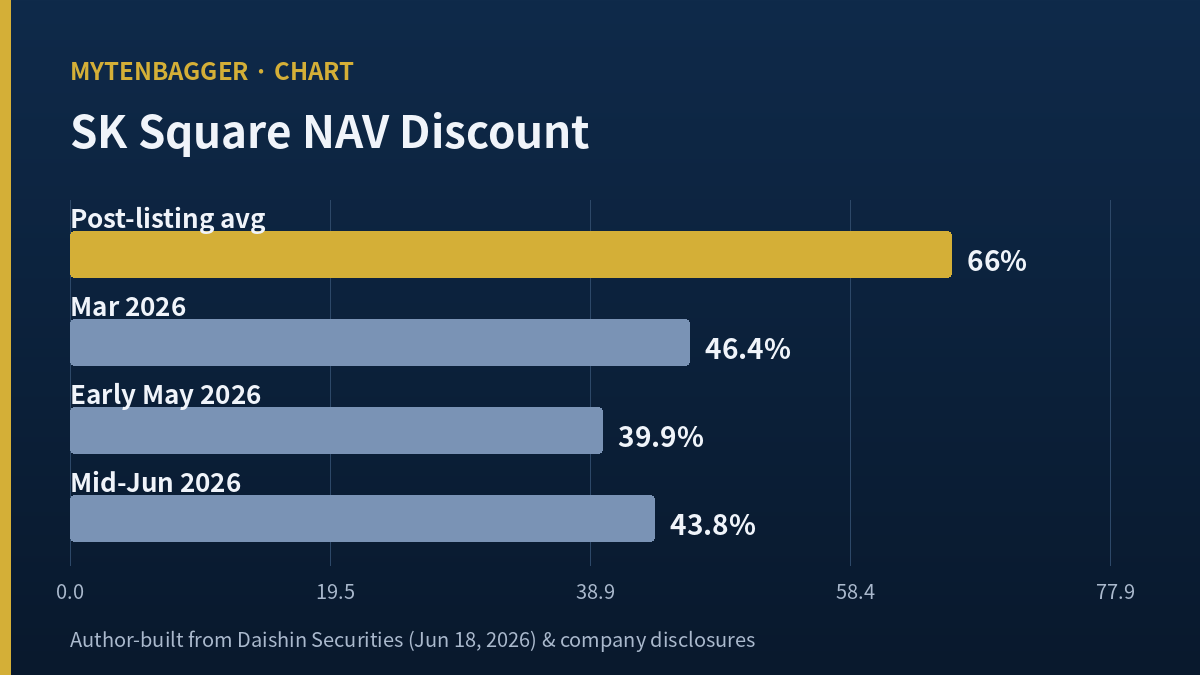
I have long treated SK Square (KOSPI: 402340) as a cheap way to own SK Hynix. The problem is that the thing that made it cheap — its discount to net asset value — narrowed from about 66% to a 39.9% trough, then widened back to 43.8% (Daishin Securities, June 18). At roughly ₩1,747,000 (about $1,135) the stock now trades above the 12-month analyst consensus target near ₩1,630,000. It will track Hynix on the way up, but SK Square’s own edge has thinned. So I am watching, not buying.
Last month I kept seeing the same headline: SK Square was rising faster than SK Hynix itself. My first reaction was that a holding company should not be able to out-run the asset it holds. A company whose earnings are mostly the equity-method share of a subsidiary, climbing harder than that subsidiary, feels wrong. Then I opened the numbers, and it was not wrong — it was structural. And inside that structure sat every reason I am not chasing the stock right now.
Most people treat SK Square as “the cheap way to own SK Hynix,” and that is fair: more than 90% of the company’s net asset value is its SK Hynix stake plus cash. But the thing worth watching is not how fast that discount is closing. It is that the discount has recently started widening again. For readers outside Korea, this sits inside the broader “Korea discount” — the long-standing tendency for Korean stocks, especially conglomerate structures, to trade below the sum of their parts, which Seoul’s Corporate Value-up Program was launched to address.
A quick primer if you are coming to this from a US index-fund mindset. A holding company like SK Square owns stakes in other companies, so in theory you can price it by adding up those stakes (its “net asset value”) and subtracting net debt. In practice these vehicles almost always trade below that sum — the “holdco discount” — because investors pay for the hassle of the wrapper: no control over when the underlying value is realized, a layer of overhead, and sometimes tax friction on eventual sales. SK Square’s entire investment case is a bet on that gap narrowing. So the discount is not a footnote here; it is the whole variable.
Contents
Why I am watching SK Square, not buying
First: much of the move is flow, not fundamentals
The biggest driver behind SK Square out-running Hynix, in my read, is a Korean fund rule rather than a fundamental improvement. Domestic equity funds in Korea can hold no more than 10% of assets in any single stock. SK Hynix has become so large — its weight in the KOSPI climbed to about 25.5% (cited by Daishin Securities, June 18) — that funds wanting more Hynix simply cannot buy it. They bump into the cap.
The workaround is the parent that owns roughly 20% of Hynix: SK Square. If you cannot buy Hynix directly, you buy the shell that holds a fifth of it. A Daishin Securities analyst described SK Square as having strategically absorbed the alternative Hynix demand created by that single-stock limit — I am paraphrasing the Korean-language note, not quoting an English original.
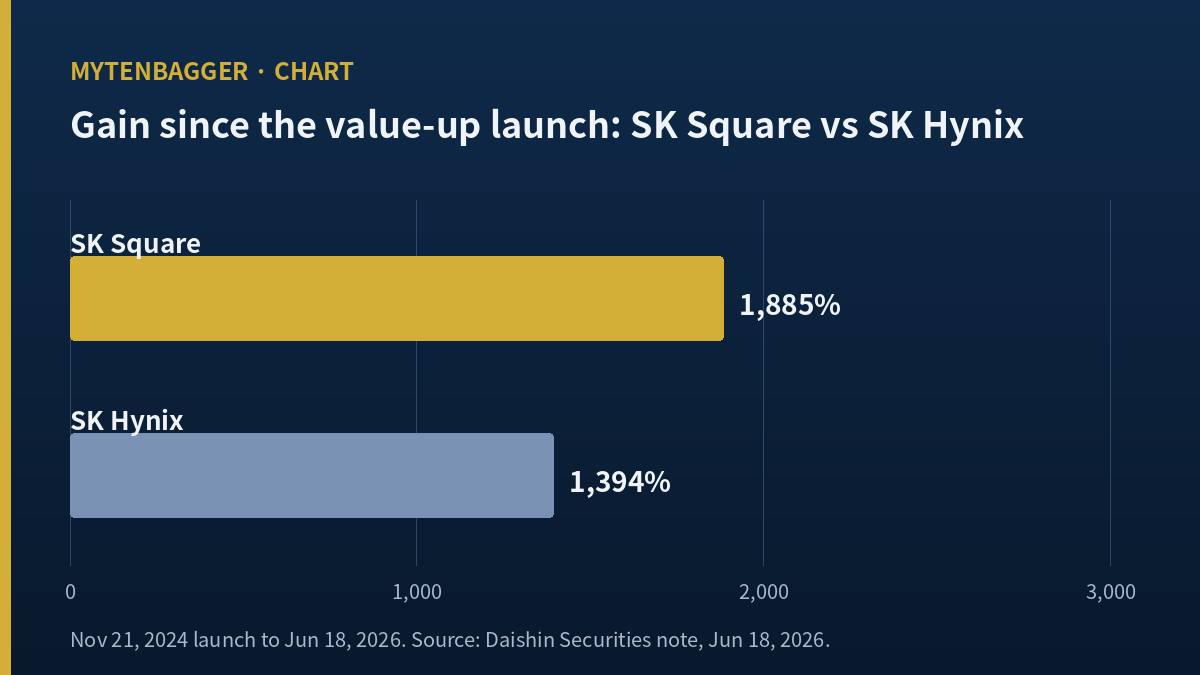
The size of that leverage shows up in the tape. From the November 21, 2024 launch of its value-up plan, SK Square stock rose roughly 1,885%, while SK Hynix rose about 1,394% over the same window (Daishin Securities, June 18). The parent beat the subsidiary by nearly 500 percentage points. A company that is, by accounting, downstream of Hynix somehow outpaced it — and most of that gap, I think, came from those two forces overlapping (rule-driven alternative demand plus value-up optimism) rather than from the business itself getting better. That is good news for holders, but one of those two forces — the flow — can reverse whenever fund positioning normalizes.
It is worth being concrete about how that flow could drain. The alternative demand exists only because the cap forces it there; it is not a vote of confidence in SK Square’s business. If Hynix’s KOSPI weight eases (through a pullback, an index rebalance, or simply other large caps catching up), or if Korean funds rotate, the marginal buyer who was using SK Square as a Hynix substitute has less reason to stay. Flow that arrives for a technical reason tends to leave for one too. I am not predicting that unwind — I am saying I will not pay a fundamental premium for a move that is, in large part, a plumbing artifact.
Second: the discount-closing alpha is largely spent
SK Square’s real edge was the closing of its NAV discount. After the value-up plan, a discount that had averaged about 66% since listing narrowed to a 39.9% trough by early May 2026 (Daishin Securities, June 18). Along the way, in March 2026, the discount reached 46.4%, pulling forward the company’s original “below 50% by 2027” target. If you held SK Square through that stretch, you earned twice: Hynix rising and the discount compressing. That double was the alpha.
The question is how much of it is left. Going from roughly 66% to about 40% means the largest re-rating is already behind us. The company’s new goal is below 30% by 2028, but the path from 40% to 30% is far narrower and slower than the path from 66% to 40%. The remaining alpha is smaller than the alpha already banked — that is my read.
Honestly, I feel some ambiguity here. If the 30% target is hit, there is still upside from these levels. But the strong sense I get is that the easy stretch is over.
Third: SK Square’s identity still rests on one leg
SK Square was spun off from telecom carrier SK Telecom in 2021 as SK Group’s intermediate holding and investment arm, with a mandate to invest aggressively in semiconductors and AI. Chey Jae-won, a senior vice chairman within the SK Group, has reportedly joined SK Square, and the company reorganized around a strategic investment center — which has attached fresh M&A hopes to the story.
Yet the 2025 consolidated results — record revenue of ₩1.41 trillion, operating profit of ₩8.80 trillion (about $5.7 billion) and net profit of ₩8.82 trillion (company 2025 consolidated basis) — are mostly the SK Hynix equity-method contribution. Strip Hynix out and the standalone entity is understood to struggle to turn a profit; even its dividend capacity leans on Hynix. The company’s planned 2026 shareholder return of roughly ₩310 billion (funded from 30%+ of its recurring dividend income) ultimately traces back to dividends flowing up from Hynix. Even the power to raise shareholder returns comes from Hynix. The vice-chairman appointment and M&A hopes are still hopes, and there is a credible view that, amid group rebalancing, the heavier investment decisions are being recentered on the top holding company, SK Inc. Until the new identity is proven in earnings, I still read this as a company standing on one leg — Hynix.
SK Square by the numbers
Here are the figures I am watching, each with its basis and source. Amounts are shown in USD first (₩1,540 per US$1) with won in parentheses.
| Item | Value | Source / basis |
|---|---|---|
| Share price | ~$1,135 (₩1,747,000) | Jul 1, 2026 close |
| 52-week range | ~$85–$1,421 (₩131k–₩2,189k) | Investing.com |
| SK Hynix stake | ~20% (20.07% H1) | SK Square semi-annual report |
| NAV discount | 43.8% (39.9% May trough) | Daishin Securities, Jun 18 |
| 2025 operating profit | ~$5.7B (₩8.80T) | Company 2025 consolidated (Hynix equity method) |
| Brokerage price targets | $1,215 / $1,753 (₩1.87M / ₩2.70M) | Daishin Jun 18 / NH Investment |
| 12-month consensus target | ~$1,060 (₩1,630,000) | Investing.com analyst compilation |
Source: per row | Basis: early July 2026 | FX ₩1,540/US$1
The two rows my eye keeps returning to are the last two. The stock trades near ₩1,747,000 while the average 12-month consensus target sits around ₩1,630,000 — the price has already passed the average target. Yet the individual targets are scattered: Daishin Securities at ₩1.87 million versus NH Investment & Securities at ₩2.70 million (NH builds from NAV with a 25% holding-company discount). That is a spread of nearly ₩1 million on the same company.
When the price has already cleared the average analyst target, the market is valuing SK Square more aggressively than the consensus. The target is not pulling the price up; the price is dragging the targets along.
Scale is part of why this matters. After a nearly twenty-fold run since the value-up plan, SK Square has become one of the KOSPI’s larger names by market capitalization — this is no longer a small, overlooked holdco where a re-rating can quietly compound. When a stock this size trades above the average target, it means the easy, consensus-sized upside has largely been priced in already, and further gains lean on the more bullish, NAV-based cases actually playing out. That is a different risk-reward than buying the same story at a 66% discount two years ago.
SK Square NAV discount and the current stock price, in one place
If you arrived looking for the SK Square NAV discount next to the current stock price, both figures are above, and here they are with their dates attached. The discount was 43.8% on Daishin Securities’ June 18, 2026 reading, after touching a 39.9% trough in early May 2026. The share price was ₩1,747,000 at the July 1, 2026 close, roughly $1,135 at ₩1,540 per US$1. Those two readings are dated on purpose. They were not measured on the same day, and neither one is a live quote.
The dating matters more here than it would at most companies. SK Square’s NAV is 90%+ SK Hynix plus cash, and the stake is about 20% (20.07% at the half year). The denominator of the discount therefore moves with the SK Hynix share price every session. A discount quoted three weeks ago can read as a different number today without SK Square itself having done anything at all.
That is also why the brokerage targets built on NAV scatter so widely. NH Investment & Securities builds from NAV and applies a 25% holding-company discount to reach ₩2.70 million. Daishin Securities arrives at ₩1.87 million. Same company, nearly ₩1 million apart, because a NAV-based target is in substance a SK Hynix forecast wearing a holding company’s name.
For the longer view, the discount averaged about 66% from listing until the value-up plan. Read against that average, 43.8% is narrow. Read against the 39.9% trough two months earlier, it is widening. Which of those two comparisons you make carries most of the argument.
SK Square scenarios, and how I weight them
The path I see as most likely (my call: 55%)
SK Hynix’s AI and HBM demand carries through 2026, and SK Square follows via the equity method. This is not a hopeful assumption: Hynix has said its 2026 output is effectively committed to customers, so the base case for the underlying asset is unusually well-anchored for a memory name. But the discount compresses only slowly, or stalls. The stock tracks Hynix’s direction while SK Square’s own excess alpha shrinks clearly versus the past year. This is the picture best supported by the data. In this world, the reason to route into Hynix through SK Square weakens — you could just own the asset.
Where I could be wrong (my call: 30%)
Value-up genuinely accelerates. Non-core divestitures, share cancellations and real AI/semiconductor M&A land as facts, and the discount pushes into the 30s. SK Square then out-runs Hynix again — this is the world NH’s ₩2.70 million target draws. It is not a stretch: the company has already flagged roughly ₩110 billion (about $71 million) of buybacks and cancellations across 2026–2027 and paid a ₩1,500 per-share dividend in June. If the execution track record compounds, I have to change my mind.
The bear case (my call: 15%)
The Hynix memory cycle cools earlier than expected, or the single-stock 10% flow reverses. When Hynix corrects, the leverage does not only work upward — it works downward too. Add a re-widening discount and SK Square can fall harder than Hynix. The discount already swung nearly four points in under two months (39.9% in early May to 43.8% in June); in a Hynix drawdown that swing gets larger. Memory is cyclical by nature, and rivals are not standing still — Samsung and Micron are both racing to close the HBM gap, and any sign that the shortage is easing would hit Hynix first and SK Square second, with leverage. I weight it low, but it is not a scenario to ignore.
Two things the market is missing on SK Square
One: the NAV discount does not close on value-up alone
This is the part I most want to make. The market reflexively trusts the narrative that SK Square is “closing its discount through value-up.” The recent data says the opposite.
On Daishin’s numbers, the discount narrowed to 39.9% in early May, then widened back to 43.8% by mid-June. Why? SK Square rose, but SK Hynix rose faster. When the numerator (the value of the Hynix stake) grows faster than the price (SK Square’s market cap), the discount widens even if the company does nothing. In other words, “discount compression” is not self-executing through value-up effort. The paradox is that the better the subsidiary performs, the wider the parent’s discount can get.
Flip that around and it means SK Square can only drive the discount toward 30% if its own value-up execution — divestitures, cancellations — outpaces the Hynix rally. So far it has been the reverse. That is why I treat “the moment the discount starts compressing again” as the real re-entry signal. While it widens, value-up is losing to flow.
Two: there is no valuation anchor — and the asset is buyable directly
The second thing the market underplays is why those price targets scatter so much. Because SK Square’s NAV is 90%+ SK Hynix plus cash, its fair value is effectively a function of the Hynix price. So a ₩1 million spread between analysts is really a spread in how bullish each one is on Hynix. The SK Square target is less an independent anchor than a Hynix view divided once by a holding-company discount.
Here is where the global-peer lens helps. The crown jewel is genuinely world-class: SK Hynix posted a roughly 72% operating margin in Q1 2026, ahead of global peers Micron (about 67.6%) and even TSMC (about 58%), per TrendForce, on roughly 57% HBM share and a 2026 output book that is essentially sold out to customers like Nvidia. But that is exactly the point: if I want that asset, I can buy it directly rather than through a shell whose discount adds a second, noisier variable. The holding-company-discount playbook — buy the shell, wait for management to close the gap — is familiar globally from names like Naspers/Prosus and its Tencent stake, where even years of buybacks have not made the discount reliably disappear. That history is a caution, not a promise.
And the scale of the asset makes the “buy it directly” option realistic rather than academic. SK Hynix reported FY2025 revenue of about ₩97.1 trillion ($63.8 billion) and net profit near ₩42.9 trillion, then a record Q1 2026 with revenue around ₩52.6 trillion ($34.5 billion). Chairman Chey Tae-won has said the wafer shortage could persist toward 2030, and the company is committing roughly ₩19 trillion to a new domestic fab, with HBM4 mass production targeted for 2027.
What breaks my thesis
I am watching SK Square, not holding it. Here is the order in which I would drop that stance.
The first indicator to report back is SK Hynix’s quarterly print. If AI and HBM demand keep running — and Hynix has said its 2026 output is already committed, betting on an extended super-cycle — then Hynix underpins SK Square’s floor. The next thing I watch is SK Square’s own value-up execution: non-core divestitures and share cancellations confirmed in filings, not talk — the sale of a remaining unlisted portfolio company (an 11st or a Dreamus, the kind of non-core asset the company has flagged for securitization), say, or a sizable cancellation that shrinks the share count outright. If that lands and the discount starts compressing back below 40%, the gains are coming from structure, not flow, and I would re-open the work.
The other direction matters too. If Hynix’s quarterly print shows a peak-out signal while fund positioning in Hynix normalizes and the alternative demand drains away, the leverage runs in reverse. If those two show up in the same quarter, I set the stock aside for a while.
Where I land: not chasing SK Square here
To sum up, I have long used SK Square as a channel to own Hynix cheaply, but right now I am on the sidelines. The discount-closing alpha passed its best stretch on the way from about 66% to the low 40s, and it has recently widened back to 43.8%. The price has cleared the average consensus target, and the run includes not just value-up but the institutional flow created by the single-stock 10% rule.
None of this is a knock on Hynix. If I am going to bet on Hynix, I would rather own the asset than the wrapper. What gets me back into SK Square is the discount starting to compress again with value-up proven in filings. The one thing I am really waiting on is simple: the discount curve turning back down. I have caught myself wanting to chase this a couple of times — the tape is loud, and being on the sidelines while a name runs is uncomfortable — but every time I go back to the numbers, the same answer comes out. Until SK Hynix’s Q2 print and the discount trajectory that follows it, I cannot find a reason to buy this one yet.
Related reading