Samsung C&T Stock: 29% Drop, Stakes Worth Twice the Cap
- I started scaling back into Samsung C&T during this month’s roughly 29% pullback. My reason is a gap: the listed affiliate stakes it holds are worth more than twice its own market cap.
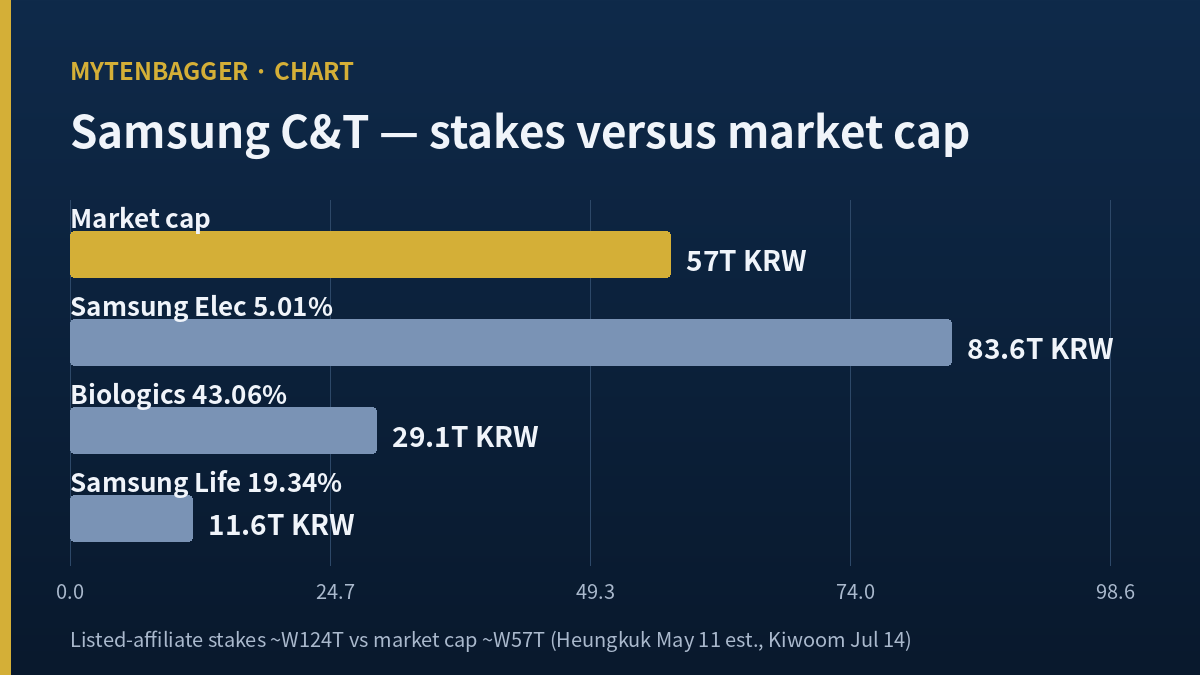
- Kiwoom data (July 14, 2026) puts the stock at ₩354,500 (about $257) and market cap near ₩57 trillion (~$41 billion). Korean sell-side Heungkuk tallied three listed stakes alone at about ₩124 trillion (~$90 billion) on May 11.
- My thesis breaks if the affiliate re-dividend never shows up as a real payout hike, or if the Samsung Electronics and Samsung Biologics stakes themselves crack.
When three numbers on one ticker point in different directions, I stop and look harder. Here is the set that stopped me. A stock that more than doubled over twelve months (Kiwoom: +112.8%). The same stock down 28.7% in a single month. And a company whose listed affiliate stakes alone are worth more than twice its market cap. That ticker is Samsung C&T (KRX: 028260), and the collision of “expensive momentum,” “sharp correction,” and “deep discount” in one name is exactly why I bought the dip instead of walking past it.
One line of context for readers outside Korea. Samsung C&T trades on the KOSPI, the main board of the Korea Exchange (KRX) — Korea’s large-cap market, the rough equivalent of the NYSE, as opposed to the tech-heavy KOSDAQ. The company is, in practice, the de facto holding company of the Samsung group: it runs its own construction, trading, fashion, and resort businesses while sitting as the anchor shareholder of Samsung Electronics, Samsung Biologics, and Samsung Life. So the share price is not explained by its own earnings alone. It moves with the value of the stakes it holds, and with how much of the cash from those stakes it hands back to shareholders. I split the story along those two axes.
I’ll be honest: I underrated holding-company discounts for years. I once bought a holding entity purely because it traded at half of net asset value, and I watched that discount sit there for years while neither dividends nor buybacks moved. Cheap and re-rating are two entirely different things — that episode taught me the difference the hard way. So this time I did not stop at “cheap.” I looked first for what would actually narrow the discount. I found an answer, which is why I’m writing this; if I hadn’t, I would have let it drift by, cheap and stuck.
Contents
Why I bought Samsung C&T in this pullback: three reasons

First: the gap between stake value and market cap got too wide
The stake value is what I weighted most. Korean sell-side house Heungkuk Securities, in a May 11 note, put the company’s investment-asset value near ₩133.1 trillion (~$96 billion). Break it down and, as Heungkuk framed it, the 5.01% Samsung Electronics stake was about ₩83.6 trillion, the 43.06% Samsung Biologics stake about ₩29.1 trillion, and the 19.34% Samsung Life stake about ₩11.6 trillion — all Heungkuk’s May 11 tally. The three listed stakes alone add to roughly ₩124 trillion (~$90 billion). Even on that same date, that is more than double the current market cap (Kiwoom: ~₩57 trillion).
Of course, that stake value moves every day with Samsung Electronics and Samsung Biologics shares. Part of why this stock itself fell so hard over the past month is the correction in those two names. So I don’t nail down “₩124 trillion” as a fixed figure. What stayed constant is that, whenever you take the snapshot, the market cap sits around half of the stakes’ value. Korean press (Insight and others) pegged the discount to net asset value in the mid-50s percent even when the stock was above ₩500,000. I read that discount as opportunity, not as a permanent tax.
Second: the engine that re-distributes affiliate dividends is hardening
Discounts don’t narrow on their own. Something has to convert stakes into cash in a shareholder’s hand. That trigger is re-dividending. Per Heungkuk’s note, the company returns 60–70% of the dividend income it receives from affiliates back to its own shareholders, and has committed to a minimum dividend of ₩2,500 per share. The actual payout has climbed three years running. On DART (Korea’s regulatory filing system) the dividend per share was ₩2,300 in 2022, ₩2,550 in 2023, ₩2,600 in 2024, and ₩2,800 in 2025.
Let me spell out why the mechanism matters. When this company receives a dividend from Samsung Electronics, that cash either piles up in its own coffers or flows through to shareholders. If it only piles up, the market shrugs and keeps the discount — “they’ll use it someday.” But once a rule says a large slice of received dividends goes back out as dividends, the distance between the cash the stakes generate and the cash a shareholder receives gets shorter. The shorter that distance, the less justification the discount has. What I actually bought here is that shortening process.
Here the Samsung Electronics variable enters. DS Investment & Securities, on June 18, raised its price objective to ₩620,000 from ₩380,000, citing a scenario in which Samsung Electronics pays large dividends across 2026–2028 and this company re-distributes much of what it receives. On that logic DS estimated a 2026 dividend per share of ₩23,050 (a yield near 4.8% on the price at the time). I do not adopt that ₩23,050 as my own number. It is DS’s estimate, and it hinges entirely on how much Samsung Electronics actually returns and how. But the direction — a thickening pipe from stakes to dividends — matched my thesis.
Third: the operating businesses were not at rock bottom
If you buy only for the stakes, that’s indirect exposure to Samsung Electronics and Samsung Biologics — nothing more. I wanted to check separately whether the operating businesses at least throw off cash. Q1 consolidated revenue was ₩10.47 trillion (~$7.6 billion), crossing ₩10 trillion for the first time (+7.5% year on year), and net profit was ₩1.086 trillion, up 15.9%. The trading division led with revenue up 19.7% to ₩4.11 trillion, and fashion grew double digits to ₩573 billion.
What honestly nags at me is construction. The construction division’s revenue fell 5.7% to ₩3.41 trillion, and the company cited one-off costs and the completion of major projects. That kept consolidated operating profit roughly flat at about ₩720 billion. Mirae Asset Securities, in its Q1 review, flagged that operating profit came in about 20% below the market’s expectation. I don’t dispute it. But trading and fashion filled the construction gap, and with the Pyeongtaek semiconductor plant work ramping from Q2, I read this as a one-quarter air pocket rather than a structural decline.
I also give the trading division more credit than the market seems to. In a de facto holding company, an in-house trading arm that grew revenue nearly 20% is a real, cash-generating business, not a rounding error — it partly funds the dividend without touching the stakes. That distinction matters to me: the more the operating cash covers the payout, the less the company has to lean on selling down stakes to keep its promise. A holding entity that can pay you from operations while the stakes compound is a cleaner structure than one that must liquidate to distribute.
Order intake wasn’t dry either. New orders of about ₩5 trillion (₩4.9 trillion in construction) came in during Q1, and multiple Korean sell-side notes share the view that order momentum in the Pyeongtaek chip lines and in nuclear/SMR builds picks up into the second half. I treat construction as this company’s weak link, not a dead one. If a weak link starts reconnecting within a quarter, that becomes an extra card the operating side deals — separate from the stake value.
Samsung C&T in numbers: Q1 results and stake value
| Item | Value | Source / attribution |
|---|---|---|
| Price / market cap | ₩354,500 / ~₩57tn | Kiwoom, 2026-07-14 |
| Q1 consol. revenue | ₩10.47tn (+7.5%) | company Q1 results |
| Q1 operating profit | ~₩720bn (−0.6%) | company / ~20% below consensus (Mirae Asset) |
| Q1 net profit | ₩1.086tn (+15.9%) | company Q1 results |
| Construction revenue | ₩3.41tn (−5.7%) | company Q1 results |
| PER / PBR / ROE | ~25x / 1.2x / 6.0% | Kiwoom (TTM) |
| Listed stakes (3) | ~₩124tn | Heungkuk Sec., 2026-05-11 |
| Dividend per share (2025) | ₩2,800 | DART |
Sources: Kiwoom, company Q1 results, Heungkuk Securities, Mirae Asset Securities, DART | As of July 2026. USD conversions approximate at ~₩1,380/$.
The cells I stared at longest are the PER of about 25x and PBR of about 1.2x. On its own earnings, this stock is not cheap. On a net-asset basis that layers in the stakes, it’s roughly half price. Same company, and whether you call it “expensive” or “half off” depends entirely on which yardstick you pick up. I picked up the stake-value yardstick and weighted it heavily.
Let me be precise about the yardstick problem, because it’s the crux. Earnings-based multiples treat this company as an under-earning industrial: a 6% return on equity and a 25x earnings multiple say “pass.” Asset-based multiples treat it as a discounted claim on Samsung’s crown jewels: half of net asset value says “load up.” Both are true statements about the same share price. What tips me toward the asset lens is the re-dividend policy, because it’s the bridge that turns the asset story into cash the earnings lens can eventually see. Without that bridge I’d stay on the earnings side and pass — and for years, on other holding names, that’s exactly where I sat.
One more cell: the yield. At today’s price, the 2025 dividend (₩2,800) is a yield below 1%. On that number alone there is no appeal. But if the re-dividend structure above actually starts turning, that figure is more likely at a floor than a ceiling. So I’m watching the direction of the dividend, not its current level. That’s where the investor who’s put off by today’s low number and the one who accumulates ahead of the direction part ways, as I see it.
A 54% holding discount: how I read it
A holding discount isn’t a curse. It’s a policy function — start returning cash and it compresses.
This is the part I most wanted to write. Holding companies trading below net asset value is not a Korean disease. Everywhere, holding and conglomerate structures get discounted when it’s unclear when the stakes turn into your cash — and the discount compresses when that cash-conversion path gets clearer. The cleanest recent analog is the Japanese trading houses (Mitsubishi, Mitsui and peers): after Berkshire Hathaway built stakes and the houses leaned into buybacks and dividends, their net-asset discounts narrowed materially. I read the Korean holding discount through the same grammar.
There’s a top-down tailwind I can’t ignore either. Since 2024 Korea has run a Corporate Value-up Program aimed squarely at the “Korea discount” — the chronic gap between Korean equity valuations and global peers, much of it concentrated in exactly these holding and cross-shareholding structures. The policy pushes listed firms to disclose capital-return plans and lift shareholder yield. I don’t treat a government program as a catalyst by itself; plenty of them fade. But it lowers the friction for a company already committing to re-distribute affiliate dividends, because the incremental disclosure and the governance nudges point the same way. When a policy tailwind and a company’s own policy line up, the discount has fewer places to hide.
Apply that grammar here and the policy of re-distributing 60–70% of affiliate dividends is precisely the device that makes the cash path clearer. Once the market believes it, a discount in the mid-50s percent has no reason to hold. That’s the same logic behind Heungkuk lifting its price objective to ₩580,000 from ₩400,000 while cutting the discount it applied to 35% from 52.7%. I don’t adopt that objective as mine, but I agree with the direction of applying a smaller discount. This is the step I take past where others stop at “holdings are just always cheap.”
Take it to the extreme and a holding entity that has earned deep trust in its capital allocation — Berkshire Hathaway is the obvious case — can trade near or above book. The size of a discount is ultimately the market’s scorecard on how faithfully management converts these assets into shareholders’ share. I read this company’s scorecard as one that had been marked low and is now ticking up, notch by notch, on the re-dividend policy. I don’t expect a perfect score. I do think the case for it sitting at half price gets weaker from here.
Samsung C&T stock: the three branches I see
My base case (probability 55%)
The re-dividend policy is confirmed as a real 2026 payout hike, and the Samsung Electronics and Samsung Biologics stakes hold their current level. The discount then compresses gradually toward net asset value. This is the path best supported by the data. In particular, if the year-end dividend decision confirms the policy in hard numbers, the market’s conviction accelerates and the discount compression comes forward. This is where I placed my weight.
Where I’m wrong (probability 30%)
Samsung Electronics dividends fall short of expectations, or a semiconductor/bio drawdown cuts the stake value itself. Net assets then shrink and the “half price” case weakens. Same result if the construction one-off costs don’t end in a single quarter. This is not a stretch — it’s a perfectly plausible road, and I keep it in view.
The rest (probability 15%)
The best case (10%) is Samsung Electronics announcing a larger-than-expected return that makes the re-dividend balloon. The worst case (5%) is a group governance issue reigniting and the stakes getting reclassified as a risk rather than an asset.
To make the bear leg concrete: the stake value is not a static cushion. Because the Samsung Electronics position dominates the sum, a sharp memory-chip downcycle would pull two levers against me at once — it would compress the stake value and, indirectly, soften the very Samsung Electronics dividend that feeds the re-dividend engine. That’s the correlation I respect most. The stakes and the payout are not independent bets; they lean on the same Samsung Electronics cash cycle. I sized my adds with that single-point sensitivity in mind, which is another reason I’m buying in tranches rather than a block.
Where my Samsung C&T thesis breaks

I anchor my breakpoints on events, not on a price. The first to answer is the dividend. Concretely, whether the 2026 year-end dividend meaningfully exceeds 2025’s ₩2,800 is my first checkpoint. If the re-dividend policy is not confirmed as an actual payout hike, the trigger for the discount to compress is gone, and I cut my weight. Next is the stake value. If Samsung Electronics or Samsung Biologics shares slide hard enough to break net assets, my premise that “the cap is half the stakes’ value” disappears. Last is the core business. If construction runs losses for consecutive quarters rather than one, or if new orders visibly dry up, the third leg — operating businesses backing the stakes — wobbles.
Among the three, I watch the dividend first and weight it heaviest. If the other two shake but the re-dividend is alive, I give it more time. If the dividend trigger snaps first, I dial the tone down even with the other legs intact. That ordering — dividend, then stakes, then operations — is where my stance sits right now.
So what I’m doing with Samsung C&T now
To pull it together: I’m scaling back into Samsung C&T across this roughly 29% pullback. The reasons are three — listed stakes worth more than twice the market cap, a re-dividend structure that pipes those stakes into payouts, and operating businesses that at least earn cash — and as long as those three point the same way, I hold. After a doubling, I’m not entirely comfortable, which is exactly why I’m not buying in one clip but adding in pieces.
The next checkpoints are clear: whether Q2 earnings show construction shedding its one-off costs, and whether the re-dividend size hardens into an actual dividend decision as the year closes. Those two are why I’ll reopen this journal next quarter. It would be a lie to say I have zero impatience after a two-bagger, but as long as all three legs are alive I’m trying not to flinch. I’m just accumulating at my own spot, on my own reasons.
Related reading
- SK Square Stock: NAV Discount Back to 43.8%
- Lotte Chilsung Stock: Interest Takes Half the Operating Profit
- Samsung Electro-Mechanics Stock: The Trigger Sits in Kyoto