Poongsan Copper and Tariffs: Inventory Equals 94% of Market Value
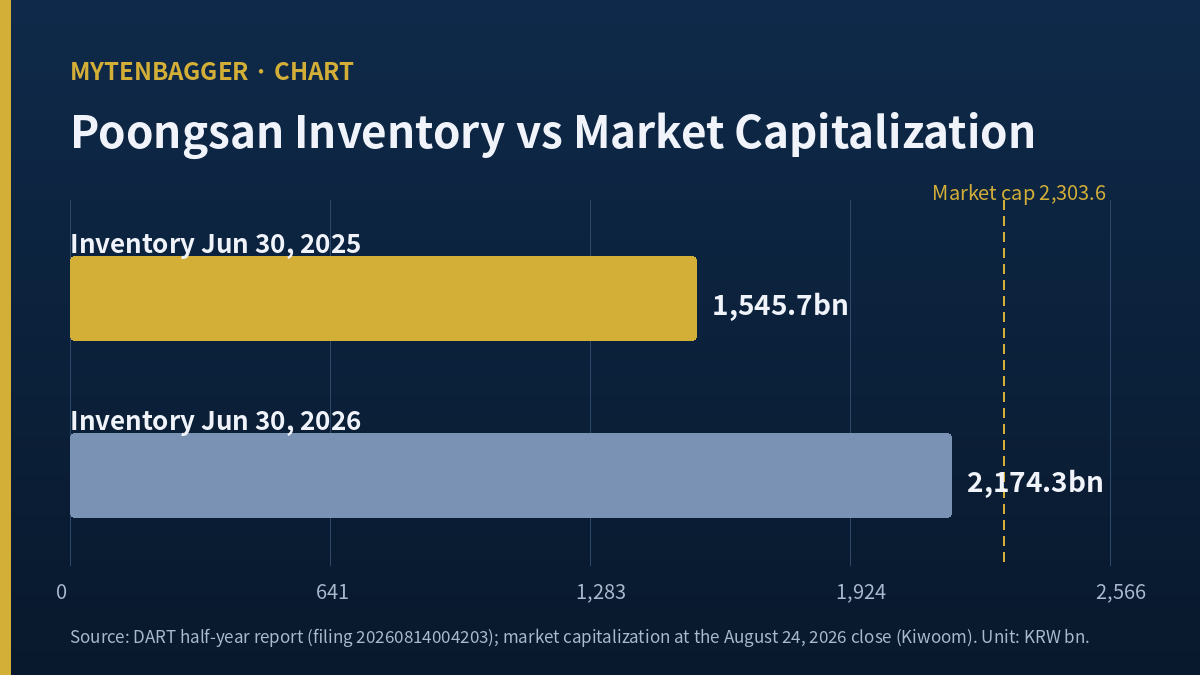
2,174.3 divided by 2,303.6 is 0.9439. I ran that division before I had decided what to do with it, and then I sat with the answer for a while. Both figures are in billions of Korean won. The one on top is the inventory line on Poongsan’s consolidated balance sheet at June 30, 2026. The one underneath is what the whole company was worth at the August 24, 2026 close. Poongsan stock, in other words, carries a warehouse of copper on its books that the market values at roughly what it values the entire business.
One sentence, three numbers under it
At the August 24, 2026 close, this company’s inventory was worth 94.4% of its market capitalization1, that inventory had grown 40.7% in twelve months while revenue grew 11.9%2, and the stock traded at 99.3% of its book value per share3.
- Inventory KRW 2,174.3bn (DART half-year report, filing 20260814004203) over market capitalization KRW 2,303.6bn (Kiwoom data, August 24, 2026 close).
- Inventory was KRW 1,545.7bn at June 30, 2025. First-half consolidated revenue went from KRW 2,449.9bn to KRW 2,741.2bn.
- Close KRW 82,200 on that date against book value per share of KRW 82,813 on the same data screen.
What follows is a watch note, and the thing I am watching is a ratio between two stock quantities, both measured at a point in time, neither of them a flow.
Contents
What the two numbers behind Poongsan stock actually are
Poongsan Corporation trades on the Korea Exchange under 103140. KOSPI is the main board of that exchange, the senior of Korea’s two markets, and the index most foreign allocations to Korea track. The company does two unrelated things: it fabricates copper into strip, sheet, tube, rod and wire, and it makes ammunition, from small-caliber sporting rounds through 155mm artillery shells.
The figure on top is the inventory line: KRW 2,174.3bn at June 30, 2026. That is 43.4% of the company’s KRW 5,005.2bn of total assets on the same date, by my calculation. Copper fabricators hold metal, so a large inventory line is not by itself surprising. What made me stop was the second number.
The figure underneath is market capitalization: KRW 2,303.6bn, which is the August 24, 2026 close of KRW 82,200 multiplied by roughly 28.02 million shares. In dollars, at the KRW 1,382.4 per dollar Seoul close on the same day, that is about USD 1.67bn of company against about USD 1.57bn of inventory. The two figures come from different sources and different moments in the reporting calendar, and I will come back to why that matters.
Poongsan stock’s inventory grew 40.7% while revenue grew 11.9%
Twelve months earlier, at June 30, 2025, inventory stood at KRW 1,545.7bn. It is now KRW 2,174.3bn. That is a 40.7% increase, computed by me from the two balance sheet dates. Over the same twelve months, first-half consolidated revenue went from KRW 2,449.9bn to KRW 2,741.2bn, an 11.9% increase, and first-half consolidated operating profit went from KRW 163.3bn to KRW 215.4bn, up 31.9%. Both revenue figures come from DART filings, the Korean regulator’s disclosure system.
Against the December 31, 2025 balance sheet, where inventory was KRW 1,623.4bn, the six-month build is 34.0%. So the stack did not accumulate slowly over years. Most of it arrived in the last two reported quarters.
Some of that is price. Copper on the London Metal Exchange settled at USD 14,291 per tonne on the cash contract on August 21, 2026, and the three-month contract was USD 13,888 on August 20, 2026, according to the International Copper Association Australia weekly brief of August 21, 2026 and Westmetall. On COMEX the metal was USD 6.58 per pound on August 24, 2026, 47.29% above where it sat a year earlier, per Trading Economics. A given tonnage of copper simply costs more to hold than it did.
But price is not the whole answer, because the third measure moved too.
Days of inventory went from 108.7 to 134.6
Inventory days here means the closing inventory balance divided by that single quarter’s revenue, scaled to a 91-day quarter. For the June 2026 quarter: KRW 2,174.3bn over KRW 1,470.3bn of quarterly revenue, giving 134.6 days. For the June 2025 quarter: KRW 1,545.7bn over KRW 1,294.0bn, giving 108.7 days. I have checked both divisions myself.
Twenty-six extra days of metal sitting in the system is the part that price alone does not explain. If copper had merely become dearer and volumes were flat, the days measure would have held roughly steady, because the same metal would be revalued on both sides of the fraction. It rose by a quarter instead. Something is moving through the plants more slowly, or more of it went in than came out.
I cannot tell you which, and I want to be precise about why: I have not opened the inventory note in the half-year report, so I do not know the split between raw metal, work in progress and finished goods, nor whether any valuation allowance was taken. The Taihan Cable position I looked at earlier this month had a similar kind of question and a very different answer to it, so I have learned not to assume the reason.
Poongsan stock and the rest of that balance sheet
| As at the August 24, 2026 close | Value |
|---|---|
| Share price | KRW 82,200 |
| Market capitalization | KRW 2,303.6bn (about USD 1.67bn) |
| Book value per share | KRW 82,813 |
| Price to book / price to earnings | 0.99x / 15.65x |
| Inventory, June 30, 2026 | KRW 2,174.3bn |
| Total assets / total equity, June 30, 2026 | KRW 5,005.2bn / KRW 2,444.6bn |
| Liabilities to equity, June 30, 2026 | 104.75% |
| Same measure, December 31, 2025 | 88.38% |
| First-half interest expense, 2026 versus 2025 | KRW 45.3bn versus KRW 26.5bn |
| FY2025 consolidated revenue / operating profit | KRW 5,048.6bn / KRW 297.4bn |
Prices and multiples reflect the August 24, 2026 close as checked at the time of writing. This piece is scheduled after it is drafted, so the live quote will have moved by the time you read it. Dollar figures are approximate conversions at about KRW 1,382.4 per dollar, the Seoul daytime close on the same date (BetaNews, August 24, 2026).
Inventory is KRW 2,174.3bn and equity is KRW 2,444.6bn, so the metal is 88.9% of the shareholders’ capital as well. Liabilities passed equity in the June quarter for the first time since the June 2022 quarter in the series I keep, and first-half interest expense rose 70.8% while first-half operating profit rose 31.9%. I am not claiming a causal chain from the metal to the borrowing, because I have not traced the borrowings to a use. I am noting that three lines moved in the same direction in the same six months.
The most interesting sentence available about this company this month is not in either flow statement; it is a single closing balance held up against a share price, and I would not have found it if I had kept to the usual order of reading and stopped when I got tired.
What the copper price and the US tariff do to Poongsan stock
The metal is close to record levels. Trade coverage of the metal put the three-month LME contract above USD 14,100 per tonne in mid-August 2026, up about 14% year to date, with COMEX September futures reaching USD 6.7140 per pound on August 12, 2026 (MINING.COM, August 14, 2026). Backwardation between the cash and three-month LME contracts reached the widest level since the 2021 squeeze in the week to August 21, 2026.
For a fabricator this cuts both ways within the same year. Rising metal inflates the margin on inventory bought earlier; a sharp spike produces hedging losses. Kwon Ji-woo of Hanwha Investment & Securities wrote in a February 12, 2026 note that a metal-price spike produced KRW 26.0bn of hedging losses in the fourth quarter of 2025 (Korean press coverage of the note). The same direction of travel gave the company a tailwind in one quarter and a charge in another.
The US tariff line on semi-finished copper
The 50% United States Section 232 duty on semi-finished copper products, in force since August 2025, still applies. From April 6, 2026 the dutiable base widened from the value of the metal content to the full customs value, and on June 8, 2026 the US-content threshold was eased from 95% to 85% (White & Case). The separate duty on refined cathode remains suspended and the Commerce review that was to inform it has passed its deadline without a published decision. Poongsan does not disclose what it has paid under any of this, so I have the rate and not the amount.
One paragraph on the June quarter, because it explains the copper
On July 31, 2026 the company reported consolidated second-quarter revenue of KRW 1,470.3bn, up 13.6% year on year, and consolidated operating profit of KRW 125.2bn, up 33.8% (ZDNet Korea). On a separate-entity basis, copper fabrication revenue was KRW 933.7bn, up 37%, on 47,300 tonnes shipped, while defense revenue was KRW 188.6bn, down 45% on inspection-testing delays at home and shipping delays through the Strait of Hormuz. The two segment figures add exactly to the KRW 1,122.3bn of separate revenue the company reported. That is where the copper volume in the inventory line is coming from, and it is as far as I will take the segment story here, because the company does not disclose operating profit by segment and the published estimates of the split disagree with one another.
How Poongsan stock has traded on three clocks
One month: up 26.07%. Three months: down 3.86%. Six months: down 25.20%. Twelve months: down 32.62%. All four are total-return figures on adjusted closes through August 24, 2026 from the price data I use. The twenty-day window is the odd one, with the stock up 20.35% against 8.80% for its non-ferrous metals peer group and 0.09% for the market, a gap the screen flags as company-specific.
Set against the 250-session range, the close of KRW 82,200 is 51.6% of the KRW 159,200 high and 48.9% above the KRW 55,200 low, both on adjusted closes and both computed against the same KRW 82,200 I have used everywhere in this note. A stock can be up a quarter in a month and still be at half its one-year high; that is what a 58% peak-to-trough drawdown leaves behind. I went through something structurally similar with POSCO Holdings in July, where a sharp fall and an improving operating fact arrived in the same weeks, and the lesson I took was that the two do not settle each other.
Two peer sets, because the two businesses have none in common
Most Korean industrials can be laid beside one comparator group. This one cannot, so I built two and kept them apart. I have converted nothing, which means I have also written no size multiples anywhere in this note: if I decline to put four currencies on one scale, I do not get to say one company is some number of times another. Fiscal year ends are given because three different ones appear across the seven peers and a fourth is unverified.
| Copper group, FY2025 | Year ended | Revenue | Reported profit line |
|---|---|---|---|
| Aurubis AG (ETR: NDA) | Sep 30, 2025 | EUR 18,171m | EUR 355m operating EBT |
| Wieland-Werke AG (private) | FY2024/25, month unverified | EUR 6,619m | EUR 707m operating EBITDA |
| Furukawa Electric (TSE: 5801) | Mar 31, 2026 | JPY 1,307,560m | JPY 63,856m operating profit (4.9%) |
| Nexans SA (EPA: NEX) | Dec 31, 2025 | EUR 6,098m standard sales | EUR 439m operating margin (7.2%) |
| Poongsan (KRX: 103140) | Dec 31, 2025 | KRW 5,048.6bn | KRW 297.4bn operating profit (5.89%) |
| Ammunition group, FY2025 | Year ended | Revenue | Reported profit line |
|---|---|---|---|
| Rheinmetall AG, Weapon & Ammunition segment | Dec 31, 2025 | EUR 3,532m | EUR 1,037m operating profit (29%) |
| Olin Corporation, Winchester segment | Dec 31, 2025 | USD 1,724.6m | USD 67.7m segment earnings, from USD 237.9m |
| Hanwha Aerospace (KRX: 012450) | Dec 31, 2025 | KRW 26,607.8bn | KRW 3,034.5bn operating profit |
Sources for the two tables, in order: Aurubis, Wieland, Furukawa Electric, Nexans, Rheinmetall, Olin. The Hanwha Aerospace figures come from Korean press reporting of the February 9, 2026 results release and not from the company’s own English filing, and I flag that because the rest of the table is drawn from primary documents.
Four caveats sit under those tables. Aurubis reports revenue that includes a large metal pass-through, so its profit line divided by its revenue is not comparable to anyone else’s. Wieland is privately held and gives an EBITDA measure. Two of the seven peer entries are segments of larger companies and not companies in their own right. And the Winchester line is worth holding beside the Rheinmetall line: civilian ammunition earnings fell 71.5% year on year while military ammunition profit rose about a third. Poongsan sells into both of those markets from the same plants.
What the Korean sell-side has put on Poongsan stock
| Note dated | House / analyst | Valuation | Rating |
|---|---|---|---|
| August 5, 2026 | Korea Investment & Securities / not confirmed | KRW 112,000 | not confirmed |
| August 4, 2026 | BNK Investment & Securities / not confirmed | KRW 100,000 | not confirmed |
| August 3, 2026 | Kiwoom Securities / Lee Jong-hyung | KRW 130,000 | Buy |
| July 21, 2026 | Hanwha Investment & Securities / Kwon Ji-woo | KRW 103,000 | not confirmed |
| April 20, 2026 | Meritz Securities / Jang Jae-hyuk | none given | Not Rated |
Four of those five were written inside the fifteen days from July 21 to August 5, 2026, and among those four the highest valuation is 1.30 times the lowest. The fifth house declined to put a figure on the company at all. On the numbers underneath, Kiwoom’s Lee Jong-hyung modelled 2026 consolidated revenue of KRW 6,211.9bn and operating profit of KRW 427.4bn (Etoday, August 3, 2026), while Meritz’s Jang Jae-hyuk had KRW 358.4bn of 2026 operating profit in the April note. The gap between those two operating profit estimates is 19.3%, by my calculation.
Separate books and consolidated books are not the same scale
The company’s own 2026 outlook, disclosed on February 4, 2026, is KRW 4,292.3bn of revenue on a separate basis. The broker estimates above are consolidated and sit above KRW 6,000bn. Putting the two side by side and concluding that the houses are far more optimistic than management would be an error of scale. In FY2025 the gap between consolidated revenue of KRW 5,048.6bn and separate revenue of KRW 3,849.1bn was KRW 1,199.5bn, or about 24% of the consolidated figure.
Twelve places this could be wrong
- The one that hurts most. The lower half of my ratio is a price. If the stock re-rates by a third, the 94.4% falls toward 70% with nothing inside the company having changed. That would make this note an observation about a quote and not about a business, which is not what I set out to write.
- Holding a lot of metal is the operating model of a copper fabricator. A high inventory-to-market-value figure may simply be what this industry looks like when the metal is expensive, and I have not built the comparison that would settle that.
- I have not opened the inventory note in the half-year report. The split between raw metal, work in progress and finished goods is unknown to me, as is any valuation allowance.
- Carrying value is not market value. Cost formulas and metal hedging both sit between the copper price and the number on the balance sheet.
- First-half operating cash flow was negative KRW 62.1bn. That sounds like support for a working capital story until you see that the same half of 2025 was negative KRW 130.7bn, which is worse. Negative half-year operating cash is ordinary at this company, so I did not build anything on it.
- My statement that liabilities last exceeded equity in the June 2022 quarter is bounded by my data, which starts in the first quarter of 2022.
- First-half interest expense rose 70.8% against a 31.9% rise in operating profit. I have quoted both and traced neither to a specific use of borrowings.
- The credit view runs against mine. NICE Investors Service raised the rating from A+ with a positive outlook to AA− with a stable outlook in April 2026 (Bloter, April 9, 2026).
- Segment operating profit is not disclosed, so my single paragraph on the June quarter rests on revenue only. Published estimates of how much of group profit the ammunition business contributes range from about 75% to about 90% depending on the outlet, which is a wide enough band that I have used none of them here.
- Korea Investment & Securities has been cited as guiding to KRW 415.3bn of third-quarter defense revenue, more than the first-half total for that business. If deferred shipments do come back, inventory could convert faster than this note assumes.
- The share count differs by source. My screen shows 28,024,331 shares and reconciles to the market capitalization to the won; WiseReport showed 28,024,278 as at August 21, 2026. Fifty-three shares changes nothing here, but it is the kind of gap that compounds if ignored.
- Copper near record levels is not a one-way risk. A fall would take the top figure down along with the earnings, so the ratio I am watching could close from the top as easily as from the bottom.
What would make this note obsolete. It is not an earnings miss and it is not a change in the copper price on its own. It is the figure underneath going away. If the shares re-rate on the defense narrative, on a resumed corporate action, or on nothing in particular, the ratio at the center of this piece stops being remarkable while every fact underneath it stays exactly where it was. That is the uncomfortable property of building an observation on a market price: the observation can be retired by the market without ever being refuted. The third-quarter report, due on or after Monday, November 16, 2026, because the statutory deadline of November 15 falls on a Sunday, will tell me whether the inventory started moving. The share price may make the question moot before then.
- KT Corp Q2 Earnings: Five Ways to Score One Korean Telco Quarter
- Why HD Construction Equipment Shares Fell on Q2 Earnings Day
- Why Korea’s SK Gas Shares Fell 11.41% as Finance Costs Rose