TKG Huchems AprilBio Investment Paid 2.1x the Current Price
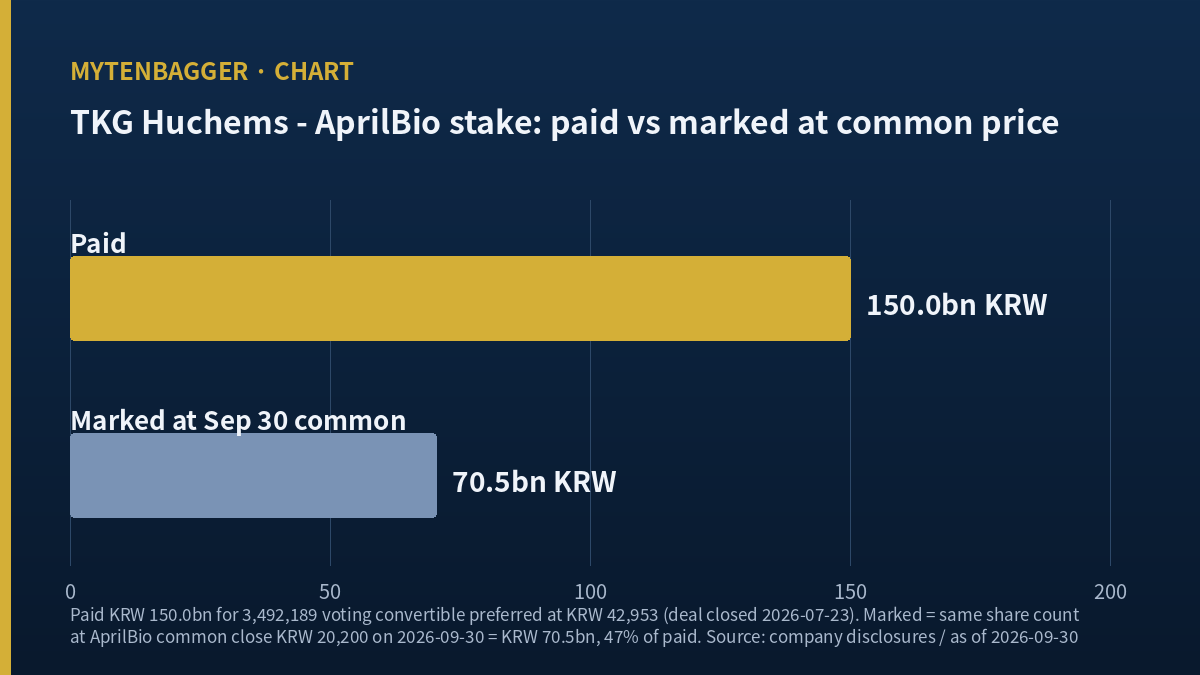
The TKG Huchems AprilBio investment closed on July 23, 2026 at KRW 42,953 per voting convertible preferred share, and on September 30 AprilBio’s listed common stock finished at KRW 20,200. If those 3,492,189 preferred shares turn into common one for one, they are worth about KRW 70.5bn (about $52.1m) at that close, or 47% of the KRW 150.0bn (about $110.9m) that TKG Huchems paid. That cost alone equals 23.3% of TKG Huchems’ own market value of roughly KRW 643.8bn ($475.9m).
I do not own TKG Huchems (KRX: 069260). I opened its file because of a six-percent dividend yield and ended up spending most of the evening on a biotech deal that a nitric acid producer signed in June. My stance is watch only. What follows is the asset side of that decision: what the company bought, how it paid, and what the stake looks like next to the price of the parent.
| Paid (KRW) | Preferred shares | Price paid | AprilBio common | Marked at common | Marked / paid | Buyer market value | Paid / market value | Cash + deposits, Jun 30 | CB face value |
|---|---|---|---|---|---|---|---|---|---|
| 150.0bn | 3,492,189 | 42,953 | 20,200 | 70.5bn | 47.0% | 643.8bn | 23.3% | 303.3bn | 50.0bn |
KRW. Marked value assumes a one-for-one exchange into common, which I could not confirm. Ratios are my calculations.
Contents
What the TKG Huchems AprilBio investment actually bought
TKG Huchems is a KOSPI-listed maker of basic and fine chemicals in Yeosu, on Korea’s south coast. KOSPI is the main board of the Korea Exchange, the rough local equivalent of the NYSE listing tier; AprilBio trades on KOSDAQ, the smaller growth board. The company sells nitric acid, DNT (an input for polyurethane chemicals) and related products, and it sits inside TKG, a family-controlled Korean group.
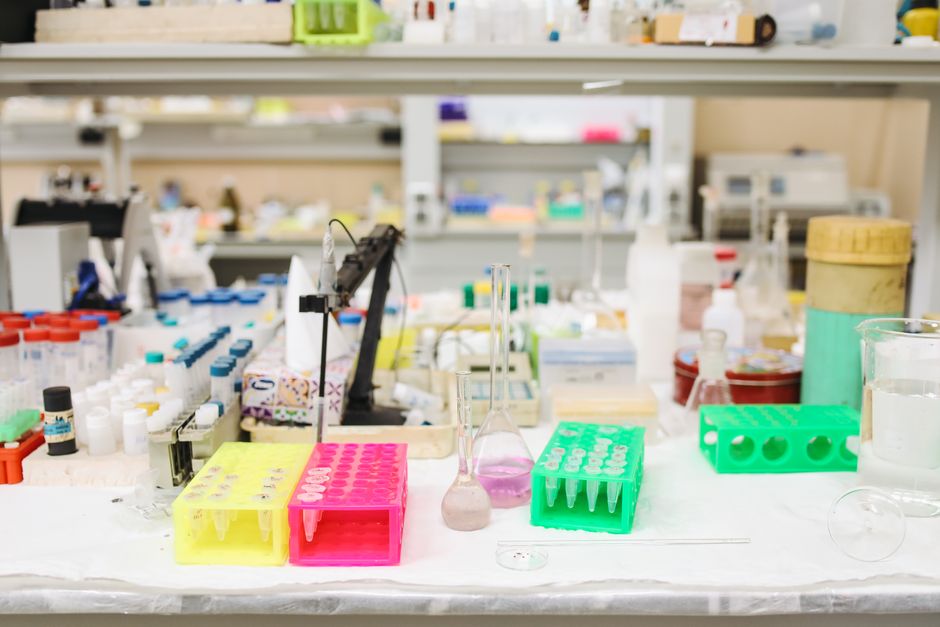
On June 25, AprilBio, a Seoul antibody developer that earns its revenue mainly by licensing drug candidates to larger drugmakers, announced a KRW 346.8bn ($256.4m) share sale to two buyers. Dailypharm’s report that day set out the pieces: IMM, a Korean private equity and venture group, took common shares at KRW 34,620 and non-voting preferred shares at KRW 40,908, while voting convertible preferred shares went out at KRW 42,953. TKG Huchems took 3,492,189 of those voting preferred shares. Multiplying the two gives KRW 149,999,994,117, which is the KRW 150.0bn figure every outlet reported.
It helps to see the whole share sale laid out, because the class of share is where the control sits. The numbers below are the three tranches Dailypharm listed, multiplied out by me.
| AprilBio tranche | Shares | Price (KRW) | Amount (KRW bn) | Buyer |
|---|---|---|---|---|
| Common | 4,095,456 | 34,620 | 141.8 | IMM |
| Non-voting convertible preferred | 1,222,254 | 40,908 | 50.0 | IMM |
| Voting convertible preferred | 3,608,595 | 42,953 | 155.0 | TKG Huchems 3,492,189; IMM venture fund 116,406 |
Source: Dailypharm, June 25, 2026. Amounts are shares times price, my arithmetic; the three sum to KRW 346.8bn.
Two points stand out. TKG Huchems holds about 96.8% of the voting preferred tranche, and that tranche carried the highest price of the three. In other words, the buyer that took the most expensive class is also the one that got the board seats. IMM’s cheaper common made it the largest holder by share total, but it is TKG Huchems that names the directors.
The money arrived on July 23. Edaily reported the payment and the governance terms in the same piece: an IMM vehicle becomes the largest shareholder, TKG Huchems nominates three of AprilBio’s five directors, and every new share is locked up for one year. The new common shares were set to list on August 13.
So the stake gives TKG Huchems control of the board with roughly one-tenth of the equity. A separate report put its post-deal holding at 10.8% of common-equivalent shares and 11.2% of voting rights. I want to be careful here: control of a board is valuable only if the company it controls produces something, and AprilBio reported 2025 revenue of about KRW 2.17bn (a 92% drop from the year before, per AlphaSquare’s company page). Its value sits in licensing deals, and sales barely register.
The board majority raises an accounting question that I cannot answer yet and that could matter more than the share price. Korean listed companies report under IFRS. Under those rules an investor that holds 20% or more is usually presumed to have significant influence and uses the equity method, and an investor that can direct the investee’s key activities, for example through a board majority, may have control and have to consolidate it, whatever its percentage. TKG Huchems holds about a tenth of the shares but names three of five directors. If its auditors conclude that this is control, AprilBio’s cash of roughly KRW 440bn and its research losses would sit inside TKG Huchems’ consolidated statements, with most of the equity shown as non-controlling interest. If they conclude it is significant influence, the stake appears as one line and TKG Huchems records its share of AprilBio’s losses. If neither, it is a financial asset marked to a fair value. Each treatment gives a very different picture of the same KRW 150.0bn, and the third-quarter report is the first place the choice will show. I am not guessing which one applies; I am noting that the call-and-put arrangement with IMM also feeds into that judgment.
The TKG Huchems AprilBio investment and how it was paid
The check was large for this company. At the end of March, according to Etoday’s June 25 report, cash and equivalents were KRW 39.3bn and short-term financial assets were about KRW 226.1bn. The June 30 balance sheet on Valueline, a Korean financial data site, shows cash of KRW 123.3bn and short-term deposits of KRW 180.0bn, a total of KRW 303.3bn (about $224.2m).
The June balance sheet before the cash went out
Because the payment happened on July 23, the June 30 figures still include the KRW 150.0bn. Subtract it and the two lines fall to about KRW 153.3bn, before whatever the chemical business earned or spent in July through September. I will not know the actual September figure until the third-quarter report, which is due by November 16.
There is a second way to see the size of this outflow. The company has paid the same per-share dividend for seven years, which at today’s share total comes to about KRW 40.9bn a year in cash. The AprilBio payment equals roughly three and two-thirds years of that dividend. Put differently, at today’s share total the company wrote one check in July that was larger than three full years of those dividends combined.
Total equity attributable to owners was KRW 939.65bn on June 30. The AprilBio cost is 16.0% of that. Total assets were KRW 1,285.78bn. The stake is not a rounding error on either measure.
For a chemical company with a similar asset read, I looked back at Lotte Fine Chemical, where the question was whether a low price relative to net assets reflected one weak business line. At TKG Huchems the question is different. The chemical business had a strong first six months; the uncertainty sits in a new asset outside that business.
The convertible bond and the share total
In April the company sold a KRW 50.0bn private convertible bond to J&Alpha, a vehicle set up by the private equity firm J&PE. The June balance sheet carries it at KRW 40.96bn as a liability, which is what you would expect when part of a convertible’s value is recorded in equity. Etoday described the bond as help that lightened the funding load of the AprilBio purchase.
A Korean news headline on April 27 said J&Alpha’s total holding in TKG Huchems had reached 6.45%. I could not open the underlying disclosure, so I do not know the price at which the bond turns into shares. If that 6.45% is measured on a diluted basis, with the bond shares added to both sides, it implies about 2.82 million new shares and an exchange price near KRW 17,740. That is my derivation from a headline, and I am not putting weight on it. What I can say is that there is a pending share-total change of several percent, and every per-share number in this piece uses today’s 40,878,588 shares.
The TKG Huchems AprilBio investment against the parent’s market value
TKG Huchems closed at KRW 15,750 on September 30 (Wed), the figure shown by AlphaSquare and Korea Economic TV; Kiwoom daily data shows KRW 15,760 and Valueline KRW 15,790. With 40,878,588 shares listed, the market value is about KRW 643.8bn. Against equity attributable to owners of KRW 939.65bn, the stock trades at about 0.685 times net assets by my calculation.
Here is the part that made me slow down. The company spent an amount equal to 23.3% of its own market value on one minority stake. If I mark that stake at AprilBio’s September 30 common price, it is 11.0% of TKG Huchems’ market value. The other 12.3 percentage points are, for now, a gap between what was paid and what the listed market currently says a similar share is worth.
I tried the comparison two ways because the securities are different. The preferred shares carry voting rights and a board majority; AprilBio’s listed common does not. Paying more than the common price for control is normal. What is less normal is the size of the gap: the preferred price was already 24% above the common issue price on the same day (42,953 against 34,620), and since then the common has fallen to 20,200. AprilBio’s own common closed at KRW 38,500 on June 25, the announcement day, per Kiwoom daily data. The listed price has lost about 48% since.
Korean chemical names with more net assets than market value are not rare right now. Korea Petrochemical traded at about 63% of its current assets in mid-September. What sets TKG Huchems apart is that a large part of its recent capital went into something no chemical screen will value.
I laid the AprilBio common closes against the price TKG Huchems paid, using Kiwoom daily data, because the path matters as much as the endpoint.
| Date (2026) | AprilBio common close (KRW) | As % of 42,953 |
|---|---|---|
| June 25, deal announced | 38,500 | 89.6% |
| July 23, money paid | 26,550 | 61.8% |
| August 13, new common listed | 29,150 | 67.9% |
| September 30 | 20,200 | 47.0% |
Closes from Kiwoom daily data (September 30 also matches AlphaSquare). Percentages are my arithmetic.
The common never closed at or above the preferred price after the announcement; its highest close in that stretch was KRW 42,600 on June 29. Even on the day the deal became public, the market paid about 90% of what TKG Huchems agreed to pay. That tells me the gap was not created by a later collapse alone; part of it was there from the start and probably reflects the value of control and the one-year lockup.
The use of the money matters too. Bloter’s report on the deal said AprilBio plans to put the proceeds into research at a pace of KRW 13.3bn in 2026, KRW 50.7bn in 2027 and KRW 282.7bn from 2028 onward. Most of the cash TKG Huchems helped raise will not be spent, let alone turned into results, for two years or more. As a holder of the parent, I would be waiting on a timetable measured in trial phases.
A peer that also bought outside its core
The closest reference I found is Orica (ASX: ORI), the Australian explosives and mining chemicals group, which agreed in February 2024 to buy Cyanco, a US sodium cyanide producer, for US$640m. International Mining reported that the deal was largely paid from existing cash and undrawn debt lines, alongside an A$400m placement of new shares.
I am not comparing valuations or profits between the two companies. The point of the peer is the funding mix. Orica stayed inside mining customers and still chose to issue equity for part of the price. TKG Huchems moved much further from its customers, into drug discovery, and paid with cash on hand plus a bond that can become equity. Both routes end with existing shareholders owning a smaller slice if the new shares appear. The difference is that Orica’s buyers of new stock paid a known price on day one, while TKG Huchems’ future dilution depends on an exchange price I have not seen.
There is also a nitric acid link that I did not expect. Nitric acid is the feedstock for ammonium nitrate, which is what mining explosives are made from. On September 28 TKG Huchems disclosed a ten-year nitric acid supply deal with an Indonesian ammonium nitrate plant owned by the Bakrie group, starting March 31, 2029 (Seoul Shinmun). That deal lives in the chemical business. It does not change the AprilBio arithmetic, and it starts two years after a long-running DNT contract with OCI ends on its original end date, March 28, 2027 (EBN on OCI’s exit from TDI).
Three ways the TKG Huchems AprilBio investment could play out
These probabilities are my own guesses about the twelve months to September 2027. I cannot defend them with a model.
Central case, about 50%
AprilBio keeps spending its roughly KRW 440bn of post-deal cash on trials, the common trades in a band that stays well under the preferred price, and TKG Huchems carries the stake at a value its auditors accept without a large write-down. The chemical business decides the share price, and the market treats the stake as a side detail. In this case the gap between price and net assets stays wide, and I keep watching.
Worse case, about 30%
AprilBio’s common stays near KRW 20,000 through year-end and TKG Huchems has to record an impairment or a fair value loss on the stake in its annual accounts. Against 2025 net profit attributable to owners of about KRW 59.4bn, a loss even a third the size of the gap between cost and the common mark would be felt. At the same time, the bond holder converts, adding shares. That combination is what I most want to rule out before buying.
The other 20% covers the better case: a new licensing deal lifts AprilBio’s common back above the price TKG Huchems paid, and the stake becomes a source of value that the market does not currently credit. I cannot put a date on that.
Where I could be wrong
- The one-for-one exchange assumption may be wrong. If each preferred share turns into more than one common share, the marked value rises in proportion.
- Marking a controlling, locked-up preferred stake at the listed common price may understate it. Control has value, and the lockup means TKG Huchems was never going to sell in 2026 anyway.
- AprilBio has licensed candidates to Lundbeck and Evommune, with reported cumulative deal values up to $923m. One milestone payment could move its common far more than any chemical data point moves TKG Huchems.
- The chemical business may absorb all of this. April to June operating profit was KRW 32.8bn against roughly KRW 22.0bn a year earlier, per the company’s preliminary results.
- My read of the convertible bond is thin. If the exchange price is well above today’s share price, the dilution may never happen.
Ten checks on the TKG Huchems AprilBio investment
- How the third-quarter report (due November 16) classifies the stake: subsidiary, associate, fair value through profit, or fair value through other comprehensive income.
- The carrying amount of the stake at September 30.
- Cash and short-term deposits at September 30, against my estimate of about KRW 153.3bn before operating cash.
- The exchange ratio of the voting preferred shares into common.
- The exchange price and exercise window of the April convertible bond.
- Any exercise notice from J&Alpha.
- The terms and trigger dates of the call and put options between TKG Huchems and the IMM co-investors.
- AprilBio’s next licensing announcement or milestone payment.
- The 2026 year-end dividend decision (seven straight years of the same per-share payout through 2025).
- Whether a new DNT customer appears before March 28, 2027.
Items 1 through 3 arrive together in November and matter most. Item 1 decides whether AprilBio’s price swings flow straight into TKG Huchems’ profit line.
Why I am staying on the watch list
A dividend yield above six percent was what made me open the file, and it is the same dividend that makes me cautious now. A company paying out close to seventy percent of its profit (about KRW 40.9bn of dividends against 2025 net profit attributable to owners of KRW 59.4bn) and also spending 23.3% of its market value on a biotech stake is using the same cash twice. I first read the stake as a side bet that the chemical business could easily carry. After laying the cost next to the parent’s market value and the June cash balance, I changed my mind: the stake is large enough to shape the next two annual reports on its own.
So I am not buying at KRW 15,750 ($11.64). I will reopen this entry when the September 30 balance sheet shows me the stake’s carrying value and the cash that was left after paying for it. If that report also names the accounting treatment, I will know which of the three pictures above I am actually looking at, and that single choice will tell me more than any move in AprilBio’s share price between now and then.
Prices and multiples reflect the September 30, 2026 close. Dollar figures are approximate, at roughly ₩1,352.8 per dollar, the Seoul market close that day. Company figures are consolidated. Percentages marked as mine are rounded calculations from the cited numbers.