LX International Dividend Reveals 2.79 Million Treasury Shares
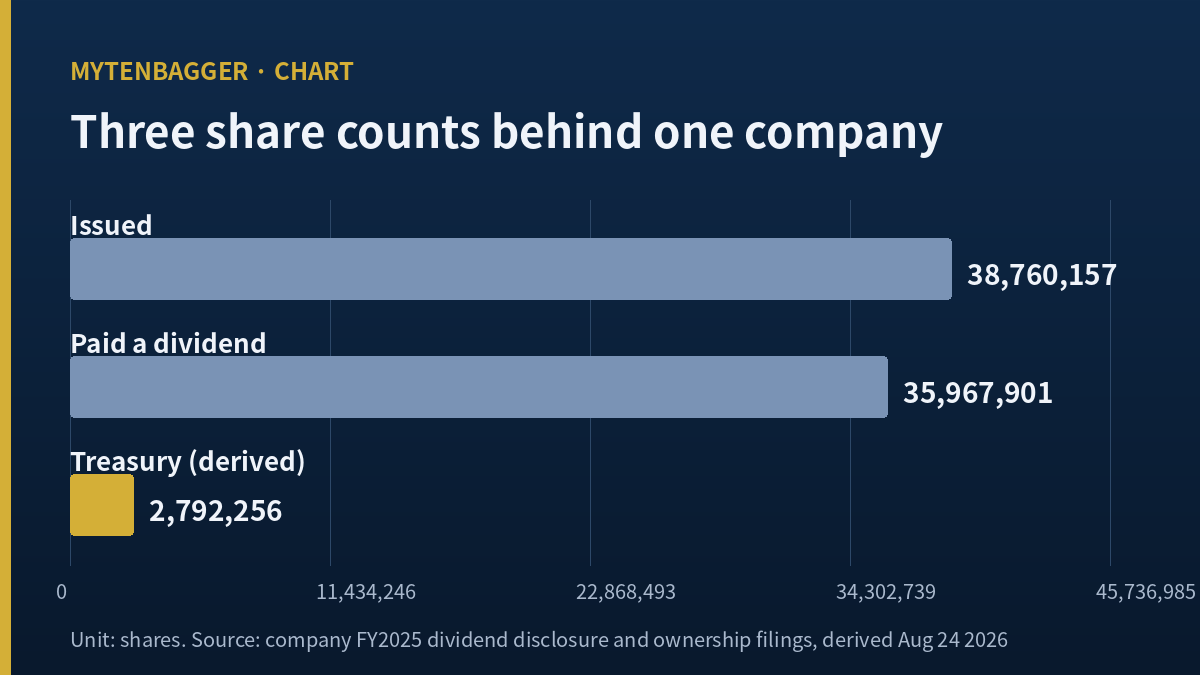
I went looking for one number in LX International stock and could not find it anywhere. How many of its own shares does the company hold? The Korean filings I can reach give the share count as 38,760,157. They give the largest holder, LX Holdings, at 27.83 percent. They give a free float. Nowhere in the pages I opened does a treasury figure appear as a figure. So I went at it sideways, through the dividend, and the number that came back was 2,792,256 shares.
One division, checked twice
Route A: dividend cash of 71,935,802,000 won divided by 2,000 won a share = 35,967,901 shares paid. Subtract from 38,760,157 issued: 2,792,256.
Route B: 38,760,157 issued minus 25,180,602 free float minus 10,787,300 held by LX Holdings: 2,792,255.
The two routes land one share apart. Everything below is built on that number, and I derived it; the company did not hand it to me.
Contents
LX International stock and a number the filings do not give me
LX International trades on the KOSPI, the senior board of the Korea Exchange, under code 001120. It is one of Korea’s general trading houses, the local answer to Mitsubishi Corporation or Itochu: it moves coal and nickel out of Indonesia, runs a logistics arm called LX Pantos, and trades IT components and petrochemicals. It carried the LG name until the group split in 2021, which matters when you search for it, because older material files under LG International.
I closed Monday, August 24, 2026 with the shares at 38,150 won and a market value of 1,478.7 billion won, roughly 1.07 billion dollars. That market value is the issued share count multiplied by the close. The dividend, by contrast, is paid to a smaller number of shares. Once I noticed that gap I could not stop pulling on it.
The share count is what I got wrong, and I want to write that down plainly. I had been treating “shares outstanding” as a single fact about a company, the way I treat its founding year. It is not one fact. It is at least two, and which one a screen has quietly picked determines whether the earnings per share I am reading is 3,659 won or 3,943 won. Both of those numbers are published. Both are correct. I had never once asked which share count produced the one in front of me.
Dividing the LX International stock dividend by the dividend per share
The arithmetic
For the 2025 financial year LX International paid 2,000 won a share, unchanged from 2024, and the company’s own investor page puts the total cash out at 71.9 billion won, paid on March 26, 2026. Divide 71,935,802,000 by 2,000 and you get 35,967,901. That is how many shares actually collected the dividend. Issued shares are 38,760,157. The difference, 2,792,256 shares, is 7.2039 percent of the company and collected nothing, because a company does not pay a dividend to itself.
Two more routes that agree
I did not want to publish a derived number with a single support under it. The second route is ownership arithmetic: issued shares minus the free float of 25,180,602 minus LX Holdings’ 10,787,300 leaves 2,792,255. One share apart from route A, which is what rounding in a percentage-based float figure will do.
The third route is the company’s own per-share disclosures. Its Korean annual filing reports earnings per share of 3,943 won and book value per share of 77,069 won for 2025. Owners’ net profit that year was 141.81 billion won and owners’ equity was 2,772.0 billion won. Divide each by 35,967,901 and I get 3,942.68 and 77,068.66. Both round to the published figures. Divide them instead by all 38,760,157 issued shares and I get 3,658.65 and 71,517, neither of which the company printed. So the company computes per-share figures on the smaller count, and my derived treasury number is the thing that makes its arithmetic close.
Two share counts behind LX International stock, and four ratios
| Ratio | On 38,760,157 issued | On 35,967,901 paid |
|---|---|---|
| Earnings per share | 3,659 won | 3,943 won |
| Book value per share | 71,517 won | 77,069 won |
| Price to earnings | 10.43x | 9.68x |
| Price to book | 0.533x | 0.495x |
Earnings and the multiple
The screen I use shows 3,659 won and 10.43 times, so that screen is on the issued count. The company’s filing shows 3,943 won, which puts the multiple at 9.68 times against Monday’s close. The spread between the two multiples is 7.76 percent, and 7.76 percent is exactly 38,760,157 divided by 35,967,901. Every gap in this table is that same ratio wearing different clothes.
Book value, where the difference is largest in won
Book value per share moves 5,552 won between the two share counts. That is more than a seventh of the entire share price. For a company that trades below half of its own owners’ equity, I care which of those two book values a valuation screen has silently chosen, because the answer decides whether I am told this is a 0.495 times business or a 0.533 times business.
The dividend yield is two numbers too
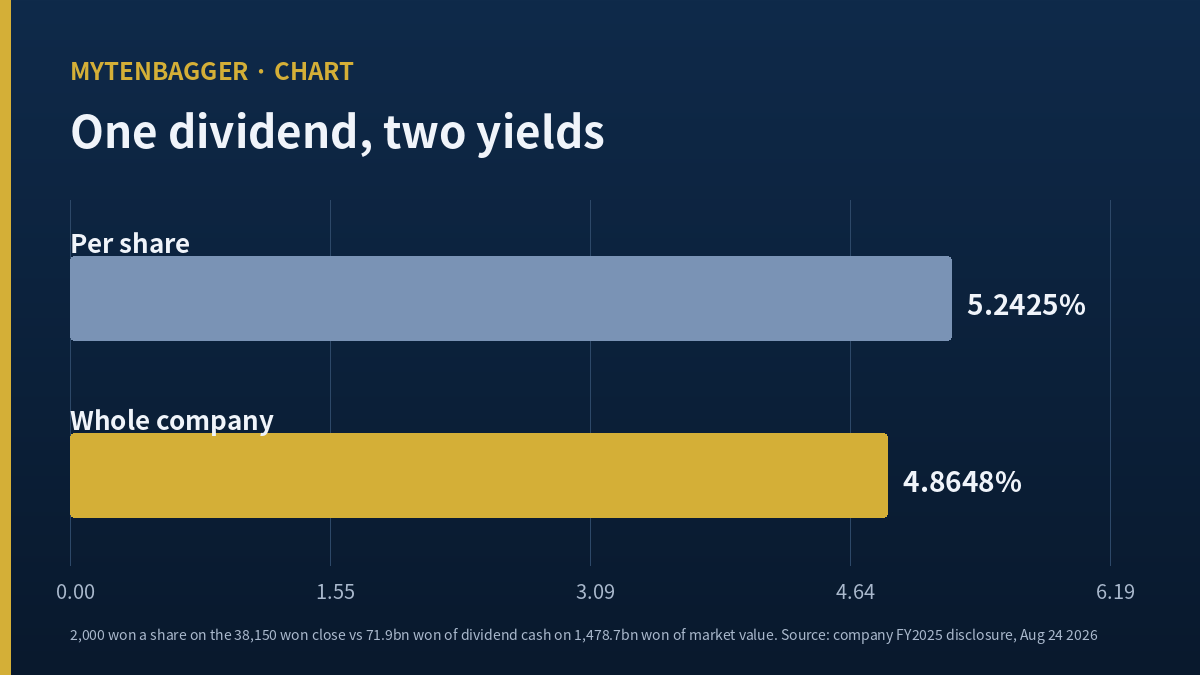
Two thousand won against a 38,150 won close is a 5.2425 percent yield. But the cash that actually left the company, 71.9 billion won, against the full market value of 1,478.7 billion won, is 4.8648 percent. A buyer of the whole company at Monday’s close would collect 4.8648 percent; the 5.2425 percent belongs to a per-share view. The ratio between them is 1.07763, the same 7.76 percent again.
What cancellation would do to the table
I know of no plan to cancel these shares and I am making no forecast about it. The arithmetic of a cancellation is still worth writing out, because it shows what the two columns above really are. Retire 2,792,256 shares and the issued count becomes 35,967,901. Earnings per share is then 3,943 won at every screen instead of only in the company’s filing. Book value per share is 77,069 won everywhere. The multiple on Monday’s close reads 9.68 times and the price-to-book 0.495 times, with no change whatsoever to profit, equity, revenue or cash.
The neatest consequence is in the dividend. Market value at the same 38,150 won price would fall to 1,372.2 billion won, and 71.9 billion won of dividend against that is 5.2425 percent, which is exactly the per-share yield. The two yields I separated above collapse into one number the moment the shares stop existing. That is the cleanest proof I have that the gap between them was never about the dividend at all; it was about how many shares were standing between the cash and the market value.
What the shares are worth sitting there
At 38,150 won, those 2,792,256 shares carry a market value of 106.5 billion won, about 77 million dollars. They pay no dividend, they carry no vote while held, and I could find no disclosure of any plan to cancel them or sell them. They are simply a seventh of the market value doing nothing that I can see.
What that dividend actually costs the company
Seventy-one point nine billion won is 50.73 percent of the 141.81 billion won of profit attributable to owners in 2025. The company has now paid 2,000 won a share for two consecutive years while that profit fell, which is why the payout ratio climbed from roughly 41 percent on the 2024 result to just over half on the 2025 one. Operating profit for 2025 was 292.2 billion won, down 40.27 percent from 489.2 billion won in 2024, on revenue of 16,706.3 billion won that barely moved.
The interest line deserves a warning label. The 2025 consolidated statements show finance costs of 444.8 billion won against operating profit of 292.2 billion won, and if I stopped there I would have written that this company cannot cover its interest. Finance income the same year was 318.6 billion won. Net finance cost is 126.2 billion won, and the company’s published interest coverage of 2.3 times reproduces as 292.2 divided by 126.2. Trading houses run trade finance in both directions and both directions show up gross. Total borrowings did rise 34.46 percent in 2025, to 1,740.8 billion won, and that part is real.
Two more balance-sheet facts sit behind that. Net borrowings stood at 1,446.7 billion won at June 30, 2026 and the debt ratio was 165.42 percent on the consolidated June accounts. And all three Korean credit rating agencies carry this issuer at AA minus: NICE Investors Service on April 3, 2025, Korea Ratings and Korea Investors Service on April 2, 2025. I could not find the outlook attached to any of the three, so I am reporting the grades without them. An AA minus domestic grade alongside a 0.95 percent net margin is a combination worth holding in mind: the agencies are looking at asset coverage and group standing, and I am looking at what the operations return.
Where the profit behind LX International stock came from in June
Against the March quarter
The results pack the company issued on Monday, August 3, 2026 splits operating profit three ways. June quarter: logistics 51.0 billion won, trading and new business 45.2 billion, resources 21.6 billion, total 117.8 billion. March quarter: 33.4, 43.4, 32.1, total 108.9. So group profit rose 8.9 billion won while the resources segment fell 10.5 billion. Logistics added 17.6 billion and covered it. The company puts the resources decline down to lower coal output and the logistics gain down to container freight, noting the SCFI index ran 39.1 percent above the year-earlier quarter.
Against the June 2025 quarter
A year earlier the same three segments were 34.9, 11.4 and 8.7 billion won, for a total of 55.0 billion. The 62.8 billion won of year-on-year growth breaks down as trading 33.8, logistics 16.1, resources 12.9. Measured against the previous quarter the driver is logistics; measured against the previous year it is trading. Resources comes third on both measures, and third in all three quarters I laid out. That is the finding the Korean-language edition of this note is built around, and I mention it here because it is the reason I went looking at the balance sheet at all.
I have written before about how far a freight index can be pushed as evidence, in a note on a Korean shipping name whose smallest quarter was also its best. Freight moves a quarter hard and gives no undertaking about the next one.
One gap in that quarter I could not close. Operating profit rose 114.2 percent against the year-earlier quarter while net profit rose only 40.05 percent, from 56.2 billion won to 78.8 billion. Something between the operating line and the bottom line absorbed most of the improvement, and neither the results pack nor the Korean coverage I read explains which item did it. Finance costs, equity-method results and tax are the obvious candidates and I can rank none of them without the interim notes. I am recording the gap and leaving it open, because a 74 percentage point difference between two growth rates is not a rounding matter.
Coal went up and the mining profit went down
Newcastle coal futures settled at 131.50 dollars a tonne on Friday, August 21, 2026, 18.15 percent above the year-earlier level. Indonesian thermal coal also ran above the prior year through the June quarter. And the resources segment still fell 32.71 percent against the March quarter.
Volume is the company’s explanation, and policy sits on top of volume. Indonesia began routing coal exports through a single state channel on Monday, June 1, 2026; Newcastle went from about 134 dollars to the 150s during that month. The force that raised the price and the force that constrained the tonnage came from the same place. When Samsung Securities widened its discount against resource comparables on Tuesday, August 4, 2026, the variable its analyst singled out was Indonesian approval of additional production quota. That reading and mine point at the same square.
Five Japanese houses, and the column I did not build
| Company | Year end | Net margin | Return on equity |
|---|---|---|---|
| Itochu (8001) | Mar 31, 2026 | 6.07% | 14.6% |
| Marubeni (8002) | Mar 31, 2026 | 6.58% | 13.6% |
| Mitsubishi (8058) | Mar 31, 2026 | 4.23% | 8.5% |
| Mitsui (8031) | Mar 31, 2026 | 5.96% | 10.2% |
| Sumitomo (8053) | Mar 31, 2026 | 8.18% | 12.9% |
| LX International | Dec 31, 2025 | 0.95% | 4.48% |
Why there is no operating profit column
I wanted one and could not have it. Four of these five Japanese houses do not present an operating income line at all: their income statements run from gross profit through selling costs and other items straight to profit before tax. Itochu shows a line it calls trading income, which is its own construction. Marubeni does print an operating profit and attaches a footnote saying it does so for the convenience of Japanese investors and that the item is not required under its accounting standards. Putting LX International’s 292.2 billion won of operating profit next to those would have been five different definitions in one column, so I deleted the column and kept only the two lines every one of them publishes.
What the two surviving columns say
The five Japanese net margins run from 4.23 to 8.18 percent. Mine reads 0.95 percent. Returns on equity there run from 8.5 to 14.6 percent against 4.48 percent here. I take the margin gap less seriously than it looks, because trading houses recognize revenue on wildly different gross-versus-net conventions and a margin is a ratio to whichever revenue definition a company chose. The return on equity gap is the one I weigh, because equity is equity. Mitsubishi’s own results release is where its figures come from.
Where LX International stock sits in the index products
The ETF holds a different Korean trading house
POSCO International, the other listed Korean general trading house, is in those holdings at 0.24 percent. So the sector shows up in that fund; this particular company does not. For the Franklin FTSE South Korea ETF I could only see the published top 25 positions as of Thursday, August 14, 2026, and LX International is not in those 25; the remaining names in its 162-holding portfolio I could not open, so I am not claiming either way.
The three places this can be wrong
- The whole piece rests on a number I made. If LX International discloses a treasury count that differs from 2,792,256, then the earnings per share, book value per share, both multiples and the dividend comparison above all sat on a share count I invented. Three routes agreeing gives me reassurance. It does not give me disclosure.
- The 71.9 billion won dividend total and the 25,180,602 free float both come from secondary presentations of Korean filings, one step removed from the documents. I could not open the primary Korean regulatory database from here. If either input is stale by a share issue or a buyback I did not see, route A and route B would both drift in the same direction and their agreement would prove nothing.
- Nothing here says the treasury holding will be canceled, and I have assumed no view on it. Cancellation would lift earnings per share by 7.76 percent with no operating change whatsoever; a sale into the market would do the reverse to the float. The disclosure list for the last 90 days contains no buyback, no cancellation, no issue and no split, but absence in a summary index is weaker evidence than a statement, and I did not read the underlying documents.
Values I looked at and left out
The screen’s book value per share of 72,567 won matches neither of the two counts I derived, so I left it out entirely. A recovery-from-trough field in my benchmark tool returned a figure I could not reproduce from the peak, trough and current prices, so that went out too. Three-year revenue growth and the payout-ratio field carried definitions I could not pin down. I ran into the same kind of gap in a Korean materials name whose screen ratios stood on a balance sheet that a capital raise had already overtaken, and the lesson repeats: a published ratio is a division, and you do not know it until you know both of its inputs.
My standing position on LX International stock
At about 1.07 billion dollars of market value this sits well down the Korean board, and watching is my default for names that size. What I take away is narrower than a view on the business: when a company publishes per-share figures on a share count it never names, I do not use anyone else’s per-share figures until I have rebuilt that count myself. That is a rule about my own procedure, and this company is where I learned it.
Here is the condition that breaks the piece. If LX International discloses a treasury share count materially different from 2,792,256, then three independent routes agreed on a wrong number, and every ratio in the table above was computed on a share count that does not exist. That would not be a small correction. It would mean the method was the error, and I would rather find that out from a filing than keep the table.
Prices and multiples here reflect the Monday, August 24, 2026 close as I checked them while writing; this note may appear later than that, so live quotes will differ. Financial figures come from the company’s consolidated Korean filings and its own results presentations. Korean won is the reference currency; where a dollar figure appears it is an approximation at about 1,382.4 won per dollar, the Seoul market close on the same date, and is offered only to give a sense of scale.
- Korean Fashion Firm F&F Buys the Discovery Expedition Brand
- Hyundai Department Store Buyback: Shares Not Yet Canceled
- Sajo Daerim Dividend Yield 0.90% as Its Largest Holder Buys
- Pan Ocean Tanker Orders Ahead of a 2028 Delivery Wave