Why Pearl Abyss Cut Its 2026 Guidance and What It Leaves Out
What I actually did with Pearl Abyss stock this weekend was put two company documents side by side and subtract one from the other, line by line. Both are annual guidance for the same year, 2026. One was attached to the first quarter results on May 12. The other came with the second quarter results on August 12. Three months apart, the same company wrote down the same year twice, and the two versions do not agree. I got further with those two pages than I did with any brokerage note I opened afterward.
[Company, August 12]Full-year 2026 revenue of 709.8bn to 743.8bn won. Three months earlier the same line read 879.0bn to 975.4bn won, so the low end came down by 169.2bn won, or 19.25 percent.
[DART half-year report]First-half consolidated revenue of 521.11bn won and operating profit of 279.72bn won. Add up operating results for the four years from 2022 through 2025 and the total is a loss of 27.07bn won.
[My position]Watching. I established which line the cut came out of. I did not establish why that line moved, beyond one sentence the company wrote.
Contents
Pearl Abyss stock sits on a year the company has now written twice
Pearl Abyss trades on the KOSDAQ under 263750. KOSDAQ is the smaller of South Korea’s two main boards, the venue where technology, biotech and game developers list, while the KOSPI carries the large industrial and financial names. A KOSDAQ listing does not imply a small company. It does mean thinner index inclusion and, for foreign holders, fewer of the passive flows that reach KOSPI constituents.
2026 is not an ordinary year for this developer. Crimson Desert, the open-world action title it had been building for years, launched worldwide on PC and console. Korean outlets split on the date: some carried the confirmation as March 19, and the launch-day coverage ran on March 20 Korean time. I treat that as a time-zone split, use March 20 Korean time for the arithmetic below, and flag the one-day exposure where it matters.
The company issues its annual revenue outlook as a band, not a point. Here is how that band moved.
| Line | Issued May 12 | Issued August 12 | Change at the low end |
|---|---|---|---|
| Total revenue | 879.0bn to 975.4bn | 709.8bn to 743.8bn | down 169.2bn (19.25%) |
| Crimson Desert IP | 644.1bn to 734.8bn | 468.9bn to 497.3bn | down 175.2bn (27.20%) |
| Black Desert IP and other | 234.9bn to 240.6bn (implied) | 240.9bn to 246.5bn | up 6.0bn (2.55%) |
| Operating profit | not issued | 315.5bn to 345.2bn | no comparison possible |
Notes. Figures in Korean won. The May 12 band comes from Korean trade press coverage of the first quarter results, the August 12 band from Korean coverage of the company filing. The Black Desert and other line is my own subtraction of the Crimson Desert band from the total band. In the August 12 version the company itemized Black Desert at 239.0bn to 244.6bn and other at 1.9bn, and adding those to Crimson Desert reproduces 709.8bn and 743.8bn exactly.
The cut is larger than the cut
This is where I stopped and re-ran the arithmetic. The company took 169.2bn won off the low end of total revenue. It took 175.2bn won off the low end of Crimson Desert. The product line fell further than the whole company did. For that to balance, something else had to rise, and it did: Black Desert and other moved up from 234.9bn to 240.9bn, a gain of 6.0bn won. The same holds at the top of the band, where Crimson Desert came down 237.5bn and the rest went up 5.9bn.
So what this company revised down three months into its biggest launch year was not the business. It was the new title, alone. The service game it has run for more than a decade, whose North American and European operation the company marked as reaching ten years in its second quarter release, was nudged up. In the launch years I have looked at, the new product is usually the line that holds while everything else gets trimmed. Here it is inverted.
The reason behind the Pearl Abyss stock guidance cut was not weaker demand
Having found the line, I went looking for the stated cause. In the August 12 filing the company gave two of them. First, that in the second quarter Crimson Desert saw a rising share of channels where only a portion of the amount paid is recorded as revenue, so its estimate of the average selling price came down against the prior quarter. Second, that it had reflected the gap between when physical packages sell and when they are recorded, along with revenue deferred in connection with refund guarantees. Both sentences are paraphrased into English here from the Korean filing coverage instead of being set inside quotation marks.
Neither sentence says fewer copies moved. Both are about how much of a sale gets recorded, and when. The first describes a mix shift toward channels booked on a net basis. The second describes physical retail, where the sale and the recording separate, and a refund-guarantee reserve pushes recognition later.
I spent longer on those two sentences than on anything else in this filing, because the first thing I normally count for a game company is units. This company has written down, in its own filing, that units will not get me there. When I counted the bill attached to a four-million-copy hit at Krafton, the unstable link was between units and cost. Here the unstable link is between units and revenue itself.
Cash reached Pearl Abyss stock a quarter after the profit did
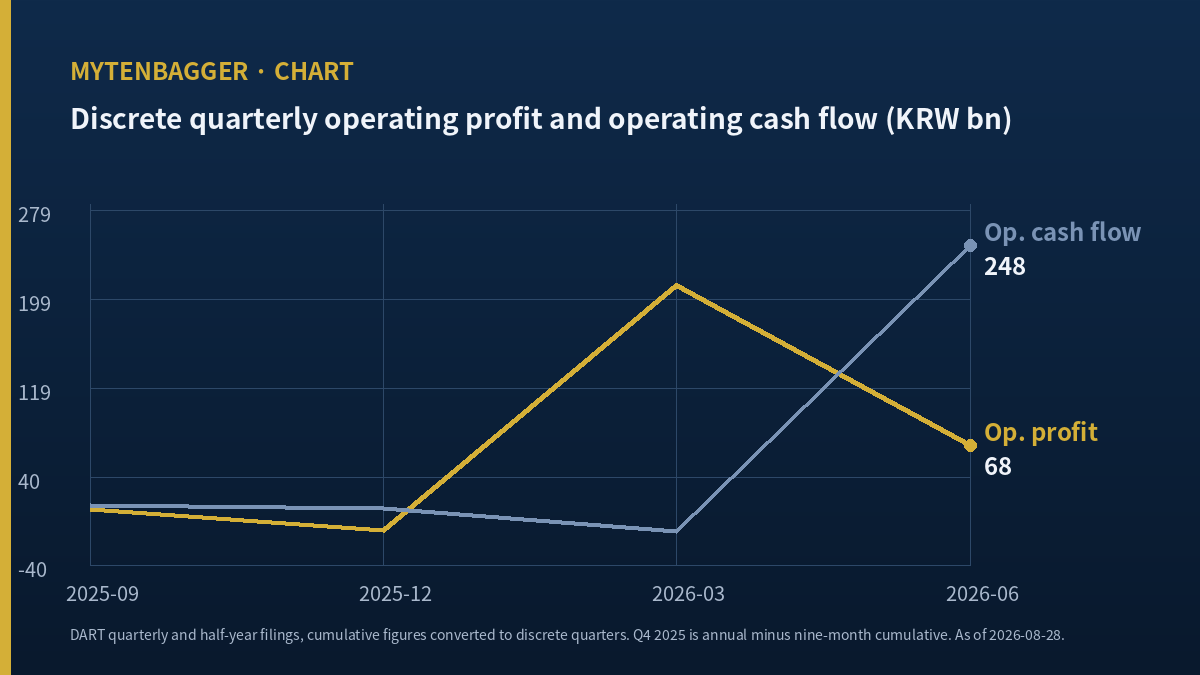
If recognition timing sounds abstract, the cash flow statement makes it physical. I put the two 2026 quarters next to each other and the company sentence stopped being abstract.
| Quarter, discrete | Revenue | Operating profit | Operating cash flow |
|---|---|---|---|
| 2025 third quarter | 106.82bn | 10.62bn | 13.93bn |
| 2025 fourth quarter | 95.50bn | operating loss of 8.41bn | 11.60bn |
| 2026 first quarter | 328.50bn | 212.10bn | negative 9.29bn |
| 2026 second quarter | 192.61bn | 67.63bn | 247.83bn |
Notes. Korean won, converted from the millions reported in DART quarterly filings and stated here in billions. Quarterly figures in Korean filings are cumulative, so these are discrete quarters derived by subtraction. The 2025 fourth quarter is the annual figure less the nine-month cumulative.
The first quarter carried 212.10bn won of operating profit against operating cash flow of negative 9.29bn won. The second quarter carried 67.63bn won of operating profit, under a third of the first, against operating cash flow of 247.83bn won. Take the half as a whole and net profit of 257.51bn won sits within 19.0bn won of operating cash flow of 238.54bn won. Split it into quarters and the two numbers are in opposite corners.
That is the physical form of the sentence about timing. Sales concentrated around the March 20 launch landed in the first quarter income statement, while platform and distributor settlement had not yet arrived, and the money came in during the second quarter. Having seen that, I wrote down that this company’s quarterly income statement describes an accounting rule at least as much as it describes a quarter of trading.
The screen still prices Pearl Abyss stock as a company that loses money
There is a practical trap sitting on top of all of this. The market data screen I use shows this business as loss-making. Its earnings multiple field is empty because the figure is not computable, earnings per share reads negative 131 won, return on equity negative 1.1 percent, an operating margin of negative 4.05 percent, and two of seven boxes ticked on its indicator checklist. The revenue, operating and net figures on that screen are labeled as a trailing four-quarter sum, and they match the audited 2025 full-year results to the nearest hundred million won. They are the year before Crimson Desert.
Adding the last four discrete quarters myself inverts the picture.
| Item | Shown on screen | Rebuilt by me |
|---|---|---|
| Revenue, last four quarters | 365.6bn | 723.43bn |
| Operating result | operating loss of 14.8bn | operating profit of 281.93bn |
| Profit to owners | net loss of 8.4bn | net profit of 271.30bn |
| Earnings multiple | not computable | 7.53 times (reverse-calculated) |
| Price to book | 2.50 times | 1.95 times (reverse-calculated) |
Notes. The rebuild sums the third and fourth quarters of 2025 with the first and second of 2026. Earnings per share of 4,317.1 won divides profit to owners of 271.30bn won by 62,843,077 shares, and the multiple uses the close of 32,500 won on August 28, 2026. Price to book divides that close by book value per share rebuilt from equity attributable to owners of 1,046.05bn won at the end of the second quarter. The screen’s book value per share of 12,979 won multiplies out to 815.64bn won, which matches no balance sheet date I can find, so I left it out. Screen data from Kiwoom, on the August 28, 2026 close.
Step back further and the gap widens. Add up operating results for 2022, 2023, 2024 and 2025 and the four-year total is a loss of 27.07bn won. One half-year in 2026 produced operating profit of 279.72bn won, which is 306.80bn won more than those four years combined. When I looked at what a 15.2 times multiple was dividing at NCSoft, the problem was the profit being divided. Here the problem is the period that profit belongs to.
Take-Two publishes the figure Pearl Abyss stock does not have
The global comparison I want here is not about size or margin. I picked the one listed company that already treats this exact accounting problem as something worth reporting on its own line.
Take-Two Interactive, on the Nasdaq, closed at 235.39 US dollars on August 28, 2026, the same session I am using for the Korean close. That gives a market value of 44.01 billion US dollars across 186.98 million shares, and 235.39 multiplied by 186.98 million reproduces 44.01 billion with no drift. Revenue over the last twelve months was 6.69 billion US dollars and the result was a net loss of 320.40 million US dollars, so its trailing earnings multiple is also not computable. Its forward multiple is 28.71 times. Pearl Abyss, converted at 1,372.5 won to the US dollar on the same day, carries a market value of about 1.49 billion US dollars.
Two companies with no usable trailing multiple, for opposite reasons: one because its screen is showing a year that ended before the launch, the other because deferred revenue on a large release keeps reported profit below what the business collected. And the reason I chose this comparison is that Take-Two has long reported a net bookings figure alongside its accounting revenue line, defined on its own reporting as what was sold in the period, so a reader can see the sale and the recognition separately. Pearl Abyss publishes no equivalent line. These two are at different points in their own cycles and I am not moving either one onto the other. I am pointing at one disclosure that exists on one side and not the other.
Dividing the reported revenue by units breaks one of two sentences
The company reported Crimson Desert IP revenue of 266.5bn won in the first quarter and 136.1bn won in the second, which by my own subtraction is 81.13 percent and 70.66 percent of total revenue in those quarters. But the first-quarter figure was recorded over twelve days, from March 20 to March 31, and the second-quarter figure over 91 days. Per day that is 22.21bn won against 1.50bn won, a factor of 14.85. Move the launch to March 19 and the first-quarter window becomes thirteen days, 20.50bn won a day, a factor of 13.71. The order of magnitude survives either way.
Dividing by units gives the opposite answer. Samsung Securities analyst Oh Dong-hwan, in a July 22 note reported by Korean press, put Crimson Desert unit sales at four million in the first quarter and two million in the second. Dividing the company’s reported IP revenue by those counts gives 66,625 won a copy and then 68,050 won a copy, so the recorded amount per copy goes up. Both of those are reverse-calculated. The company, on August 12, wrote that its estimate of average selling price had come down against the prior quarter.
Those two statements cannot both hold
One of three things is off. The sell-side unit count may not match what was actually sold. My division may be wrong, because IP revenue is not only base-game copies. Or the average selling price the company referred to is defined differently from the amount per copy I computed. I could not separate those three with the material I have. I am recording that gap instead of picking one of the three and writing it up confidently. The gap is itself information about how revenue gets made at this company.
What I put on the other side
Six items, and I hold them at the same weight as everything above.
- The lowest 2026 figure I found came from the company. Yuanta Securities analyst Choi Ji-woon modeled 2026 operating profit of 470.2bn won in a June 30 note. The top of the company’s own August 12 band, 345.2bn won, is 73.42 percent of that. The Yuanta note predates the second quarter results, and it is the only named sell-side 2026 operating profit estimate I was able to obtain, so on the full year I am writing into a coverage gap.
- 2027 is drawn as a cliff. The same Yuanta note carried 2027 revenue of 522.9bn won and operating profit of 188.3bn won against its own 2026 figures of 906.8bn won and 470.2bn won. Oh Dong-hwan at Samsung Securities raised his 2027 operating profit view to 206.2bn won on July 22 to reflect expansion plans, and cut his valuation on the shares to 36,000 won while holding a neutral stance.
- The second quarter came in under the estimate. Oh modeled second quarter revenue of 252.7bn won and operating profit of 105.4bn won. Reported figures were 192.61bn won and 67.63bn won, short by 60.09bn won and 37.78bn won.
- The sales curve is already flattening. On the company’s own announcements, Crimson Desert passed five million copies 26 days after launch and six million after 83 days. Five million in the first 26 days, one million in the next 57.
- The forward fields are empty. On my data screen this name has no twelve-month forward earnings per share, no forward multiple and no peer multiple. There is nothing on that screen that looks ahead.
- The market has already answered. The shares closed at 36,900 won on August 11, 2026 and 31,550 won on August 12, a fall of 14.50 percent in one session on volume of 2,337,064 shares, 4.65 times the prior day. Against the 250-session high of 77,400 won the close of 32,500 won is 58.01 percent lower.
The share count behind Pearl Abyss stock changed once in June
Before computing any multiple I check when the share count last moved, and here it moved recently. On June 9, 2026 the company announced its first dividend policy together with a cancellation and a purchase of its own shares. It canceled 1,403,945 shares on June 12, half of the 2,803,945 it held, and said it would buy a further 100.0bn won of stock in the second half. The dividend policy is the greater of 10.0bn won a year or ten percent of net profit.
Total shares of 64,247,022 less 1,403,945 gives 62,843,077, which is exactly the share count on my screen, and multiplying that by the 32,500 won close gives a market value of 2,042.4bn won with no difference against the screen figure. So the ruler I am using already reflects the cancellation. The shares retired were 2.185 percent of the total, and the announced 154.0bn won of cancellation and buying together is 7.54 percent of the current market value. Ten percent of first-half net profit is 25.75bn won, above the 10.0bn won floor in the policy.
On access: I found no American depositary line and no United States over-the-counter quote for this name in the sources I opened, and I am recording that as not found instead of stating that none exists. Direct purchase runs through a broker carrying Korean market permissions. Balance sheet risk is not the issue here in any case: the debt-to-equity ratio at the end of the second quarter was 22.41 percent, which is a different situation from the one I described when I wrote up three sell-side cuts at Neowiz in ninety days.

Where I stand on Pearl Abyss stock and what would end it
Watching. I do not take a buying stance on a company this size. And this entry leans on the measuring stick more than on the stance, because when a company revises its own outlook down by 19.25 percent in three months and attributes the change to recognition instead of demand, I cannot tell where the figures now sitting in the income statement will land next quarter.
Four conditions would make me rewrite this.
- Third quarter operating cash flow turning negative again. If the 247.83bn won in the second quarter was settlement catching up, the third should normalize, and a negative print means my reading was wrong.
- The company revising its annual band a third time in the November results. Direction aside, a band revised more than twice stops working as a measuring stick.
- A filed date for the Crimson Desert expansion. Every difference between the 2027 estimates I found rests on that single date.
- Nine-month cumulative operating profit exceeding 90 percent of the 315.5bn won low end of company guidance. That would leave under 31.55bn won for the fourth quarter and would settle how conservatively the company wrote its second half.
Swapping out the item I left open
The open item I carried into this entry was what period a vendor data field actually points at. That one is now closed. A screen labeled as the last four quarters was showing the last completed fiscal year, and at a company whose results inverted around a launch, that mislabeling moves the earnings multiple by roughly a factor of three.
In its place I am putting a new one: what one copy of Crimson Desert is recorded as. The company wrote that its average selling price estimate came down. My division using sell-side unit counts says the amount per copy went up, from 66,625 won to 68,050 won. Those cannot both hold and I could not tell which one is off with the material I have. This closes on the day the third quarter report carries a revenue recognition note, or the day the company discloses unit sales itself. The only thing I will fix now is that when it does close, the page I need to open is the notes, not the income statement.
Sources
- Newspim, second quarter 2026 results coverage, August 11, 2026. Revenue of 192.6bn won, operating profit of 67.6bn won, Crimson Desert 136.1bn won, Black Desert 55.0bn won, overseas share of 91 percent.
- Digital Daily, first quarter 2026 results coverage, May 12, 2026. Revenue of 328.5bn won, operating profit of 212.1bn won, Crimson Desert 266.5bn won, and the May 12 annual band of 879.0bn to 975.4bn won.
- Finance Today, August 12, 2026, coverage of the August 12 guidance filing. The 709.8bn to 743.8bn won band, the per-IP split, and the company’s wording on revenue recognition.
- Money Today, July 22, 2026, coverage of the Samsung Securities note by Oh Dong-hwan. Neutral stance, a 36,000 won valuation, second quarter estimates and unit counts.
- Newsquest, coverage of the Yuanta Securities note by Choi Ji-woon, June 30, 2026. The 2026 and 2027 estimates and a 52,000 won valuation.
- Bloter, coverage of the share cancellation and first dividend, June 9, 2026. The 1,403,945 shares, the 100.0bn won purchase plan and the dividend policy.
- Gamevu, coverage of six million cumulative Crimson Desert copies, June 11, 2026. Five million in 26 days, six million in 83.
- Businesskorea, Korean market close report for August 28, 2026. The Seoul foreign exchange close of 1,372.5 won to the US dollar.
- Stockanalysis.com, Take-Two Interactive quote page, on the August 28, 2026 close. Price, market value, share count, revenue and result over the last twelve months.
- Financial source data from DART quarterly and half-year filings. Price and indicator data from Kiwoom on the August 28, 2026 close. Korean press items above are paraphrased into English instead of being set inside quotation marks.