SK Networks Divestiture: What Is Left to Earn After the Sale
Contents
SK Networks stock and the line it sold
SK Networks trades on the KOSPI, the senior board of the Korea Exchange, under the code 001740. It is a Korean conglomerate in the older sense of the word: commodity trading, mobile handset distribution, a hotel, an appliance rental business, a car servicing chain. On Friday, August 28, 2026 it closed at 6,690 won, which puts the whole company at 1.342 trillion won, or roughly 978 million dollars at the 1,372.5 won per dollar Seoul close that same day.
I opened the file expecting to write about a decline. Revenue fell 30.22% between 2022 and 2025. What I found instead was a company that had deliberately handed away its most profitable business, and I could not find a clear answer to the question that follows from that. So the question became the piece.
| What I settled first | Figure |
|---|---|
| Business sold in 2024 | SK Rent-a-Car, about 820 billion won. In 2023 it was 15.3% of revenue and 35.9% of operating profit |
| Shares retired in April 2026 | 20.71 million common shares, 9.4% of the count, about 109.4 billion won |
| Operating margin left behind | 1.28% for 2025, the lowest line on my peer table |
| First half of 2026 | Revenue 3.188 trillion won, up 1.11% year on year, after three straight annual declines |
| My position | Watching. Next checkpoint November 16, 2026 (Mon) |
What went out the door, and what only changed its name
Seven things happened to this company between 2022 and the middle of 2026. Four of them moved the consolidated revenue line. Three did not, and I want to separate them before anyone reads that 30.22% as a story about a business getting smaller.
The four that changed the consolidation
SK Rent-a-Car. The entire stake went to Affinity Equity Partners, with the board resolution dated June 20, 2024. Two Korean outlets put the price differently: about 820 billion won in the later reporting, and about 850 billion won in an April 2024 piece written before the resolution. I use the lower figure and note the 30 billion won spread rather than averaging the two. In 2023, its last full year inside the group, Korean press reporting put it at 15.3% of group revenue and 35.9% of group operating profit. Applying those percentages to the audited 2023 numbers gives roughly 1,397.5 billion won of revenue and 85.2 billion won of operating profit, both my own back-calculations from the reported percentages.
Mintit, the used-handset kiosk business, sold 90% to a Korean private equity buyer for about 45 billion won in March 2026, leaving a 10% residual holding.
SK Electlink, the fast electric-vehicle charging arm, changed control in April 2026, with the SK Networks holding falling to 21.4%.
Incross, an advertising company, came the other way and joined the group in January 2026. It is the only addition among the four.
The three that changed nothing in the consolidation
Speedmate, the car servicing chain, and Glowide, the trading arm, were each spun into separate legal entities in 2024 while SK Networks kept 100% of both. When a parent keeps the whole equity, consolidated revenue does not move by a single won. The Korean word for this kind of separation makes it sound like a business left, and it did not.
The third is a rename. SK Magic became SK intellix in July 2025, absorbing a robotics unit, with SK Magic surviving as a product brand. I mention it because I nearly missed this company in my own coverage checks by searching only for the old name.
What SK Networks stock has left to earn with
| Year | Revenue (bn won) | Operating profit (bn won) | Operating margin | Total assets (bn won) |
|---|---|---|---|---|
| 2022 | 9,666.4 | 154.2 | 1.60% | 9,499.3 |
| 2023 | 9,133.9 | 237.3 | 2.60% | 9,110.4 |
| 2024 | 7,657.3 | 113.9 | 1.49% | 5,157.1 |
| 2025 | 6,745.1 | 86.3 | 1.28% | 5,040.8 |
Source: consolidated statements filed with Korea’s electronic disclosure system, fiscal years ending December 31. Margins are my own division of the two columns.
The 2023 operating margin of 2.60% is the high point of this table, and 2023 is also the last year the rental arm was inside it. Strip out the sale and the trend is not dramatic, but the direction is unhelpful: 1.60%, then 2.60%, then 1.49%, then 1.28%. Total assets nearly halved over the same span, from 9,499.3 billion won to 5,040.8 billion won, and total liabilities fell 57.22%, from 7,048.5 billion won to 3,015.2 billion won.
That is a real balance sheet repair and I do not want to be glib about it. Debt to equity went from 287.61% at the end of 2022 to 147.89% at June 30, 2026. But the repair was funded largely by selling assets, and one of the assets sold was the third of operating profit that the rental business carried.
Nine point four percent of the shares are gone
In April 2026 the company retired 20.71 million common shares plus 30,648 preferred shares, a package worth about 109.4 billion won and equal to 9.4% of the share count. The board had put it to the annual meeting on March 26, 2026 (Thu). Company materials put cumulative retirements since 2023 above 47 million shares.
Two consequences matter to me. First, the count I divide by is not stable across years, so per-share comparisons between 2023 and 2026 are comparing two different share counts, and I do not treat a falling multiple in this company as evidence of anything on its own. Second, the largest shareholder gets more concentrated for free. SK Inc. held 49.35% at June 30, 2026 according to company investor materials, against 43.88% reported in Korean press in May 2025. Retirement of treasury shares raises everyone’s slice, and the largest holder’s slice most visibly.
The other side of that arithmetic is that this company has 6,620,394 treasury shares outstanding at June 30, 2026, about 3.30% of the 200,593,889 shares the company itself reports. Dividends are paid on the rest. The 2025 dividend of 250 won a share on 193,973,495 non-treasury shares comes to 48.5 billion won, which matches the company’s own stated total to within seven million won. That reconciliation is how I confirmed which share count the company actually uses.
The first half of 2026 stopped a three year slide
| Period | Revenue (bn won) | Operating profit (bn won) | Net profit to owners (bn won) |
|---|---|---|---|
| First half 2025 | 3,153.0 | 59.5 | 20.3 |
| Q1 2026 standalone | 1,743.4 | 33.4 | 41.7 |
| Q2 2026 standalone | 1,444.5 | 24.8 | 48.3 |
| First half 2026 | 3,187.9 | 58.1 | 90.0 |
Source: consolidated interim filings. Korean quarterly filings report flow items cumulatively, so standalone quarters are the cumulative figure minus the prior cumulative figure, my own subtraction. The two 2026 quarters sum to the half year figure.
Revenue grew 1.11% against the first half of 2025, my calculation from the two totals. After three annual declines that is worth noting even though the size of it is small. Operating profit slipped 2.29%, and the half-year operating margin was 1.82%.
The eye-catching row is the last column. Net profit attributable to owners was 90.0 billion won for the half, against 58.1 billion won of operating profit. Company statements and Korean press attributed the gap to revaluation gains on investments, chiefly its stake in Upstage, a Korean AI model developer, and a Silicon Valley research subsidiary. In the second quarter alone, operating profit fell 42.4% year on year while net profit rose 90.4%.
I did not build this piece on that gap. The gain comes from a private company whose valuation basis I cannot inspect, and I try not to put a number I cannot audit at the center of anything I write. It sits in my bear list instead.
What two houses wrote about 2027
Hana Securities analyst Yoo Jae-sun published a full forecast table on Friday, May 15, 2026. Two rows in it move in opposite directions. Operating profit rises from 116.3 billion won in 2026 to 124.8 billion won in 2027. Net profit falls from 87.7 billion won to 61.3 billion won, a 30.1% decline by my arithmetic. The report was written against a reference price of 7,900 won, the prior session’s close; the stock closed at 8,720 won that day.
Samsung Securities analyst Baek Jae-seung published in April 2026 with a reference price of 5,410 won, and applied a 20% discount to peer multiples in the sum-of-parts. That house has 2026 operating profit at 128 billion won and 2027 at 139 billion won, with net profit rising from 60 billion to 70 billion won.
So the two disagree about the direction of 2027 net profit, and the disagreement is informative, not embarrassing: one house treats a chunk of 2026 earnings as revaluation that does not repeat, the other does not. Both were writing when the stock was in the 5,000 to 9,000 won area, before the summer round trip described below. Neither of them was modelling the price the market briefly paid in June.
SK Networks stock had three prices in eight months
I pulled 260 sessions of daily bars and looked only at closes. The lowest close in that window was 4,295 won on January 12, 2026 (Mon). The highest close was 14,290 won on June 9, 2026 (Tue). The close on August 28, 2026 (Fri) was 6,690 won. From the low to the high is 3.3271 times, and from the high to Friday is a decline of 53.18%.
The climb had two steps. On May 26, 2026 (Tue) the stock rose by the daily limit to 10,920 won as the company disclosed a further investment into Upstage. On June 8, 2026 (Mon) it traded down to 9,500 won intraday and then closed limit-up at 14,170 won, the day SK Group announced an artificial intelligence partnership with Nvidia. The next session set the intraday high of 16,240 won and closed at 14,290 won, a 3,340 won range inside a single day.
Why my drawdown figure differs from the screen
My data vendor reports a 250-session high of 16,240 won and a low of 4,275 won, and derives a 58.8% drawdown from the high. Those two prices are intraday extremes, from June 9 and January 13 respectively, and neither is a closing price, even though the vendor labels the basis as adjusted closes. Since my tables carry the Friday close, I compare closes: down 53.18% from the highest close, up 55.76% from the lowest close, and sitting at 46.82% of the highest close. Using the screen numbers would show the drawdown 5.63 percentage points deeper. Neither basis is wrong; mixing them inside one article would be.
For context, the stock sits 9.22% under its 20-day average of 7,370 won, 25.15% under the 60-day average of 8,938 won, and 13.20% under the 120-day average of 7,707 won. Foreign investors held 18.03% at the same date.
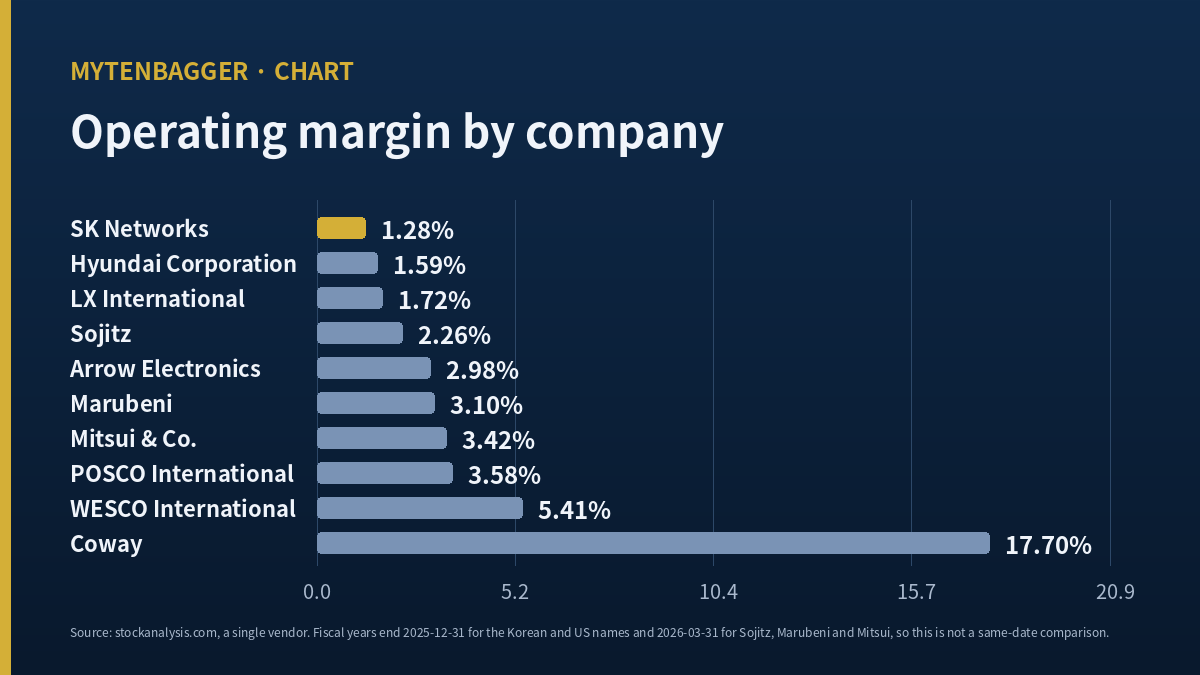
An operating margin table with SK Networks stock on it
| Company | Listing | Fiscal year end | Operating margin |
|---|---|---|---|
| SK Networks | KOSPI 001740 | 2025-12-31 | 1.28% |
| Hyundai Corporation | KOSPI 011760 | 2025-12-31 | 1.59% |
| LX International | KOSPI 001120 | 2025-12-31 | 1.72% |
| Sojitz | Tokyo 2768 | 2026-03-31 | 2.26% |
| Arrow Electronics | NYSE ARW | 2025-12-31 | 2.98% |
| Marubeni | Tokyo 8002 | 2026-03-31 | 3.10% |
| Mitsui & Co. | Tokyo 8031 | 2026-03-31 | 3.42% |
| POSCO International | KOSPI 047050 | 2025-12-31 | 3.58% |
| WESCO International | NYSE WCC | 2025-12-31 | 5.41% |
| Coway | KOSPI 021240 | 2025-12-31 | 17.70% |
Source: stockanalysis.com, a single vendor, for all ten rows. Two rows were cross-checked against primary sources: the SK Networks figure against Korean disclosure reporting, and Coway’s against its own results release. The Japanese fiscal years end three months later than the others, so this is not a same-date comparison.
The table has a trap in it and I would rather name it than let a reader walk into it. Japanese trading houses book equity-method income and dividends received below the operating line under their reporting standard. Mitsui’s net profit is 1.742 times its operating profit and Marubeni’s is 2.122 times, both of which I derived from the revenue and margin figures in the same source. Reading those two as thin-earning businesses from the margin column alone would understate them badly. Toyota Tsusho runs the other way at 0.673 times. So I use this table to see what kind of profit structure SK Networks sits on, and not to order the companies.
What the bottom row does show is the shape of the problem. Coway, the Korean water purifier and appliance rental company, earns 17.70%, which is 13.83 times the SK Networks margin. SK Networks competes directly in that market through SK intellix. Most of its revenue comes from the low-margin trading and distribution lines; the business with the attractive margin is a subsidiary inside a much larger low-margin envelope. Which table you put this company on changes the impression entirely.
Where SK Networks stock trades, and at what level of certainty
I checked this at two levels of certainty, so I will report it at two levels instead of flattening them.
Confirmed. The shares trade only on the KOSPI in Seoul, in Korean won, under 001740. Settlement, disclosure and the annual meeting all happen on the Korean calendar, and Korean disclosure filings are published in Korean first.
Checked and not confirmed. I did not open the issuers’ own holdings files for the broad Korea funds, so I am not putting a weight on whether this name appears in them. If the position size matters to you, read the fund’s published holdings instead of my sentence.
The practical version is this: any position here is a Korean-won position with a Seoul trading calendar attached, and the currency moves independently of the business. The won closed at 1,372.5 per dollar on August 28, 2026 (Fri), having stayed under 1,400 since mid-August.
The bear case I built against SK Networks stock
- The weakest part of my own work first. I separated seven events into four that moved the consolidation and three that did not, but I only know the revenue contribution of one of the four. Without the other three, my separation is half finished, and the four percent of the argument that rests on it is softer than it reads.
- Operating profit in the second quarter of 2026 fell 42.4% year on year. The half-year operating margin of 1.82% is better than the 1.28% full-year 2025 figure, but it still does not reach two percent, and the company attributed the weakness to marketing spend at the appliance subsidiary it has positioned as a growth engine.
- A large share of first-half net profit came from revaluing an unlisted holding. Revaluations move in both directions, and the input that sets them is not something an outside reader can check.
- The chief executive set a target in 2024 of tripling operating profit within three years. Measured from the 2023 base of 237.3 billion won that implies roughly 711 billion won, my own arithmetic. The 2025 result was 86.3 billion won.
- The company’s own value-up filing in April 2026 targets a 2026 return on equity of 3.5% plus alpha. Hana Securities forecasts 2.96% for 2027, below the target the company set for the year before.
- Korean trade press reported in March 2026 that the current ratio had fallen to 88.5% from 95.9% a year earlier, with losses continuing at several of the venture investments and only the slow-charging affiliate turning profitable.
My stance on SK Networks stock, and what breaks it
I am watching. This company is small enough by market value that my default is to observe, but this time I have a second and more specific reason. I cannot read the revenue line yet. Until the company separates what it stopped counting from what stopped selling, a percentage change in revenue tells me nothing I can act on.
What would change that is the third-quarter report. The statutory filing deadline is November 15, 2026, which falls on a Sunday, so it lands on November 16, 2026 (Mon) or after. I will look at two things there: whether the 1.11% first-half revenue gain survives into the nine-month figure, and which way the revaluation line moves once it is no longer working in the company’s favor.
The condition that breaks this reading
Every date and every classification in my seven-event split came from press reporting, not from the filings themselves. I did not confirm the accounting effective dates on which each disposal and each addition entered or left the consolidation. If the rental business barely appeared in the 2024 consolidated accounts, or if Mintit and SK Electlink are still inside the 2026 accounts, then the line I drew belongs somewhere else and this article starts again at its first paragraph.
What this one taught me
Naming. I check every new company against our published archive before I start, and for this one I ran twenty-two variants because I suspected the group had renamed things. It had. SK Magic became SK intellix in July 2025, and the trading arm acquired a name that did not exist in 2023. When the count of a company’s names arrives after the research instead of before it, an absence of results reads like an absence of the thing.
Prices and multiples reflect the August 28, 2026 (Fri) close of 6,690 won as checked at the time of writing. Korean won is the reference currency throughout, and the single dollar conversion in this article is approximate, at roughly 1,372.5 won per dollar on that same date. Financial figures are consolidated and stated in billions of won.
Related notes of mine: Why Korea’s SK Inc Rose 19% After Agreeing to Sell SK Siltron · Why Dentium Fell 40% After Cancelling Its Treasury Shares · Coway Outlook: Netmarble’s Share Purchase Window Ends September 8 · Lotte Rental Earnings: Used Car Sales and Rental Profits Split
Sources I worked from: Herald Business on the second-quarter results · Economic Review on the same release · Digital Today on the 2025 annual filing · Digital Today on the value-up plan · SK Networks investor relations, share information · SK Networks investor relations, shareholder returns · Infostock Daily on the rental arm sale · Dealsite on the venture investments and current ratio · Newstomato on the subsidiary changes · stockanalysis.com company financials, used for the peer table · The Korea Times on the August 28 won close
- KG Mobility Operating Margin Stayed Under 1% for Four Years
- KT Corp Q2 Earnings: Five Ways to Score One Korean Telco Quarter