ISU Petasys Stock: The Real Gate Is Capital Discipline
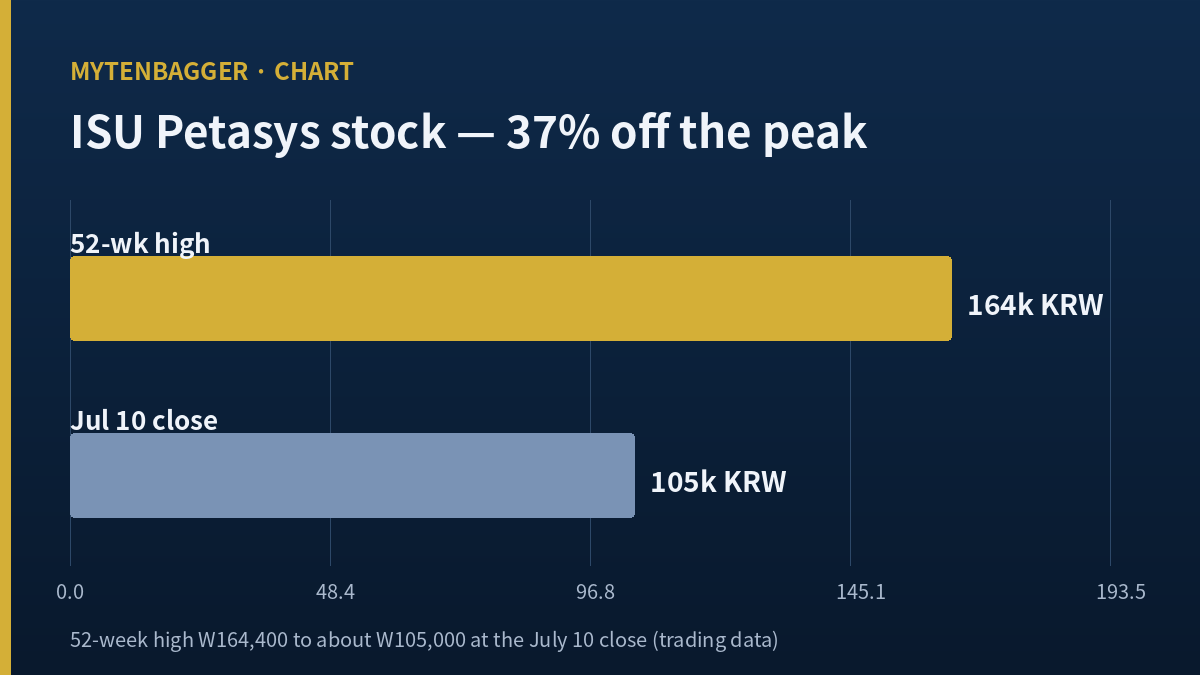
ISU Petasys stock has fallen 37% from its 52-week high, and I still do not own it. I believe the oligopoly — only a few companies can mass-produce the high-layer boards that AI accelerators need — is real. But this is a company that, at the peak of the AI boom in 2024, launched a surprise rights issue to buy a business unrelated to its own, then had to walk it back. With a ~46x P/E and negative free cash flow, the first thing I check here is not earnings. It is capital discipline.
Let me put three numbers side by side. On the most recent annual basis, ISU Petasys stock is backed by operating profit that more than doubled year on year (roughly +101%). The same company’s shares sit 37% below their 52-week high. And the stock still trades at about 46 times trailing earnings. Profits are exploding, the price has almost halved from its top, and yet the valuation is still three to four times the market average. I am always a little uneasy when those three numbers appear on one screen. If all three are true, the market is pricing something specific into this name — and I want to understand what before I chase it.
A quick orientation for readers outside Korea. ISU Petasys (KRX: 007660) is listed on the KOSPI, the main board of the Korea Exchange, and it reports in Korean won (₩). Through this piece I lead with U.S. dollars and put won in parentheses, using an approximate rate of ₩1,380 per dollar; currency swings alone can move the dollar figures. There is no U.S. I hold none of it today — this is a watch note, not a book position.
Contents
Why ISU Petasys stock stays on my watch list, not in my book
Let me be clear about one thing first: I do not think the business is bad. The opposite, really. The number of companies that can actually mass-produce the high-layer-count multilayer boards (MLBs) that go into AI accelerators and high-speed switches for customers like Nvidia and Google is small. Boards well past 20 layers are hard because yield itself is the barrier to entry, and ISU Petasys sits inside that small group. That is a genuine strength. So my hesitation is not about the product. It rests on three things.
First: the moat is in the product, the crack is in the management
ISU Petasys has a technology-and-oligopoly moat: few rivals can pull high-layer MLBs at production yield. That part is real. My problem is that the moat lives only on the product side. Turn to how management allocates capital and I see a crack, not a moat. In late 2024, at the height of the AI cycle, the company reached for a large rights issue to buy a business far from its core (I lay out the detail below). I trust the engineering that turns copper and glass into a 30-layer board. I trust the hand that decides where the cash from that board goes rather less. A good business and good capital allocation are two different questions, and this name splits them.
Second: a ~46x P/E and ~10x book leave no room for error
On the trading data I checked, ISU Petasys stock trades at roughly 45.8 times earnings and 10.1 times book. High even for a growth name. A multiple like that has already pulled several years of growth forward, which is another way of saying the price allows no mistakes. If a customer’s capex slips by a single quarter, or a new product’s yield stabilizes later than planned, a 46x stock moves hard. The fact that ISU Petasys stock has shed nearly 15% in the past month is a small demonstration of that sensitivity. I like buying things cheap, so to start a position at this valuation I need proof, not hope.
Third: free cash flow is still negative
ISU Petasys is in a heavy capacity build. It wants to secure multilayer capacity ahead of demand, and the direction is right. But the price of that, on the financial data I checked, is operating cash flow and free cash flow that are both negative. Earnings are rising while cash is still leaving the building. That window lasts until the new capacity converts into revenue. It is a common shape for a growth company — but overlay it on the rights-issue history and you get a specific combination: a cash-hungry phase in a company that already has one capital-allocation accident on its record. That is why I treat a turn in the cash flow as one of the conditions for taking this off watch.
ISU Petasys stock: the earnings and valuation I checked
Here are the numbers I keep at the base of my judgment. Results are on the most recent annual basis; the forward line is a sell-side estimate. I mark the basis and source in each row.
| Metric | Value | Basis / source |
|---|---|---|
| Latest annual revenue | ~$0.79B (₩1.09T) | Results data (+30% YoY) |
| Latest annual operating profit | ~$148M (₩204.7B) | Results data (+101% YoY) |
| Operating margin | 18.8% | Results data |
| ROE | 29.6% | Trading data |
| P/E (current) | ~45.8x | Trading data |
| P/B (current) | ~10.1x | Trading data |
| 2026E revenue / operating profit | ~$1.13B / $236M (₩1.56T / ₩326B) | NH Investment & Securities estimate |
Sources: results and trading data; NH Investment & Securities report. As of early July 2026; last close ~₩105,000 (~$76) on Jul 10, about 37% below the ₩164,400 high. FX ≈ ₩1,380/$.
Laid out this way, the bull logic is easy to follow. NH Investment & Securities, a Korean brokerage, estimates 2026 revenue of ₩1.56 trillion and operating profit of ₩326 billion, and lifted its price objective to ₩170,000 from ₩160,000 in the first half of 2026. Earlier in the year another Korean broker, Hana Securities, had already raised its own price level, citing an MLB shortage. If NH’s estimate holds, this year’s operating margin climbs to roughly 21% (I derive that by dividing ₩326 billion by ₩1.56 trillion — a back-calculation, not a reported figure). That the sell-side is clustered in one direction is a real market signal. But this is the brokers’ estimate, not a number I adopt as my own. I read it as “the picture the bull case assumes,” not as “so it gets there.”
I want to sit with that margin math for a second, because it is the crux of the bull case. Moving from an 18.8% operating margin toward the low-20s while revenue grows more than 40% in a single year implies real operating leverage — the high-layer mix carrying the top line up faster than costs rise. If that leverage actually shows up in the prints, a 46x multiple compresses on its own as earnings catch up to the price. If it does not — if the mix stays flat and the margin drifts sideways — then the multiple is doing all the work, and multiples that do all the work tend to be the ones that fall first when a quarter disappoints. So I am not waiting on revenue growth, which I already believe in. I am waiting on the margin line inside it.
The 2024 rights issue that still shapes ISU Petasys stock
This is the part I most want to write about, because it is the part most coverage skips. Behind the glossy AI-substrate story, this company stumbled badly on capital allocation about a year and a half ago.
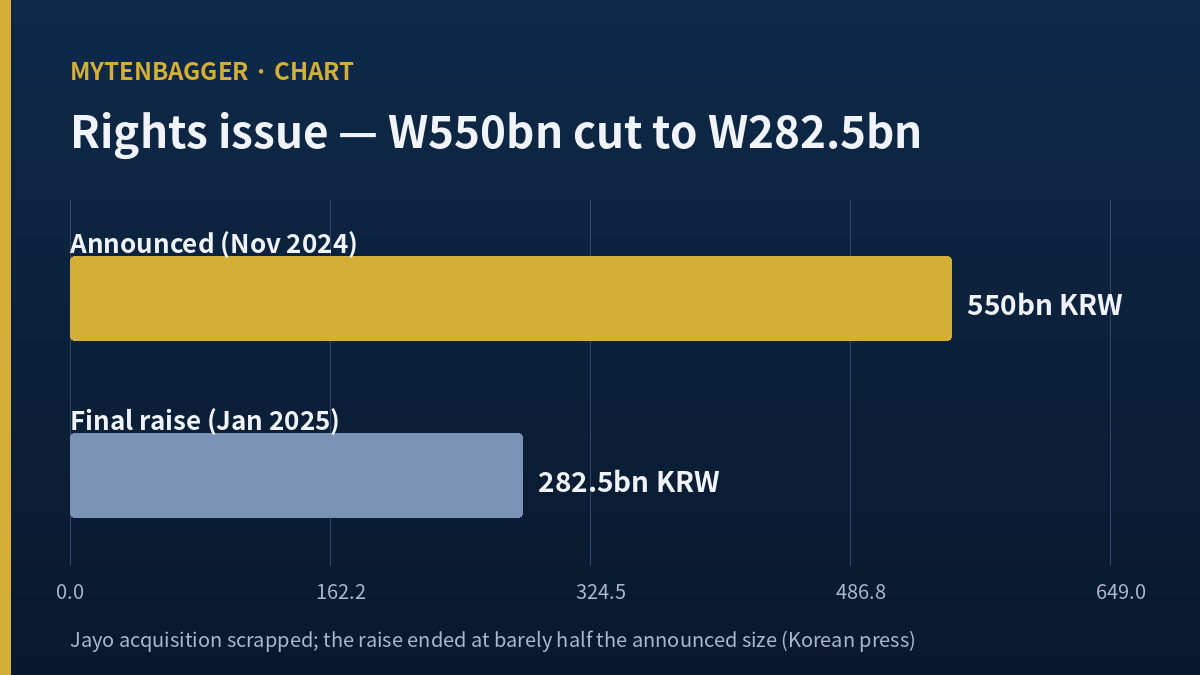
In November 2024, ISU Petasys announced a surprise rights issue of ₩550 billion (~$400M). About ₩300 billion (~$217M) of it was earmarked to take control of a company called Jaeo. The problem was that Jaeo sat far from ISU Petasys’s core printed-circuit-board business. It was known in the market as a carbon-nanotube (CNT) materials maker for batteries, but as Korean press reported, the bulk of its revenue — around 88% — actually came from plant construction. Why would a PCB company use PCB cash to buy a plant builder, especially when the ISU group already runs materials affiliates? Minority holders pushed back hard, and even the sell-side said it could not follow the logic. ISU Petasys stock dropped more than 20% right after the filing, according to Korean press such as the Seoul Economic Daily.
It did not end there. Korea’s Financial Supervisory Service stepped in and demanded the securities registration be corrected, which held the deal up. In the end, the company terminated the Jaeo acquisition in January 2025 and cut the raise by more than half, to ₩282.5 billion (~$205M), as Korean press including the Hankyung reported. The tell is what happened next: as another Korean outlet, Newsis, noted, brokers actually raised their price levels once the deal was scrapped. The market had priced the acquisition as a negative from the start, and undoing it was the good news.
What I took from the episode is one thing: product competitiveness and capital-allocation judgment can run on separate tracks inside the same company.
Honestly, when I first looked at this name in 2024 I nearly glanced at the results table, said “not bad,” and moved on. Without the rights-issue filing I would probably have parked it on an AI-beneficiary list and forgotten it. That the filing stopped my hand is, in hindsight, lucky. A good business that pours capital into the wrong place still shrinks the owner’s share of the pie. ISU Petasys showed that once, and since then I read this company’s capital-allocation news before I read its earnings table. That makes my reason for watching it different in kind from why I watch Samsung Electro-Mechanics (its profit trigger sits with Murata’s MLCC pricing) or LG Innotek (its earnings trigger sits with Apple). This one is specific to ISU Petasys.
And it is hard to file away as a one-off. ISU Petasys is controlled by the founding family through the ISU group, which holds several materials and chemicals affiliates. The very reason the 2024 rights issue landed so badly was the suspicion that cash earned by a listed board subsidiary would be redirected toward another leg of the group. That ownership structure has not changed. So I do not fully close the door on a similarly shaped decision reappearing in a different form. This is exactly why I put my key check on “capital discipline,” not on “earnings.” Earnings can improve. The question is whether the cash those earnings create stays with shareholders.
ISU Petasys stock versus TTM Technologies, the global peer
Widen the lens and the company’s position gets sharper. Among companies that mass-supply high-layer boards into AI accelerators and high-speed switches, the U.S.-listed TTM Technologies (Nasdaq: TTMI) is the most visible Western peer. As of July 10, 2026, per stockanalysis.com, TTM carried a market cap around $15.2 billion on trailing revenue of roughly $3.1 billion, and traded near 80 times trailing earnings — an even richer multiple than ISU Petasys. Its business spans aerospace and defense, commercial, and RF components, so its data-center exposure is diversified with a large defense book.
The contrast is the useful part. ISU Petasys is smaller — a market cap around $5.5 billion (₩7.6 trillion) — and far more of a pure play on AI-substrate demand. TTM trades at a premium too, but it carries defense and aerospace diversification and does not have a recent capital-allocation blow-up hanging over it. So the market is paying up for both, but for different reasons: TTM for a diversified, mission-critical board franchise, ISU Petasys for a concentrated bet on the high-layer AI ramp — a bet where I still want the management question answered. The seat is good. The hand that keeps the seat has not finished proving itself to me.
One more thing worth pinning down. The market bundles this company under one phrase, “AI substrate,” but even within boards the economics change completely with layer count. High-layer multilayer boards are made by few players because yield is hard, and they carry higher prices and margins. Low-layer commodity boards, by contrast, face steady capacity additions from Chinese and Taiwanese makers and are exposed to price competition. So the real thing to watch is not “revenue grew” but “is the high-layer mix inside that revenue growing.” That is where the margin leverage comes from, and if the mix wobbles, the quality of earnings deteriorates no matter how big the top line gets. When I read a quarterly print, I check that mix shift before I check the headline revenue.
It is worth being concrete about where the high-layer demand comes from, because it is both real and narrow. The buyers are a short list of hyperscalers and AI-chip vendors building out accelerator clusters and the networking spine that connects them. Each new generation of AI switch and each new accelerator board tends to push layer counts and board complexity higher, which is exactly the slice of the market this company is levered to. That is the good news. The uncomfortable side is concentration: when growth rides on a handful of customers’ capex plans, a single deferred data-center build can swing a quarter. I like that the demand is structural. I am less comfortable that so much of it funnels through so few decision-makers, and that is one more reason I want a valuation cushion before I commit rather than after.
My scenarios for ISU Petasys stock
The path I weight most (probability 50%)
Multilayer demand more than doubles on the back of 800G and 1.6T switches and new customers — the picture NH draws for 2027 and beyond — and the new capacity converts to revenue, flipping free cash flow positive. The engine here is a switch-generation transition: moving from 800G to 1.6T, each switch handles more data, which raises the layer count and board area required. The scarcity of companies that can build high-layer boards is what turns into pricing power at that point; that is the spine of the bull case. In this path the high multiple resolves through rising earnings. I weight it the highest. The catch is that it takes time to confirm, and in the meantime the stock swings with customer capex timing.
Where I could be wrong (probability 30%)
Customer capex slips a quarter or two, or new-product yield stabilizes late. That is not a stretch. The AI investment cycle moves in quarterly waves, and a 46x multiple amplifies every wave. Add one more capital-allocation decision the market struggles to understand, and the valuation can get cut before earnings even turn. I keep this path fully open.
The tails (probability 20%)
The best case (about 12%) is that the high-layer oligopoly hardens faster than expected and price and share rise together. The worst case (about 8%) is that capacity runs ahead of demand, utilization drops, and the cash drain lasts longer. I put low odds on both tails.
Where my thesis breaks
I have set the conditions for moving this from watch to book, and they run in order. The first to report is cash flow. If quarterly and half-year results show operating and free cash flow starting to climb out of negative territory, I read it as the first sign the build is converting to revenue. Next comes capital discipline: whether the next investment or acquisition decision is explained inside the core (high-layer boards and materials vertical integration) rather than veering off in a 2024-style direction. When those two point the same way, I begin scaling in.
Let me be concrete about that second check, because “capital discipline” can sound vague. What I want to see is the next large use of cash explained inside the fence: buying more high-layer capacity, integrating upstream into the glass-and-copper materials that feed the boards, or funding yield improvement. All of that sits inside the core, and I would read it as disciplined. Reaching outside the fence — into an unrelated business, a group affiliate, or a premium-priced acquisition that needs a fresh equity raise to fund — is the 2024 pattern, and I would read a repeat as the thesis breaking rather than progressing. The ownership structure that produced the first episode is still intact, so for me this is an active check, not a settled one.
The signals that keep me watching longer are just as clear. If a customer-schedule delay feeds into a guidance cut, or if a fresh large capital-raise issue appears before the build is even finished, then I keep my hands off ISU Petasys stock no matter how far it has fallen. In a name trading at 46 times earnings, watching is not a cost — it is a defense.
Bottom line — good business, a hand I do not yet trust
So here is how I see it. The business is good. The high-layer AI-substrate oligopoly is a real seat, and the sell-side pointing up is not baseless. But I am not buying the technology so much as the hand that manages the cash that technology throws off — and that hand shook badly once in 2024, and today it is running through a negative-free-cash-flow stretch. So even with earnings exploding, and even with ISU Petasys stock down 37% from its high, I keep it on watch.
The next checkpoints are clear: the direction of cash flow in the Q2 results, and the progress of the multilayer capacity ramp. Where those meet the conditions I have written down is where I decide whether to move it into the book. That is how I see it here.
Related entries from the same substrate/components tree: why I watched Samsung Electro-Mechanics after its MLCC spike and buying a cracked monopoly — HPSP.
Related reading
- Dongwon Industries Stock: Capex Follows the Cash It Earns
- Taihan Cable Stock Grew on Money Shareholders Paid In