Samsung SDS Stock: A $5 Billion Vault Behind the AI Headlines
- Samsung SDS stock trades near ₩185,000 (about $122). I don’t own it yet — but this year my reason for watching changed.
- A ₩2.9 trillion (~$1.9B) national AI computing center, a GPU supply win over AWS Korea, three sell-side desks raising their numbers — while roughly $5 billion of liquidity sits idle on the balance sheet.
- My checkpoints run in time order. The first is the upcoming Q2 earnings call: cloud growth and any concrete word on buybacks.
Everyone has started calling Samsung SDS an AI data center play. The headlines this year read like a winning streak: preferred bidder on a ₩2.9 trillion national AI computing center, a GPU contract taken from AWS Korea’s hands, price targets marching higher. If headlines moved stocks, this one should have run. It went the other way. As of July 20, Samsung SDS stock sits near ₩185,000 — roughly $122 at recent exchange rates of about ₩1,520 per dollar — down almost 12% in a month. I spent a long time staring at that mismatch, and here is where I landed: the real key to this stock is not the order book. It is the seven-plus trillion won locked in the company vault. The market isn’t doubting the work. It is doubting the hands holding the money.
Contents
Samsung SDS Stock: The Vault That Weighs More Than the Business
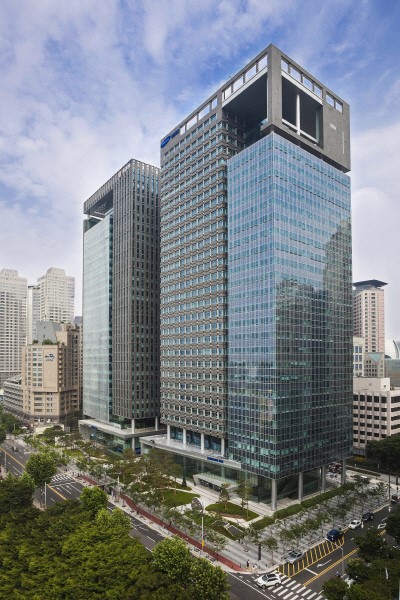
Let me lay out the numbers first, because they are strange in an interesting way. Samsung SDS is the IT services and logistics arm of the Samsung group, listed on the KOSPI — Korea’s main stock exchange, the rough equivalent of the NYSE — under ticker 018260. The company’s own preliminary 2025 results showed revenue of ₩13.93 trillion (about $9.2B) and operating profit of ₩957.1 billion (about $630M). This is not a broken business. It pays a dividend too — ₩3,190 per share for fiscal 2025 (about $2.10), raised two years running per Korean regulatory filings.
Now the balance sheet. Herald Business, a major Korean financial daily, tallied the company’s liquidity in May at roughly ₩7.6 trillion — ₩6.4 trillion of cash-like assets plus a ₩1.2 trillion convertible bond position tied to KKR. Call it $5 billion. Multiply the July 20 share price by the share count and the whole company is valued near ₩14.3 trillion, or about $9.4 billion (my arithmetic). More than half the market cap is sitting in the vault.
Strip the liquidity out and the operating business is being handed to you at roughly ₩6.7 trillion — about $4.4 billion (again my arithmetic). Against last year’s earnings — ₩9,816 per share per Korean market data services, roughly ₩760 billion or $500 million in total (derived) — the ex-cash business trades under nine times earnings (derived). That is a thin price for a company that just printed $630 million of operating profit.
The market hasn’t discounted the business. It has discounted the capital allocation — money that does nothing gets valued like it’s worth nothing.
I remember watching this stock during its 2014 IPO frenzy, when it ran past ₩420,000 on listing euphoria. Back then the excitement wasn’t really about system integration margins — it was about what the shares might one day mean inside the Samsung group’s ownership structure, a story that quietly stopped mattering to the market years ago. Herald Business noted in May that the shares had fallen nearly 60% from that post-IPO peak of ₩429,500. Twelve years on, revenue and profit are larger than they were then. What broke was not the business — it was the expectation that any of that cash, or any of that strategic positioning, would ever find its way back to shareholders in a form they could bank.
The 2026 Order Flow — a ₩2.9 Trillion AI Center, GPUs, and Gumi
On top of that locked vault, work has been piling up all year. I keep three items on my list, and they are not equal.
First — the national AI computing center, ₩2.9 trillion in total
Per Korean newswire News1 (May 11), a Samsung SDS-led consortium was selected as preferred bidder for Korea’s national AI computing center — ₩2.9 trillion (~$1.9B) of total investment and 15,000 GPUs by 2028, the anchor infrastructure of the government’s “AI highway” initiative under the Ministry of Science and ICT. The reported timeline: a special-purpose company set up within Q2, construction starting in Q3. The site is Haenam, in the country’s southwest, per Korean trade press The Elec.
Here I’ll log a correction I made to my own reading. I initially filed the ₩2.9 trillion as “Samsung SDS’s investment.” It isn’t. The structure is a consortium running through an SPC, which means neither all of the money nor all of the revenue belongs to Samsung SDS. Between the headline number and what actually lands on this company’s income statement sits a gap the size of its consortium share — and that share hasn’t been disclosed yet. So this item goes in my file as a catalyst of undetermined size.
Second — beating Elice and AWS Korea for a GPU supply deal
Korean IT daily Digital Daily reported on July 9 that Samsung SDS won this year’s GPU supply contract for a public AI research computing program run by a national ICT promotion body. The tender was scored 100% on technology: Samsung SDS 90.857 points, Elice Group 90.607, AWS Korea 88.016. The previous edition of this program had gone to the foreign hyperscaler, so there is real symbolism in taking it back onshore.
But I note the substance next to the symbolism. The program’s budget was cut from an initial ₩150 billion to ₩75 billion — roughly $49 million — after a failed first tender, and the contract runs only through year-end (same Digital Daily report). A win worth having, at half the headline size, with no recurrence built in.
Third — Dongtan and Gumi, GPUaaS built with its own money
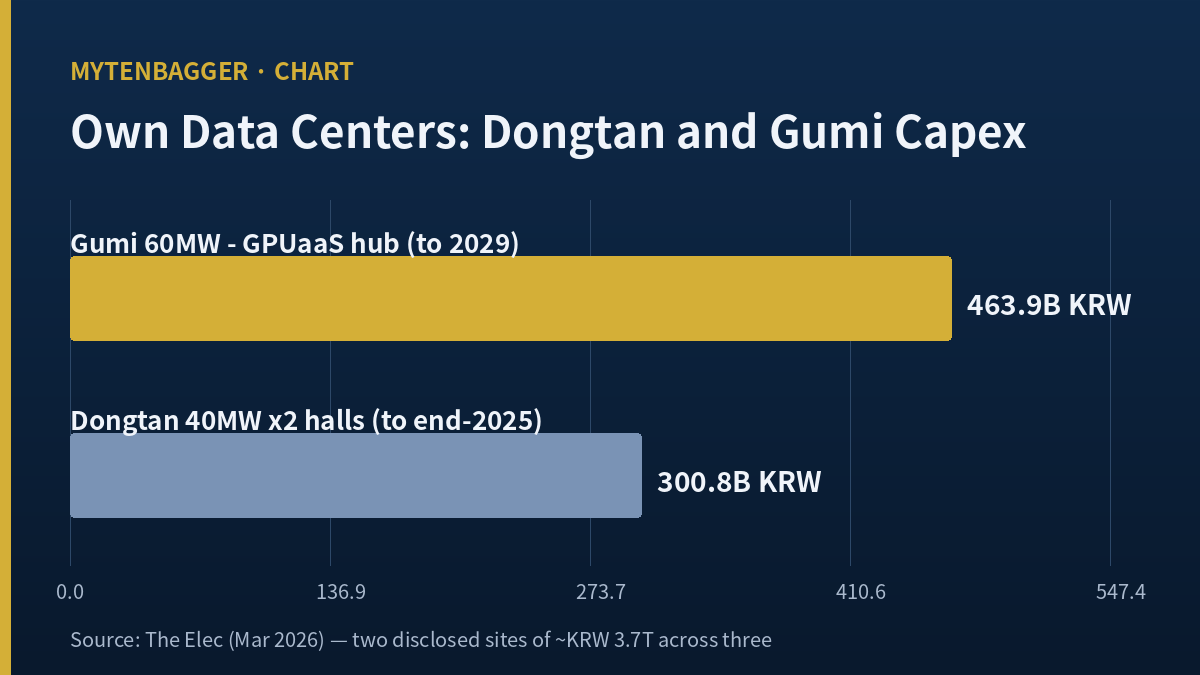
The Elec’s March rundown of the company’s own data center program totals about ₩3.7 trillion (~$2.4B) across three sites: two 20MW buildings in Dongtan (₩300.8 billion spent through end-2025), the Haenam involvement, and a 60MW campus in Gumi budgeted at ₩463.9 billion through 2029 — Gumi being the designated hub for a GPU-as-a-service business, where the company rents out accelerator capacity instead of just billing system-integration hours. On the Q1 earnings call, management put a frame around all of it: roughly ₩10 trillion (about $6.6B) of AI investment through 2031, as reported by Korean newswire Newspim. This is the first time in years the vault has visibly picked a direction, which is why the third item is the one I stare at longest.
Line the three up and their characters diverge. Haenam is the biggest number with the murkiest share. The GPU supply deal is the clearest share with the shortest life. Only Dongtan and Gumi build recurring revenue on owned assets — the one thing that historically changes the multiple a market is willing to pay an IT services company. Note that my order of importance runs exactly opposite to the order of headline size: ₩2.9 trillion > ₩463.9 billion > ₩75 billion.
Samsung SDS Stock Through Analysts’ Eyes: ₩240,000 to ₩270,000
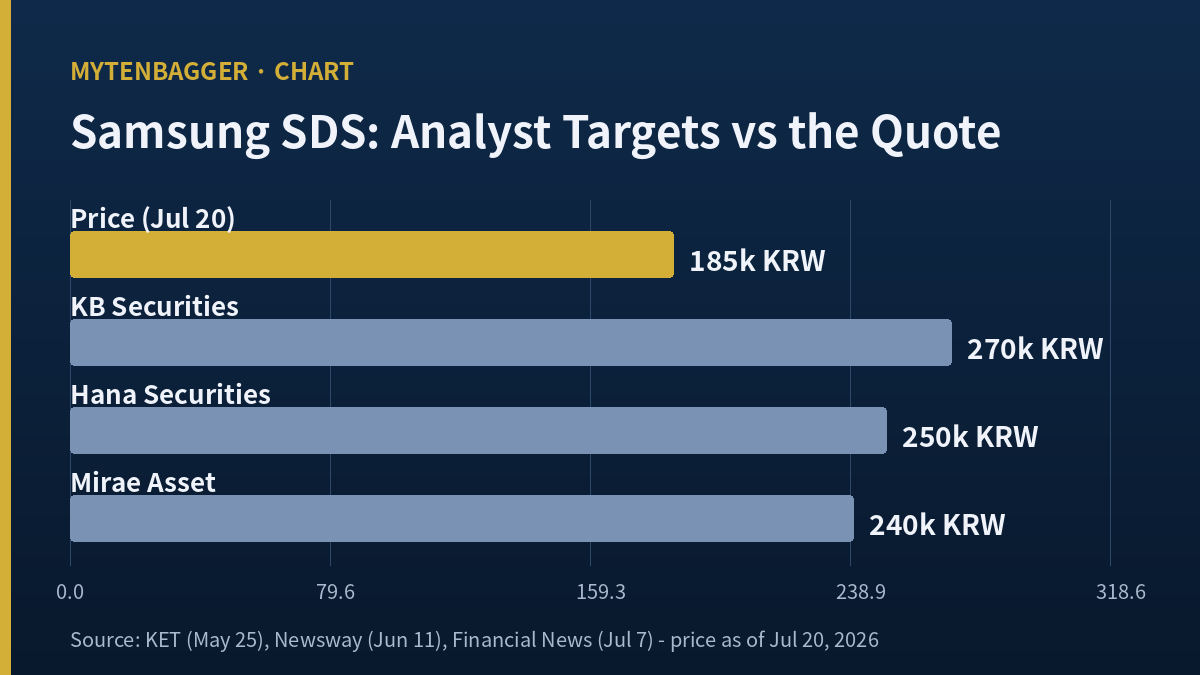
Since spring, Korean sell-side desks have been raising their numbers in sequence. Three that I verified:
| Broker (analyst) | Date | Objective | Core argument |
|---|---|---|---|
| Mirae Asset (Lim Hee-seok) | May 25 (new coverage) | ₩240,000 (~$158) | AI infrastructure beneficiary; 2027 cloud revenue seen at ₩3.62T |
| KB Securities (Kim Jun-seop) | June 11 | ₩270,000 (~$178) | GPUaaS monetizes idle assets; rising ROE re-rates the stock |
| Hana Securities (Kim So-hye) | July 7 | ₩210,000 → ₩250,000 (~$164) | Q2 as the inflection point of earnings normalization |
Sources for the table: the Mirae Asset initiation via Korean outlet Economy Times, the KB call via Newsway, and the Hana upgrade via Financial News. A few of the underlying numbers are worth carrying over. Hana models Q2 revenue of ₩3.69 trillion (~$2.4B), 6% above consensus, and operating profit of ₩246.7 billion (~$162M), 9% above — on cloud growing 15.5% and logistics swinging back to profit, with cloud accelerating toward 20% in the second half as externally-facing managed services scale up. KB runs a different kind of math: put ₩5 trillion into AI data centers at a 5% spread between return on invested capital and interest rates, and after-tax profit rises by ₩250 billion — against KB’s estimate of roughly ₩900 billion in 2026 net income. That is better than a quarter added to the earnings engine. Mirae’s annual arc: revenue from ₩14.12 trillion this year to ₩14.89 trillion next, operating profit from ₩826 billion to ₩1.01 trillion.
All three are buy-rated, and even the lowest objective sits about 30% above the current quote. I don’t adopt anyone’s number as my own — what I’m weighing is not the destination but the reasons the destinations moved: an earnings inflection and the monetization of assets that used to sit idle. If I ever buy, I’m buying those two reasons.
Samsung SDS Stock Fundamentals: What the Company Itself Guided
Analyst models are one thing; I also want the company’s own words on the record. On the April 23 first-quarter call, per Newspim’s report, management guided IT services revenue to mid-single-digit growth for the full year — call it 4 to 6 percent — with the acceleration starting in Q2 as cloud work and finance/public-sector projects expand. For the second quarter specifically: low-single-digit IT services growth with the segment’s operating margin recovering to the late-11% range. Logistics was guided to claw back to 2025 levels over the full year despite Middle East headwinds, helped by firmer freight rates, with the Cello Square digital forwarding platform — the part of logistics that serves customers outside the Samsung group — growing revenue more than 30%. And, once again, management said it is actively exploring M&A.
Set that guidance against the sell-side arc — Mirae’s operating profit path from ₩826 billion this year to ₩1.01 trillion next — and both parties are telling the same story: recovery now, acceleration later. Meanwhile the stock trades near 20 times headline earnings per market data services, which looks expensive until you remember the vault math above: ex-cash, under nine times (derived). The same company manages to look pricey and dirt-cheap at once depending on whether you count the money it refuses to use. That contradiction, more than any single quarter, is the twelve-year story of Samsung SDS stock in one line.
The Bear Case: LG CNS Envy and a Locked Vault
Now the other side, because this stock has been cheap for twelve years for reasons that haven’t gone away.
The May Herald Business piece is the sharpest summary of the bear case I’ve read. Shareholders watch domestic rival LG CNS trade and can’t forgive the gap. At the March shareholder meeting, CEO Lee Jun-hee acknowledged — in remarks I’m rendering from Korean — that buybacks and share cancellation are an important lever for shareholder value, yet offered neither a size nor a date. In the same article, Hana’s Kim So-hye attributed the valuation de-rating to a company sitting on six-plus trillion won of cash while staying passive on M&A and growth investment, and Meritz Securities’ Lee Hyo-jin argued the stock ultimately trades on actual M&A outcomes. Read that carefully: even the optimists are conditional — the stock works only if management acts.
The earnings record cuts the same way. By Investing.com’s tally, quarterly earnings per share came in below consensus three quarters running through the end of 2025 — misses of roughly 14% in Q2, 8% in Q3, and 9% in Q4 against the analyst average. That pattern matters for how much weight I put on today’s bullish previews: the same sell-side community now calling a Q2 inflection spent the last three quarters overestimating this company. Logistics — a huge slice of revenue — is exposed to freight cycles, and management itself flagged Middle East-related demand softness on the Q1 call. The IT services core leans heavily on captive Samsung-group work, a ceiling on growth that skeptics have cited for years. Hana’s “Q2 inflection” is, for now, a forecast standing on a three-quarter losing streak against consensus.
Even the dividend needs a footnote. Two straight raises, yes — but the record shows ₩3,200 in 2022 cut to ₩2,700 in 2023, and the 2025 payout of ₩3,190 still sits ₩10 short of where it stood three years ago (per Korean regulatory filings). This is a history of restoration, not compounding. Collecting a roughly 1.7% yield (derived) while waiting for the vault to open is not a plan I’d lean on.
Samsung SDS Stock Scenarios: Vault Open vs. Vault Shut
So I split my scenarios not by macro but by corporate behavior.
The vault opens. Q2 lands near Hana’s numbers, and the call produces an actual figure — for buybacks, for M&A, for either. Then KB’s re-rating logic starts to run: idle assets become GPUaaS revenue, ROE lifts, and the multiple follows. Starting from an ex-cash valuation under nine times earnings (derived), the runway is not short. The backdrop helps too: KB’s note pointed to the Naver–Nvidia AI factory announcement and Samsung SDS’s own commercialization of Nvidia B300-based services as evidence that domestic demand for rented GPU capacity is becoming real. For a U.S. reader, the closest analogue is the GPU-cloud model CoreWeave built a listing on — a business the U.S. market has shown it will pay for on growth rather than on services-hours billed. The structural difference is the funding: the American GPU clouds lean on debt and equity raises to buy accelerators, while Samsung SDS can fund its version out of the cash pile that currently earns it a discount, with no dilution required. If the market ever starts valuing the Gumi buildout the way it values rented-GPU capacity elsewhere, the same won that today subtracts from the multiple becomes the thing that built the growth engine. And the broader Korean market has a tailwind the U.S. lacks: the government’s Value-Up program keeps pressing exactly this kind of cash-hoarding balance sheet toward shareholder returns, much as Tokyo’s exchange reforms did for Japan’s hoarders.
The vault stays shut. Results come in fine, and capital returns stay “under review.” Then this reverts to the box I’ve watched for twelve years — a good business wearing a discount it earned. In that world the Samsung SDS stock chart goes sideways no matter how many order headlines stack up, and there are faster hands elsewhere in this market to give my money to.
The bad tail. Q2 misses consensus — a fourth straight quarter — and the “inflection” thesis dies on contact. The sell-side numbers that marched up this spring would march back down, and I’d shelve the name for a while.
Samsung SDS Stock: My Three Gates, in Order
My checkpoints run in time order, and I intend to move only in that order.
Gate 1 — the Q2 results and call, due between late July and mid-August. Two things. The numbers: does the print land near Hana’s line (₩3.69T revenue, ₩246.7B operating profit, cloud growing about 15%, logistics profitable) — because that would snap the three-quarter chain of consensus misses. And the words: does March’s “important lever” language evolve into a figure with a size and a date? If both show up, I start sizing a small position.
Gate 2 — third quarter, the Haenam paperwork. Does the SPC get established and construction start on the reported schedule, and does a regulatory filing — Korean listed companies disclose through the DART system, the local equivalent of EDGAR — finally pin down Samsung SDS’s consortium share and capital commitment? That is the moment the catalyst of undetermined size acquires a size, and the moment I can actually model it instead of footnoting it.
Gate 3 — year-end, delivery. The GPU supply contract runs only through December 31 per Digital Daily, so by year-end I get a clean pass/fail on execution: did roughly ₩75 billion of public GPU work get delivered on time, on spec, against two rivals who scored within three points? And in parallel — does Gumi’s GPUaaS buildout, budgeted through 2029, keep posting visible progress rather than sliding right the way big Korean capex schedules sometimes do? Gate 3 is the least dramatic of the three, but it is the one that tells me whether the AI-infrastructure story is an operating reality or a press-release genre.
And my kill condition, written down in advance: if Q2 cloud growth prints single-digit and shareholder returns come up empty-handed again, the inflection thesis is broken by my own standard — I stop waiting for Gates 2 and 3 and walk away.
Standing in front of Samsung SDS stock at ₩185,000, the question I keep asking myself is a simple one: who is this vault locked for? If the upcoming call answers even a quarter of it, I will sit back down and redo my numbers. This is my journal, kept for my own account — what you do with it belongs in yours.