Hyundai Corporation Stock Doubled Revenue on a 3.81% Margin
- Over four years, revenue at Hyundai Corporation stock went from 3,782.5 billion won to 7,554.3 billion won, a rise of 99.72 percent, while cost of revenue rose 97.93 percent.
- Over one year, operating profit rose 2.25 percent and net income fell 28.31 percent, so the two lines pointed in opposite directions inside the same annual report.
- Over one quarter, the June 2026 period produced 62.9 billion won of operating profit on 2,816.4 billion won of revenue, the company’s largest quarterly operating profit on record.
Hyundai Corporation stock belongs to a business model that Americans mostly do not have. A Korean general trading company buys and sells on behalf of others, takes a sliver of each transaction, and books the entire contract value as revenue. The result is a company with the revenue of a mid-cap industrial and the margin of a payment processor running at a loss. I do not own the shares and I have no order in, but the arithmetic of a business that keeps under four won of every hundred is worth writing down.
The stock closed at 26,500 won on September 18, 2026, which is roughly 19.20 dollars. KOSPI, Korea’s main exchange and the rough equivalent of the New York Stock Exchange in local terms, ranks this company well outside its hundred largest listings by market value. That is where my default stance comes from: I watch these names, I do not buy them.

Contents
Hyundai Corporation Stock and a Revenue Line That Doubled in Four Years
Revenue ran 3,782,498 million won in 2021, 6,126,969 million in 2022, 6,580,448 million in 2023, 6,995,663 million in 2024 and 7,554,286 million in 2025. The trailing twelve month figure on the same page is 7,770,102 million won. In dollars the 2025 number is about 5.47 billion, using the rate in the footnote.
Doubling revenue in four years is a real thing for a company this size, and I want to be careful about what it means here. A trading house books gross revenue when it acts as principal and a net commission when it acts as agent. A jump in reported revenue can therefore reflect either more business or a shift in how the business is booked. The company’s own quarterly release credits volume: passenger vehicles into the Commonwealth of Independent States, commercial and military vehicles, rail cars, North American transformer exports, and petrochemicals riding higher oil prices.
Where the 3.81 Percent Gross Margin Comes From
Revenue grew 99.72 percent and cost of revenue grew 97.93 percent
Those two growth rates sit 1.79 percentage points apart across four years. That gap is the entire story of this company’s margin, and it is small enough that a single year of pricing pressure could close it. Cost of revenue was 3,671,382 million won in 2021 and 7,266,626 million in 2025.
| Millions of won | 2021 | 2023 | 2024 | 2025 |
|---|---|---|---|---|
| Revenue | 3,782,498 | 6,580,448 | 6,995,663 | 7,554,286 |
| Cost of revenue | 3,671,382 | 6,380,853 | 6,747,200 | 7,266,626 |
| Gross profit | 111,115 | 199,595 | 248,463 | 287,660 |
| Operating profit | 35,246 | 99,998 | 117,433 | 120,071 |
| Net income | 37,790 | 83,687 | 121,068 | 86,795 |
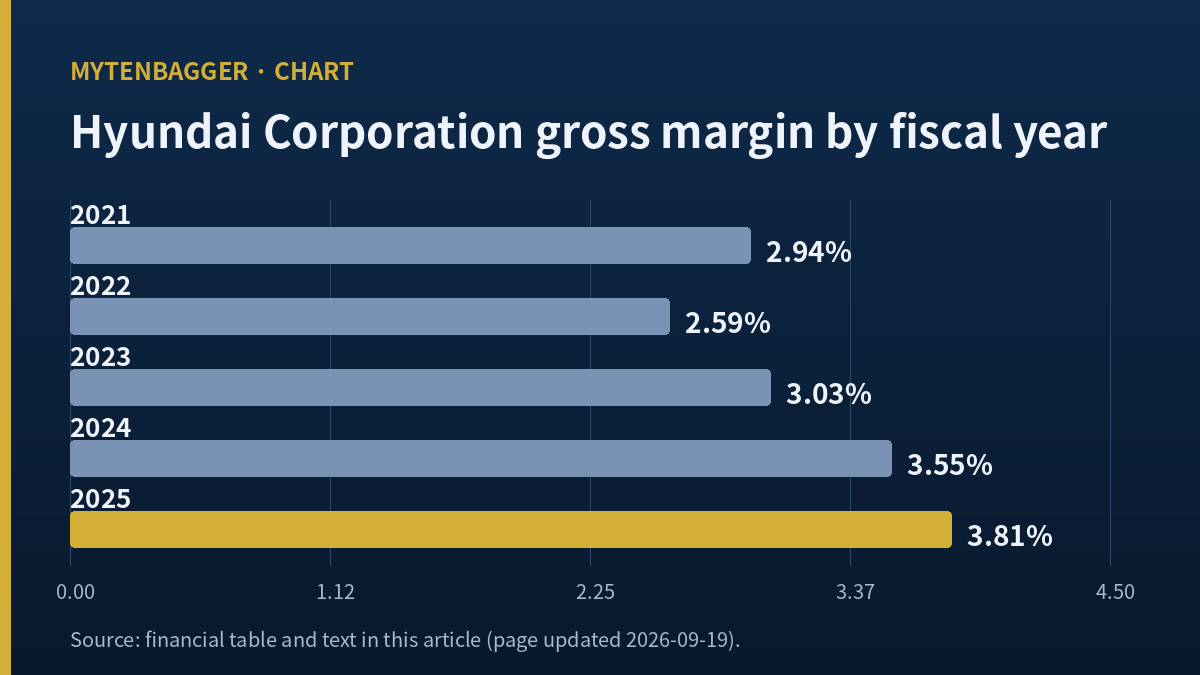
| Gross margin | 2.94% | 3.03% | 3.55% | 3.81% |
Source: stockanalysis.com income statement, carrying S&P Global Market Intelligence data, page updated March 31, 2026. The 2022 column is omitted for width and appears in the text.
The gap compounded into a 158.88 percent rise in gross profit
Gross profit went from 111,115 million won to 287,660 million won, a rise of 158.88 percent, which is well over the 99.72 percent growth in revenue that carried it. That is what leverage looks like when the margin is thin: a small improvement in the percentage produces a large improvement in the absolute. Gross margin by year reads 2.94, 2.59, 3.03, 3.55 and 3.81 percent. The 2022 dip to 2.59 percent happened in the same year revenue grew 61.98 percent, the fastest single year in the series, and I take that as a reminder that volume and margin do not have to move together here. Growth measured from 2022 instead of 2021 comes to 23.30 percent, which is the honest alternative framing of the same five columns.
Five years of this business, added up, comes to 31,039,864 million won of revenue and 1,005,552 million won of gross profit. That is 3.24 percent across the whole period, and it is the number I would use if someone asked me what this company earns on what it moves. The annual figures wander between 2.59 and 3.81 percent around it.
Here is what thin means in won. One tenth of one percentage point of gross margin, applied to 2025 revenue, is 7,554 million won. That single basis point block is worth 6.29 percent of the full year operating profit. A contract renegotiated at a slightly worse rate, or a freight cost that moves against the company for two quarters, lands on the operating line with that kind of force. It also works the other way, which is the part I keep having to say out loud to myself, because the same leverage is why gross profit grew 158.88 percent on 99.72 percent revenue growth.
For scale, 287,660 million won of gross profit is about 208 million dollars. That is the money the company had to run itself, pay interest and taxes, and return something to owners. When I looked at Korea Gas the interesting number was a receivable that dwarfed the market value. Here the interesting number is how little of the top line ever becomes anything at all.
Hyundai Corporation Stock and What Operating Expenses Take
Operating expenses took 58.26 percent of gross profit in 2025
Operating expenses were 167,589 million won in 2025 against 287,660 million won of gross profit. Almost three won in every five that survived the cost of goods went to running the company, leaving 120,071 million won of operating profit and an operating margin of 1.59 percent.
Samsung C and T, another Korean name whose trading arm sits inside a larger group, taught me to read the overhead line before the earnings line, and this is where that reading lands. That ratio has been improving. In 2021 operating expenses of 75,869 million won against 111,115 million won of gross profit was 68.28 percent. So the company has been widening its take and holding its overhead, which is the right order for the two to move in. I keep coming back to how narrow the whole structure is, though. A company that converts 1.59 percent of revenue into operating profit has almost no room between a good year and a bad one, and that is a structural fact about this business and not a criticism of its managers.
The Record Quarter Disclosed in July 2026
Revenue up 46.80 percent and operating profit up 81.64 percent
On July 29, 2026 the company filed a provisional consolidated earnings disclosure for the June quarter. Revenue was 2,816,433 million won, up 46.80 percent from the same quarter a year earlier. Operating profit was 62,937 million won, up 81.64 percent. Net income was 40,297 million won, up 154.75 percent. Korean press reporting on the filing described the operating profit as the largest the company has posted in a single quarter.
The filing notes that the figures are provisional and have not completed external audit review, which is standard language and which I take at face value. The operating margin in that quarter was 2.23 percent, above the 1.59 percent the company managed for full year 2025. Management attributed the result to vehicle volumes into the Commonwealth of Independent States, a broader mobility portfolio covering commercial vehicles, military vehicles and rail cars, North American transformer exports, and petrochemicals.
What the March quarter looked like by subtraction
The same filing gives a half year cumulative net income of 51,355 million won. Subtract the June quarter’s 40,297 million and the March quarter comes to 11,058 million won of net income. I derived that figure; the company did not disclose it. It is the only number in this piece I produced by subtraction instead of reading it off a page. It matters because it says the June quarter carried 78.47 percent of first half profit. One quarter is not a year, and I am not going to multiply 62,937 by four.
The trailing twelve month column on the same page is the other way to see the distance between a good quarter and a good year. Revenue there is 7,770,102 million won, 2.86 percent above the 2025 annual figure. Operating profit is 123,852 million won, 3.15 percent above. Net income is 73,997 million won, 14.75 percent below. So the trailing window has already absorbed some improvement at the top and in the middle, and none at the bottom. That is the same divergence the annual columns show, still open.
Hyundai Corporation Stock, Operating Profit Up and Net Income Down
Here is the line that made me keep reading. Between 2024 and 2025, operating profit rose from 117,433 million won to 120,071 million won, a gain of 2.25 percent. Over the same two annual columns, net income fell from 121,068 million won to 86,795 million won, a drop of 28.31 percent. Net margin went from 1.73 percent to 1.15 percent. Earnings per share went from 10,079.78 won to 7,226.32 won, and the trailing twelve month figure is 6,161.13 won, lower still.
Something below the operating line took 34,273 million won that had been there the year before. I did not open the notes and I cannot tell you whether it was interest, foreign exchange, an impairment, an equity method loss, or tax. A trading house with cross border receivables and heavy borrowing has candidates in every one of those categories. What I can say is that the two lines diverged, that the divergence is larger than the operating gain, and that it is the first thing I would want explained. With Hanwha Ocean the unexplained gap had a name and a date attached to it. Here it does not yet.
What Two Korean Houses Put in Their 2026 Models
Coverage here is thin but it exists, and both files are hosted on the company’s own investor relations site. Hyundai Motor Securities, analyst Shin Dong hyun, published on February 27, 2026 with 2026 revenue of 7,847.0 billion won and operating profit of 148.0 billion won. Shinhan Securities, analysts Han Seung hun and Park Kwang rae, published on April 20, 2026 with 2026 revenue of 8,392.2 billion won, operating profit of 177.8 billion won and earnings per share of 9,359 won.
Both carried a buy rating and both wrote down what could go wrong. Hyundai Motor Securities flagged weaker bunkering demand under rising protectionism and a falling share of steel business going to the United States. Shinhan flagged petrochemical supply and pricing as the thing to monitor. I note that both files are roughly five months old and that two quarters have reported since. The June quarter’s 62,937 million won of operating profit runs ahead of the quarterly pace implied by either model, which is a point for the sell side and against my caution.
Hyundai Corporation Stock Next to a Japanese Trading House
The general trading company as a category came from Japan, where it is called a sogo shosha, and Korea’s version was built on that model. For a global reference I picked Sojitz Corporation, listed in Tokyo under 2768, on one criterion: among companies classified in the country that invented this business category, it is the one whose revenue sits closest to the company I am looking at. Sojitz reported revenue of 2,757,350 million yen and gross profit of 367,489 million yen for the fiscal year ended March 2026, a gross margin of 13.33 percent, against 13.82 percent the year before.
I am putting one line next to one line and nothing else. I am not building a comparison table, I am not converting yen into won or dollars, and I am not saying which company is larger, because the two disclosures may not be measuring the same thing. Here is why that caveat is doing real work.
The gross margin is where I nearly wrote something I could not support
The gross margin at Sojitz is 3.50 times the one I calculated for the Korean company, and my first note to myself read that the Japanese house is three and a half times more profitable per unit of business. I had written that sentence before I asked whether both figures describe the same operation. They may not. A trading house that owns manufacturing subsidiaries consolidates their production costs and their production margins, while one that intermediates more of its flow reports closer to a commission. I could not confirm how much of either company’s revenue is booked as principal versus agent, and without that the ratio of the two margins is a ratio of two different definitions. So the sentence came out and this paragraph went in. The correction rule I am keeping: before comparing one ratio across two companies, confirm that the top and bottom of the fraction are built the same way, and if I cannot confirm it, print both values and refuse the ratio.
Numbers I Left Out of This Piece
Three I could have used and did not
First, the whole balance sheet. Total assets, borrowings, equity and the cash flow statement are all things I read while preparing this, and all of them are out. This piece is built on one financial statement and I wanted the argument to stand or fall on that statement alone.
Second, valuation multiples. Price to earnings and price to book both exist for this name and both differ between the screens I use, and a multiple whose bottom line I have not settled is not evidence. Third, the sell side valuation figures. Both files carry one and I read both, and I am leaving the amounts off this page because the estimates above already tell you where those analysts think the business is going.
Twenty-Two Places Where I Could Be Wrong About Hyundai Corporation Stock
These are ordered by how much weight I give them, heaviest first.
- I could not determine what took 34,273 million won between operating profit and net income in 2025, and that unexplained amount is larger than the operating gain I am calling an improvement.
- Revenue growth at a trading house can come from a change in principal versus agent booking and not from more business, and I could not confirm which applies here.
- The same ambiguity undermines the margin comparison with the Japanese company, which is why the piece stops at printing both values.
- A 3.81 percent gross margin is thin, but thin margins are normal for this model, so calling it thin is a description and not a finding.
- Picking 2021 as the starting year produces 99.72 percent revenue growth. Starting from 2022 produces 23.30 percent, which is a different sentence about the same company.
- 2021 revenue of 3,782,498 million won is itself unusual against the years that follow, and a low starting point flatters every growth rate in this piece.
- The June 2026 quarter was a record, and records are the kind of thing that make a watcher look slow.
- That quarter is provisional and has not completed audit review, by the company’s own statement.
- The March 2026 net income of 11,058 million won came out of my own subtraction. Any error in the cumulative figure lands entirely in it.
- One quarter carrying 78.47 percent of half year profit could mean a strong quarter or a weak one before it, and I did not establish which.
- Both published models put 2026 operating profit above 148.0 billion won, and the June quarter is running ahead of both.
- Two analyst files is thin coverage, and thin coverage is often where mispricing lives and not where risk lives.
- Both files are roughly five months old and predate the record quarter.
- Both analysts held a buy rating while writing down their own risks, which is more disclosure than I am giving credit for.
- Falling United States exposure in the steel business, which one file flags as a risk, could equally be read as diversification working.
- Petrochemical pricing helped the June quarter, and the same variable can reverse without any change inside the company.
- Earnings per share fell from 10,079.78 won to 7,226.32 won, and the trailing figure of 6,161.13 won is lower still, so the recent quarterly strength has not yet reached the annual line.
- I used a share count implicitly through earnings per share without verifying how the data provider weights it.
- Operating expenses at 58.26 percent of gross profit have been falling as a share, which is the opposite of a company losing control of its costs.
- I did not read the segment disclosures, so every attribution of the quarter to vehicles, transformers or petrochemicals in this piece comes from the company and the press. I did not open a filing to check it.
- The currency conversions here are approximate and use a single rate for a company whose business spans many currencies.
- I have no position, which means nothing in this piece has cost me anything to be wrong about.
Where My Thesis on Hyundai Corporation Stock Breaks
The path I lean toward, at about 45 percent, is that the June quarter marks a real step up in the take rate and not a single strong period, and that the September quarter holds an operating margin above 2 percent. If that happens, the gross margin series stops being a slow drift and becomes a trend.
Where I am most likely wrong, at about 35 percent, is that the June quarter was a coincidence of vehicle volumes and petrochemical pricing landing in the same three months, and that the September quarter returns to the 1.6 percent area. In that case the four year doubling of revenue is a volume story with no margin inside it.
The remainder splits. About 13 percent is a step change upward, where the transformer and mobility lines keep compounding and full year operating profit clears the higher of the two published models. About 7 percent is a reversal, where whatever took 34,273 million won below the operating line in 2025 shows up again and net income falls while revenue holds.
So my thesis breaks on six things. Whether third quarter operating margin holds above 2 percent. Whether the gap between operating profit and net income narrows in the next filing. Whether cost of revenue growth stays below revenue growth for a sixth consecutive period. Whether either analyst house revises its 2026 operating profit estimate after the record quarter. Whether petrochemical contribution is disclosed by segment instead of being described in a press release. Whether the trailing earnings per share figure of 6,161.13 won turns back up. The first two come out of the same statement, and that is the one I open first.
One thing this piece decided not to cover is the balance sheet, and the reason is worth stating plainly. This company borrows heavily, carries large receivables and has been adding fixed assets, and every one of those facts would pull the argument toward financing and away from the income statement. I wanted to know what the business earns on what it sells before I looked at how it is funded. That is an order of reading. It carries no verdict on the funding question, which is the one I would open next.
Prices and multiples reflect the September 18, 2026 close. Won to dollar conversions are approximate, at roughly 1,380.39 won per dollar, the September 17, 2026 close. Annual figures come from stockanalysis.com, carrying S&P Global Market Intelligence data with a page update date of March 31, 2026. The quarterly disclosure is the provisional consolidated earnings filing of July 29, 2026, and the record quarter was reported by Korean press coverage the same day. The two analyst files are Hyundai Motor Securities, February 27, 2026 and Shinhan Securities, April 20, 2026, both of which I read as published files. Peer figures are from the Sojitz income statement page.