Samsung Biologics Stock: Why I Watch Valuation, Not Tariffs
Samsung Biologics stock hit about $1,430 (₩1.97M) in mid-January and now trades near $1,000 (₩1,386,000) on the KOSPI, Korea’s main board. I have real conviction in the quality here — the world’s largest CDMO capacity and switching costs that are almost impossible to unwind are the real thing. But I have not bought yet. A PER of 52x already prices in that perfection, and the US pharma tariff due July 31 plus a stalled order book are the locks I need opened before I pay up.
Let me be honest about the framing. When people look at Samsung Biologics stock right now, they reach for two things first: US tariffs and the May strike. Both are real, and both weighed on the price. But I treat them as short-term noise. The tariff structure gets defined by the end of July, and even Korean sell-side desks expect the strike loss to stay boxed inside the third quarter.
What I actually study before I buy sits somewhere else. One thing is price. Everyone already knows this is the global number one; the problem is that I have to pay for that number-one premium at 52 times earnings today. The other is orders. Since the company absorbed a GSK plant last year, the deal flow big enough to move the needle has thinned to a single contract. The world’s largest capacity needs a steady stream of volume to justify this valuation. Those two are what I weigh more heavily than the tariff.
And one more thing. This company split in two late last year. The Samsung Biologics I am looking at now is not the old company — it shed its biosimilar arm and is a pure-play CDMO. That spin-off is where my interest starts.
A quick note for readers outside Korea: Samsung Biologics has no US-listed ADR. KRX is the Korea Exchange; the KOSPI is its large-cap index, roughly Korea’s S&P 500. One structural quirk worth flagging: foreign investors hold only about 13% of Samsung Biologics, because Samsung C&T and Samsung Electronics together own the bulk of the shares. The free float is thin for a company this size, which can make the stock swing harder on the same flow of buying or selling — something I keep in mind on both the way up and the way down.
Contents
Samsung Biologics stock: three reasons I back the quality
Before the caution, let me set down why I believe in the business itself. My watching stance is a judgment about price, not about the company.
One: switching costs you cannot unwind
The thing I value most here is not scale but switching cost. In biologics, once you set a production line you cannot swap it. You have to manufacture on the exact process a regulator (FDA, EMA) approved, and moving factories means re-validating from scratch. A drugmaker has no reason to move a CMO that is running well. That is a far stickier lock-in than a cost or patent moat.
The numbers back it. On the company’s own IR disclosure, Samsung Biologics counts 17 of the top 20 global pharma companies as clients and reports a 99% batch success rate. A large client that is already inside is more likely to add volume than to walk away. I see this switching-cost moat as the backbone of the whole thesis.
Two: the world’s largest capacity
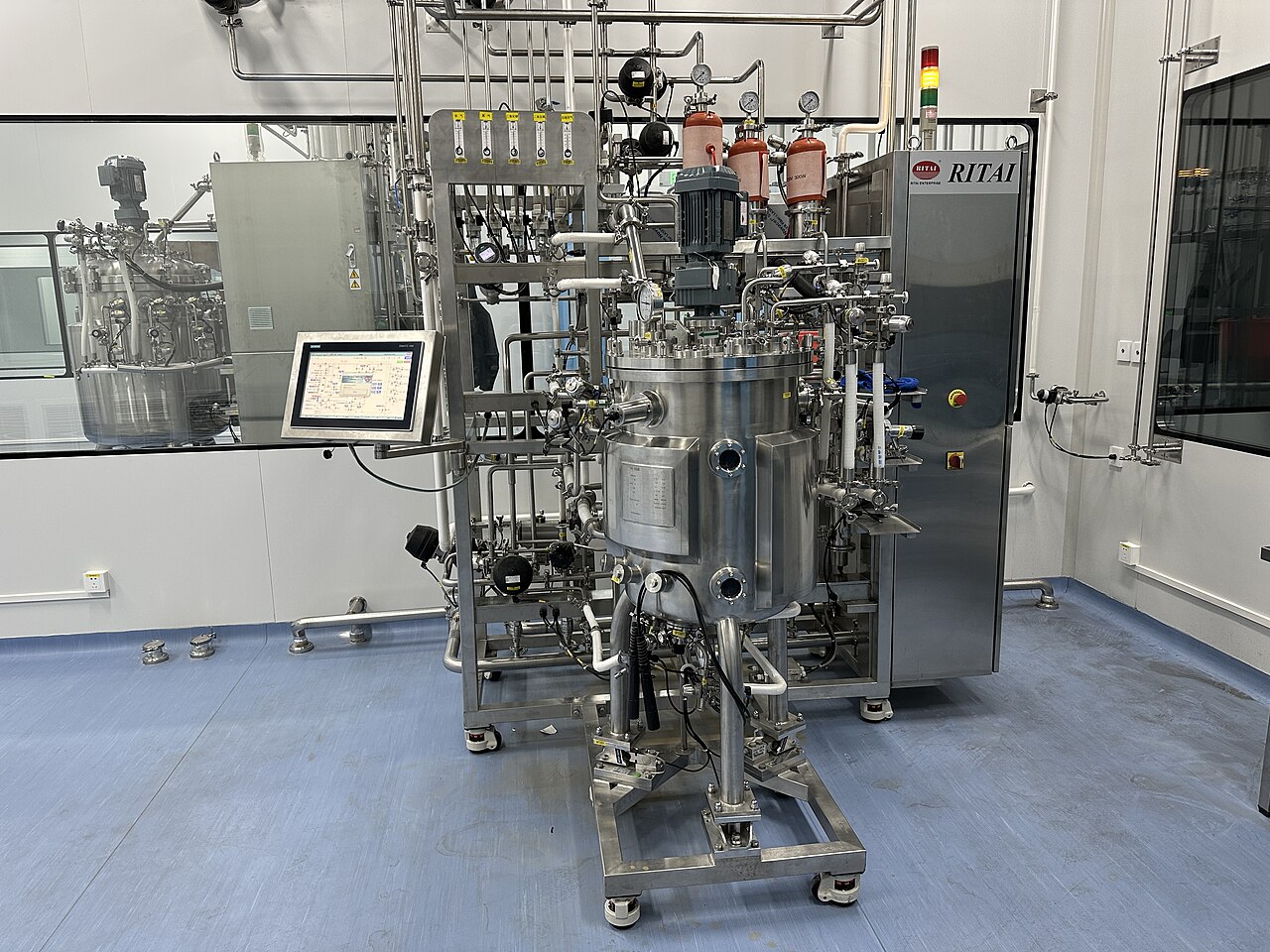
The second is scale. With the 180,000-liter Plant 5 that came online in April 2025, Samsung Biologics’ total capacity reached 784,000 liters — the largest in the world. In CDMO, capacity is the size of the bowl you can fill with orders. There are only a handful of places on earth where big pharma can place hundreds of thousands of liters at once, and this is the biggest bowl among them.
So the orders follow the capacity. On the company’s disclosures, 2025 order intake reached roughly ₩6.6 trillion (about $4.8 billion), passing the prior full-year total within ten months, and the order backlog cleared $10 billion. I read that backlog as several years of revenue laid down in advance — a safety plank under the stock.
The most recent order worth noting is a first 2026 CMO contract of about ₩279.6 billion (roughly $200 million) with an undisclosed European pharma company, running out to 2032. It is a solid deal, but it is a single one — not the wave that a 784,000-liter platform is built to absorb. That contrast, a huge bowl against a thin recent pour, is exactly the tension I keep coming back to. A backlog is a stock of past wins; what I need to see is the flow of new ones, and in 2026 that flow has been quiet.
There is a subtler upside to the split that I think the market underrates here. As long as biosimilars sat inside the same company, a big pharma client handing its molecule to Samsung Biologics was, at least in appearance, also handing it to a firm that ran a competing biosimilar business down the hall. Pure CDMOs sell trust and confidentiality above everything. By moving Bioepis out to Samsung EPIS Holdings, the surviving company erased even the look of that conflict. I do not think this shows up in any single quarter, but over years it is the kind of edge that wins the marginal contract against Lonza or a Western rival — and it strengthens the very switching-cost moat I opened with.
Three: it became a pure-play CDMO
The third is the real starting point of my interest. Samsung Biologics resolved on a spin-off on May 22, 2025, established Samsung EPIS Holdings on October 1, and re-listed on October 29. The split ratio was about 0.65 to the surviving company (Samsung Biologics) and 0.35 to the new holding company (Samsung EPIS Holdings). Samsung Bioepis, the biosimilar arm, went to Samsung EPIS Holdings as a wholly owned subsidiary.
Why does that matter to me? The old Samsung Biologics fused CDMO (contract manufacturing) with biosimilars (in-house development) in one body. Biosimilars carry heavy earnings volatility — drug development, litigation, price wars. The surviving Samsung Biologics stripped that volatility out and became a pure contract-manufacturing play. For someone who wants to bet on CDMO alone, I think the structure got cleaner. When I first heard about the split I brushed it off as governance housekeeping; looking again, the sharpening of what this is as an investment mattered more.
The company’s own stated direction backs that read. On the spin-off materials, the surviving Samsung Biologics laid out a three-axis growth plan — capacity, portfolio, and global footprint — and said it would invest in next-generation modalities like antibody-drug conjugates (ADC), adeno-associated virus (AAV) gene therapy, and pre-filled syringes. That widens not just how much it can make but what it can make. I see it as adding a breadth-of-moat to the size-of-moat. It is an option I will watch over years, though, not today’s earnings — these modalities barely move revenue yet.
Samsung Biologics stock and the numbers I see
Having granted the quality, I look at what that quality costs today. Here is the table as I keep it.
| Metric | Value | Note |
|---|---|---|
| Price (Jul 13 close) | ~$1,000 (₩1,386,000) | ~30% below Jan high of ₩1.97M |
| Market cap | ~$46B (₩64T) | Large-cap on KOSPI |
| P/E (TTM) | 52.7x | Korean data aggregator |
| P/B / ROE | 6.3x / 19.4% | High-ROE, high-P/B profile |
| Operating margin (TTM) | 45.4% | Rare for a manufacturer |
| 2026E revenue (sell-side) | ~$3.6B (₩5T) | Plant 5 ramp-up |
Sources: price, P/E, P/B, ROE, margin — Korean market data (TTM) | 2026E revenue — Korean sell-side estimates | USD at roughly ₩1,380 | as of July 2026
Here is how I read it. A 45%-plus operating margin and a high-teens ROE — very few manufacturers print that. On business quality alone there is little to fault. The issue is the PER 52x sitting next to it. The market already knows how good this company is and is paying the full bill for it. I try to separate a good company from a good stock, and right now this table draws a circle around “good company” and a question mark around “good stock.”
Korean sell-side estimates fill in this year’s picture. On figures compiled by Korean financial press, 2026 revenue is put around ₩5 trillion (~$3.6B) with operating profit in the mid-₩2-trillion range. The second quarter specifically is seen near ₩1.3 trillion in revenue, up roughly 30% year on year, at a 45-46% operating margin. The May strike disruption is expected to hit third-quarter numbers partially without derailing the annual trajectory, according to both the company and the sell-side. I find these estimates broadly credible, but I always keep a note beside the table that these are sell-side projections, not confirmed results.
The sell-side price targets split, too. Reported as facts: Sangsangin Securities set ₩2.3M on April 23, KB Securities ₩1.9M on May 27, Samsung Securities ₩1.8M on May 21 (a cut), and Korea Investment & Securities ₩1.95M (also a cut). A ₩500,000 gap between the top and bottom of that range tells me the sell-side itself has not agreed on this valuation. I read that disagreement as the market’s own confession that price is hard to be sure of right now. When the most professional buyers on the Street cannot converge within 25% of each other, I take it as a sign to slow down rather than speed up.
Samsung Biologics stock next to its global CDMO peers
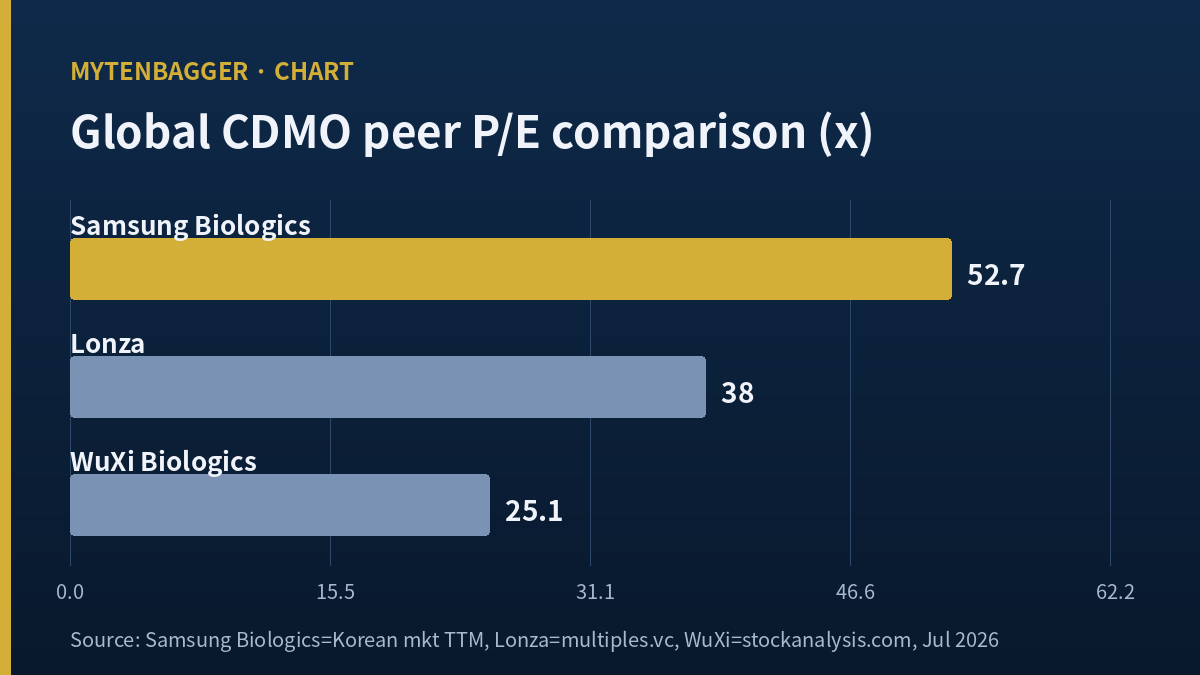
Looking at one Korean name alone, I cannot feel whether 52x is expensive. So I line it up next to the world’s competitors. The two poles of CDMO are Switzerland’s Lonza and China/Hong Kong’s WuXi Biologics.
| Company | P/E | Margin |
|---|---|---|
| Samsung Biologics (Korea) | 52.7x | Op. margin 45.4% |
| Lonza (Switzerland) | 38.0x | EBITDA margin 32% |
| WuXi Biologics (China/HK) | 25.1x (fwd 19.6x) | Op. margin 30.5% |
Sources: Samsung Biologics — Korean market data (TTM); Lonza — multiples.vc; WuXi Biologics — stockanalysis.com | as of July 2026
Here my picture sharpens. Samsung Biologics has the highest margin of the three — a 45%-plus operating margin looks down on Lonza’s 32% EBITDA margin and WuXi’s 30.5%. On quality it is clearly first. But it is also first on valuation. At 52.7x it is nearly 40% richer than Lonza and more than double WuXi. In other words, buying at this price is betting a premium on the idea that Samsung Biologics holds its peer-beating margin and growth without a wobble. I agree with that future — I just do not want to pay the whole premium for it today. That is why valuation outweighs the tariff for me.
Since I raised the tariff, one more point. The US pharma tariff is usually treated as pure bad news for Samsung Biologics. It is a fact that US Section 232 tariffs on patented pharmaceutical imports take effect July 31 on a tiered schedule, and export volumes carry a burden. But I see a paradox here. Samsung Biologics already has manufacturing inside the US, and there have been reports (Korean press) of new CMO volume assigned to its US site. The harsher the tariff, the more valuable a “made-in-America CDMO” becomes. Whether this tariff is only a negative, or whether US capacity is a hedge, is something I want to judge after the structure is set at month-end — not by panicking or cheering early.
Samsung Biologics stock: the two paths I map
The path where I do buy (my base case)
The picture in which I actually start buying goes like this. The end-of-July tariff structure confirms that US capacity works as a shield rather than a penalty, Plant 5 utilization climbs, and the big new orders that dried up after the GSK deal start landing again. Then the $10-billion backlog visibly flows into real revenue and profit, and the 52x P/E begins to read as “growth pulled forward” rather than “expensive.” At that point the valuation weight melts into growth, and I start scaling in on a phased basis. My conviction in the number-one’s quality is high enough that once it is confirmed, I do not hesitate. The weight I put on this path right now is a bit over half. Concretely, what would move me from watching to buying is a pair of catalysts landing together: a tariff outcome where the US site clearly reads as a hedge, and one or two large multi-year contracts that put the recent order lull to bed. If both print, the backlog stops being a static number and starts converting into visible revenue growth, and I would rather pay 52x for a story that is re-accelerating than 35x for one that is stalling.
The path where I am wrong
I will write the other side honestly. If the tariff comes in heavier than expected, the big-order gap runs on for several more quarters, and labor issues like the May strike repeat past the third quarter, the market re-rates that 52x from “a fair price for quality” to “a mark of over-heating.” Short sellers are already betting that way. On Korean press reporting (late April), the net short balance that stood near ₩100 billion early in the year had doubled by April, with the short-sale share approaching 30%. That is not a signal to wave off. Premium names get marked down fast the moment the growth story so much as pauses. Half of why I am waiting instead of buying sits right here. The arithmetic is unforgiving: if the market decides this deserves a Lonza-like 38x rather than 52x on unchanged earnings, that alone is a roughly 27% de-rating before a single estimate is cut. On a name where the sell-side already can’t agree within a quarter of the price, I do not want to be the one holding the top of that range when the story goes quiet.
I will admit one bias I am watching in myself. I have a habit of respecting a great franchise so much that I overpay for it, and I have been burned that way before — buying the quality and waving off the entry price. With Samsung Biologics that instinct is loud, precisely because the quality is so obvious. That is exactly why I am forcing myself to name three concrete locks instead of trusting the story to carry me in.
The tails I weigh less
The extremes, briefly. The best case is tariffs framed in favor of US capacity plus back-to-back large orders that fully justify the premium as growth. The worst is tariffs, orders, and labor all going wrong at once and the premium unwinding sharply. I keep both probabilities low, but I stay mindful that on a premium name the downside tail lands harder. So until the higher-probability base case is confirmed, I do not step in on “good company” alone.
Three locks that must open before I buy Samsung Biologics stock
To sum up, my watching is not vague caution but an ordered checklist. I write it starting from whichever answer arrives first.
The first lock to answer is the tariff. By July 31 the US Section 232 rate structure is revealed. If US capacity is confirmed to work as a hedge there, the single biggest uncertainty pressing the stock lifts. This is the fastest checkpoint.
The second lock is a restart in large orders. Since the GSK plant purchase, needle-moving contracts have thinned to a single deal. Big new orders have to return to fill the world’s largest capacity before the backlog turns into growth. I cannot pin a date on this, so I follow the disclosures quarter by quarter.
The third lock is valuation. Once the first two open, the 52x P/E starts to be justified by growth. But if those two stay shut while the price alone runs up, that is not a place for me to chase — it is a place to step back. I judge the third lock by the speed at which the first two swing open.
Where I land on Samsung Biologics stock now
I have not decided against Samsung Biologics — I just have not bought it yet. That distinction matters. The world’s largest CDMO capacity, the switching-cost moat, the pure-play CDMO structure the spin-off sharpened — on the quality of this business I have conviction I do not need to hide. But paying the full PER 52x for that quality today, with the end-of-July tariff and the stalled large orders still latched, is more than I will do.
My order of watching is tariff (July 31), then a restart in large orders, then valuation justification. Once I see the first two swing open, I start scaling in on a phased basis. I cannot buy the number-one’s quality at half price, but I have the patience to wait until the premium melts into growth. For me these three are an ordered question, and I am quietly waiting on the first answer at month-end.
Further reading: Samsung Biologics official spin-off announcement, Reuters healthcare & pharma coverage, Crowell & Moring on the Section 232 pharma tariff schedule, WuXi Biologics valuation statistics, Lonza Group valuation multiples, Korean press on the short-selling build-up.
Related reading
- Hyundai Motor Stock: I Watch Tariffs and Margins, Not Robots
- Alteogen Stock: The 2% Royalty That Capped a KOSDAQ Leader