Celltrion Stock: Record Earnings, 52-Week Low. Why I’m Buying
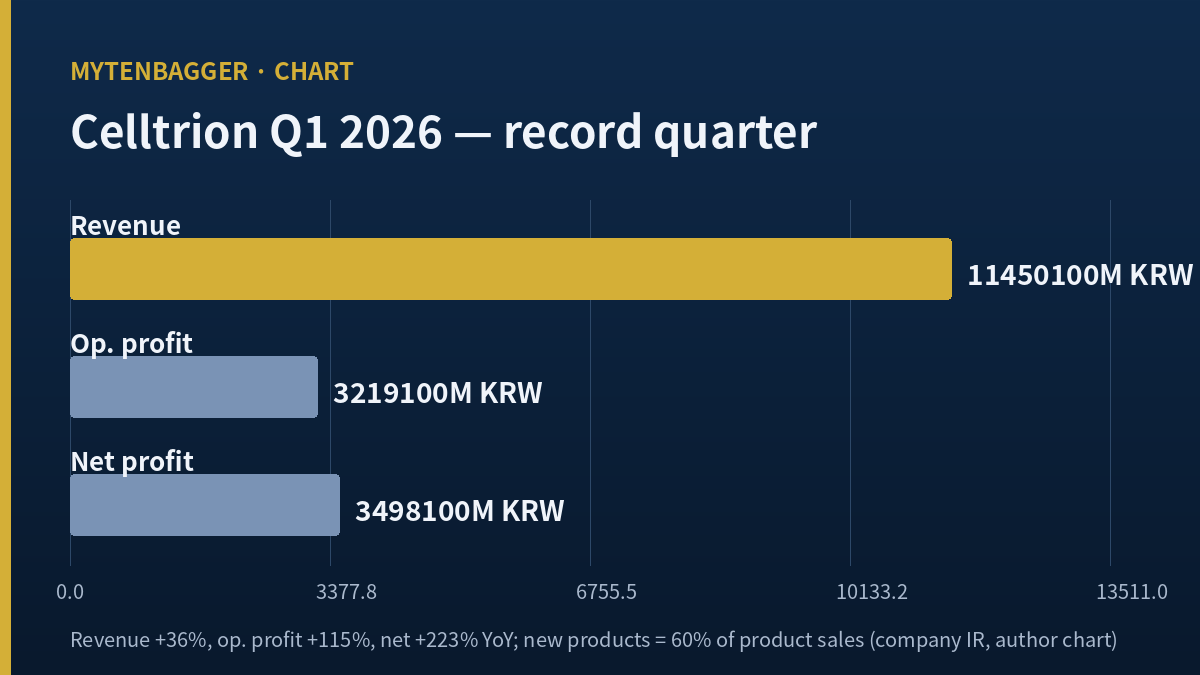
The 30-second version. Celltrion stock is in a strange spot. The company just posted its best quarter ever — Q1 2026 revenue of ₩1.145 trillion (about $830 million) and operating profit of ₩321.9 billion (about $233 million), up 36% and 115% from a year earlier by the company’s own report — yet the shares trade only 9% above their 52-week low and 31% below the high. I read that gap as the market being slow, not the earnings being false. New products now carry 60% of product revenue, and the company plans to cancel roughly ₩1 trillion (about $725 million) of treasury shares. So I started buying Celltrion in stages. I am also writing down the uncomfortable numbers — a trailing PER near 41x and a 5.9% ROE — because I want the place where my thesis breaks marked in advance.
Contents
Why Celltrion Stock Sits at a Low on Record Numbers
Some context for readers outside Korea first. Celltrion trades on the KOSPI, Korea’s main board, under ticker 068270. It is the country’s largest biosimilar maker and one of the ten or so biggest names on the exchange, with a market value around ₩40.2 trillion (roughly $29 billion).
What pulled me back into the name was prescription data. Zymfentra — the subcutaneous form of infliximab — hit record monthly US prescriptions, more than triple a year earlier, per the company. So I opened the income statement. Q1 2026 came in at ₩1.145 trillion of revenue, ₩321.9 billion of operating profit and ₩349.8 billion of net income, with year-on-year growth of 36%, 115% and 223% respectively (company report, via The Korea Herald and Seoul Economic Daily). That is a record first quarter.
And yet Celltrion stock told the opposite story. At ₩172,800 (about $125) on July 14, 2026, the shares sat 31% under the 52-week high of ₩251,000 and just 9% over the low of ₩158,500. They were below their 20-, 60- and 120-day moving averages — a clean downtrend on the chart. A record quarter and a downtrend on the same ticker: that dissonance is what Celltrion stock is right now, and it is exactly the kind of setup that pulls in a searcher already itching to buy. So I made myself answer the honest question first — are the earnings fake, or is the market late? I landed on late.
The Numbers I Read: New Products Now Carry the Profit
What separates a good quarter from a durable one is the mix. In Q1 2026, new-product sales were ₩581.2 billion and made up 60% of product revenue, up 67% year on year (company report). I weight that 60% more than any headline. When Celltrion merged with Celltrion Healthcare at the end of 2023, the market’s doubt was whether merger synergy would ever show up in the P&L. This quarter is the receipt that it did — the profit engine is now the newer, higher-margin drugs, not aging Remsima and Truxima.
| Product (originator) | Q1 result (company) | What I noticed |
|---|---|---|
| Zymfentra (infliximab SC) | Record US monthly scripts, 3x+ YoY | US direct-sales, high margin — the core engine |
| Omlyclo (Xolair biosimilar) | ~₩71.7B, +45.5% QoQ | Europe share: Denmark 98%, Spain 80%, Netherlands 70% |
| Stoboclo/Osenvelt (Prolia/Xgeva) | ~₩68.5B | Sole preferred listing at US CVS Caremark |
| Steqeyma (Stelara biosimilar) | 10%+ US share | Double-digit share soon after launch |
Here is where I read it differently from the crowd. The market treats Omlyclo’s 98% share in Denmark as a simple “good headline.” I read it as evidence of what Celltrion’s real moat actually is. A biosimilar copies a drug whose patent has expired, so a true monopoly is impossible. The winner wins a different way: lower cost than the originator, first through each country’s tenders and formularies, and then sticky once switching costs set in. Ninety-eight percent in Denmark is not magic — it is the receipt of winning that cost-and-access fight. So I define Celltrion’s moat not as a monopoly but as a compound of cost leadership, an accumulating library of approvals, and large in-house capacity.
The full-year frame the company gave fits that read. For 2025, revenue was ₩4.16 trillion ($2.84 billion), operating profit ₩1.69 trillion, and operating margin 28.1% (company report, via The Korea Herald). For 2026 the company guided to ₩5.3 trillion of revenue (about $3.8 billion) and ₩1.8 trillion of operating profit. The sell-side draws a similar picture — DS Investment & Securities modeled 2026 revenue of ₩5.396 trillion and operating profit of ₩1.80 trillion, a 33.4% margin, while keeping a buy rating and a ₩320,000 objective (May 2026 note, via Newspim). I do not adopt that objective as my own. But five Korean brokers — DS at ₩320,000, DB and Korea Investment at ₩290,000, SK at ₩260,000, Heungkuk at ₩270,000 — cluster between ₩260,000 and ₩320,000 against a ₩172,800 price, and I do record the size of that gap as a market signal.
The 2025 detail underneath that headline is what convinced me the mix shift is structural, not a one-quarter flourish. Across full-year 2025, biopharmaceutical sales reached ₩3.86 trillion with 54% coming from new products, and five products launched only in the second half of 2025 already combined for about ₩300 billion (company report, via The Korea Herald). The fourth quarter alone did ₩1.33 trillion of revenue and ₩475.2 billion of operating profit, up 25.1% and 142% year on year. When I line those quarters up, the pattern is a company crossing from old-drug maturity into a new-drug ramp — and the ramp is accelerating, not fading. That is the single most important thing a trailing PER cannot see, because a trailing multiple divides today’s price by yesterday’s earnings.
The access story sits underneath the sales, and I think it is underrated. Korea Biomedical Review reported that both Zymfentra and Inflectra secured major US formulary listings — the sort of wins that decide whether a biosimilar is a catalog item or a franchise. In a market where a payer’s preferred-drug list can make or break a launch, formulary placement is the moat being poured in real time. I would rather own the company winning those listings quietly than the one issuing louder press releases.
Zymfentra and the SC Play — Celltrion Stock’s Engine and Its Risk
Zymfentra is the piece I stared at longest. It takes infliximab — historically an IV drug — and reformulates it as a subcutaneous injection that earned near-novel patent protection in the US. In the most price-competitive biosimilar market on earth, that SC differentiation lets Zymfentra step aside from a pure price war. That is the real engine under Celltrion stock: high margin, sold direct in the US, so the company keeps the distribution spread too.
But I treat that same play as a risk. Korean trade press (Newstomato) flagged that as Keytruda (pembrolizumab) loses exclusivity, the originator is moving to an SC form to defend it — and called that “cold water” on Korean biosimilars. SC reformulation is exactly the card Celltrion played with Zymfentra; if originators play the same card, the follow-on biosimilar markets Celltrion is aiming at get narrower. The weapon of growth and the weapon of threat are the same “SC strategy,” and I keep that double edge written down on purpose.
On capacity there is a reassuring signal too. Celltrion agreed to supply Eli Lilly ₩678.7 billion of contract manufacturing through 2029 from its Branchburg, New Jersey plant (company report). Turning spare capacity into CMO cash is a cushion for when biosimilar pricing compresses, and I like owning a business with that kind of defensive cash line laid down.
Pricing Celltrion Stock Against Global Peers
Korean investors pair Celltrion with Samsung Biologics, but I value it against the global peers whose business model is closer. The pure-play biosimilar leader is Sandoz, spun out of Novartis; the large hybrid of biosimilars and originator drugs is Amgen.
| Company | Valuation (July 2026, source noted) | Character |
|---|---|---|
| Celltrion | PER 40.8x · PBR 2.16x · ROE 5.9% (trading data, trailing) | Vertically integrated biosimilars + US direct sales |
| Sandoz | P/E 31.2x · EV/EBITDA 15.7x (multiples.vc) | Pure-play global biosimilar leader |
| Amgen | P/E about 26x (macrotrends) | Originator drugs plus biosimilars |
On trailing PER alone, Celltrion stock is more expensive than even Sandoz, the pure-play leader. Stop there and “overvalued” is the verdict. But I look at direction, not the trailing snapshot. Celltrion’s 40x trailing multiple exists because profit is only now inflecting — operating profit up 115% in Q1 — so the denominator is still small. If the company’s ₩1.8 trillion guidance and the sell-side estimates land, the forward multiple falls well below that 40x. I am betting on the speed at which the denominator grows, not buying today’s trailing 40x. That distinction is the whole of my buy logic.
The peers themselves tell me the biosimilar tide is real, which matters because a single-company bet is safer when the category is expanding. Sandoz confirmed strong biosimilar growth in its Q1 2026 results and reaffirmed full-year 2026 guidance (Sandoz report), and Amgen’s own commentary increasingly frames biosimilars as a growth pillar rather than a sideline (industry coverage). If the whole category is compounding and Celltrion is the lowest-cost vertically integrated player winning formularies, then the question is not whether the market grows but who takes the share. I think the structure of Celltrion’s cost base answers that in its favor, and the peers’ multiples — Sandoz at 31x, Amgen near 26x — give me a rough floor for where Celltrion’s forward multiple could settle once its earnings catch up to its footprint.
Foreign Ownership, the Won, and the Amgen Comparison
Foreign investors already hold about 24.5% of the shares (trading data), so this is not an illiquid backwater — it is a globally owned large cap that simply happens to price in won. That currency point cuts both ways: I earn the re-rating in won, and a weaker won trims the dollar return, so I treat the FX as a variable I accept rather than one I can forecast. The cleanest way to size the position is against a name carrying the same exposure — if you own Amgen for its biosimilar optionality, Celltrion is the pure-play version of that same thesis, cheaper on forward earnings if the ramp lands, riskier on governance and disclosure history. I own it with my eyes open to both sides of that trade.
The Buybacks and Catalysts Behind Celltrion Stock
Part of what gave me the nerve to buy the low is the capital return. Celltrion announced plans to cancel roughly ₩1 trillion (about $725 million) of treasury shares and recently bought a further 488,983 shares (company report). A cancellation, unlike a dividend, cannot be reversed — it permanently shrinks the share count. The dividend points the same way; the per-share payout has climbed from ₩375 to ₩750 over recent years (DART filings). The yield itself is a thin 0.41%, but I am not buying this as a dividend name — I am buying the combination of profit that is rising while the share count falls. Multiply those and per-share value climbs fast.
The catalyst calendar is stacked too. Per sell-side summaries (Newspim), the second half brings a US launch of Omlyclo, a European launch of Apytozma (a tocilizumab biosimilar), and a Japanese launch of Yuflyma. The company is expanding total production capacity toward 571,000 liters and targets new products at 70% of revenue by year-end across an 11-product global portfolio. On top of that, Celltrion has already filed a Cosentyx biosimilar in Canada, aiming at a $10 billion market (per Seoul Economic Daily). No single one is a blockbuster approval — but the pace at which these approvals and launches stack is, in my judgment, the real moat. Eleven products across the US, Europe and Japan is not one big bet; it is a portfolio where any single price war is diluted by the others still ramping. That breadth is exactly what a vertically integrated, low-cost manufacturer can afford to build and a smaller rival cannot, and it is why I keep coming back to capacity — 571,000 liters is not vanity, it is the physical precondition for launching that many products without ceding cost leadership. When I weigh the Branchburg supply deal with Eli Lilly against that build-out, I read a company deliberately converting fixed manufacturing into two revenue streams at once: its own biosimilars and other firms’ molecules. That is the kind of capital discipline I want to see before I add to a position, not after.
I have watched this company from a distance since the 2018 accounting controversy that whipped the shares around. What I took from that stretch is that the Celltrion name always carries an expectation premium and a suspicion discount at the same time. Right now the evidence — actual earnings — is thicker than it has ever been, and the price is standing on the suspicion side. I put my money on the evidence winning.
The Other Side — What Worries Me About Celltrion Stock
The harder I lean bullish, the larger I owe the bear case. The skepticism on Celltrion is grounded. First, valuation: the 5.9% ROE is low, largely because the merger inflated equity and intangibles, so the denominator is big; how the market prices a business with 28% margins but low ROE is still an open argument. Second, positioning: Korean outlets (Dailymedi, Etoday) have repeatedly noted Celltrion is an easy short target given its valuation, and a downtrend with a 0.41% yield offers thin defense to short-term traders. Third, the industry itself: biosimilars are a structurally price-declining market, so volume gains can be offset by falling prices and revenue growth can stall. Even this record quarter was down 13.9% in revenue and 32% in operating profit sequentially (company report) — a seasonal dip I will be watching to see whether it becomes a trend. Fourth, the macro: the US is Celltrion’s core market, and drug tariffs and pricing pressure resurface with every US political cycle. A model like Zymfentra’s, which earns a thick margin selling direct in the US, is by the same token directly exposed to US policy risk. I cannot control that variable, so my answer is to approach only in stages at the low and keep my average cost down.
There is a fifth item I refuse to paper over, because it is the one I have watched longest: governance and disclosure history. The 2018 accounting episode — questions over how the then-separate Celltrion and Celltrion Healthcare recognized inventory and revenue between related parties — is why this name has always carried a suspicion discount that a clean-sheet biotech would not. The 2023 merger was meant, in part, to remove exactly that related-party opacity by folding the sales arm into the manufacturer. I think it largely did, and this quarter’s clean 60% new-product mix is evidence the plumbing is simpler now. But I do not pretend the memory is gone; a market that once found reasons to doubt the numbers will demand a few clean quarters in a row before it fully pays up. My low ROE point compounds this: 5.9% on 28% margins is the signature of a balance sheet swollen with merger goodwill and intangibles, and until earnings grow into that equity base, the ROE stays optically poor even if the cash economics are fine. A skeptic can build a coherent bear case out of those two facts alone, and I would rather write it myself than have the market write it for me.
Why I’m Buying, and Where My Thesis Breaks
So, to gather it up: I started buying Celltrion in stages around the ₩172,000 zone. My three reasons are that new products now make 60% of profit and merger synergy has shown up as real numbers, that management is returning capital through a ~₩1 trillion cancellation plus more buying, and that a record quarter sitting 9% above a 52-week low is an unusual gap to have open. I think the re-rating room here is large. This is not me telling anyone else to buy — it is a record of why I put my own money in at this spot.
And I nail down, in advance, the place where I admit I was wrong — in time order. First, if next quarter’s new-product growth clearly decelerates and biosimilar price erosion outruns volume, the first button of my re-rating thesis has come undone. Next, if Zymfentra’s US prescriptions or formulary access retreat, or originators’ SC defense actually starts eating the follow-on markets, I have to re-run the growth engine from scratch. Last, if quarterly progress keeps falling short of the ₩5.3 trillion / ₩1.8 trillion guidance, I lose the ground to justify the valuation premium. Watching whether those three buttons come undone in order is my job now. When I re-read this later, those markers — not my mood today — will tell me whether I was right.

Sources I used: The Korea Herald — Celltrion record earnings, Seoul Economic Daily — record Q1, Korea Biomedical Review — Zymfentra formulary wins, Seoul Economic Daily — Cosentyx biosimilar filing, multiples.vc — Sandoz multiples, macrotrends — Amgen PE ratio.
Related reading