Duksan Neolux Stock: A Third of the Profit Is Not OLED
Prices here are the September 11 (Fri), 2026 close on the KOSDAQ, the junior board of Korea Exchange that sits alongside the larger KOSPI. Won figures are in billions. The US peer figures are the same day’s close in New York. I am putting the footnote at the top because the number this piece is built on is a difference between two lines that usually get printed without one, and that difference is 42.3.
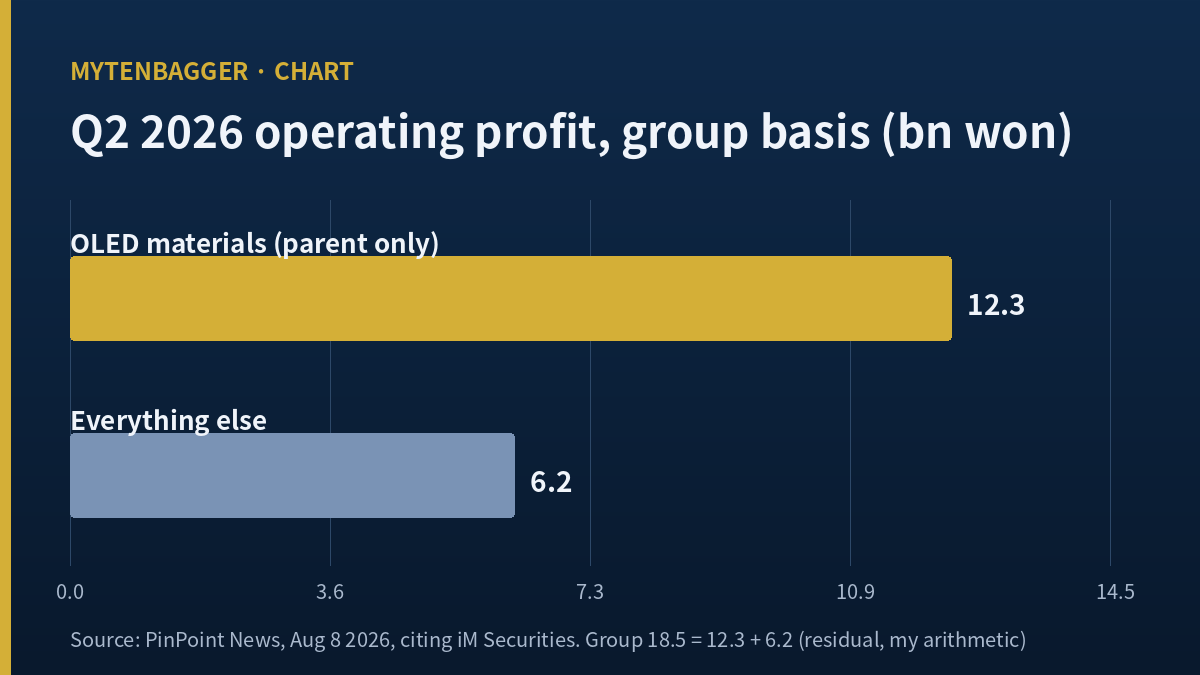
Q2 2026 operating profit, group basis: 18.5 billion won

  OLED materials, parent company only   ############   12.3
  Everything else that rolls up          ######         6.2

  (one block = 1 billion won)
Contents
Duksan Neolux Stock Reports Two Businesses in One Income Statement
I came to Duksan Neolux stock for organic OLED materials. That is what the company is known for in Korea, that is what its name maps to in every sector screen I use, and that is the business I wanted to understand. What I found in the June quarter is that roughly a third of the operating profit came from industrial pumps and compressors.
The company bought a majority position in a rotating-machinery maker and closed that purchase on February 28, 2025, according to Korean trade outlet The Elec. In 2026 it put fresh money into a special purpose vehicle to take a valve manufacturer, as Korean financial outlet IB Tomato reported on September 8 (Tue), 2026. I am deliberately leaving the purchase prices and the balance sheet effects out of this piece. Those belong to the asset side and I handled them separately; here I stay on the income statement.
The stock closed at 30,850 won. Every multiple below uses that close.
What the Second Quarter Actually Said
Korean outlet PinPoint News reported the June-quarter results on August 8 (Sat), 2026, citing Korean sell-side house iM Securities. Group revenue was 94.6 billion won, up 17% year on year, and group operating profit was 18.5 billion won, up 80%. On a parent-company-only basis, revenue was 52.3 billion won, up 10%, and operating profit was 12.3 billion won, up 22%. The market had been looking for 17.5 billion won of group operating profit, so the print came in 5.71% above it by my arithmetic.
The two lines, subtracted
94.6 minus 52.3 leaves 42.3 billion won of revenue that did not come from the parent company. 18.5 minus 12.3 leaves 6.2 billion won of operating profit in the same position. That remainder is 44.71% of group revenue and 33.51% of group operating profit, both by my arithmetic. A third of the profit line in a company filed under display materials was made somewhere else.
Why the prior-year base matters
The comparison quarter is a genuine one and not something I built. A Korean market report from August 31, 2025 put the year-earlier group figures at 80.9 billion won of revenue and 10.3 billion won of operating profit. 94.6 over 80.9 gives 16.94%, which rounds to the 17% the newer report used, and 18.5 over 10.3 gives 79.61%, which rounds to 80%. Both growth figures reproduce. That is worth checking, because the machinery business only entered the group late in the first quarter of 2025, so year-on-year comparisons around that seam can be half arithmetic and half business.
The half year, added up
Putting the two 2026 quarters together gives 167.47 billion won of group revenue and 35.59 billion won of group operating profit, a 21.25% margin for the half, all by my arithmetic on the two reported quarters. That half-year revenue is 48.64% of what the whole of 2025 brought in, again by my arithmetic, which is roughly the pace you would expect from a full-year comparison that finally has the machinery business on both sides of it. I keep the half-year margin separate from the quarterly ones below, because 21.25% is a two-quarter blend and the June quarter alone ran 19.56%.

Duksan Neolux Stock and the Margin That Falls When You Consolidate
Here is the part I find most useful, and it is a margin question.
The parent company alone earned 12.3 on 52.3, which is a 23.52% operating margin by my arithmetic. The group earned 18.5 on 94.6, which is 19.56%. The remainder earned 6.2 on 42.3, which is 14.66%. So the machinery half is real profit and it is also lower-margin profit, and adding it pulls the reported group margin down by close to four percentage points against the materials business standing alone.
That has a consequence for how I read any group-level margin number for this company. A group margin of 19.56% is not the OLED materials margin, and it is not the machinery margin. It is a weighted blend whose weights move whenever the machinery order book moves. If someone tells me this company’s margin expanded or compressed, my first question is which of the three numbers they mean.
I ran into the mirror image of this problem at another Korean display-chain name, where five quarters of nearly flat revenue hid an operating profit that swung by a multiple; I wrote that up in my LX Semicon piece. There the flat line was the disguise. Here the blended line is.
The First Quarter Number That Looks Better Than It Is
Korean outlet Digital Today reported the March-quarter filing on May 12 (Tue), 2026: group revenue 72.87 billion won, up 92.1%, group operating profit 17.09 billion won, up 72.7%, and group net profit 16.81 billion won, up 105.1%.
Those growth figures are the least informative numbers in this piece and I want to say so plainly. The machinery business closed into the group at the end of February 2025, so the year-earlier March quarter contained about one month of it and the 2026 March quarter contained three. A large part of that 92.1% is the arithmetic of a changed reporting perimeter, and none of it tells me whether either business got better. The June quarter is cleaner because both sides of that comparison carry the machinery business in full.
For scale on what was added: a Korean pre-IPO publication, The Stock, reported on March 20 (Fri), 2026 that the machinery unit accounted for 142.0 billion won of the group’s 344.3 billion won of 2025 revenue, which is 41.24%. The Elec, in its 2025 report, put that unit’s 2023 standalone figures at 114.7 billion won of revenue and 15.1 billion won of operating profit. So this is not a bolt-on. It is close to half the top line.
Duksan Neolux Stock Against Five Sell-Side Numbers
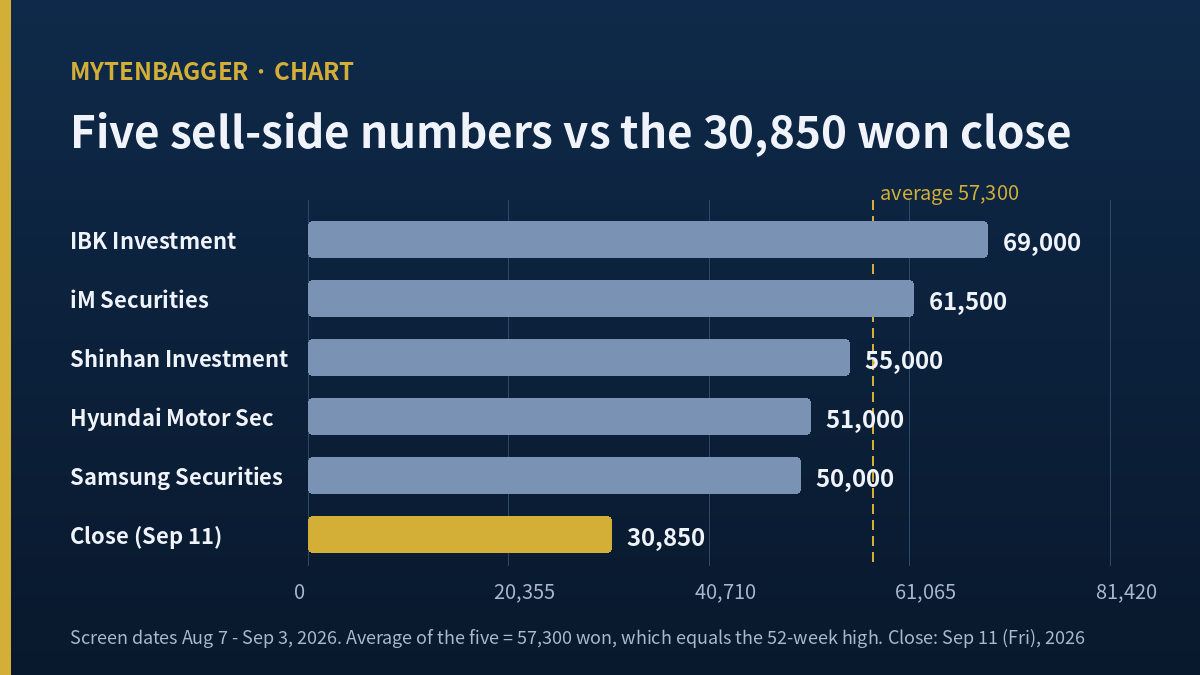
Five Korean houses carry a valuation on this name on the screen I use. I am reporting them as facts with their dates, and I have not adopted any of them as my own view.
| House | Number on screen (won) | Screen date |
|---|---|---|
| IBK Investment Securities | 69,000 | August 13 (Thu), 2026 |
| iM Securities | 61,500 | August 7 (Fri), 2026 |
| Shinhan Investment | 55,000 | August 13 (Thu), 2026 |
| Hyundai Motor Securities | 51,000 | September 3 (Thu), 2026 |
| Samsung Securities | 50,000 | August 7 (Fri), 2026 |
Against the 30,850 won close, the lowest of those five sits 62.07% above and the highest sits 123.66% above, by my arithmetic. That is a wide band for a company where every one of those five is looking at the same two-part income statement.
Two of the five moved, in opposite directions
The screen shows one date per house. The path behind those dates is more interesting. Korean outlet Marketin Edaily and a same-day Korean market wire carried an iM Securities view on June 11 (Thu), 2026 from analyst Jeong Won-seok carrying 70,000 won. The screen now shows 61,500 for that house, which is 12.14% lower. Going the other way, IBK Investment analyst Kang Min-koo raised his number from 67,000 to 69,000 on July 10 (Fri), 2026, a 2.99% increase, citing wider adoption of black pixel-defining material and a longer sales tail on a flagship handset.
Kang’s July note also previewed the June quarter on a parent-only basis at 53.2 billion won of revenue and 12.1 billion won of operating profit. The actual parent-only print was 52.3 and 12.3. He was within about 1.7% on each. That is a good call, and it is a good call on the half of the company that is OLED. I have no equivalent check on anyone’s machinery estimate, because none of the coverage I could open published one separately.
An Average That Lands Exactly on the 52-Week High
Add the five numbers and you get 286,500 won. Divide by five and the average is 57,300 won.
The 52-week high on this stock is 57,300 won. The same figure, to the won.
I want to be careful about what that coincidence means, because it means less than it looks. Five houses rounding to the nearest thousand will land on round averages often, and there is no mechanism I know of that makes an analyst average snap to a trailing high. But the arithmetic does describe the situation compactly: the consensus of these five is that the stock returns exactly to where it has already been in the last twelve months, and no further. Against the 30,850 close that average sits 85.73% higher, by my arithmetic. Against the 24,500 won 52-week low the close sits 25.92% higher, and against the high it sits 46.16% lower. The high is 2.3388 times the low.
Duksan Neolux Stock Next to Universal Display
The closest listed comparison I have for the materials half is Universal Display Corporation on the Nasdaq, which licenses and sells phosphorescent OLED emitter material. It is not a clean comparison, because Universal Display is a licensing-heavy model and Duksan Neolux is a manufacturer, and because half of the Korean company is machinery. I am setting the two against each other anyway, as questions and answers, because the differences are the point.
How big is each?
Universal Display: 3.86 billion dollars of market value on 45.97 million shares at 83.95 dollars, as of September 11 (Fri), 2026.
Duksan Neolux: 568.44 million dollars, by my conversion of the 30,850 won close on 24,831,179 shares at 1,347.63 won per US dollar on the same date. The US name is 6.79 times larger.
How profitable is each at the operating line?
Universal Display: 34.07% operating margin on 606.91 million dollars of trailing revenue, with 195.64 million dollars of net income.
Duksan Neolux: 23.52% for the parent company alone in the June quarter, 19.56% for the group. Neither Korean figure is trailing twelve months, and I am not going to pretend a single quarter and a trailing year are the same measurement.
What does each cost against reported earnings?
Universal Display: 20.2778 times, by my arithmetic on 83.95 dollars and 4.14 dollars of earnings per share. The screen prints 19.59, which reproduces off the prior session’s close, so the screen multiple is one day stale while the market value on the same screen is current.
Duksan Neolux: 14.4025 times, by my arithmetic on 30,850 won and 2,142 won of trailing earnings per share.
How far has each fallen?
Universal Display: 45.27% below its 52-week high of 153.38 dollars, with a low of 76.42 dollars.
Duksan Neolux: 46.16% below its high. The two are within a percentage point of each other, which tells me the de-rating in OLED materials has been a sector event and not a company event.
Who holds each, and how hard does each move?
Universal Display: a beta of 1.56 against the US market.
Duksan Neolux: a beta of 1.03 against its own market, with foreign investors holding 10.05% of the shares. The Korean name is the steadier of the two on its home board, which surprised me for a mid-cap whose business mix changed this much in eighteen months. One reading is that a domestic shareholder base with modest foreign participation simply trades less. Another is that the machinery half, selling into long-dated industrial projects, dampens the handset-cycle swings that drive the US name. I cannot separate those two explanations with the data I have, and a beta calculated across a period in which the company’s reporting perimeter changed is a weak measurement to begin with.
Three Universal Display figures sit outside the comparison above, and I am naming them once so that nothing is quietly withheld: a return on equity of 11.52%, a dividend of 2.00 dollars a share at a 2.38% yield, and a book multiple of 2.3050 by my arithmetic on a 36.42 dollar book value. All three belong to the balance-sheet question this piece does not answer, so none of them carries any weight in what I conclude here. Working them into the peer table would have let the asset side back in through a side door.
The Earnings Multiple I Can and Cannot Defend for Duksan Neolux Stock
Trailing earnings per share on the screen is 2,142 won, which puts the stock at 14.4025 times by my arithmetic. The same screen carries a 2026 estimate of 3,361 won, which puts it at 9.1788 times forward.
What I can defend
Both multiples are arithmetic on a stated close and a stated earnings figure, and I have shown the inputs. Anyone can redo them.
What I cannot
I cannot tell you what those earnings are earnings of. A group earnings per share figure for this company blends a higher-margin materials business with a lower-margin machinery business, in proportions that changed in 2025 and will change again when the valve business begins reporting. A forward multiple of 9.1788 times is only meaningful if the mix behind the 3,361 won estimate is the mix I think it is, and I could not find a published estimate that splits it. So I hold the multiple loosely. It is a fact about the screen more than a fact about the company.
Four Arguments Against What I Just Wrote
The blend is normal and I may be making too much of it. Plenty of listed manufacturers run two segments with different margins, and investors price them as a whole every day without incident. A reader could fairly say the only thing unusual here is that the second segment arrived recently, and that novelty is not the same as risk.
My margin arithmetic rests on a residual. I did not read a segment note. I took the group figures and the parent-only figures from a news report and subtracted, and everything that is not the parent company landed in one bucket called machinery. If that bucket contains anything else, say an eliminations entry of any size, then 14.66% is wrong and the three-margin story goes with it.
The machinery half may be the better half. I have written this as though the OLED business is the quality asset and the pumps are dilution, which is a display investor’s reflex and not an analysis. Industrial rotating machinery sells into power generation, and power generation demand has its own tailwind at the moment. A 14.66% margin in a business with a long order book can be worth more than a 23.52% margin in a business whose customer runs one fab cycle.
A subsidiary listing could reprice all of this, in either direction. The Stock reported on March 20 (Fri), 2026 that Korean regulators had moved toward restricting the practice of listing subsidiaries of already-listed parents, and that acquired subsidiaries would be treated the same way when effective control is present. That single policy line points both ways at once. If it blocks a listing, an expected value-surfacing event disappears. If it does not, a listing may surface value at the cost of diluting what the parent’s own holders own. I decline to call the direction, and I am aware that declining is itself a weakness in a piece that otherwise takes positions.
Where My Reading of Duksan Neolux Stock Breaks
I own none of this and I have no order working. This is a watch note and not a position.
What I am watching is the mix and not the level. Two things would end this reading. First, if a September-quarter report shows group operating profit rising while the parent-only line falls, then the OLED business I came here for is shrinking behind a growing group number, and the whole framing of this piece flips from useful to misleading. Second, if the company begins reporting the valve business inside the group and the residual margin I calculated at 14.66% moves by more than a few percentage points in either direction, then my three-margin picture was a snapshot of one quarter’s mix and not a description of the business.
The demand side has its own gate, and it sits outside this company. Korean panel makers have been unprofitable in specific quarters for years running, which I went through in my LG Display piece. A materials supplier’s volumes ride on those panel makers’ utilization, and nothing in this quarter’s print tells me that relationship has changed.
Figures I looked for and did not get
A published segment note with revenue and operating profit by business. Any separate estimate for the machinery unit from any of the five houses. Quarterly net profit for the June quarter. The 2026 estimate’s assumed mix behind the 3,361 won figure. The valve business’s revenue run rate. Each gap narrows what the numbers above can carry, and the longest of them is the segment note, because without it my 42.3 and my 6.2 come from arithmetic I did, and no company line confirms them.
Prices and multiples reflect the September 11, 2026 close in Seoul and New York as checked at the time of writing. The dollar conversion is approximate, at roughly 1,347.63 won per US dollar on that date. The Korean won is the reference currency throughout and the dollar figure appears once, for scale. Growth rates and margins described as my arithmetic are computed from the reported figures shown, and were not lifted from a screen.