Hansung Enterprise Stock: I Cheer the Crab Stick, I Don’t Buy
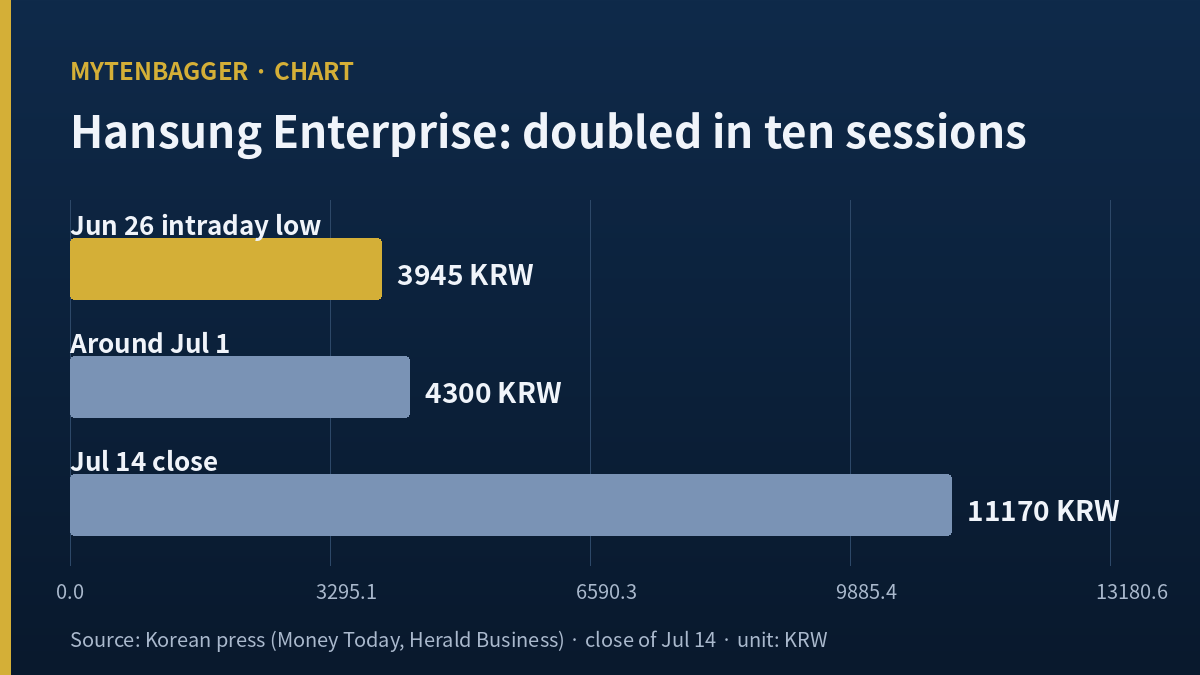
The 30-second version — Hansung Enterprise stock more than doubled in about ten trading sessions, closing at ₩11,170 (about $8.10) on July 14, up 20.11% in a single day and roughly 160% above the month’s opening price of ₩4,300, per Seoul Economic Daily. The spark was not an earnings release. It was a 25-year record of quietly sponsoring concerts for Korean War veterans, surfaced on social media, which triggered a “buycott” of the company’s crab-stick brand, Crami. Along the way the market cap crossed above Korea’s newly raised delisting floor. Let me say this up front: I like this company. I’ll keep buying Crami, and I’m glad to join the buycott at the checkout counter. I just didn’t buy the stock — cheering and trading sit on different scales, and honestly this volatility is bigger than my stomach, so I cheer with my grocery cart, not my brokerage account. Even so, this is a scene worth logging — sentiment rarely moves a regulatory survival line this directly.
Contents
What happened to Hansung Enterprise stock
Let me rebuild the facts in my own hand first. Hansung Enterprise (KRX: 003680) is a food company listed on the KOSPI — Korea’s main board, the equivalent of the NYSE, not the smaller, tech-heavy KOSDAQ (closer to the Nasdaq). I flag that because the listing venue is the crux of this whole story, and it comes back later.
The stock had been dormant for a long time. Its trailing-year low sits in the ₩3,900s — an intraday ₩3,945 (about $2.90) on June 26, per Korean financial press. Then early July flipped the tape. From about ₩4,300 on July 1, the shares hit the daily limit-up on both July 9 and July 10, clearing ₩8,000, and by the July 14 close I’m writing against they reached ₩11,170. Against the June low, that is a triple-digit gain in roughly ten sessions and well over a double.
Translated into market value the picture sharpens. On roughly 6.21 million shares, the low-price market cap was near ₩26 billion (about $19M); Korean outlets pegged the July 1 figure between ₩25.7bn and ₩26.7bn. By July 10 it had swelled to about ₩52.5 billion (about $38M), and at the July 14 price it is near ₩69.4 billion (about $50M). I reverse-checked that last one myself — 6.21M shares × ₩11,170 ≈ ₩69.4bn. The number holds.
The flow behind it was unlike the usual theme-stock spike, too. This was not institutions or foreigners: foreign ownership is under 2% and margin-loan balance is only in the 1% range on my read. In other words, this was cash buying by individuals, not leveraged speculation. That distinction feeds directly into the durability question I come back to. If it is cheer money rather than borrowed money, how long does cheer money stay?
Why retail piled into Hansung Enterprise stock
What lit the fuse was not a filing but a single act of decency. Word spread on social media that Hansung Enterprise had, as part of its corporate-responsibility work, sponsored concerts for Korean War veterans for 25 years (Seoul Economic Daily; Korean press). No splashy campaign, no investor deck — just something done quietly for a quarter of a century, noticed late.
The response came in a very Korean form: the “buycott.” Where a boycott punishes a company by not buying, a buycott rewards a good corporate citizen by buying on purpose. Netizens bought Crami crab sticks and posted the receipts, and that support spilled from the grocery aisle into the brokerage app. Korean business press reported some products even sold out. A consumption movement became, almost seamlessly, a share-buying movement.
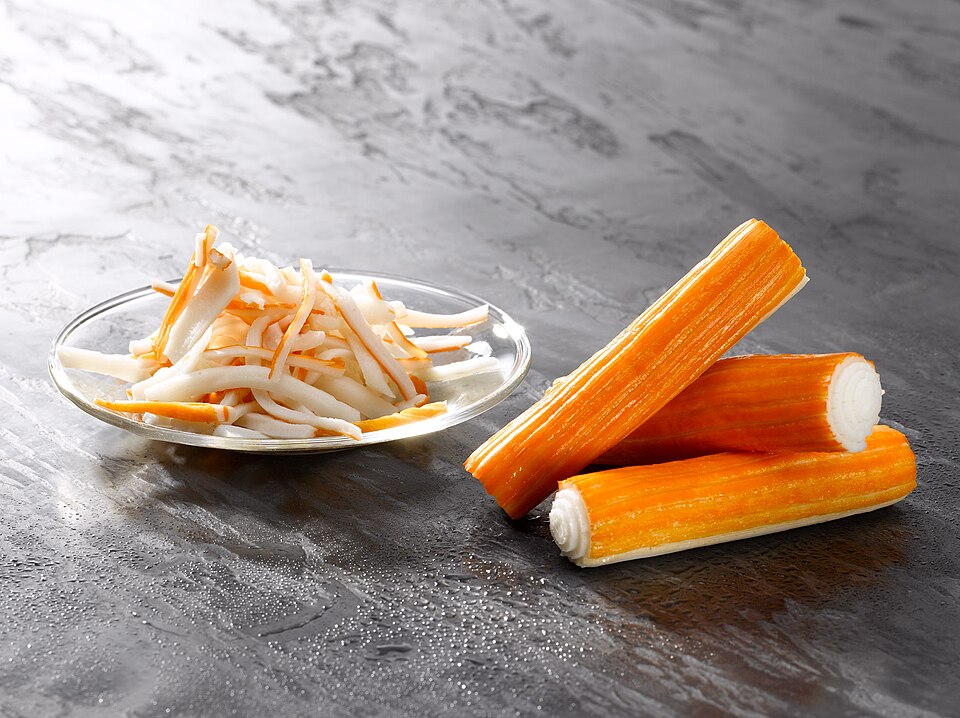
I’ll be honest — at this point I closed the browser tab and opened my fridge. Crab stick is a taste from my childhood: tucked into gimbap, layered onto tteokbokki at the corner snack shop, that same red-and-white grain. Twenty-five years means this company was sponsoring veterans’ concerts from about the time I first ate that crab stick. Wanting to cheer is only human. So I bought a few packs of Crami, and I’ll keep them in the fridge from here on — a company like this, I’m happy to reward at the register, and I don’t begrudge a won of it. What I did not buy was the stock. Support goes in the cart; the stock is another matter.
Why I cheer yet don’t buy Hansung Enterprise stock
Let me be clear first: I don’t think the buycott is silly — this kind of solidarity is one of the better faces of our market, and I’m part of it. But a consumer’s cheer and an investor’s purchase are different acts, and honestly this stock’s volatility scares me. There’s also a colder reason: the buycott lifted the price, not the margin. I try hard not to blend affection with the income statement. Here are the core numbers, copied straight across. Full-year 2025 revenue was ₩318.4 billion (about $231M) with operating profit of ₩5.8 billion (about $4.2M) — down 4.2% and 47.0% respectively from the prior year, per Korean press. Revenue above ₩300bn is a real business, but that operating profit works out to a margin of roughly 1.8%. Net profit was a razor-thin ₩0.2bn. This is the face of a classic low-margin food processor: sell ten, keep a coin.
This isn’t a flaw unique to Hansung; it’s the constitution of the surimi business itself. The raw material — pollock surimi paste — is largely imported, so margins swing with the currency and the fish price. Distribution runs through big-box and convenience chains, which hold the negotiating leverage over a manufacturer. So the category routinely gets pinned to low-single-digit operating margins even at scale. Hansung’s 1.8% sits squarely on that track. Knowing the structure, I don’t expect one buycott to rewrite the body chemistry.
Its place inside the crab-stick market matters too. Crami is one of Korea’s signature crab-stick brands, but this is not a stage Hansung has to itself. Large food houses such as Sajo Daerim and CJ CheilJedang compete with their own surimi lines on the very same shelf. Put plainly, Crami’s moat is brand familiarity, not a technical monopoly — and a recognition moat is strong while the habit lives and surprisingly fragile once a cheaper substitute sits right beside it. The buycott spiked that recognition to a momentary peak, but it does not win the price-and-taste fight at the shelf on the company’s behalf. I respect the brand moat without overrating it.
On valuation the split is even clearer. On my screen the trailing PER runs past 400x — not because the company got 400 times more expensive, but because the earnings base is so thin that any price move detonates the multiple. The PBR, by contrast, is 0.96x, just under book, with book value per share in the ₩11,000s. So this is less a company re-rated as a great earner and more a stock recovered to near its asset value. I keep that distinction close: a price lifted by profit and a price lifted by emotion hold on with very different strength.
To be fair, I record the other side too. This year’s first quarter (Jan–Mar 2026) read differently. Per Korean outlet IB Tomato, Q1 revenue was ₩77.7 billion (down about 4% year on year), but operating profit rose about 11% to ₩3.0 billion, net profit jumped roughly 76% to ₩1.9 billion, and operating cash flow swung from negative a year earlier to a positive ₩1.1 billion. In other words, profitability was already firming before the buycott arrived. That is data I won’t wave away — though I won’t call a trend off a single quarter, either.
The rare part: sentiment cleared a regulatory line
Here is where the episode turns genuinely unusual, and why I bothered to write it down. This is not a plain theme-stock pop. It is retail patriotism reaching through a market cap to touch a delisting rule — the most unusual chain of cause and effect I’ve watched in a while.
The mechanics: as part of a broad push to raise listing quality, the Korea Exchange has been ratcheting up its maintenance requirements through 2026. As The Korea Times and KED Global reported, KOSPI names now face a delisting review if common-stock market cap falls below ₩30 billion (about $22M) — a bar that steps up again to ₩50 billion next year. Set against Hansung’s early-July cap near ₩26bn, the company was sitting below that new review line. On the rule alone, it was in the zone where delisting gets discussed.
This was not a rule written for Hansung alone. The same reform is sweeping the whole market. Korean coverage of the crackdown described roughly 178 KOSDAQ names falling short of the tightened market-cap threshold, and the exchange framed 2026 as a year of aggressively clearing insolvent and penny stocks, with around 50 delistings expected on the KOSDAQ this year. Against that backdrop, a ₩26bn food company sitting below the KOSPI floor was an ordinary casualty-in-waiting, not a special case. What made Hansung the exception was not its balance sheet. It was a story that happened to be true and happened to move people. That is not a repeatable edge, and I don’t model it as one.
Then individuals, moved by a good deed, bought — and the cap climbed through ₩30bn to about ₩52.5bn, and on to the ₩69bn range now. The buttons people pressed to cheer a crab-stick maker ended up pushing the company back above the delisting-review line. Emotion moved a regulation. I have watched markets a long time, and I can count on one hand the times consumer sentiment cleared a regulatory survival line this directly. That, by itself, earned a page in my journal.
There’s a precedent worth noting, and a warning inside it. This episode also becomes a template for other small caps standing at the same market-cap edge: if a company’s good deeds surface, consumers can convert into shareholders and rescue the listing. But the reverse holds just as firmly. A company with no such story — or one whose sentiment has cooled — can quietly vanish against the very same rule. I watch that asymmetry closely: good deeds are hard to reproduce, and the floor rises to ₩50bn next year.
And I add one cold caveat. Clearing the line and staying above it are different problems. A delisting review looks at maintenance over a window, not a single day’s cap; a cap built by cheering can revert when the cheering fades. Crossing today is not the same as entering a safe zone — which is exactly why I hold the excitement down as I write this.
I also step back from the buycott phenomenon itself. A boycott is remembered by an angry person for a long time; a buycott, by contrast, spends its purpose the moment the warm glow is filled. Buy one pack, post the receipt, and the moral debt feels paid — so the same person has thinning reason to drop Crami into the cart every week thereafter. The half-life of emotional consumption is shorter than it looks. I say that not to belittle the company but to name the discount I always apply when moving sentiment-born demand onto an earnings line. The question that outlives the hashtag is whether the product is good enough to be repurchased on taste and price alone — and that question was there long before the veterans’ story, and will still be there after it.
It’s worth situating the product, too. Surimi — the minced-fish paste behind crab sticks, fish cakes, and Japan’s kanikama — is a globally traded commodity whose economics are set upstream, at the Alaska pollock catch and processing level, far from any Korean brand’s control. That is part of why a domestic crab-stick maker lives on thin, currency-exposed margins no matter how loved the brand is. It also means the buycott, however moving, sits on top of a business whose cost curve is written by global fish supply, not by how many receipts get posted online. When I weigh a name like this, I keep reminding myself which variables the company actually controls — and how few of them the cheering touches.
For a global frame, the closest cousins are Western “buycotts.” In the US, a 2020 wave of supportive buying hit Goya Foods after a political flashpoint; a Cornell-linked study reported by Cornell Chronicle found the episode did not dent — and arguably lifted — sales, though Goya is private, so there is no share price to check. Running the other way, the 2023 Bud Light boycott cost Anheuser-Busch InBev over $1 billion in lost US sales, per CNN. Surimi itself traces to Japan — the kanikama-style crab stick was popularized there by Sugiyo, also privately held. So I won’t drag in a global peer’s PER I can’t verify. I’ll only say this: demand born of feeling is strong at changing direction and weak at holding it.
What I’m watching on Hansung Enterprise stock
I’ve filed this as a watch item, not a trade. The market cap is a micro-cap nowhere near the large-cap tier I usually take positions in, so I hold no buy-or-own stance here. Instead I write down a few reference points as an observer, so I can check my own work later.
First, does the buycott survive as repeat revenue? As IB Tomato itself flagged, whether one-time interest converts into brand loyalty and repeat purchase is a separate question entirely. I watch the Q3 (reported mid-November) and Q4 revenue for the seafood-processing line — Crami included — to see if it actually re-accelerates. The number after the hashtag event fades is the real answer.
Second, does the cap stay above the line on its own power? Right now this is a cap propped up by feeling. What counts is whether, once the cheering cools, market value holds above ₩30 billion — and next year’s ₩50 billion — on the strength of earnings rather than emotion. Profit has to fill the seat sentiment is renting.
Third, the coverage gap. Frankly, I can’t find forward estimates from any named sell-side house on this stock; as a micro-cap it has essentially no analyst coverage. I won’t hide that gap — I’ll log it. No forward consensus means the numerical support under this price is thin beyond the good-news story and the flow. The dividend says the same: the recent yield is effectively near zero, so there’s little cash-return case underpinning today’s price.
A word for readers outside Korea, since the mechanics differ. I flag the plumbing because it changes the risk, not because I’m pointing anyone toward the trade.
The micro-cap nature also reshapes the risk itself. The Korea Exchange has already tapped the brake: it designated Hansung an “investment-warning stock,” and flagged that a further 40%-plus rise from the July 13 close could trigger a one-day trading halt on July 16 (KRX notice; Seoul Economic Daily). A stock that swings by daily limits can gap down the day after good news with no fresh catalyst, because thin liquidity lets a handful of sellers shove the quote. So with names like this I compute “how fast can it fall once it cools” before “how far can it run.” For an observer, that volatility is a condition to record, not a spectacle to enjoy.
If I wanted to see the buycott turn into something durable, here is the specific shape I’d look for — because “revenue went up one quarter” is not it. I’d want a step-change in the repeat-purchase rate: the seafood-processing line growing while promotion spending stays flat, and gross margin holding even as the initial surge normalizes. A genuine brand re-rating leaves fingerprints on the mix and the margin, not just on the top line for a single period. I’ve been caught before by a company whose revenue popped on a one-off event and faded the next quarter, and the tell each time was a margin that never followed the story upward. So margin, not headlines, is where I’ll keep my eyes on this one.
I’ll also write the condition that would change my mind. If Q3 and Q4 show seafood-processing revenue re-accelerating into double digits and the operating margin reclaiming a 5% handle, I’d reopen this not as a stock emotion rescued but as a business that actually turned. If instead the interest cools, revenue drifts back to prior-year levels, and the cap threatens the line again, this limit-up stays in my journal as one warm-hearted happening. Either way, I’m waiting on the numbers.
Cheering and buying are two different decisions
So here’s where I land. I’m rooting for Hansung Enterprise the company. A firm that quietly backed Korean War veterans for 25 years, then got yanked out of a delisting scare overnight, is a rare warm scene in a cold market. So I cheer with my cart, not my account: I buy Crami often and I recommend it to the people around me — that’s the buycott I can pay, and I’ll keep paying it. What I didn’t do was carry that cheer into my brokerage account. Stock trading honestly scares me, and this volatility is bigger than my stomach. Cheering is a consumer’s decision; buying is an investor’s decision; the two use different scales.
This journal is a record I keep mainly for myself. If someone reads over my shoulder and grabs another bag of crab stick, or reads the company entirely differently, that’s their call. I’m simply preserving these ten days — the stretch where emotion moved a market cap and cleared a rule. And when the Q3 print lands around mid-November, I plan to come back to this page and check the answer: whether the cheer stayed on as repeat revenue, or lingered only as the warmth of a single pack of crab stick. Until that print lands, I remain a fan of the company and a bystander to the stock, and I’m comfortable holding both of those at once — the cheer in one hand, the ledger in the other. Numbers don’t remember feelings.
Related reading
- Monami Stock: I’ll Buy the Pen, But I’m Watching the Shares
- Doosan Stock: A 59% Crash, Then a 30% Limit-Up to End July
- Hanwha Systems Stock: Profit Tripled, Price Down 66%. My Check