Doosan Stock: A 59% Crash, Then a 30% Limit-Up to End July
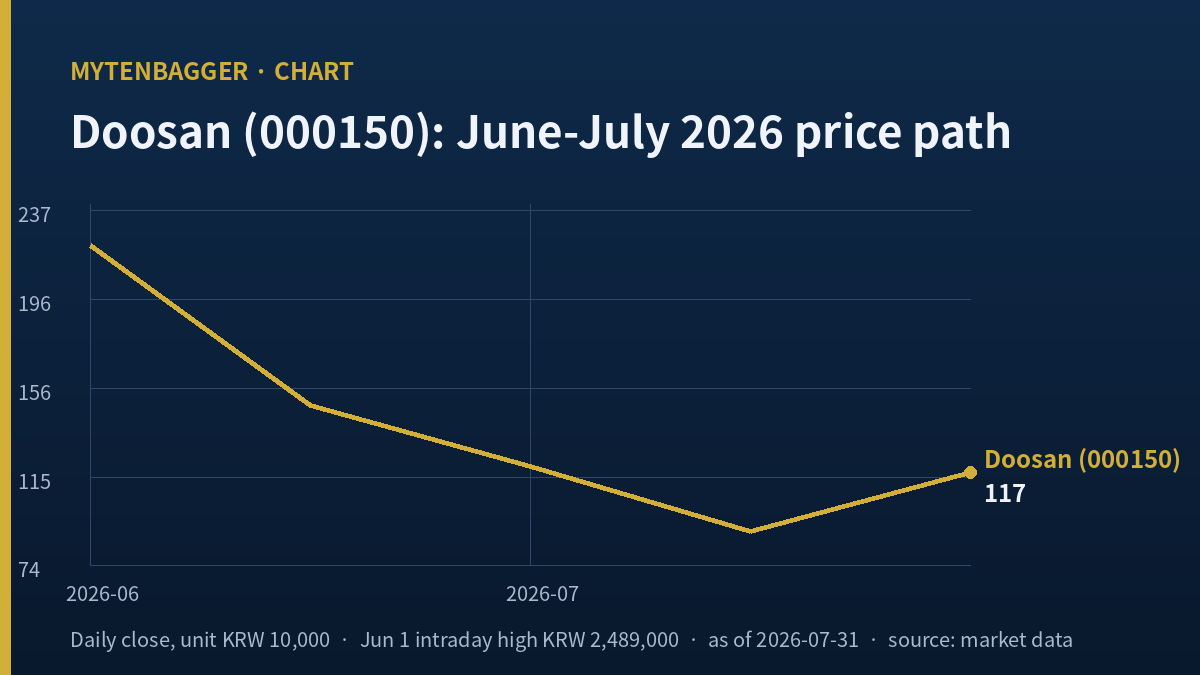
Doosan Corp. (KRX: 000150) peaked at ₩2,489,000 (≈$1,693) intraday on June 1, slid to ₩900,000 (≈$612) by July 30, then closed July 31 up exactly 30% — Korea’s daily price limit — the same day a ₩2.3 trillion (≈$1.6B) deal to buy wafer maker SK Siltron was sealed. I don’t own it and I’m not chasing it. The copper-clad laminate engine inside this holding company is real; the price tag swings on AI sentiment I can’t model. My four checkpoints are at the bottom.
I first put Doosan stock on my coverage list back on June 1, the day it printed ₩2,489,000 (≈$1,693 at the ₩1,470/$ rate I’ll use throughout) — and I remember writing one line in my notes instead of starting work: a holding company that doubles in a year felt like something that could wait its turn. That note aged badly, though not in the direction I expected. Two months later the stock had lost 59% of its value, and then, on the last trading day of July, it gained back 30% in a single session. Not “about 30%” — exactly 30.0%, because that is where Korean exchange rules force a stock to stop. I’ve watched Korean markets for years and I had not seen a major holding company close a month pinned at the daily limit. That’s what pulled me back to the file.
So this entry isn’t a list of reasons to buy. It’s my attempt to take apart a price path that looks broken — ₩2.49 million to ₩900,000 to limit-up — and figure out which parts are machinery and which parts are mood.
Contents
The 30% Day: How Doosan Stock Hit Korea’s Daily Limit
Two pieces of market plumbing first, because they shape everything in this story. Korean stocks trade on the KOSPI (the main board of the Korea Exchange, roughly Korea’s S&P 500) with a hard ±30% daily price band — no single-stock session can move beyond that, which is why “limit-up” is a real, binding event in Seoul in a way it isn’t in New York. And market-wide crashes trip circuit breakers that halt all trading, which is exactly what happened on Monday, July 28: a chip-led selloff sent the KOSPI down more than 8% intraday, triggering a halt (Korea JoongAng Daily, UPI); the index finished the day down 10.84% (closing figure per exchange data, widely carried by Korean outlets including Hankyung).
Doosan’s tape that week: down 12% to ₩1,046,000 on crash day, two more red sessions to a ₩900,000 close (≈$612) on July 30 — 59.3% below the June 1 closing high of ₩2,214,000 (my arithmetic on exchange closing prices) — and then the full +30.0% snap to ₩1,170,000 (≈$796) on July 31, a day both Korean indexes bounced double digits. At that close the company was worth about ₩18.9 trillion, or roughly $12.9 billion, ranking around 40th on the KOSPI per Korean-language market reports. Here’s the detail that keeps me honest: even after a limit-up day, anyone who bought the June peak is still down more than 45%, while anyone who bought a year ago is still up about 105% (price data through July 31). Same ticker, completely different trades.
The Catalyst Behind Doosan Stock’s Limit-Up: A $1.6B Wafer Deal
Reading the 30% day as pure index beta would miss half the story. On July 31 itself, the boards of Doosan and SK approved a share purchase agreement moving 70.61% of SK Siltron — Korea’s major silicon wafer maker — to Doosan for ₩2.3 trillion, about $1.6 billion (Seoul Economic Daily’s English edition called it Doosan’s first megadeal since Bobcat). The formal announcement landed after the Seoul close, but this was no surprise: the sale process had dragged on for months, and Korean-language press had reported since July 28 that the auction had effectively tilted to Doosan with the July 31 board meetings as the decision point (Aju Business Daily, my translation). The honest read on the limit-up is index rebound plus deal anticipation, stacked on the same session.
What the deal buys matters more to me than the pop. Siltron makes the raw silicon wafers chips are printed on. Doosan’s in-house Electronics unit makes copper-clad laminate (CCL) — the resin-and-copper sheet that becomes the backbone of AI server and accelerator boards. Doosan Tesna, another unit, tests finished chips. Put together, this holding company now spans wafer → board material → back-end test, a vertical line Korean papers summarized the same way I do: this is a semiconductor materials group assembling itself in real time. Per the Korean wire coverage of the announcement (Asia Business Daily’s wrap-up, my translation), Doosan plans to keep Siltron private, run it as a stable earnings source that helps fund dividends, and targets roughly ₩3 trillion (≈$2B) in Siltron revenue by 2031. One open flank: the deal excludes the 29.4% Siltron stake held by SK Chairman Chey Tae-won, which Newspim (Korean-language) reports Doosan also wants — a stake valued in the ₩900 billion range (≈$600M). And nothing about how a ₩2.3 trillion check gets funded has been disclosed yet. I parked that in my checkpoints below.
The Engine Inside: A Materials Business Running at a 30% Margin
Now the machinery. Doosan reported second-quarter consolidated revenue of ₩5.59 trillion (≈$3.8B), up 5.0% year over year, with operating profit of ₩488.4 billion (≈$332M), up 37.8% (company results, reported July 27 by Korean outlets including Money Today; my translation). The composition is the story. The in-house business — dominated by the Electronics BG that sells CCL — posted record quarterly revenue of ₩765.2 billion (≈$521M) and ₩212.1 billion (≈$144M) in operating profit. By my arithmetic that means the wholly-owned in-house operation generated about 43% of consolidated operating profit — no minority shareholders, no holding-company dilution, straight to the parent.
Inside that, the Electronics BG alone earned ₩201.3 billion (≈$137M) at a 29.8% operating margin, up 47.8% from a year earlier — figures Daishin Securities analyst Lee Kyung-yeon laid out in a note covered by Maeil Business Newspaper on July 28 (Korean-language, my translation). A commodity-adjacent materials maker running near a 30% margin is rare, and the drivers are documented: Daishin’s June work put the high-end product mix at 82% this year versus 73% last year, with blended selling prices up 38.5% between last year’s third quarter and this year’s first (₩49,676 to ₩68,799 per unit, ≈$33.8 to $46.8), and a first-quarter margin — 30.1% — above Taiwanese competitors EMC, TUC and ITEQ (Seoul Economic Daily English edition, June 16). Korean industry reporting in early June added that Doosan’s Jeungpyeong and Gimcheon plants ran at 122% and 106% of rated capacity in the first quarter and that the company supplies AI-accelerator-grade CCL to board makers inside Nvidia’s supply chain (Money Today, June 2, my translation — including then-unconfirmed talk of a meeting between Jensen Huang and Doosan’s chairman during Huang’s Korea visit, which I note as reporting, not fact).
The market context backs the price side of that equation. TrendForce reported in May that Korea’s CCL import prices hit $20,728 per ton in March, up 74.5% from the $11,880 of a year earlier (citing Korea Customs Service data via Hankyung), with suppliers across three countries — China’s Kingboard on its fourth hike of the year, Japan’s Resonac and Mitsubishi Gas Chemical raising prices more than 30% — pushing through increases as AI substrate demand outruns supply (TrendForce, May 6). The same report carried a detail I keep thinking about: one Seoul-area board maker placed roughly ₩10 billion of advance CCL orders with Taiwanese suppliers — five times its typical monthly usage — which is what hoarding at the bottom of a supply chain looks like. The squeeze concentrates in exactly Doosan’s lane, high-end laminate for GPU substrates, where specialty T-glass material is shortest. This is a genuine global shortage, and Doosan is one of the few reasonably direct ways a stock investor can own it. Management leaned into that in the earnings release, projecting about ₩3.2 trillion (≈$2.2B) in annual in-house revenue.
The engine of this stock is not a portfolio of subsidiaries. It’s a materials business earning software-adjacent margins — and the market prices the holding company accordingly, in both directions.
Why Holding-Company Math Fails on Doosan Stock
If you screen Doosan stock the way U.S. investors screen a holding company — earnings multiple, dividend yield, discount to net asset value — every gauge misleads.
Start with the earnings multiple. On trailing owner-attributable earnings, my arithmetic off market data puts the P/E somewhere around 330x — for a company printing nearly ₩500 billion in quarterly operating profit. The distortion is structural: most subsidiary earnings leak out to minority shareholders before they reach the parent’s bottom line, so the trailing ratio measures corporate structure, not the business. The dividend tells the same story from the other side — ₩4,000 per share for fiscal 2025 (doubled from ₩2,000, per Korean regulatory filings) is a yield in the 0.3% range. Nobody owns this for income.
Asset value is the more serious yardstick, and it has a moving-target problem. Daishin’s June note valued the Electronics BG alone at ₩23.6 trillion — about $16 billion, more than the entire company’s current ₩18.9 trillion market cap — and called it roughly half of Doosan’s net asset value, which implies a NAV around ₩47 trillion (≈$32B, my arithmetic reversing their ratio). In June I would have been tempted to write “excessive discount” and stop there. Watching July changed my mind. The other half of that NAV is made of listed-subsidiary share prices — Doosan Enerbility, Doosan Robotics — so when the group’s stocks fall, the NAV itself deflates. Daishin demonstrated the mechanism on July 28, cutting its price objective from ₩2.22 million to ₩1.84 million for precisely that reason (Maeil Business Newspaper, my translation). Anchoring to a denominator that reprices daily isn’t value investing; it’s chasing a moving target.
The same caution applies to the operating headlines those subsidiaries print. Doosan Bobcat, another separately traded Doosan name, reported second-quarter operating profit up 42.9% — but that beat rested on an $81 million US tariff refund, and on a dollar basis excluding it the line runs about minus 22%, which I work through in my read on the Bobcat quarter. A NAV assembled from subsidiary share prices inherits whatever the market paid for headlines like that, one-off included.
What Multiple for CCL? The Real Doosan Stock Debate
Strip out the holding-company noise and the whole valuation argument compresses into one question: what multiple does a 30%-margin CCL business deserve?
The Korean sell-side has answered everywhere from 10x to about 30x inside ten months. Last October, Meritz Securities framed the Electronics BG at 10.9x its 2026 estimated earnings under an ₩850,000 price objective (Biz Tribune, Korean-language, my translation). Daishin’s June valuation of ₩23.6 trillion works out to roughly 29x the second quarter’s operating profit annualized — ₩805.2 billion, my crude arithmetic that ignores seasonality and mix. That 10x-to-30x spread, not any change in the business, is what the ₩850,000-to-₩2.22-million range of price objectives actually measures. The factory didn’t halve and rebuild in eight weeks. The multiple did.
Which end is right? The premium case is above: margins beating the Taiwanese peer set, plants past rated capacity, a seat in Nvidia’s supply chain. The discount case is the oldest pattern in materials, and I’ve been burned by it before: a 30% margin is an invitation. Doosan itself is building a roughly $122 million CCL plant in Thailand for 2028 production, and TrendForce’s checks show Taiwan’s EMC and TUC booking expansion equipment through 2028. Supercycle margins look most persuasive at exactly the moment capacity starts coming. I don’t have the ability to pick the right multiple today, and I’d rather admit that than pretend. So instead of picking a number, I’m waiting for the next data point that disciplines the number — the third-quarter margin.
Korean Sell-Side Is Split on Doosan Stock — In One Week
The final week of July compressed the whole disagreement. On July 28, Daishin cut to ₩1.84 million on shrinking NAV. On July 31, BNK Investment & Securities analyst Kim Jang-won went the other way after the earnings print, raising his objective from ₩1.5 million to ₩1.7 million (≈$1,156) with a Buy call, crediting the Electronics BG’s profit growth — up 38% year over year and 43% quarter over quarter (Newspim, Korean-language, my translation). Same company, same week, opposite revisions — one pricing the shrinking subsidiary stack, the other pricing the growing engine.
Two warnings buried in those notes matter more to me than either number. Daishin flagged that the Electronics BG margin is already the best in the PCB chain and sees limited room to rise further, offset — maybe — by optical-module CCL, a new line that did ₩49.3 billion (≈$34M) in the second quarter, up 47.6% sequentially, tracking toward ₩120 billion a year on their estimate. And BNK, while raising its number, wrote that the immediate priority for the stock is stabilization of sentiment toward AI names. Read that again: a Buy note conceding that psychology, not earnings, is the binding variable. That one line is the most honest thing the sell-side said about Doosan all month, and it’s doing a lot of work in my decision to stay out.
The Paths I See From Here
No probabilities this time — conditionals are more honest than fake precision.
The path where it keeps working
If the third quarter shows the Electronics BG holding a high-20s margin while optical-module revenue layers in, Doosan keeps its identity as an AI materials stock, and the upside gets set by AI sentiment — which, as July 31 showed, can move this thing 30% in a session. In that world the Siltron integration reads as vision, the Thailand plant as prudent capacity, and the June peak eventually gets revisited. I’d note I have no edge on when sentiment turns.
The path where the margin peaks
If Daishin’s caution proves out and the margin has topped, the growth premium loses its foundation — and the fallback isn’t as solid as holdco bulls assume, because half the NAV floor is itself made of group share prices that would be falling in the same scenario. Growth premium and asset floor blurring at the same time: that tail is the single biggest reason I’m not buying the rebound. It’s also the scenario where a ₩2.3 trillion acquisition bill, funding still undisclosed, starts to feel heavy instead of visionary.
Before either: the first week of August
The first August session is the market’s first formal vote on the Siltron agreement, announced after the July 31 close — and simultaneously the test of whether the limit-up was trend or dead-cat. I treat that tape as noise either way. The same psychology that manufactures a +30% day manufactured a -12% day seventy-two hours earlier. Until the earnings date, the chart isn’t evidence of anything.
My Checkpoints: Four Axes for Doosan Stock
I split my checkpoints into four axes because they test different claims and mean different things when they break.
Cycle axis. The Q3 print, expected around early November: does the Electronics BG hold a high-20s operating margin? If this one breaks, the premise of this whole entry — the engine is real — gets rewritten first.
Group axis. Doosan Enerbility’s progress against its ₩13.3 trillion (≈$9B) full-year order target — ₩7.1 trillion booked by June, about 53% by my arithmetic — including the four 370MW steam turbines contracted for a U.S. customer with deliveries through 2029, which Korean press links, speculatively, to xAI’s data-center buildout (Money Today, June 2, my translation; I file the xAI link as talk, not fact). Half the NAV hangs on this axis even if the CCL engine stays perfect.
Balance-sheet axis. The funding disclosure for the ₩2.3 trillion Siltron check — potentially ₩3 trillion-plus if the reported pursuit of Chairman Chey’s 29.4% stake (₩900 billion range, per Newspim) becomes a second transaction, my addition. Debt-heavy funding shifts the holding company’s risk first; the company’s own framing of Siltron as a dividend-funding profit source gets harder to deliver the more leverage sits on top of it.
Price axis. This one is a trigger, not a tripwire. As long as the market cap sits below Daishin’s June value for the Electronics BG alone (₩23.6 trillion), the arithmetic says you get the entire subsidiary portfolio for free. But I saw the same arithmetic in June, when the market was paying ₩27 trillion-plus (my arithmetic off the June 16 close), and it protected nobody on the way down. Math being right and the market paying for the math are different events. I’ll act on this axis only after the cycle and group axes report in.
What I Wrote Down the Morning After
I’ll admit my first take was wrong: I initially filed Doosan’s July as collateral damage from the KOSPI crash. Looking at the whole tape, I now read it as an experiment that ran to completion — proof that this price is set by AI sentiment and deal flow, not by asset math, in both directions within a single week. The engine is real; I verified every number above pointing that way. The wafer deal makes the direction of travel — holding company converting itself into a semiconductor materials group — more legible, not less. But the price tag on that engine swings on a mood I can’t forecast, so Doosan stock goes high on my watch list and not into my account. When the Siltron funding structure is disclosed and the November margin prints, I’ll pull this entry back up and run the four axes before I look at the chart. On limit-up days especially, I’d rather write down the date of the next data release than the price.