Korean Patriotic Stocks: Why I Cheer the Crab Stick, Not the Shares
A company that makes imitation crab sticks just hit its daily price ceiling two sessions in a row. So did a pen maker, a furniture maker, and a lingerie brand, all within days of each other. These are Korean patriotic stocks, and the wave I watched build through the second week of July 2026 is unlike anything I have tracked in a while. Retail investors decided they would rescue beloved domestic firms from delisting by buying their shares. I found the warmth of it genuinely moving, and my own account did not buy a single share. This journal entry is where I put those two facts side by side and explain, in numbers, why they do not contradict each other.
Before I go further, a note for readers outside Korea. KOSPI is the main board of the Korea Exchange (KRX), roughly the local equivalent of the NYSE; KOSDAQ is the smaller, tech-and-growth board, closer to the Nasdaq in spirit. All four names here trade in Korean won (₩), and I will give US-dollar equivalents throughout at roughly ₩1,380 to the dollar so the scale is legible. This is not a single-stock deep dive — it is the opening hub for a series, where I lay out the whole phenomenon and link each company’s full write-up separately.

Contents
What actually happened to these Korean patriotic stocks
Here is the skeleton of events. According to Korea’s Herald Business Daily, Monami jumped 24.69% on July 9 and 25.66% on July 10, while Hansung Enterprise went straight to consecutive limit-up ceilings over the same two sessions and pushed its market capitalization past ₩50 billion (about $36M). In a matter of days, these companies clawed back above a threshold they had slipped under. Online communities filled with posts saying “protect our home brands” and “stop the delisting,” and retail buying piled in one direction.
The overheating drew an immediate regulatory response. As Korea’s Money Today reported, the Korea Exchange escalated Hansung Enterprise on July 15 from an “investment warning” designation to a trading-halt notice: if the July 15 close finished more than 40% above the July 13 close and above the pre-designation level, trading would be suspended for a single day on July 16. Monami was designated an investment-warning issue in the same wave. I paused here — not because a price rise is unwelcome, but because the exchange had just flipped an official switch that says “this move is outside the normal range.” That switch is both a product of the cheering and evidence of the froth.
A quick gloss on the word driving all of this. “Donjjul” is Korean slang blending don (money) with honjjul (a scolding) — the idea of “scolding a good company with your wallet,” meaning rewarding it by buying heaps of its product. It grew out of the 2019 “No Japan” boycott, when anti-Japanese-product sentiment turned into a push to buy domestic. I read this episode as the next mutation of that same feeling. Where the old version said “buy Korean instead of Japanese,” this version says “buy the shares so a Korean company doesn’t vanish from the exchange.” The object of affection moved from the product to the equity — and the moment it does, the nature of the support changes. You buy a product and you are done; you buy equity and you are strapped to the company’s income statement and its survival. I think that shift is the single most important feature of this whole thing.
It helps to know how Korea’s market-alert ladder works. The exchange escalates through investment-caution, investment-warning, and investment-risk tiers, and when a surge is steep enough it can impose a trading halt or a short-term-overheating brake. Hansung climbing from warning to a halt notice tells me how vertical the move was. A one-day halt is a brake meant to cool the heat. I watch less for when the brake goes on and more for where the price goes after it comes off — whether the buycott buying re-attaches or whether profit-taking arrives first. That, more than any single day’s ceiling, is what will tell me whether these Korean patriotic stocks have staying power.
One more early fact I flagged: Korean media began calling this a “Korean GameStop.” Readers who lived through January 2021 will recognize the reference instantly, and I will return to it, because I think the differences from GameStop describe this theme far better than the similarities do.
The trigger behind Korean patriotic stocks is a delisting rule change
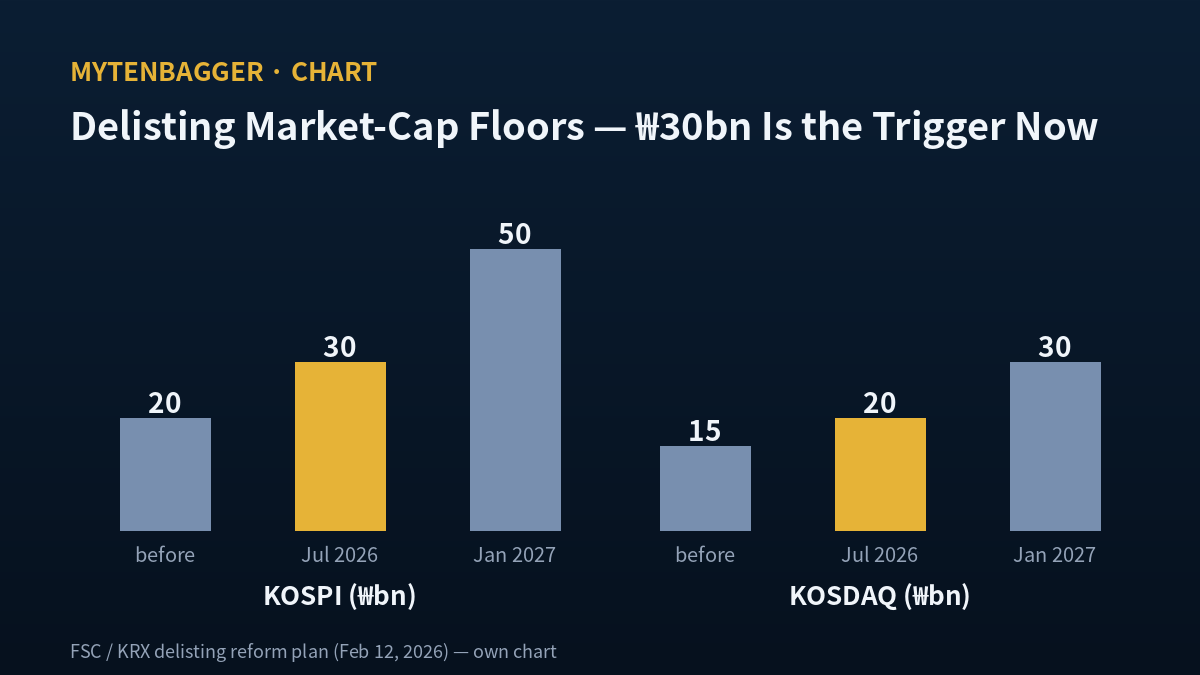
Patriotic sentiment is always there in the background. So why did it detonate now? The trigger was not emotion — it was regulation. On February 12, 2026, Korea’s Financial Services Commission and the Korea Exchange announced a delisting-reform package designed to push weak companies off the boards faster. The core lever: the minimum market capitalization a company must hold to stay listed was raised in steps.
Per the FSC’s own figures, the KOSPI maintenance threshold rose from ₩20 billion to ₩30 billion (about $22M) on July 1, 2026, and is scheduled to climb again to ₩50 billion (about $36M) on January 1, 2027. KOSDAQ moves from ₩15 billion to ₩20 billion on July 1, then to ₩30 billion next January. The FSC said it deliberately accelerated the cadence to every half-year. Any company sitting below the line enters the delisting crosshairs.
Here is the detail I dug out that most coverage blurs together. People keep saying a company “needs to clear ₩50 billion to survive,” but the line that actually triggered this rally is not ₩50 billion — it is ₩30 billion. The ₩50 billion bar is the next gate, arriving in January 2027. So this surge in Korean patriotic stocks is a short-dated scramble to clear the ₩30 billion deadline that is live right now, with a taller ₩50 billion wall already booked six months out. Miss that distinction and the relief of “we stopped the delisting” sounds far bigger than it is. Clearing today’s line does not clear next winter’s.
There is a paradox in the reform, too. Korea’s Financial News reported that the tougher rules may hand some owner-controlled companies a reason to voluntarily delist. A corporate-finance banker quoted in that piece noted that disclosure obligations and shareholder-relations costs keep rising, so family owners may re-weigh the benefits of going private — lighter disclosure, easier control, less takeover risk. In other words, retail investors can buy shares to prevent a forced delisting, and the controlling owner may still find staying listed unattractive. I regard that mismatch of incentives as the most uncomfortable blind spot in the whole buycott.
I lined up the four Korean patriotic stocks in numbers
A heartwarming story and a stock price speak different languages. So I set the narrative aside and stood these four names next to each other on the metrics alone. The table below is on trading data as of the July 14, 2026 close; because market alerts and limit-up sessions move these figures by the day, treat them as a snapshot and refresh before re-quoting. Dollar equivalents use roughly ₩1,380 per dollar.
| Company (code) | Close | Market cap | PBR | ROE | Operating result | 1-month |
|---|---|---|---|---|---|---|
| Hansung Enterprise (003680) | ₩11,170 | ₩69.4bn ($50M) | 0.96 | 0.3% | +₩5.8bn (net ₩0.2bn) | +143% |
| Monami (005360) | ₩2,650 | ₩50.1bn ($36M) | 0.62 | -12.2% | -₩5.9bn | +92% |
| Enex (011090) | ₩1,631 | ₩19.3bn ($14M) | 0.47 | -3.2% | +₩0.5bn (net -₩1.4bn) | +12% |
| Vivien (002070) | ₩8,170 | ₩19.6bn ($14M) | 0.15 | -18.1% | -₩5.0bn | +15% |
The first thing I saw in that table was two companies I would describe as “the rescue arrived, but they are still not out of the water.” Enex (market cap ₩19.3 billion) and Vivien (₩19.6 billion) hit their limit-up ceilings and still sit below the KOSPI ₩30 billion line. The names carrying the hottest buycott firepower are precisely the ones still under the threshold — that is the unvarnished face of this theme. By contrast, Hansung (₩69.4 billion) and Monami (₩50.1 billion) have reclaimed the ₩30 billion line, yet against the ₩50 billion gate waiting six months out, Monami turns precarious all over again.
The second thing I saw was the crack in a popular argument: using a low PBR (price-to-book ratio) as a reason to cheer. Vivien’s PBR of 0.15 sounds like a deep bargain — the shares change hands at 15% of book value. But I refuse to read that as “cheap.” On trading data, this company runs an ROE of -18.1% and an operating loss. When the book value itself is being eaten away by net losses, a low PBR is not a discount — it is the thickness of melting ice. “Looks cheap on the screen” and “is a good investment” are not the same sentence, and that gap deserves the coldest possible read in front of a shrinking, loss-making business.
Third, even the one profitable name, Hansung, is thin when you open it up. On trading data it posted operating profit of ₩5.8 billion, but net income was only ₩0.2 billion, ROE 0.3%, and the PER sits somewhere near 413x. Net income of ₩0.2 billion is effectively break-even, which is exactly why the PER balloons into the hundreds. Even the best-earning name of the four cannot be explained by the “thickness of its profit.” Monami, per Herald Business Daily, has run three straight years of operating losses (₩2.3 billion → ₩3.8 billion → ₩5.9 billion) against the structural headwind of a shrinking school-age population. Enex scrapes an operating profit of ₩0.5 billion but still lands in a net loss.
One more point. I went looking for forward earnings estimates on these four and found, in effect, a coverage gap. These are micro-caps of a few tens of billions of won; named sell-side analysts simply do not publish formal forward numbers on them. I treat that less as a flaw than as a portrait of the theme’s structure: institutional analysis is not making the price here — pure retail flow is. Narrative fills the seat that research vacated. I read the absence of coverage as a data point in itself. A stock that no professional has set a forward target on can rise fast, but it also has no anchor to steer it.
Put it all together and the engine of this rally in Korean patriotic stocks was not earnings. It was a supply-and-demand event powered by a regulatory deadline plus a wave of sentiment. I want to be clear that this diagnosis is not a verdict of good or bad — it is a factual read of where the force that moved the price actually came from.
How Korean patriotic stocks differ from the GameStop playbook
As someone who likes a global comparison, I could not skip the GameStop parallel. The similarities are real. An online community became the rallying point; retail investors coordinated in one direction; and the story carried that same “the little guy versus the institutions” charge that drove the 2021 US meme-stock episode around GameStop and AMC. That is why Korean media reached for the “Korean GameStop” label.
But I think the differences matter more. The engine of GameStop in 2021 was a short squeeze: a mountain of short positions that retail buyers forced against, weaponizing the short-covering itself — a head-on collision between institutions and the crowd. The engine of these Korean patriotic stocks is not a duel with short sellers at all; it is a delisting deadline plus patriotic sentiment. There is no large adversary (a big short base) to squeeze — there is a date to clear (the market-cap line). When the mechanism differs, the way it ends differs too.
The way the fuel runs out differs as well. A short squeeze burns itself out once the shorts are covered. A deadline-driven rally loses its rationale once the date passes. After July’s ₩30 billion deadline is cleared, I honestly do not yet have a clean answer for what becomes the next reason to buy. The cheering can continue, but the specific firepower born of “we must stop the delisting” may not be the same once the deadline is behind us.
And I do not forget the back half of the GameStop story. After the 2021 frenzy, GameStop’s share price ultimately fell far from its peak — the US SEC’s own staff report on the early-2021 episode documented how quickly those conditions unwound. Narrative can push a price up; narrative does not manufacture earnings. When Korean market experts, quoted by the outlet Newswell, warned that “stocks that surge on thematic sentiment are highly volatile without a fundamental improvement” and reached back to the lessons of the 2019 No-Japan rally, they were pointing at the same thing. The warmth of cheering is not the warmth of profit.
Why I cheer these Korean patriotic stocks but do not own them
Now I will state my own position plainly. I watch this phenomenon without a position — no buying, no selling. There are three reasons.
First, the force that lifted the price and the health of the business are decoupled. “We dodged delisting” and “the company got stronger” are entirely different sentences. Reclaiming the market-cap line did not turn an operating loss into a profit. I try not to mistake a price built by flow for a price built by earnings.
Second, the exchange has already flipped the warning switch. An investment-warning designation and a trading-halt notice are the market’s official way of saying “this move is overheated.” My own rule is that I do not initiate a new position inside a stretch where that light is on.
Third, and this is the core, ethical consumption and investing carry different motives and different risks. I do not use the same hand to drop a pack of crab sticks into my cart and to tap the buy button on shares. Buying a bag of crab sticks is about ₩5,000 ($3.60) of encouragement, and the worst case is that it tastes bad. A share, by contrast, is a contract that takes on the whole of a company’s profit-and-loss and its delisting risk. Taking on investment risk in the spirit of encouragement is a choice where the heart is warm but the arithmetic is not cold — and I would rather keep the arithmetic cold.
Do not mistake me. I am not mocking the culture of support. A company that has funded concerts for war veterans for years, a brand that has insisted on domestic ingredients — people sending them warmth is a healthy thing in its own right. Support goes through the wallet; judgment goes through the account. The moment I drew that line, I could cheer for the crab stick with a clear conscience.
The forks differ by name, too. Hansung, as the only profitable one, has slightly more room to pivot into a “fundamentals story,” though its thin net income is the ball and chain. Monami needs its new-business pivot — into cosmetics ODM, for instance — to actually deliver before the narrative becomes earnings. Enex and Vivien have not even cleared the market-cap floor yet, so what they need urgently is not narrative but a genuine rebound in profit and capital. Bundled under one theme, each still faces a different height of hurdle, something the table made me see again. That is why I would rather watch four separate income statements than trade the four as a single block.
I will write down where my watching thesis breaks, too. If one of these companies uses the cheering phase as a springboard to make a real change in health — a new business that works, a swing back to profit — then I have to re-rate it as an “earnings story” rather than a “flow theme.” My pivot point is not a headline that says the delisting line was cleared; it is a filing that says the income statement changed. Until that day, this theme is something I cheer, not something I buy.

What this series covers next
One mechanic matters for reading what follows. Korea caps single-session moves at roughly plus or minus 30%, so a “limit-up” here means a stock is pinned at that daily ceiling rather than trading freely — a mechanic that amplifies both the surge and the reversal on the way back down.
This opening is a hub. I built the skeleton by standing four names together; the inside of each company lives in its own entry. There is the crab-stick maker cheered for its veteran support yet thin on net income in why I cheer Hansung but did not buy; the national pen brand caught between its symbolism and three straight years of losses in buying the Monami pen while watching the shares; the furniture name still under the market-cap floor even after a limit-up in Enex, still not out of the water; and the lingerie brand trading at 15% of a book value that is itself eroding in Vivien’s low-PBR trap. Each entry cuts deeper name by name.
The question running through the whole theme collapses into one line for me: can the time bought by cheering also buy the time a company needs to change its health? The few days spent climbing back over the delisting line clearly bought some time. What these firms do with that time decides the next chapter — and I intend to verify that chapter through filings and income statements, not heartwarming stories. What you do with any of this is up to you; I am only keeping an honest record of what I watch.
Sources I used: FSC / Korea Exchange delisting-reform package (Feb 12, 2026); reporting from Korea’s Herald Business Daily, Money Today, Financial News, and Newswell; US SEC staff report on the early-2021 meme-stock episode; company metrics from trading data (July 14, 2026 close).
Sources: FSC delisting-reform package · Herald Business Daily — “Korean GameStop” · Money Today — market alerts · Financial News — “better to delist” · Newswell — sustainability analysis · US SEC staff report on early-2021 meme stocks