Monami Stock: I’ll Buy the Pen, But I’m Watching the Shares
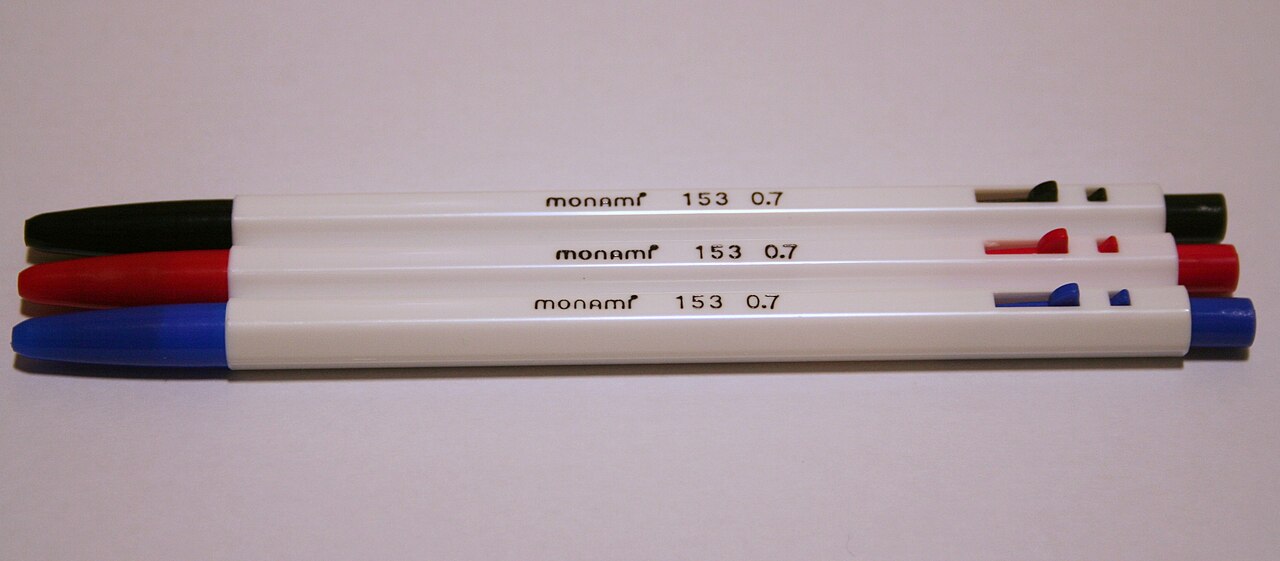
The short version — Monami stock jumped 24.69% and 25.66% on July 9 and 10, per Korean financial press. Korea’s 60-year “national pen” maker had drifted below a raised delisting floor, and retail investors rallied to “protect a homegrown company” — a buycott. I like this company’s pens. I’ll keep buying the Monami 153, and I’m glad to join the cheer. But I haven’t bought the stock. Unlike the crab-stick maker Hansung Enterprise, whose buycott I wrote about earlier, Monami has been in the red for four straight years — and it carries an uncomfortable “patriotism with two faces” backstory. Cheering and buying use different scales, and this time I’ll weigh that even more coldly.
Contents
Where Monami stock actually stands
Let me rebuild the facts myself first. Monami (KRX: 005360) is a stationery maker listed on the KOSPI — Korea’s main board, the rough equivalent of the NYSE, not the smaller, tech-leaning KOSDAQ (closer to the Nasdaq). Its signature product needs no introduction in Korea: the Monami 153 ballpoint. The stock had languished near its floor for a long time; the trailing-year low on my screen was ₩1,065 (about $0.77). Then July flipped it. Per Korean press, market cap ran from ₩24.8 billion on July 7 to ₩25.9 billion on July 8, then jumped 24.69% on the 9th to ₩32.3 billion, and another 25.66% on the 10th to ₩2,145 (about $1.55) a share and a ₩40.5 billion cap. By the July 14 close I’m writing against, Monami stock sat at ₩2,650 (about $1.92) and roughly ₩50 billion (about $36M).
I reverse-checked the cap against the share count: about 18.9 million shares × ₩2,650 ≈ ₩50 billion. The number holds. Against the ₩1,065 low that is well over a double, and even on a one-month view the stock is up around 90%. For a pen company, that is a pace you almost never see.
The buyers looked much like Hansung’s. Foreign ownership is in the 1% range on my read, and margin-loan balance is negligible. This was not institutions, foreigners, or leveraged punters — it was cash buying by individuals, “cheer money” pushing the price up. So I read this flow as a sentiment signal, not an earnings signal. Sentiment lifts a price quickly; holding that level takes something else.
What’s interesting is the sequence. Once Hansung Enterprise’s buycott went viral, a hunt began for “the next buycott stock” — a national brand at the delisting edge with a story attached. A 60-year national pen maker fit the template exactly. So Monami’s surge wasn’t purely random; it was closer to the second run of a “buycott playbook” that Hansung wrote. I watch that repeatability. When the story repeats, the pop repeats — but a repeated pop burns through sentiment faster. The first act is news; the third time the same pattern runs, it’s just a theme the market has already learned.
Why Monami stock got pushed to the delisting edge
Why did delisting even come up? Less because Monami suddenly got worse, and more because the line moved up. Per Korean press (The Korea Times, KED Global), the Korea Exchange raised the KOSPI market-cap threshold for a delisting review to ₩30 billion (about $22M) this month, up from around ₩20 billion, and it steps higher again next year. Monami’s early-July cap (₩24.8bn–₩25.9bn) sat below that new line. On the rule alone, delisting was a live topic — and the buycott lifted the cap above ₩30bn, now into the ₩50bn range. On that mechanic it mirrors Hansung: emotion reaching through a market cap to touch a listing rule.
This isn’t a rule aimed at Monami alone. The same reform is sweeping the market: Korean coverage described well over a hundred KOSDAQ names failing the tightened market-cap bar, with the exchange framing 2026 as a year of clearing insolvent and penny stocks and expecting around 50 delistings this year. Against that sweep, a loss-making pen maker below the KOSPI floor was an ordinary candidate for removal — which is exactly why the buycott rescue reads as an exception, not a fix. Exceptions don’t repair income statements.
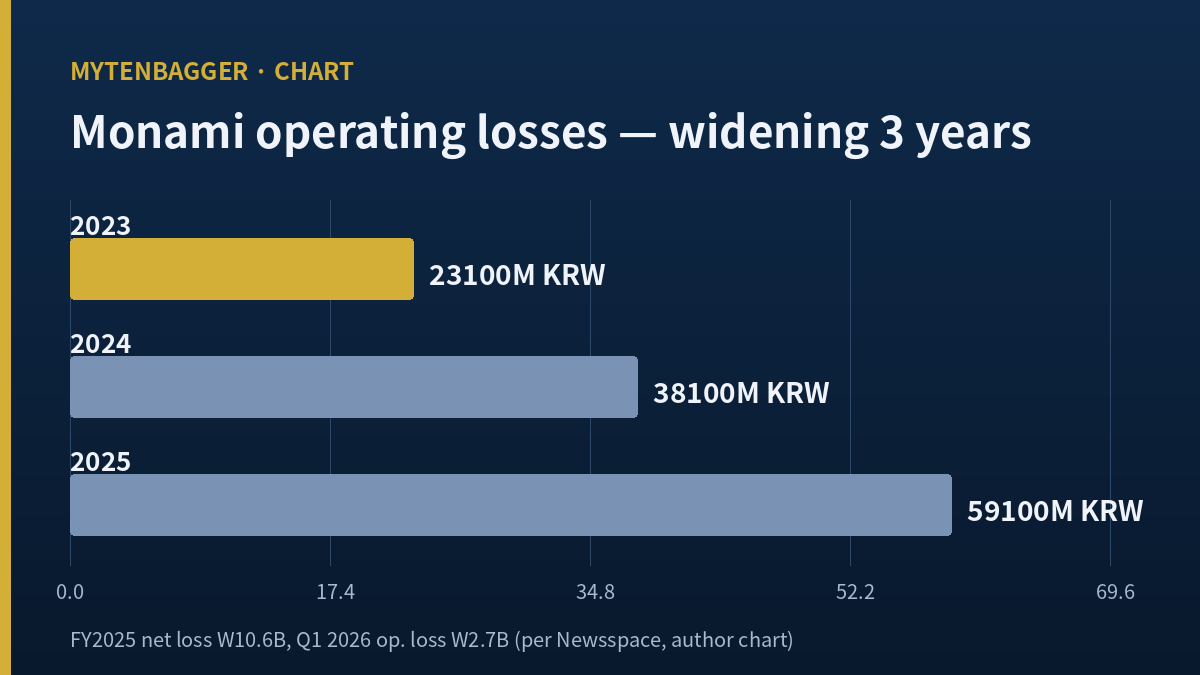
But here is where Monami diverges from Hansung in a way that matters to me: its core business was already sick. Citing Korean outlet Newsspace, Monami’s operating loss widened every year — ₩2.3 billion in 2023, ₩3.8 billion in 2024, and ₩5.9 billion (about $4.3M) in 2025, with a 2025 net loss of ₩10.6 billion (about $7.7M) and another ₩2.7 billion operating loss in Q1 2026. The same report notes the current ratio has fallen below 100% and short-term borrowings stand at ₩73.2 billion (about $53M). Where the crab-stick maker was “thin but profitable,” the national pen maker is “four years in the red.” The delisting scare wasn’t only about a rule moving up.
The backdrop deserves a cold look, too. The core buyers of ballpoints are students, and Korea’s school-age population is shrinking while writing goes digital. Monami’s bet is cosmetics ODM and K-beauty materials — extending the ink, dye, and coating know-how from pens into cosmetics. The direction makes sense, but the market read Herald relayed is that it still isn’t enough to cover the losses. I’m waiting for the quarter where that new business shows up not just as revenue but as profit. Only when it’s earnings, not a story, does this stock’s character change. The symbolism of a “national pen” and the income statement of the company that sells it are telling different stories right now.
The structural pressure deserves its own line. A ballpoint’s demand rests on students putting pen to paper, and both halves of that are eroding — fewer students each year, and more of their writing done on screens. This is not a cyclical dip a single good quarter repairs; it is a slow secular tide. That is precisely why the cosmetics pivot matters: the company is trying to move its chemistry into a market that grows rather than shrinks. But a pivot is a promise until the segment earns, and I’ve watched enough promised pivots stall at the revenue line — never reaching the profit line — to want the profit proof before I trust the story.
I buy the Monami pen — so why do I only watch Monami stock?
Let me be clear: I don’t think this cheer is silly at all. A company that has shared 60 years of Korea’s handwriting, saved from disappearing by ordinary citizens, is a genuinely moving thing. I’m in that line myself — I buy the Monami 153, I try the newer products, I recommend them. That’s the buycott I can pay, and I’ll keep paying it. I don’t begrudge a won of it.
The stock is another matter. First, this company doesn’t make money right now. Four straight years of operating losses, a net loss in the ₩10bn range, short-term debt in the ₩70bn range. A support-buying wave lifted the price, but it can’t flip the income statement from red to black. I try not to blend feeling with the financials, and on this name the distance between the two is unusually wide. Second, the nature of the valuation. With no profit, the PER is meaningless; the PBR, on my screen, is 0.62x — under book. So this isn’t a company re-rated as a strong earner. It’s a stock that traded at six-tenths of book and got carried up by cheer. A price lifted by profit and a price lifted by sentiment hold on with very different strength.
Third, the company has kept paying a dividend even while losing money. The recent dividend per share on my read is around ₩30, cut down over the years from ₩70. Paying a dividend is shareholder-friendly in itself, but a dividend funded by drawing down the coffers rather than by earnings is not a sustainable one. Before I buy a dividend, I look at where it comes from. Right now, Monami’s dividend comes from patience, not profit.
One more thought on that dividend. Trimming it from ₩70 to ₩30 over the years is itself a quiet distress signal — a board returning less because the earnings behind it thinned. Keeping any payout at all while posting losses can look like loyalty to long-term holders, and maybe it is. But a payout financed by a shrinking cash pile is a countdown, not a cushion. If I owned this, I’d almost rather they suspend the dividend and steer the won toward the ₩73 billion of short-term debt; that would read as discipline. Paying to look steady while the core bleeds reads as the opposite.
Patriotism with two faces — I’ll name it honestly
Here’s the part specific to this journal. The more you mean to cheer, the more it’s only fair to know exactly what you’re cheering. Monami’s “patriotic theme” has a back side that isn’t widely discussed.
Per Newsspace, Monami has a history: during the 2019 “No Japan” boycott it was cast as the symbol of the homegrown pen, and its stock ran 253% in a single month. Yet the same report points out that Monami itself imported and sold Japanese-brand writing instruments (brands such as Uchida and Sakura, as the outlet listed them) through a subsidiary. The sharper detail is the scale: that subsidiary booked revenue of ₩20.9 billion (about $15M) and net profit of ₩1.7 billion — larger than Monami’s own consolidated net profit of ₩0.7 billion, making it the group’s biggest cash cow, per the same outlet. While patriotic marketing lifted the shares, a meaningful slice of the company’s profit was coming from Japanese products.
The 2019 experience is still a useful reference. What people tried to replace back then were Japanese premium instruments — Mitsubishi Pencil’s Uni and Jetstream, Pilot, Zebra. Those Japanese stationery firms are generally profitable with durable brand premiums. The homegrown substitute, Monami, sat then — and sits now — in the low-price, low-margin band. Patriotic sentiment can swing demand to domestic for a while, but it didn’t rewire the taste of buyers who want a premium pen — and indeed the 2019 pop didn’t last. I won’t drag in a global peer’s PER I can’t verify; keeping unverified multiples out of the body is a rule I hold. On structure alone, though: demand born of feeling struggled to hold up against a premium preference.
I don’t raise this to run Monami down. The opposite, really. If you’re going to cheer, it’s better to cheer knowing the company is a more complicated thing than the simple “pure homegrown patriot” narrative. This is less a moral failing than a business reality: with the domestic stationery market shrinking, importing Japanese premium pens made money, so the company did it. That’s capitalism. But buying the stock on the single word “patriotic,” without knowing that reality, is — to me — not cheering but a misunderstanding. So I buy the pen with an open heart and watch the stock with those two faces priced in.
What I’m waiting for on Monami stock
I’ve filed this as a watch item, not a trade. The cap is a loss-making micro-cap nowhere near the large-cap tier I take positions in, so I hold no buy-or-own stance. As an observer, I write down a few reference points in advance.
First, the swing to profit. This company’s real problem isn’t the market cap — it’s four years of losses. I watch whether the cosmetics-ODM push narrows the operating loss in Q3 (reported mid-November) and Q4, and ideally turns it. However hot the buycott runs, as long as the income statement is in red ink, the price eventually returns to that weight.
Second, whether the cap holds the line on its own. The ₩50bn cap today is a value cheer pushed up. What matters is whether, once the cheering cools, market value stays above ₩30 billion — and next year’s higher bar — on the strength of earnings rather than emotion. Newsspace put it plainly: without a fundamental turn in earnings and governance, the listing standard could be threatened again. I watch the same spot.
Third, micro-cap volatility. Thin-liquidity names can gap down the day after good news with no fresh catalyst, because a handful of sellers move the quote. And a runaway pop like this can draw an exchange “investment-warning” designation or a trading halt at any time. So I compute “how fast can it fall once it cools” before “how far can it run.”
A note for readers outside Korea, since the plumbing differs. I flag the mechanics because they change the risk, not because I’m pointing anyone toward the trade.
Fourth, the balance-sheet cushion. Per Newsspace, Monami’s current ratio is below 100% and short-term borrowings are ₩73.2 billion — debt to repay or roll within a year, no small figure for a company still losing money. A bigger cap from the buycott can widen the door to raising capital, say a rights issue — but that would dilute the very shareholders who cheered. So I watch whether the company uses its larger cap to pay down debt or to print new shares. The former means cheer became a real improvement; the latter means cheer comes back someday as supply. Whether the cheer money pays debt or scatters into dilution — that fork is what I’m watching.
Two companies have now cleared the delisting edge on a buycott: crab-stick maker Hansung Enterprise and national pen maker Monami. They look like the same event, but I see them differently. Hansung was thinly profitable; Monami has been in the red for four years. Both need earnings to take the baton from a sentiment-built cap — but the fitness of the earnings that must take it differs. So even for the same buycott, I put a bigger question mark on Monami. It isn’t the size of the cheer but the presence of the profit to catch it that decides what comes next for each.
And there’s a meta-signal I can’t ignore. Monami is the second buycott rescue in a matter of weeks, and a pattern on its second run is no longer a surprise — it becomes a trade others anticipate. That changes the character of the next such pop: fast money front-runs the story, and the sentiment that once built over days gets priced in hours. For me that argues for more caution, not less, on any “third Monami” that appears — a playbook works right up until everyone has read it, and then the last ones in are buying the exit. I’d rather log the pattern than chase its next printing.
I’ll write the condition that changes my mind, too. If the new business genuinely earns, annual operating profit turns positive, and that profit holds the cap above the line on its own, I’ll reopen this not as “a stock sentiment rescued” but as “a business that changed its constitution.” If instead the cheering fades, the losses continue, and the cap threatens the line again, this surge stays in my journal as one warm-hearted happening. Either way, I’m waiting on the numbers.
The pen is a cheer; the stock is an observation
So here’s where I land. I’m rooting for Monami the company. CEO Song Jae-hwa’s handwritten note — “I’ll repay the seat you protected with better products and sincere quality,” as Korean press reported it — and the scene of citizens’ cheering actually saving a listing, I take as good. It’s a brief proof that the market isn’t always a cold place. So I cheer with my pencil case, not my account: I buy the Monami 153, recommend it, try the new products. That’s the buycott I can pay. And Song’s promise of “sincere quality” translates, for me, into a single number: new products selling well enough that domestic stationery revenue rises again, and that revenue keeping a margin. Cheer can make the first month’s sales; from the second month, the product has to sell itself. I watch that second month’s number — and if it improves, my account, not just my pencil case, will look at this company again.
What I didn’t do was carry that cheer into my brokerage account. After seeing four years of losses and the two faces, the hand that buys a pen and the hand that buys the stock couldn’t be the same. Cheering is a consumer’s decision; buying is an investor’s; on this name the gap between those two scales is wide. This journal is a record I keep mainly for myself. If someone reads over my shoulder and grabs another Monami 153, or reads the company differently, that’s their call. I’m simply preserving this summer — the stretch where citizens’ cheering cleared a rule — and I’ll check the answer against the Q3 print in mid-November: specifically, in the report’s first lines, whether the operating loss narrowed year on year and whether cosmetics revenue climbed meaningfully. Whether the cheer stayed on as profit, or lingered only as the warmth of a single pen. The age of handwriting may be fading slowly, but the way a good company survives, in the end, is written in numbers.