Hyundai Department Store Stock: A Buyback Not Yet Canceled
I stopped following this company in May 2026. The first-quarter report had just landed, consolidated operating profit was below the same quarter a year earlier, and I closed the window. When I opened it again on September 15, 2026, Hyundai Department Store stock had traveled a long way up and most of the way back down. The close on September 14, 2026 was 98,500 won, or about USD 73.11 at 1,347.3 KRW per USD (2026-09-14).
The arithmetic of that round trip is simple. May 15 close: 118,700 won. June 17 close: 207,000 won. September 14 close: 98,500 won. The first leg ran 74.3892 percent over 21 trading sessions (118,700 won to 207,000 won). The second leg took back 52.4155 percent (207,000 won to 98,500 won). I went looking for the event that explained both legs. What I found instead was something the company had not done.
Every price in this article uses the September 14, 2026 close, because I am writing on the morning of September 15, 2026 and the prior session is the last confirmed one. Financial figures come from the company’s filings with Korea’s electronic disclosure system. Screen values come from a Kiwoom data feed dated September 14, 2026.
What the company announced in 2026, and which part has not happened yet
| Announced and executed | Still outstanding inside the same announcement | How I established it |
|---|---|---|
| 232,460 treasury shares bought between February 12 and April 30, 2026 for 20,999,910,450 won (USD 15.59 million) | Canceling those 232,460 shares | Dividing the August 5 dividend total |
| Interim dividend introduced August 5, 2026 at 500 won per share (USD 0.37) | Nothing outstanding. Record date September 30, payment October 30 | Cash dividend resolution filing |
| Group-wide 350 billion won treasury share program announced March 13, 2026 | Public confirmation of how this company’s 21 billion won portion ended | No follow-on filing found after the April result report |
| Half-year report filed August 14, 2026 with 178.103 billion won consolidated operating profit | Nothing outstanding | Filing text |
The first cell on the right is not written down anywhere as an unfinished item. I read it out of two numbers the company did publish.
Contents
Hyundai Department Store stock closed 52.42 percent below its June peak
Start with the number I saw in May and walked away from. Consolidated operating profit for the first quarter of 2026 was 98.784 billion won (USD 73.32 million). The same quarter of 2025 was 112.462 billion won (USD 83.47 million). That is a decline of 12.1623 percent. The quarterly report was filed on May 15, 2026. I read the decline and found no reason to keep looking.
Here is what the price did afterward, with only the dated announcements attached.
| Date | Close (KRW) | Close (USD) | Filing or report that week |
|---|---|---|---|
| 2026-03-31 | 79,200 | 58.78 | Group treasury plan March 13, annual report March 18 |
| 2026-05-15 | 118,700 | 88.10 | Q1 report filed, operating profit down 12.1623 percent |
| 2026-06-17 | 207,000 | 153.64 | Highest close inside the 250-session window |
| 2026-07-20 | 136,400 | 101.24 | Down 13.3418 percent from 157,400 won the prior session |
| 2026-08-05 | 110,100 | 81.72 | Preliminary Q2 results and interim dividend resolution |
| 2026-09-14 | 98,500 | 73.11 | Reference close for this article |
From 79,200 won on March 31 to 207,000 won on June 17 is a rise of 161.3636 percent. The first-quarter report sits inside that window and it reported lower profit. I could not attach the sentence “earnings improved, so the price went up” to this leg, at least not using the consolidated income statement.
Two filings, one division, and a number the company never printed
Take the filings in order. On February 11, 2026 the board resolved to buy 194,085 treasury shares. The stated purpose was cancellation. On April 30, 2026 the company filed a result report showing that it had actually bought 232,460 shares for 20,999,910,450 won. Korean outlet Digital Today, summarizing that filing, reported that the share count came in above plan because the price fell during the buying window while the budget of 21 billion won held.
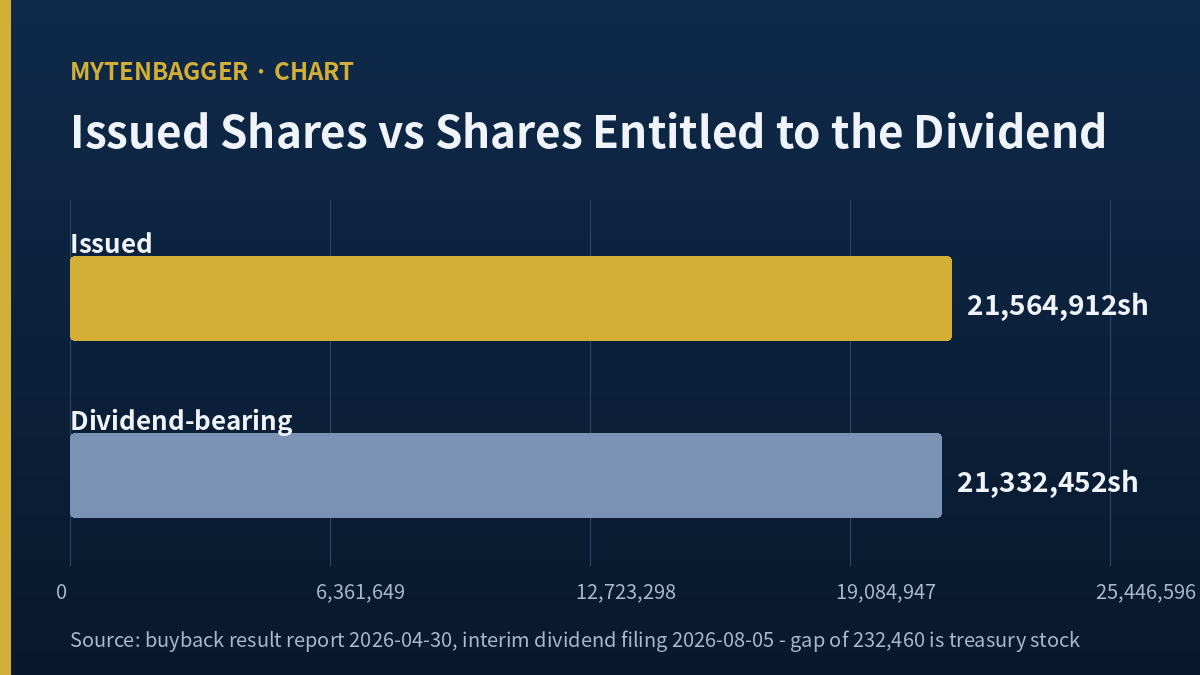
The same filing lists 21,564,912 issued shares and a treasury ratio of 1.1 percent. Dividing 232,460 by 21,564,912 gives 1.0780 percent. Working backward from the cash spent, 20,999,910,450 won over 232,460 shares implies an average of 90,337.74 won (USD 67.05) per share. That average is my own back-calculation and not a disclosed figure.
The dividend resolution locates those shares
On August 5, 2026 the board declared an interim cash dividend of 500 won per common share, a total of 10,666,226,000 won, with a September 30, 2026 record date and an October 30, 2026 payment date. Korean outlet Datatooza reported the terms from the filing.
Treasury shares receive no dividend. So the declared total divided by the per-share amount returns the number of shares entitled to be paid. 10,666,226,000 divided by 500 is 21,332,452.
And 21,564,912 minus 232,460 is 21,332,452. Not one share off.
That equality settles one thing. On the day the board sized this dividend, the 232,460 shares bought in February were still inside the company. Shares purchased under a stated cancellation purpose had sat there for close to six months. I could not find a filing that says so in words, because there is no requirement to announce something one has not done. Unfinished business only shows up in arithmetic.
I want to be careful about what this is. It is not a violation. Buying and canceling are separate procedures with separate timelines, and the group said in March that it intended to complete the program within the year. What I am pointing at is elapsed time, not misconduct. But while that time elapses, the share count underneath every per-share figure stays where it was.
Hyundai Department Store stock and the two operating profits reported on August 5
Two Korean articles published on August 5, 2026 gave different operating profit figures for the same quarter. Newspim reported 79.3 billion won, down 8.7 percent year over year. Herald Business reported 110.1 billion won, up 58.6 percent. Neither one is an error.
The half-year filing settles which is which. Standalone consolidated operating profit for the second quarter of 2026 was 79.319 billion won (USD 58.87 million) against 86.873 billion won (USD 64.48 million) a year earlier. That works out to a decline of 8.6955 percent, which matches the reported 8.7 percent to the first decimal.
The larger figure is the department store division on its own. The Herald Business piece lists division net sales of 643.8 billion won and division operating profit of 110.1 billion won (USD 81.72 million) for the quarter, plus 6.2 billion won (USD 4.60 million) at the duty-free business, which swung from a 1.3 billion won loss a year earlier. Those two divisions add to 116.3 billion won. Consolidated came in at 79.319 billion won, which is 36.981 billion won (USD 27.45 million) lower.
The 36.98 billion won that sits between the divisions and the group
| Basis | Q2 2026 (bn KRW) | H1 2026 (bn KRW) | Source |
|---|---|---|---|
| Department store division operating profit | 110.1 | 246.0 | Herald Business, August 5, 2026 |
| Duty-free operating profit | 6.2 | 9.6 | Herald Business, August 5, 2026 |
| Sum of those two | 116.3 | 255.6 | My addition |
| Consolidated operating profit | 79.319 | 178.103 | Half-year filing |
| Difference | 36.981 | 77.497 | The two rows above, one taken off the other |
Neither article breaks that difference into line items. Korean coverage from Insight and Ajunews both placed the mattress and furniture subsidiary Zinus in that position, and an analyst comment from Daishin Securities attributed a full-year estimate cut to weakness there. I did not open the segment note itself, so I am not writing that the whole 36.981 billion won is one subsidiary. What is settled is the size and the direction.
June bought one set of numbers and August sold the other
The reasons published in June all point at the division. Kiwoom Securities lifted its valuation to 220,000 won on June 10, 2026 on revenue growth. Heungkuk Securities went to 270,000 won on June 19 on department store strength. Korean trade coverage on June 18 cited an expected 17 percent same-store growth rate for the quarter and foreign visitor spending. Shinhan Investment analyst Cho Sang-hoon wrote on August 6 that department store transaction value grew 16 percent, that the flagship store grew 31 percent, and that foreign-customer sales grew 66 percent.
Those are all division figures, and the division really was strong. First-half division operating profit of 246.0 billion won (USD 182.59 million) was up 47.7 percent year over year according to the same Herald Business report.
The reasons published in August point at the consolidated line. Ajunews reported on August 6 that second-quarter consolidated operating profit of 79.3 billion won fell short of a consensus of 89.3 billion won. Dividing 79.319 by 89.3 gives a shortfall of 11.1769 percent. The same article said eight houses cut their valuations that week.
One house had it nearly right a week early. Hana Securities analyst Park Jong-dae opened coverage on July 29, 2026 with an estimate of roughly 78 billion won for the quarter and a 180,000 won valuation built on twelve times forward earnings. The actual 79.319 billion won came in 1.691 percent above that estimate while consensus sat 89.3 billion won. I do not read this as one firm being clever. I read it as evidence that people watching the division and people watching the group were carrying pictures of the same company that differed by more than 10 billion won. On August 5 those pictures resolved into one. The close went from 118,400 won on August 4 to 110,100 won on August 5, a decline of 7.0101 percent, then to 106,400 won on August 6.
Hyundai Department Store stock against Dillard’s, a retailer that does shrink its count
I wanted an outside marker for the thing this article is actually about, which is whether a buyback ends in a smaller share count. Dillard’s (NYSE: DDS) is the clearest comparison I know: a department store operator whose share count has been getting smaller year after year, which is a different thing from announcing that it will.
As of September 14, 2026, stockanalysis.com shows Dillard’s at USD 655.12 per share with a market capitalization of USD 10.23 billion on 15.62 million shares. Multiplying price by share count returns USD 10.233 billion, so that pair reproduces. Trailing revenue is USD 6.60 billion with net income of USD 681.78 million, a net margin of 10.33 percent, and 681.78 divided by 6,600 does return 10.330 percent. The dividend yield is 4.80 percent and the beta is 1.19.
The line I came for is the share count change: negative 1.50 percent year over year. Dillard’s buys and the count goes down.
The matching line for the Korean company cannot be written the same way. Its issued share count is 21,564,912 and it was 21,564,912 before the February program too, because the 232,460 shares it bought moved from the market into the company and not out of existence. The comparable figure is zero, and the reason it is zero is procedural, not financial. That contrast is the whole point of putting the two names next to each other.
I left two Dillard’s fields out. The site prints a price-to-earnings ratio of 14.90 and a price-to-book ratio of 4.79, but 655.12 over the stated USD 43.66 earnings per share gives 15.005 and 655.12 over the stated USD 135.77 book value per share gives 4.8252. Both miss by about 0.7 percent, which is more than rounding on two-decimal inputs should produce. I do not compare multiples I cannot reproduce.
For scale, Dillard’s market capitalization of USD 10.23 billion is 6.49 times the Korean company’s USD 1.577 billion, on trailing revenue that is roughly twice as large. Korean consolidated revenue for 2025 was 4,230.3 billion won (USD 3.140 billion) with a net margin of 3.3456 percent.

Three screen fields I left out of Hyundai Department Store stock
Three values sit on the data screen that I could not rebuild from filed statements, so none of them carries any argument here. I am listing them instead of deleting them.
First, book value per share of 206,105 won. Multiplied by 21,564,912 issued shares that implies roughly 4,444.7 billion won of equity. Owners’ equity at the end of 2025 was 4,549.528 billion won, owners’ equity at the end of June 2026 was 4,649.950 billion won, and total consolidated equity at the end of June 2026 was 6,365.677 billion won. The implied figure matches none of the three, so price-to-book stays out.
Second, earnings per share of 9,179 won. Multiplied by the share count that implies about 197.9 billion won of earnings. Consolidated net income for 2025 was 141.528 billion won and net income attributable to owners was 207.666 billion won. The screen’s price-to-earnings ratio of 10.72 stands on a third number that is neither, so I picked no multiple.
Third, return on equity of 4.6 percent. This one does rebuild, and the way it rebuilds is what bothered me. Owners’ net income of 207.666 billion won over year-end owners’ equity of 4,549.528 billion won gives 4.5646 percent, matching the screen. But the same screen prints consolidated net income of 141.528 billion won in its net income field, and that number over total consolidated equity gives 2.2427 percent, matching what the filing itself reports. One screen uses the consolidated figure in one cell and the owners’ figure in the next. Neither is wrong on its own. Read together they make profitability differ by roughly a factor of two, so return on equity stays out as well.
The 250-session window still holds an unfinished session
The screen prints a 250-session high of 222,000 won and a low of 74,100 won, and labels the basis as adjusted closing prices. I pulled the daily series and counted.
On closing prices, the same window peaks at 207,000 won on June 17, 2026 and bottoms at 74,700 won on April 7, 2026. The screen’s two numbers are intraday: 222,000 won is the June 18 intraday high and 74,100 won is the April 7 intraday low. The basis label says closing and both values are intraday.
The window’s end date is the part that surprised me. The only 250-session range that reproduces both screen values runs from September 5, 2025 through September 15, 2026, which is today. The September 15 row carries 17,946 shares of volume against 123,460 the prior session, or 14.5 percent of it, and its exchange field reads unknown while its finalization field is empty. An unfinished session is inside the window that the high and low are drawn from.
The effect is measurable. Using the screen’s own 98,400 won current price against the intraday extremes gives a drawdown of 55.6757 percent and a gain from the low of 32.7935 percent. Using the confirmed September 14 close of 98,500 won against the closing extremes gives 52.4155 percent and 31.8608 percent. The drawdown differs by 3.26 percentage points. As a separate matter, the screen’s 98,400 won is not the confirmed September 14 close of 98,500 won either, and the screen’s update stamp of 17:02 on September 14 falls before the end-of-day confirmation pass.
Where I stand on Hyundai Department Store stock and what would move me
I hold none of this and I have no order working. At USD 1.577 billion of market value it sits below the size band where I take positions, so this is an observation file. I keep it open for one reason. A stretch where the division improves while the group deteriorates does not usually last. One of the two lines moves toward the other, and the next report decides which.
Three things would close the file. If the third-quarter report shows consolidated operating profit down again year over year while division growth drops into single digits, the division story is over. If those 232,460 shares move toward disposal instead of cancellation, the capital return message is over. If the interim dividend turns out to be a one-time gesture with no follow-up, the whole March announcement was framing.
Three arguments against me, dated by where I first met each one
Met in the Shinhan Investment note of August 6, 2026. Treating the 36.981 billion won difference as a warning may be too harsh. Cho Sang-hoon wrote that the core department store and duty-free businesses were strengthening even with the subsidiary dragging, and Park Jong-dae at Hana Securities wrote on July 29 that closing the Dongdaemun duty-free site removed an annual loss of roughly 40 billion won. If the loss-making pieces are shrinking, the distance between division and group closes on its own.
Met in the group announcement of March 13, 2026. Not yet canceled is not the same as never canceled. The group said within the year, and September 15 is still within the year. What I verified is the position as of August 5, and the forty days since then are outside what I checked. If this objection holds, the dividend division above reads as work in progress instead of delay.
Met in the Asiae sector piece of August 20, 2026. Explaining a halving with company earnings alone may be too narrow. That article reported the three listed Korean department store operators down roughly 40 percent from mid-June highs with forward earnings multiples near eight times, and attributed the move to won strength weighing on inbound spending and to heavy reliance on luxury categories. Shinyoung Securities was quoted in the same piece questioning whether a correction of that size was warranted. If the whole sector moved together, one company’s division accounting is a secondary variable.
What the neighbors taught me first
I read three names in the same Korean retail bracket before settling the angle here. Shinsegae fell 47 percent while its estimates went up, which is the same disconnect between reported results and price that shows up in this file. Lotte Shopping paid more in dividends than it earned, a reminder that capital return announcements and capital return capacity are separate questions. BGF Retail earns its returns through asset turnover, which is the structural opposite of a company carrying department store real estate on its books.
Three things I decided not to do with Hyundai Department Store stock
Writing this raised several temptations. Three of them I turned down, and the reasons are worth keeping.
I will not build a multiple on the 110.1 billion won division figure. Doing so makes the stock look considerably cheaper. But a buyer of one share buys the consolidated entity, not the division. Choosing the flattering numerator is precisely what the June valuations did.
I will not publish per-share figures that assume the 232,460 shares are gone. Cancellation would cut the share count by 1.078 percent and improve every per-share line by that much. Adjusting a record for an event that has not occurred turns it into a forecast, and this file is a record.
I will not describe the distance between the current price and the post-cut valuation band of 160,000 to 220,000 won as upside. Those figures were set on August 6 and the price has not touched the lower bound since. While that distance persists it is a disagreement, not an opportunity.
What I have scheduled instead is narrow. On Monday, November 17, 2026, after the statutory filing deadline of November 15, I will open the third-quarter report and look at exactly two cells: consolidated operating profit, and whether the treasury share count still reads 232,460. Whichever cell moves first writes my next sentence about this company.
Sources
Korean electronic disclosure filings for Hyundai Department Store: half-year report filed August 14, 2026, first-quarter report filed May 15, 2026, and annual report filed March 18, 2026. Screen values are from a Kiwoom data feed dated September 14, 2026, with book value per share, earnings per share and return on equity excluded for the reasons given above. Korean-language sources appear here in my own paraphrase, not as quotations, since the originals are not in English.
Newspim, August 5, 2026, consolidated second-quarter results | Herald Business, August 5, 2026, division results | Ajunews, August 6, 2026, consensus and the week of cuts | Edaily, Shinhan Investment note | Digital Today, buyback result report coverage | Datatooza, interim cash dividend filing | Asiae, August 20, 2026, department store sector correction | Investing.com Korea, group treasury share program | Money Today, June 10, 2026, Kiwoom Securities note | stockanalysis.com, Dillard’s key statistics