HD Hyundai Stock Sits on a Book Two Thirds Not Mine
HD Hyundai (KOSPI: 267250) reports 34.86 trillion won of consolidated equity as of June 2026. Of that, 12.23 trillion belongs to the parent company’s shareholders and 22.63 trillion belongs to somebody else. I own none of it either way, because I do not hold the shares. But if I did, the number attached to my certificate would be the smaller one, and the number printed in every summary of HD Hyundai stock would be the larger one. That gap is the whole subject of this journal entry.
Contents
HD Hyundai Stock and a Line Most Screens Do Not Draw
A quick orientation for readers outside Korea. KOSPI is the main board of the Korea Exchange, the larger of the country’s two listed markets, and 267250 is HD Hyundai’s ticker on it. The company is a holding vehicle: it does not build ships or refine crude itself. It owns the companies that do, and several of those subsidiaries are separately listed on the same exchange. That structure is common in Korea and it is the reason the equity line splits the way it does.
I pulled the balance sheet items from Valueline Korea, which carries the June 2026 consolidated statement. Total assets 90.69 trillion won. Total liabilities 55.83 trillion won. Total equity 34.86 trillion won. Within that equity line, 12.23 trillion is marked as attributable to the owners of the parent and 22.63 trillion as non-controlling interest.
Those two add back cleanly. Assets minus liabilities land within a rounding step of the equity total, and the two equity components sum to the whole. So the split is not an estimate I imposed. It is printed. What is not printed, on any summary screen I looked at, is the ratio.
Two Thirds of the Equity Belongs to Somebody Else
Dividing gives 35.08% to the parent and 64.92% to the minority holders. I did that division myself; no source I used states either figure.
The plain meaning is that when a headline says this company has 34.86 trillion won of net assets, roughly two thirds of those assets are already spoken for by people who hold shares in the subsidiaries instead of shares in the parent. A shipyard that HD Hyundai controls but does not wholly own contributes its full asset base to the consolidated total and its full debt too, and then a single line at the bottom quietly removes the portion that belongs to the other owners.
Where the other owners actually sit
The 22.63 trillion won does not belong to one party. It is spread across the outside shareholders of every subsidiary the parent controls without wholly owning, and several of those subsidiaries trade on the same exchange. A Korean investor can therefore choose which side of this line to stand on, and many of them have. The line is not an accounting artefact hiding somewhere in the notes; it is the aggregate of decisions other people made in the same market on the same day.
The mistake I had been making for years
A consolidated income statement had been, in my head, a statement about the company whose name is on top of it. I read the revenue line as its revenue and the profit line as its profit. That is wrong in a specific and measurable way for any holding structure, and I never stopped to measure it until this week. Consolidation is a rule about control. Ownership is a separate question and the statement does not answer it. It tells you what the parent directs. It does not tell you what the parent keeps. For years I let those two questions collapse into one, and the number I quoted to myself was the bigger of the two every time.
I am writing this down because the correction is cheap once you see it and expensive while you do not. Every ratio built on a consolidated total inherits the error. So does every comparison between a holding company and an operating company, unless you split both sides first.
HD Hyundai Stock Against Two Net Asset Figures
Share count first, because everything below divides by it. HD Hyundai has 78,993,085 shares outstanding with a par value of 1,000 won, per the Korean corporate filing summary. The same screen shows the company was established in April 2017 and listed on 10 May 2017, with a five-for-one share split recorded on 13 April 2021.
Now the two figures. The vendor screen at Korea’s WiseReport company page prints net assets per share of 143,153 won. Take the June 2026 parent-attributable equity of 12.23 trillion won and divide it by the share count above, and you get 154,804 won. The two differ by about 7.5%, and the vendor figure is the lower one.
Which of the two multiples follows
Price-to-book on the vendor screen reads 1.73 times. Using my own division instead, the same 14 September 2026 close produces 1.60 times. Both are defensible; they answer slightly different questions. The vendor number is almost certainly anchored to an earlier balance-sheet date, most likely December 2025, which would explain a smaller equity total and therefore a smaller per-share figure.
I could not confirm that. The screen does not state which period its per-share net asset figure uses, and I did not find a note that says so. I multiplied the vendor figure back by the share count to see whether it reproduced any equity total I had, and it reproduced none of them. I am reporting that failure here instead of burying it, and it is why both multiples stay in the piece.
The Screen Number I Could Not Rebuild
It is worth sitting with the failure above for one more paragraph, because it changes how much weight the rest can carry.
When a vendor prints a per-share figure and I cannot reproduce it from the balance sheet the same vendor links to, I have three options. I can assume the vendor is right and my share count is stale. I can assume the balance sheet is right and the vendor figure is old. Or I can carry both and say so. I chose the third because the first two both require me to know something I do not know, which is the as-of date behind the vendor cell.
The 7.5% gap is not large enough to change any conclusion in this entry. The split between parent and minority owners is 35.08% either way, because that ratio comes from the balance sheet directly and never touches the per-share figures at all. But readers should know which numbers here rest on one source and which rest on two.
HD Hyundai Stock and a Company of Forty-Seven People
The filing summary lists 47 employees as of June 2026. That is the holding company itself. The shipyards, the refinery, the excavator plants and the switchgear factories all sit inside subsidiaries with their own payrolls, and none of those headcounts roll into that 47.
I like this number because it makes the structure physical. Forty-seven people, working out of an office in Bundang, south of Seoul, sit on top of a consolidated balance sheet of 90.69 trillion won in assets. Their job is capital allocation and governance. Nothing is produced at that address. Shipbuilding and refining each account for roughly two fifths of consolidated revenue, with construction equipment and electrical gear making up most of the rest, but the parent’s own contribution to that revenue is essentially nil.
Leverage sits below, and so does the cash
Liabilities of 55.83 trillion won against equity of 34.86 trillion works out to a debt-to-equity ratio of 160.2%, which matches the vendor screen. But almost all of that debt was raised by operating subsidiaries, and so was almost all of the cash that services it. The parent’s own balance sheet is a fraction of what the consolidated statement shows, in both directions.
This is the part that makes holding companies awkward to value with ordinary tools. A debt ratio computed on consolidated numbers describes a group. A share certificate is a claim on a parent. Korean sell-side work handles this by valuing the subsidiary stakes and applying a discount, which I looked at in an earlier entry on Hyosung. That piece was about whether the size of the discount was worth buying; this one is about who owns the assets the discount is applied to. Different question, same structural cause.
A Group That Was Assembled in 2017
One detail keeps the balance sheet in proportion. This holding company was established in April 2017 and listed on 10 May 2017. The consolidated statement I have been dividing therefore describes a group that has existed in this legal form for about nine years, while the shipyards and the refinery inside it go back decades. The parent is a recent legal wrapper placed around much older industrial assets, and the equity split I keep quoting is a consequence of how that wrapper was drawn and not a description of the businesses themselves.
Two chief executives and one address
The filing summary lists two co-chief executives and a head office in Bundang. I note this because governance is the thing a parent shareholder is actually buying when the operating assets sit one level down. A discount applied to subsidiary stakes is, in part, the market pricing its confidence in the people at that address. I have no basis to price that confidence and I am not going to pretend otherwise.
What the share count carries forward
The 78,993,085 shares outstanding today reflect a five-for-one split in April 2021 and a small buyback cancellation before it. I checked this only because every per-share number in this entry divides by that count, and a share count that changed recently would make the division wrong. It has not changed since the split.
Brookfield Runs the Same Structure Harder
For a peer I wanted a company where the same line splits the same way, so the comparison would be about degree instead of about whether the phenomenon exists. Most large US industrials have almost no minority interest at all, which makes them useless here. Brookfield Corporation (NYSE: BN) is the opposite case.
From Brookfield’s balance sheet on a trailing twelve month basis to 30 June 2026: total assets 525,515 million dollars, total liabilities 358,879 million, total equity 166,636 million, of which minority interest is 120,065 million. Subtracting leaves 46,571 million for the parent’s own shareholders.
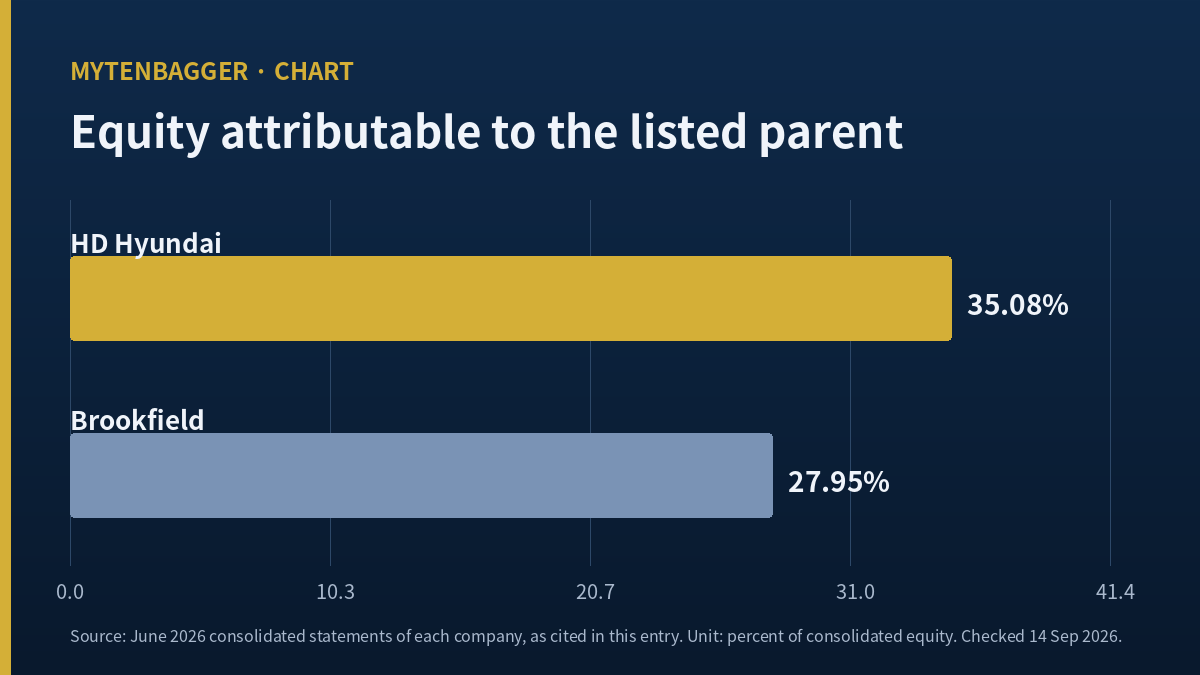
So here is the comparison, and I want to be exact about what is being compared. I am not putting the two companies’ multiples side by side. I am putting side by side the fraction of each consolidated equity line that belongs to the listed parent.
| Share of consolidated equity | HD Hyundai | Brookfield Corporation |
|---|---|---|
| Attributable to the listed parent | 35.08% | 27.95% |
| Attributable to minority holders | 64.92% | 72.05% |
| Balance sheet date used | June 2026 | June 2026 |
Both ratios are my own division. Brookfield’s other figures, for context and not for the comparison: market capitalisation of 85.17 billion dollars, 2.23 billion shares, a price-to-earnings ratio of 67.76 times, trailing twelve month net income of 1.26 billion dollars against revenue of 80.69 billion, and a dividend yield of 0.72%.
Why I converted neither side into the other
I could have restated Brookfield’s equity in won, or HD Hyundai’s in dollars, and put the two totals in one column. I did not, because the comparison here is between two ratios and a ratio survives currency conversion untouched. Converting would have added a rate, a date and an error band to a table that needs none of them. The dollar figures below are context for readers who price things in dollars, and they do no work in the argument.
What strikes me is that Brookfield is generally understood as an asset manager whose whole business model is deploying other people’s capital. Of course its balance sheet is mostly other people’s. HD Hyundai is not described that way by anyone. It is described as an industrial group. And yet the structural fact is the same and only seven percentage points milder.
HD Hyundai Stock: What I Do Not Believe Here
- Every ratio in this entry is my own arithmetic. Neither vendor prints 35.08% or 64.92% anywhere.
- The balance sheet came from one Korean data vendor. I did not open the half-year report itself.
- That vendor rounds to a hundred million won, so the components sum to the total within a rounding step and not exactly.
- Net assets per share of 143,153 won could not be reproduced from any equity figure I had, using the current share count.
- My own figure of 154,804 won assumes the share count is current as of the same balance sheet date.
- The two price-to-book readings, 1.73 and 1.60, therefore rest on different and partly unverified period assumptions.
- Minority interest is a single aggregated line. It does not say which subsidiaries it belongs to.
- A parent share of 35.08% is not the same thing as economic exposure of 35.08%. Control brings benefits that do not appear in the equity split.
- Nor does it map to the share of profit. I did not compute the profit split in this entry at all.
- Brookfield reports under a different accounting framework and in a different currency.
- Brookfield’s figures are trailing twelve month values and therefore span a window that no fiscal period matches.
- Brookfield’s own per-share net asset figure did not reconcile with its equity and share count either, so I left it out entirely.
- One peer is a sample of one. I chose it because it shares the structure, which is a selection made to prove a point.
- Most large US industrials would have made the contrast look dramatic. I did not use one, and that choice governed how the table reads.
- The 52-week range of 333,000 won high and 147,100 won low sits in this entry without analysis. I mention it so readers know the stock has moved violently in both directions this year.
- Foreign ownership of 26.90% is a vendor figure and I did not check it against exchange disclosure.
- The employee count of 47 refers to the holding company only and says nothing about group headcount.
- The revenue description as roughly two fifths shipbuilding and two fifths refining is deliberately imprecise, because the exact split belongs to a companion entry.
- Dollar conversions in this entry use a single rate from one date, noted at the end.
- Korean won is the reference currency throughout; converting does not make anything more accurate.
- I have never visited any of this group’s facilities and have never spoken with anyone who works there.
- Splitting a printed line in two and dividing is not research. It is reading carefully, which is a lower bar.
Buying HD Hyundai Stock From Outside Korea
There is no American depositary receipt for this name, so a US-based holder cannot reach it through the usual over-the-counter route. I am not naming a broker here because the list changes and the terms differ enough that anyone doing this should price it themselves.
The index does not answer this question either
The index route reaches it differently. A Korea-tracking fund holds this company at whatever weight the index assigns, and here the structural point of this entry comes back with force. An index weight is calculated from market capitalisation, which is a claim on the parent. But the earnings and assets the index fund’s marketing material describes are consolidated. Buying the index does not resolve the question of what fraction of those assets you own; it just spreads the same question across two hundred names at once, each with its own parent-to-minority ratio that nobody shows you.
Foreign ownership of this particular name stands at 26.90%, so the structure has not deterred overseas capital. Whether those holders split the equity line before buying, I have no way to know.
HD Hyundai Stock, My Position and the Questions I Get
I hold no shares and have no order working. Watching.
The reason is narrow and I want it on the record. I do not yet know whether owning the parent or owning one of the listed subsidiaries fits what I am trying to do, and the equity split above is exactly why the question is hard. Buying the parent means buying 35.08% of a very large set of assets plus a control premium of unknown size, at a discount of unknown adequacy. Buying a subsidiary means buying a larger share of a smaller thing. Neither is obviously better and I have not done the work to say.
The disclosure that would move me
Here is what would settle it, or at least move it. A disclosure that breaks the minority interest line down by subsidiary. That single table would turn the 64.92% from an aggregate into a map, and the map is what tells you whether the parent’s discount is about governance, about double counting, or about something else. Korean half-year reports carry equity notes that sometimes include this. I did not find one for this period, and finding one would be the first thing I do before I touch the shares. Separately, if the parent’s attributable equity ratio moves materially above or below 35.08% at the next reporting date without a corresponding transaction, my reading of the structure as stable is wrong.
Six months from now, reading this back, which sentence looks silly first? I think it is the Brookfield comparison. A peer chosen because it shares a structure is a peer chosen to agree with me, and that will read as convenient. Second to go is the 154,804 won figure, which one properly dated disclosure erases. Third is the employee count paragraph, which is vivid and does no work. The sentence most likely to survive is the plainest one: the equity line splits 35.08% to 64.92% and it is printed that way. Printed numbers age better than the things I say about them.
- Does minority interest mean the company is worth less than it looks?
- It means the consolidated asset and equity totals overstate what a parent share claims. Whether that makes the stock cheap or expensive depends entirely on the price, which this entry does not resolve. The point is that the comparison must be like for like on both sides.
- Why compare with Brookfield instead of a shipbuilder?
- Because the subject is the ownership structure, not the industry. A pure shipbuilder would have shown a very different equity split for reasons that have nothing to do with the question. Brookfield shares the structure, which lets the comparison be about how far it goes.
- Is a 160.2% debt ratio a problem?
- On its own it tells you very little for a holding company, because the debt sits in operating subsidiaries alongside the cash flows that service it. A group-level ratio answers a group-level question. It is not the ratio a parent shareholder should be looking at first.
- Should I buy it?
- I did not. My reason is above and my trigger is a subsidiary-level breakdown of the minority interest line. Until I see one, I am looking at a discount whose composition I cannot describe, and I do not size positions against things I cannot describe.
Balance sheet figures reflect the June 2026 consolidated statement as carried by a Korean data vendor and checked at the time of writing, so screen values can differ from what is shown here. The market close behind both price-to-book figures is 14 September 2026. Dollar amounts converted from won use roughly 1,341.59 won per dollar, the 11 September 2026 close from Investing.com Korea, and are approximate. Korean won is the reference currency. Annual and quarterly results referenced indirectly were checked against Alphasquare. Related entries: Samsung Heavy Industries, which looked at order intake against shareholder returns instead of at who owns the equity, and S-Oil, which examined capital committed to a single segment instead of the ownership of the group total.