NH Investment & Securities Stock: Why the Sector’s Top Dividend Yield Makes Me Cautious
NH Investment & Securities has the highest dividend yield of the five names in this series — a mid-4% yield, a per-share dividend raised to ₩1,300 (about $0.94), and a payout ratio parked above 40% for years. If you screen for Korean dividend stocks, this one lands on the first line. And yet I haven’t bought it. The reason isn’t the yield. It’s the profit behind the yield: NH’s earnings lean heavily on deal-driven investment banking and proprietary trading, so a high dividend here does not automatically mean a safe dividend. This is the fourth entry in my Korean brokerage series, and it’s the one that tests my own dividend discipline hardest.
Here is the number that stopped me. NH Investment & Securities pays the fattest dividend yield in the Korean brokerage sector — and its shares still fell roughly 30% from a May peak to a late-June trough before bouncing back. A yield near 4-5% is supposed to be the calling card of a stable, boring stock. A 30% round trip in two months is not what boring looks like. That gap between “highest yield in the group” and “swings like a growth stock” is the whole reason I put NH Investment & Securities on my watch list rather than in my book. For readers outside Korea: NH trades on the KOSPI, the main board of the Korea Exchange, roughly the Seoul equivalent of the NYSE. It is a full-service brokerage — retail trading, wealth management, and investment banking under one roof — and it sits inside the NongHyup financial group, Korea’s agricultural-cooperative-rooted banking conglomerate. I am writing this as a personal trading journal, not as advice, and I want to walk through why the sector’s best headline yield is exactly the one I’m most careful with.
Contents
NH Investment & Securities dividend: what pulls me in, what holds me back
Let me credit the attraction first. NH’s per-share dividend jumped from ₩950 in 2024 to ₩1,300 (about $0.94) for 2025, per its regulatory filing with Korea’s electronic disclosure system (DART). At the current share price of roughly ₩31,000-32,000 (about $23), that is a mid-4% yield; earlier in the year, when the stock was cheaper, the yield cleared 5%. The payout ratio has been held above 40% for a long stretch, according to Korean financial outlet EBN (April 2026), citing a Mirae Asset Securities report. On top of that, NH meets the criteria for Korea’s newly separated dividend-income taxation, as Korean outlet Business Post (January 2026) noted, citing a Korea Investment & Securities report — a tax change that lifts the after-tax appeal of high payers. In the “capital-return type vs. reinvestment type” split I drew in the series opener, NH is the flagship of the capital-return camp.
So what holds me back? A high dividend yield is one of two things: either the company is genuinely generous, or the market distrusts the earnings and has pushed the price down. With NH, it’s a blend of both. Its return on equity sits in the low 11% range — a 2026 estimated ROE of 11.6% per Korean outlet Joseilbo (January 2026) — which is at the low end of the sector. The dividend is large, but the engine that compounds capital is comparatively soft. Read this name as “just a high-dividend stock” and you miss the thing that actually matters.
Three reasons NH Investment & Securities is on my watch list
1. The sector’s highest yield, backed by a 40%+ payout history
The dividend case is real. A mid-4% yield is the highest of the five brokerages I’m covering and above most Korean bank stocks. A payout ratio held above 40% for years gives the dividend a degree of predictability. And Korea’s 2026 dividend-income tax change raises the after-tax value of heavy payers — the fact that NH clears the qualifying bar means policy is now actively subsidizing this dividend through the tax code. I regard the direction of NH’s capital return as the single strongest thing about the stock.
When I judge whether a dividend will hold, I don’t look only at the level — I look at the track record. NH’s per-share dividend climbed from ₩700 in 2022 to ₩800, then ₩950, then ₩1,300 for 2025 (DART filings). A company that raises its dividend every year without cutting it is treating capital return as a policy, not a one-off gesture. That history partly offsets the earnings-volatility worry I get to below. A firm that has lifted its dividend four years running does not casually abandon it.
2. IB deal flow is recovering, and brokerage revenue is riding along
NH Investment & Securities has long been a heavyweight in investment banking — a top-tier arranger in both equity capital markets and debt capital markets. The deal environment that sagged in the second half of last year is gradually recovering, in the sell-side’s read (EBN, April 2026, citing Mirae Asset). Layer rising trading volumes on top and brokerage fees rise alongside. Mirae Asset estimated NH’s first-quarter net profit attributable to owners at ₩415 billion (about $301 million), up roughly 99% year over year (EBN, April 2026) — meaning brokerage, trading, and IB are all improving in the same quarter. Dig one level deeper: Korea Investment & Securities pegged NH’s brokerage commissions at ₩220.3 billion and its wealth-management interest income at ₩124.3 billion, with both legs firing together (Business Post, January 2026). This is not a company that lives or dies on a single deal; brokerage and interest income lay a floor. That floor is a big part of why I keep NH on the watch list — even in a quarter when deals don’t land, the well doesn’t run fully dry.
3. A cheap multiple and a string of target-price upgrades
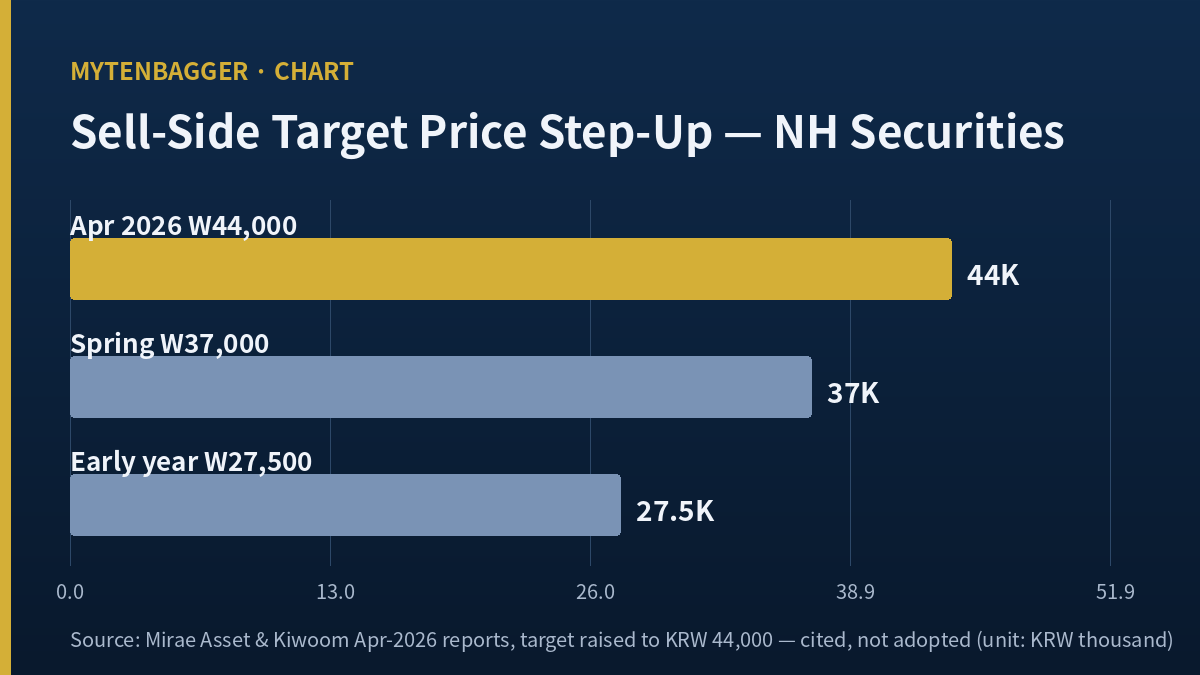
NH trades at roughly 10x earnings and 1.16x book. As results and dividends came in firmer than expected, the sell-side raised its targets repeatedly. Mirae Asset and Kiwoom both lifted their target price to ₩44,000 (about $32) in April 2026 (per each brokerage’s report) — around 1.4x the current price. I don’t adopt those targets as my own; no brokerage’s number becomes my entry price. But the fact that several houses raised their sights on the back of earnings and dividends is worth logging as market information. The trajectory is the striking part. A target that sat near ₩27,500 at the start of the year stepped up through spring to ₩37,000 and then ₩44,000 (Korean outlet Joseilbo, January 2026, and subsequent brokerage reports). The sell-side lifting its eye level that fast in half a year tells me results and dividends kept beating. I read the speed of the upgrades as circumstantial evidence of an earnings inflection — while remembering that targets come down as fast as they go up.

NH Investment & Securities: the numbers that matter
Here are NH’s dividend, earnings, and valuation figures. Dividends are per DART year-end filings, earnings and estimates per sell-side reports, and valuation per recent financial data. Every cell was checked against its source. Won-to-dollar conversions use roughly ₩1,380 per USD.
| Metric | Value | Note |
|---|---|---|
| Dividend per share | ₩1,300 (~$0.94) | 2024 ₩950 → +36.8% (DART) |
| Dividend yield | mid-4% | sector-high; topped 5% at the year’s lows |
| Payout ratio | 40%+ | meets separate-taxation criteria |
| 2025 net profit | ~₩1.0tn (~$725M) | KIS raised its forecast to ₩1.16tn |
| P/E · P/B | 10x · 1.16x | 2026E ROE 11.6% (low end of sector) |
| Proprietary (PI) net operating rev. | ₩1.04tn (~$754M) | 2025 −12% YoY |
Sources: dividend = DART FY2025 filing | earnings/estimates/ROE = Business Post 2026-01 (KIS), EBN 2026-04 (Mirae Asset), Joseilbo 2026-01 | valuation = recent financial data | as of July 2026. FX ~₩1,380/$.
On the tape, NH peaked in the ₩38,000s (about $28) in early May, was pushed down to ₩27,000 (about $20) by late June, and now sits near ₩31,000-32,000. Over twelve months it’s up more than 60%; over three months it’s negative. For a supposed dividend anchor, that is a lot of movement. A near-30% drawdown from the high and back inside two months is not how a genuinely stable high-dividend stock behaves. And that is precisely the bridge to the next section: if you classify NH as a “safe high-dividend stock” on yield alone, you can’t explain why it swings like this. Price volatility mirrors earnings volatility, and NH’s earnings — as we’ve seen — are lashed to deals and proprietary trading.
What the market misses on NH Investment & Securities — look at what funds the dividend
This is the part I most want to make. People routinely use “high-dividend stock” as a synonym for “stable stock.” The unspoken assumption is that a company paying a big dividend must have steady earnings. With NH Investment & Securities, that assumption is dangerous. The dividend is large, but the profit that produces it is itself variable.
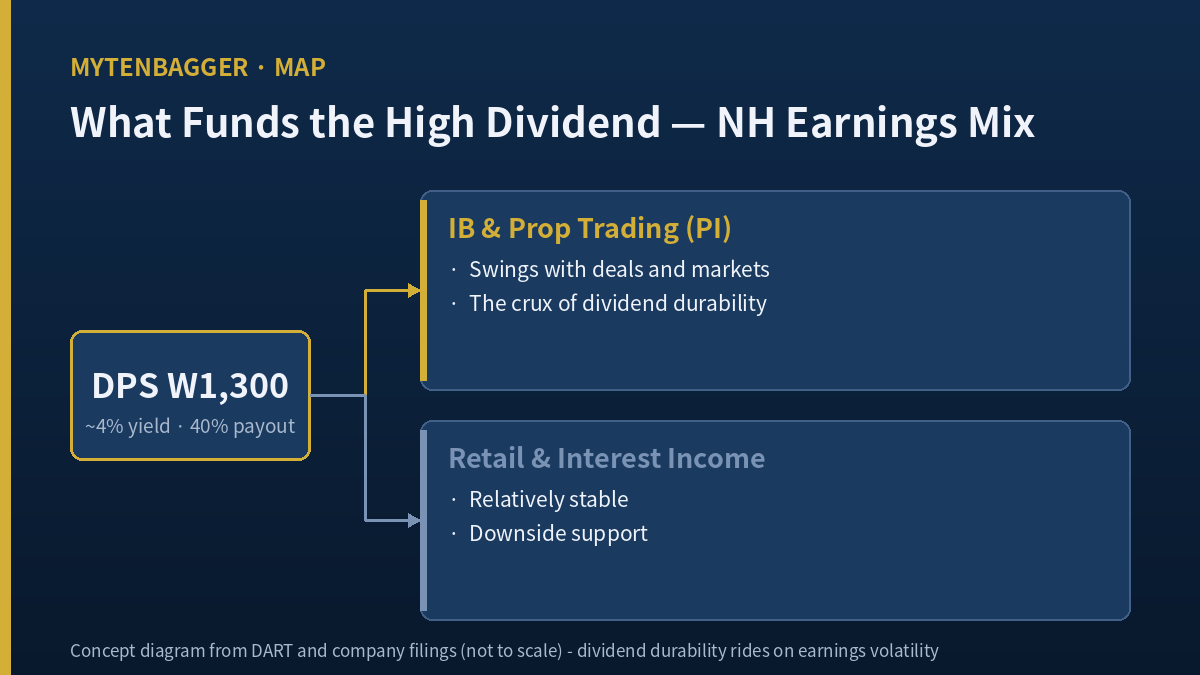
Look at the earnings mix. Investment banking and proprietary trading make up a big slice of NH’s profit. IB only books revenue when a deal closes, so it lurches quarter to quarter, and deal conditions were weak in the second half of last year. Proprietary trading saw net operating revenue of ₩1.04 trillion (about $754 million) in 2025, down 12% year over year (Joseilbo, January 2026). In other words, a substantial share of the dividend’s funding depends on “how many deals landed this quarter” and “how the trading book did.” That is not the metronomic money a bank earns on net interest. In my Samsung Securities entry earlier in this series, I proposed a single yardstick — “what are the earnings tethered to?” Apply the same yardstick to NH and the answer splits. Samsung’s profit is tethered to client assets under custody, so it moves slowly; NH’s profit is tethered to deals and proprietary trading, so it swings fast. Both are “brokerages,” both pay dividends, but the stability of the earnings behind those dividends is close to opposite. Because two stocks share the surface label “high dividend” does not mean they belong in the same safety tier — that’s my view.
So I read NH not as a “safe high-dividend stock” but as “high dividend plus a variable profit source.” Half the reason the yield is high is a good capital-return policy; the other half is the market applying a discount to that variable profit and pushing the price down. You have to separate the two to judge whether, if you buy the dividend today, you’ll keep collecting it.
Here’s the global-peer lens I keep coming back to, and it’s the sharpest way I know to frame the NH dividend. Look at how Morgan Stanley rebuilt itself over the past decade: it deliberately grew wealth management until stable, recurring fee income — not deal-driven trading — became the ballast of its earnings, and its investor-relations disclosures now lean on that recurring base to justify a steadily rising capital return. The global playbook for a durable brokerage dividend has been to shift the profit mix toward the boring, repeatable stuff. NH’s dividend is the highest in its Korean peer group, but it is funded by the opposite mix — deal-driven IB and proprietary trading, the very lines Morgan Stanley spent years de-emphasizing precisely because they whip the dividend around. That contrast is the whole thesis in one sentence: a high yield built on volatile income is not the same asset as a slightly lower yield built on recurring income. It also sits inside Korea’s Korea Exchange “Value-up” program, the government-backed push (tracked closely by wire services such as Reuters) to lift the chronically low valuations of Korean companies through better capital return — a tailwind for high payers like NH, but one that rewards durable payouts, not fragile ones.
One more structural point. NH Investment & Securities is a subsidiary of NongHyup Financial Group. A high payout ratio carries an added incentive: sending dividends up to the parent. That cuts both ways. For minority holders, alignment with the parent’s return agenda is a reason the dividend should stay steady; at the same time, it means dividend policy is entangled not just with the company’s own judgment but with the group’s cash needs. I factor this ownership structure into any read on dividend durability. To be fair, the NongHyup affiliation reads as stability too — a solid parent means backing in capital and credibility, which can be exactly what carries a firm through a crisis. So I don’t treat this ownership as a negative only. I simply don’t forget that judging the dividend’s durability means watching the group’s variables alongside the company’s own earnings.
NH Investment & Securities: the two paths I see
The path I weight higher — deal recovery underpins the dividend
My base case runs like this. If the trading-volume cycle holds through the second half and the IB deal environment that sagged keeps recovering, NH’s earnings rise enough to carry a 40% payout comfortably. Then today’s mid-4% yield becomes an “earnings-supported dividend,” and the stock re-rates while keeping its payout — much as the sell-side targets imply. Mirae Asset did put first-quarter net profit at ₩415 billion (about $301 million), a signal that deals and brokerage came back together (EBN, April 2026). If this path plays out, buying the dividend today means keeping the dividend. I lean somewhat toward this side. Draw it out a little further: once earnings comfortably cover the payout, the market stops seeing NH as “a stock whose yield is high only because the price got crushed” and starts seeing it as “a normal high-dividend stock with earnings behind it.” At that moment the yield holds while the price rises — the picture dividend investors like best. The premise, though, is always that deals and brokerage hold up together.
The path where I’m wrong — if earnings crack, the dividend wobbles
Now I write the other side heavily. IB deals are the first thing to dry up when markets freeze. If the KOSPI corrects hard, equity and debt capital markets stall, and proprietary trading swings to a loss, then even a company trying to hold a 40% payout sees the numerator — profit itself — shrink, and the dividend amount can be cut. On top of that sits a structural risk in every brokerage’s IB: real-estate project-finance (PF) exposure. Korean brokerage IB is deep in property development and structured finance, which is high-return when property markets are good and comes back as credit losses when they’re not. How NH manages that exposure is directly tied to the dividend’s durability, because a large PF loss erases the very profit there is to distribute, no matter how badly management wants to defend the payout ratio. I regard this PF soundness as the single biggest latent risk to the dividend story. A stock being “high dividend” does not guarantee the dividend; the dividend holds only as long as the earnings hold. I put the odds of this scenario at close to even — which is exactly why, however high the yield, I still haven’t bought.
My line in the sand — the conditions to buy the dividend
I haven’t bought NH Investment & Securities yet. A sector-topping yield, by itself, is not enough to make me enter. The conditions under which I’d start accumulating are three, and all of them point at one thing: dividend durability.
The first thing I watch is whether the IB deal recovery actually prints in the second-quarter results. Whether Mirae Asset’s estimated first-quarter surge was a one-quarter flash or the start of a trend is the opening gate. Next is real-estate PF soundness — whether there’s any sign of rising credit-loss pressure, and whether the related exposure is being managed. Last is the payout ratio actually holding: whether the company keeps its 40%-plus return even as earnings rise and fall, and whether the dividend amount stops shrinking. If earnings recovery, PF stability, and a maintained dividend all confirm in the same direction, I’ll enter this name in tranches for the dividend. If instead I see earnings cracking while the payout ratio is propped up by force, I read that as a warning sign and step back.
I don’t buy NH Investment & Securities as a dividend stock because “the yield is high.” I treat it as a stock I buy only after confirming the profit behind the dividend is sturdy. The dividend is a result, not a cause. In the next entry — the last in this series — I’ll lay out Mirae Asset Securities: the lowest yield of the group, but the reinvestment type that compounds its own capital and earnings overseas. If you were pricing this stock, would you pay up for a mid-4% yield once you’d loaded in the volatility of the profit that pays it?
This is the fourth entry in the series — earlier: #1 Korea Investment Holdings · #2 Kiwoom Securities.
Related reading
- POSCO M-Tech Stock Paid Out 1.47 Times Its 2024 Profit
- Kyobo Securities Stock Made and Lost Money in the Same Half