Samyang Corp Stock Lost 302 Billion Won: The Fine Was Waived
* Samyang Corp stock closed at a market value of about 357.12 million US dollars on September 17, 2026, and the company reported a 302.4 billion won net loss for 2025.
* The same twelve months produced 111.7 billion won of operating profit. The gap is 414.1 billion won, and a 281.3 billion won provision for a cartel fine accounts for most of it.
* I own none of it and I am watching. The operating business never stopped working. What I cannot see yet is how the waived fine settles in the books.
Samyang Corp stock sits on two numbers reported for the same twelve months of 2025, and they point in opposite directions. Operating profit was 111.7 billion won, roughly 81.09 million US dollars. Net income was a loss of 302.4 billion won, roughly 219.52 million dollars. The distance between them is 414.1 billion won.
A gap that size usually means something large happened underneath the trading business. In this case it did, and the thing that happened has a date, a regulator and a number. On July 7, 2026, Korea’s Fair Trade Commission closed a price-fixing case covering starch and starch sugar. Four producers were fined. This one was assessed and then excused from paying.
I am writing this as a watch note. I hold no position. What follows is my attempt to separate a trading business that kept working from an accounting event that made it look broken.
Contents
What Samyang Corp Stock Earned Before the Loss Arrived
Before I look at the loss I want the operating record on the table, because the loss is easier to size once the ordinary business has an outline. KOSPI is Korea’s main stock index, filling the role there that the main US benchmark fills here, and this company sits well outside its hundred largest members.
2023, 2024, 2025
| Year | Revenue | Operating profit | Operating margin | Net income |
|---|---|---|---|---|
| 2023 | 2,651.4bn won | 113.2bn won | 4.2694% | 122.0bn won |
| 2024 | 2,671.8bn won | 133.5bn won | 4.9966% | 136.4bn won |
| 2025 | 2,562.5bn won | 111.7bn won | 4.3590% | loss of 302.4bn won |
Source: Alphasquare company summary | Margins are my own division of the two columns to their left
Three years of operating margin at 4.2694%, 4.9966% and 4.3590%. That is a narrow band for an ingredients and chemicals producer, and it is the band I would expect from a business whose costs move with corn and whose customers are other manufacturers. Revenue slipped 4.0909% in 2025 from the prior year, by my calculation, and the operating line went with it.
Net income tracked operating profit closely in 2023 and 2024, at 122.0 billion won and 136.4 billion won. Then in 2025 it detached completely.
The Quarter That Took Samyang Corp Stock Negative
The annual number hides where this happened, so I pulled the quarters.
| Quarter | Revenue | Operating profit | Net income |
|---|---|---|---|
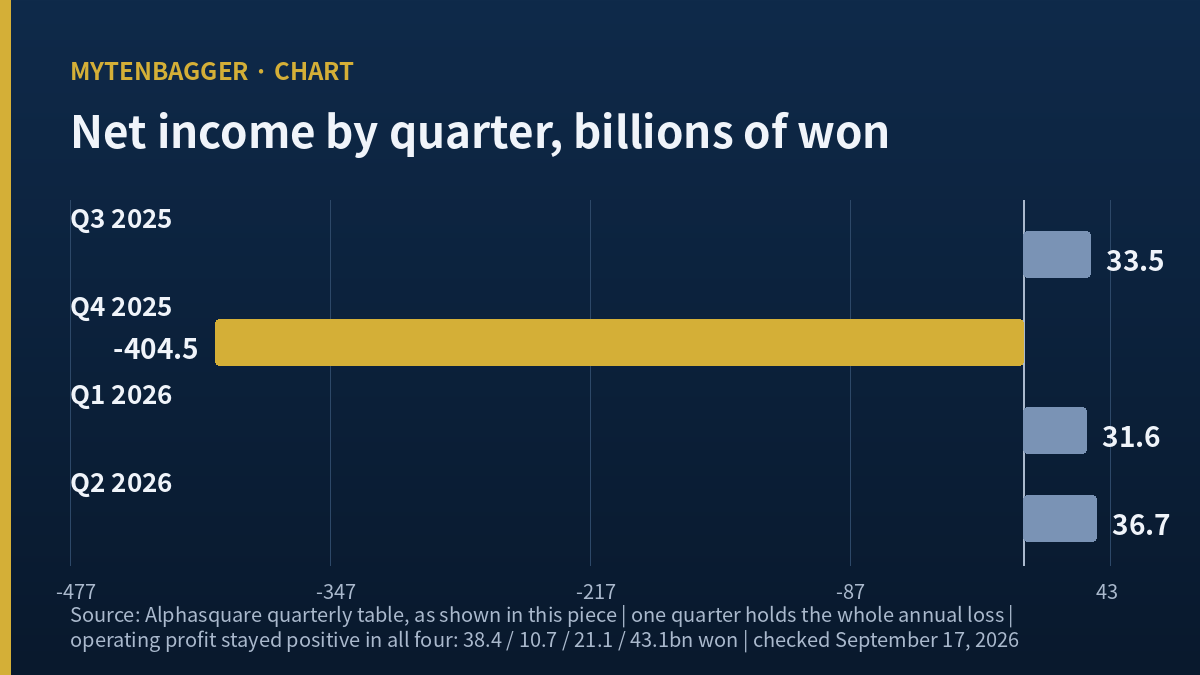
| Q3 2025 | 665.9bn won | 38.4bn won | 33.5bn won |
| Q4 2025 | 602.9bn won | 10.7bn won | loss of 404.5bn won |
| Q1 2026 | 608.3bn won | 21.1bn won | 31.6bn won |
| Q2 2026 | 705.5bn won | 43.1bn won | 36.7bn won |
Source: Alphasquare quarterly table | One quarter carries the entire annual loss
The operating line held at 10.7 billion won
Q4 2025 produced 10.7 billion won of operating profit on 602.9 billion won of revenue, an operating margin of 1.7748% by my calculation. That is weak against the other three quarters in the table, and weak is a fair description. It is not a disaster. A disaster would be negative.
Underneath that same quarter sits a net loss of 404.5 billion won. The distance between the two lines in that single quarter is 415.2 billion won, which is larger than the full-year gap of 414.1 billion won. In plain terms, the other three quarters of 2025 together netted a small positive and Q4 swallowed all of it plus far more.
What I could not split
I could not open the quarterly filing itself, so I cannot give a line-by-line decomposition of that 415.2 billion won. I know one component with a source and a number, and I will give it below. The remainder, roughly 133.9 billion won by subtraction, I have not identified. I am flagging that instead of papering over it, because anyone using this piece should know which part of the arithmetic I actually closed.
Samyang Corp Stock and a Cartel That Ran Seven Years
Seven years and five months
Korean outlets ZDNet Korea and Hankyung TV reported on July 7, 2026 that the Fair Trade Commission had fined four starch and starch sugar producers for coordinating the size and timing of thirteen price moves between May 2018 and October 2025. The regulator put the sales touched by the arrangement at 6,052.5 billion won, which is 2.362 times this company’s entire 2025 revenue and about 4.39 billion US dollars at the rate used in this piece.
The detail that matters for the balance sheet came earlier. Korean business outlet The Fact compiled what each of the four had already set aside in anticipation of the ruling. This company’s figure was 281.3 billion won, or roughly 204.2 million US dollars. The other three were reported at 375.3 billion won, 334.9 billion won and 84.9 billion won. The same compilation listed each producer’s 2024 standalone operating profit, and this company’s was 65.7 billion won, which makes the provision 4.2816 times a full year of standalone operating earnings by my calculation.
281.3 billion won is 2.5184 times the operating profit this company earned in all of 2025. A provision of that size does not pass through the operating line, and the tables above show exactly that: operating profit stayed positive while net income did not.
Then the ruling landed and, according to Edaily, this company’s assessed penalty was waived in its entirety under Korea’s leniency program for self-reporting participants. One of the other three has a payment deadline of October 29, 2026.
I want to be careful about what I am claiming. I am reading Korean-language reporting. I have not opened the Commission’s written decision. The leniency wording is how those outlets described the outcome, and the company has not said it in its own words on any page I opened. That distinction matters enough that it appears again in my list of ways this piece could be wrong.
The Word Waiver Cost Someone Else the Money
The word waiver is where I got this wrong the first time through, and the error is worth writing down because it changed how I read the whole file.
When I saw that the penalty had been waived, I processed it as a discount. Bill arrives, bill gets reduced, company keeps cash. That framing treats the regulator’s total as fixed and this company’s share of it as the only variable.
Leniency does not work that way. A leniency program exists to make the first participant to come forward better off than the ones who stay quiet, and the mechanism for that is a redistribution of exposure and not a reduction of it. The other three producers did not pay less because this one paid nothing. If anything the arrangement is designed so that the remaining parties carry the full weight. I had read a transfer as a subtraction.
The corrective practice I am taking from this: when a penalty falls unevenly across a group, I ask who ended up holding it before I ask how much anyone saved. I covered the company on the other side of this same ruling in a note on Daesang, whose provision ran 60% above the fine it actually received. That was a story about an estimate being wrong. This is a story about an estimate being right and the bill going somewhere else. Same regulator, same day, two different problems.
A third participant produced a third variation again, which I wrote up in a note on CJ CheilJedang and the year its price-to-earnings cell stayed empty. There the screens simply refused to print a multiple. Here they print a negative one, which I now think is the more dangerous of the two, because a blank cell makes a reader stop and a negative cell lets a reader file the company away.
Two Peers for Samyang Corp Stock, and the Third I Left Out
Ingredion and ADM
Ingredion (NYSE: INGR) makes the same category of product and traded at 99.28 dollars on September 16, 2026 for a market value of 6.26 billion dollars, on 7.22 billion dollars of trailing revenue, 592 million dollars of trailing net income, a price-to-earnings ratio of 10.76 and a dividend yield of 3.31%, and the limit on that comparison is that Ingredion is in the middle of a five billion dollar acquisition, so its multiple is pricing a company that is about to change size.
Archer-Daniels-Midland (NYSE: ADM) traded at 86.88 dollars on September 17, 2026 for 41.87 billion dollars of market value on 82.10 billion dollars of trailing revenue and 1.77 billion dollars of trailing net income, a price-to-earnings ratio of 23.29 and a yield of 2.41%, and the limit here is that ADM is roughly thirty times this company’s revenue with a product mix that runs far past starch, so the only thing I am borrowing from it is the profile of a processing business, together with the fact that ADM was at the center of one of the most documented price-fixing prosecutions in US corporate history and is still a functioning company three decades later.
Why Tate and Lyle is not here
I started with three peers and finished with two. Tate and Lyle would have been the obvious third name, and I took it out for a reason I would want disclosed if I were reading this instead of writing it: the most recent quote I could retrieve for it was dated June 24, 2026, and the company has agreed to be bought by Ingredion. Its market numbers no longer price an independent business, and a stale quote on top of that gives me two problems in one column. A peer I cannot date is not a peer.
Both surviving comparisons also share a limit worth saying plainly. Three companies, three accounting standards, three currencies, and a Korean producer whose ownership structure has no equivalent on either US register.
The Cost Lines I Could Not Open
I went looking for cost of goods sold and selling and administrative expense, because those two lines are what actually set an operating margin in an ingredients business. Neither the data providers I could reach nor the pages I opened split revenue that way for this company. So I am left with the margin itself and what it did across three years.
The 2025 margin of 4.3590% sits 0.6376 percentage points under 2024 and 0.0896 points over 2023. Applied to 2,562.5 billion won of revenue, that 0.6376 point slip is worth roughly 16.3 billion won of operating profit, by my calculation. Put differently, if 2025 had held 2024 cost discipline on 2025 volumes, operating profit would have come in near 128.0 billion won instead of 111.7 billion won.
I am naming that number so the size is unmistakable. Sixteen billion won is roughly one seventeenth of the provision described earlier in this piece. Whatever moved inside the cost structure between 2024 and 2025 is small beside what moved on the line beneath it, and a reader who saw only the net loss would have the proportions exactly backwards.
What Samyang Corp Stock Looks Like in the First Half of 2026
Two quarters have printed since the loss. Revenue for the first half of 2026 was 1,313.8 billion won against 1,293.7 billion won a year earlier, a gain of 1.5537%. Operating profit was 64.2 billion won against 62.6 billion won, a gain of 2.5559%. Both of those 2025 comparatives are my own subtraction of the reported third and fourth quarters from the annual figure, so I am marking them as derived values.
Net income for the first half of 2026 came to 68.3 billion won against 68.6 billion won, which is a decline of 0.4373% on my arithmetic. WiseReport, a Korean data provider, summarized the same period and described net income as up 0.7%. The two readings differ by about 1.14 percentage points and I cannot reconcile them without the filing, most likely because one of us is using the figure attributable to controlling shareholders and the other is not. I am reporting both instead of picking the one I prefer.
What the first half tells me is narrow but useful. The trading business is running at roughly the margin it ran at before the provision, and nothing in these two quarters suggests the 2025 loss reflected an operating problem.
Two Ways the Q3 2026 Filing Can Go
There are two branches here and I do not know which one the filing will show. I am writing both down now so that I cannot quietly pick the flattering one later.
In the first branch, the provision is released back through non-operating income once the waiver is final. If the full 281.3 billion won comes back in a single period, it lands above the net line and every trailing per-share figure on every data provider flips sign inside one reporting cycle. Screens that print a negative price-to-earnings ratio today would print a large positive one, and the label of a loss-making company would fall away without the operating business having changed by a single won.
In the second branch, the provision stays where it is, reclassified against private damages exposure or against another open proceeding. Korean reporting describes this company as carrying exposure from more than one price-fixing matter, and that is the specific reason I will not treat the first branch as my default. If the second branch is what happens, the 2025 loss is permanent in substance and my reading of it as recoverable is simply wrong.
What separates them is the provisions note in the Q3 2026 filing and the size of non-operating income in that quarter. I am not attaching probabilities to either branch. With no forward estimate published for this name and no access to the filing, a probability here would be a number I invented and then dressed up.
Where Samyang Corp Stock Could Prove Me Wrong
- I could not open the 2025 annual filing. Every figure in the tables above comes from data providers and not from the company’s own document.
- Roughly 133.9 billion won of the Q4 2025 gap is unexplained by the provision alone, and I did not identify it.
- The 281.3 billion won provision comes from one Korean outlet’s compilation. I did not see the disclosure it was compiled from.
- I do not know whether the provision sits entirely against this one ruling or covers more than one proceeding.
- Korean reporting elsewhere describes this company as carrying exposure from more than one price-fixing case. I did not verify the others or size them.
- The full waiver is reported by Korean media. I did not read the Commission’s written decision.
- I inferred the leniency route from how the outlets phrased it. The company has not said so in anything I opened.
- Whether any part of the provision has been released back through the income statement is unknown to me. It may already have happened.
- If a release does occur, I do not know which period it will land in or how much of it survives.
- A waived regulatory penalty does not settle private damages claims, which can follow separately.
- If the arrangement lifted prices for seven years and five months, some part of the operating profit in my three-year table was produced under it. I did not attempt to strip that out.
- My first-half 2025 comparatives are derived by subtraction and are not reported figures.
- My net income reading for the first half of 2026 conflicts with a provider’s by 1.14 percentage points and I could not resolve it.
- I did not open the cash flow statement, so my description of the loss as non-cash rests on the nature of a provision and not on a reported cash figure.
- I did not break revenue into segments. This piece does not know whether food or chemicals is producing the margin.
- Corn and other input costs move this company’s operating margin, and I did not model them.
- No brokerage forward estimate exists for this name in anything I could reach, so there is no external check on my reading.
- The absence of coverage may mean the market underweights the company, or it may mean there is nothing to cover. I cannot tell which.
- Both peers are several multiples larger and report under a different standard.
- Currency conversions in this piece use a single rate from one date, so every dollar figure moves with it.
- The ADM comparison rests on a resemblance in business profile and regulatory history and not on comparable financials.
- Prices for both peers were captured on different days, one on September 16 and one on September 17.
- The weakest join in this piece is the step from “the fine was waived” to “the loss can reverse.” A provision can be reclassified instead of released, and I have written the second half of that sentence without a document in front of me.
The Sentence in This Piece That Will Trouble Me Most in Six Months
I close by naming the lines I expect to want back, in the order I expect to want them back. Writing the ending this way leaves behind what I was unsure of, which is more useful later than a list of what I was sure of.
First and worst: “a provision of that size does not pass through the operating line.” That is a general statement about how provisions are usually booked, and I applied it to a specific set of accounts I did not open. The tables are consistent with it. Consistency is not confirmation.
Second: “roughly 133.9 billion won.” It is a subtraction between two numbers that came from two different reporting sources, and a residual built that way carries both of their errors.
Third: “leniency program.” I took the word from translated reporting and used it as though it were a legal finding I had verified.
Fourth, and the line I expect to survive: the three-year operating margin band of 4.2694%, 4.9966% and 4.3590%. I divided those myself from revenue and operating profit in the same table, they move together, and they will still be true in six months. That is where I have hung the weight of this piece, and it is also why I am watching and not buying. A steady margin tells me the business works. It does not tell me what the balance sheet still has on it.
My position in Samyang Corp stock is none, and my next checkpoint is the Q3 2026 filing and the provision line inside it. I also covered a different Korean food producer whose reported equity and shareholder equity diverged sharply, in a note on Pulmuone earning its return on barely half the equity it reports, because the practice of asking which number a screen is actually dividing by carries over intact. How would you read it?
Prices and multiples reflect the September 17, 2026 close, except where a peer quote is dated otherwise in the text. Dollar figures use 1,377.54 won to the dollar, the September 16, 2026 close reported by Investing.com, and rounding may move the last digit.