Binex Stock Is Worth a Third of Its Own Exchange Price
[A] Binex stock closed on September 17, 2026 at a level worth roughly USD 4.54 a share. The exchange price written into the company’s zero coupon bond is KRW 18,587, which is 2.9692 times that close.
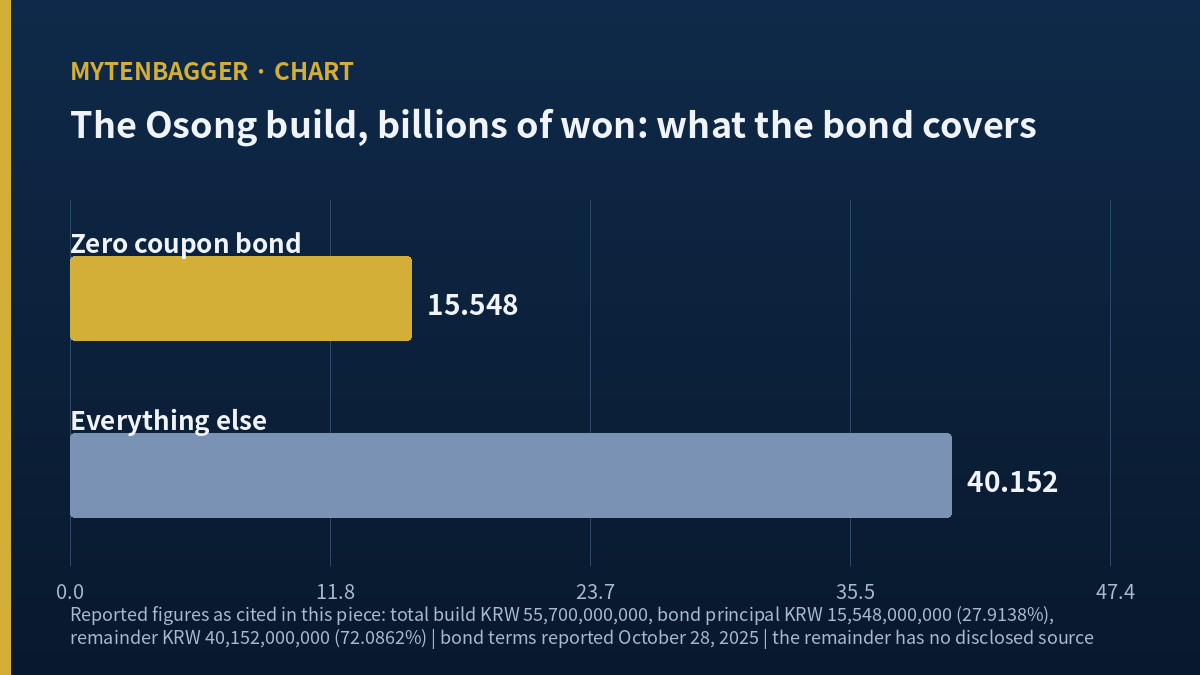
[B] The bond raised KRW 15,548,000,000, or about USD 11.29 million, and pays nothing along the way. It covers 27.9138 percent of a KRW 55,700,000,000 build at Osong.
[C] I own none of this. I could not open the cash flow statement, so I cannot tell you how much of the first-half loss of KRW 24,648,040,769 actually left the bank account, and I am not willing to call the shares cheap without that.
A lender agreed to hand this company KRW 15,548,000,000 and collect zero percent for five years. That is the part I keep coming back to. Zero coupon financing is not unusual on its own. What makes this one worth an afternoon is the other half of the bargain: the shares pledged against it can only be claimed at KRW 18,587 apiece, and the market has not been anywhere near that price in a long while.
So the lender is holding a promise of principal in 2030 and an option that is, as of now, almost three times out of reach. I wanted to understand what that arrangement says about the company doing the borrowing, because it is a stranger signal than anything in the price chart.
Binex is a Korean contract development and manufacturing organization, listed on KOSDAQ. KOSDAQ is Korea’s secondary exchange, closer in character to the Nasdaq of the early 2000s than to the main board where the large export names sit; it lists a great many small technology and healthcare companies, and liquidity thins out fast below the top names. Binex makes biologic drug substance for other companies, which is the same broad business as the large names American readers already know, at a very different size. It also sells its own synthetic pharmaceuticals, and I was never able to split the two businesses apart in anything I could read.
Contents
The bond behind Binex stock that pays nothing
The terms, as reported in the Korean trade press on October 28, 2025, are these. The company raised KRW 15,548,000,000 through an exchangeable bond. The coupon is 0.0 percent and the yield to maturity is 0.0 percent. It matures on November 6, 2030. The exchange price is KRW 18,587 a share, and the shares set aside against it are ones the company already held, and no new ones were created.
Two things follow from that structure, and I want to separate them carefully because I got them muddled the first time through.
First: the count of issued shares does not move
Because the shares behind the bond are already in existence, an exchange transfers ownership sideways. It does not create new claims on the same earnings. Every per-share figure I use later in this piece survives an exchange untouched. What does change is float: shares sitting in the company’s own hands are not trading, and after an exchange they would be. In a name this thinly traded, that matters, but it is a liquidity event and not a dilution event, and I had to stop myself from writing it as the latter.
Second: the lender gave up current income for a distant option
Five years and nine days separate the reported issue date from maturity. Over that stretch the lender collects nothing. In exchange the lender holds the right to claim shares at KRW 18,587, worth roughly USD 13.49 at the reference rate I use below. Against the September 17, 2026 close of about USD 4.54, the exchange price is 2.9692 times higher. For that option to be worth anything, this company has to roughly triple.
A lender who accepts zero percent for five years is being paid entirely in optionality. Here the optionality needs a triple. That is a very particular kind of patience.
Where the money goes, and what Binex stock is paying for
The proceeds are earmarked for an expansion at the company’s Osong site. The reported total for that build is KRW 55,700,000,000, or about USD 40.43 million. The bond therefore covers 27.9138 percent of it. The remaining KRW 40,152,000,000, about USD 29.15 million, has to come from somewhere else: internal cash, bank debt, or another raise. I could not find a document that tells me which, and I am flagging that as a hole and leaving it open.
Set that build against what the company lost recently. In the first half of 2026 the net loss was KRW 24,648,040,769, about USD 17.89 million. The Osong budget is 2.2598 times that six-month loss. So this is a company committing roughly two half-years’ worth of losses to new capacity while the existing capacity is not covering its own costs.
That is not automatically wrong. Capacity in this industry is built years before it earns, and a plant finished in a shortage is worth far more than a plant finished in a glut. The whole American contract manufacturing story of the past three years has been about capacity arriving late. But it does mean the equity case here rests on a schedule instead of on current results, and I want to be honest that a schedule is a weaker thing to own than a number.
What a March research note on Binex stock said, and what it did not
The only named piece of sell-side work I could open on this company is a March 18, 2026 note from IBK Investment and Securities, written by analyst Jung Yi-soo. It is marked Not Rated and carries no valuation figure at all.
The note puts weak fourth-quarter 2025 results down to a shutdown at the Songdo plant, and describes that shutdown as deliberate: an upgrade of the lines to make them fit for commercial-scale production, after which the shutdown cycle is expected to move from once a year to once every three years. On Osong, the note says the expansion is expected to run through the fourth quarter of 2026, again aimed at commercial-scale lines. It lists four contract manufacturing agreements totaling KRW 70,200,000,000.
What the note does not contain is any 2026 estimate. No revenue line, no operating line, no per-share figure. Six months have passed since it was written and I could not find a second named house that has published on this company since. There is an aggregated forecast sitting on a data vendor’s earnings page for the third quarter, but it carries no institution’s name and I explain below why I declined to build on it.
I have written before about the difficulty of valuing a manufacturer whose capacity is ahead of its orders. When I looked at the largest Korean contract manufacturer and decided the multiple was doing too much work, the problem was a full plant priced for perfection. Here it is the mirror image: a plant that is not full, priced by a market that appears to have given up on the schedule. And when I counted how much cash a Korean medical AI company had consumed against everything it had ever billed, the lesson I took was that cumulative burn tells you more about survival odds than any single quarter does. I could not run that count here, and its absence is the weakest seam in this piece.
Two loss-making peers that carry objectives anyway
I picked the two comparisons on a single test: contract manufacturers that are also losing money on a trailing basis, and that nonetheless have sell-side houses publishing forward objectives on them. The point of the pairing is to isolate what Binex lacks, because the operating difficulty is shared and the coverage is not.
Emergent BioSolutions, listed in New York, showed a September 16, 2026 close of USD 6.75 and a market value of USD 346.10 million against trailing revenue of USD 770.20 million and a trailing net loss of USD 176.80 million. That is a loss equal to 22.9551 percent of revenue, a company valued at 0.45 times its own sales, a 52-week range of USD 4.36 to USD 14.06, and an average analyst objective of USD 11.00, which is 62.963 percent above the close.
Lonza Group, listed in Zurich, showed a market value of CHF 39.29 billion against trailing revenue of CHF 6.87 billion and a trailing net loss of CHF 110.00 million, a loss equal to 1.6012 percent of revenue, with an average objective of CHF 681.13. I have to add a caveat to that one: the quoted price on the page I read was dated August 14, 2026, a month stale, so I have deliberately kept it out of every ratio above. The same page showed a positive earnings multiple beside a negative per-share figure, which cannot both be true, and I discarded that field entirely.
Here is the direction I want to run the comparison in, because the usual direction does not work. These two do not tell me what Binex is worth. Their businesses differ in scale by orders of magnitude and their reporting currencies differ from each other. What they do tell me is that losing money does not by itself explain an absence of coverage. Both of those companies are unprofitable on a trailing basis and both have houses willing to put a number on them. Binex has neither a number nor, since March, a note. Whatever is keeping analysts away, it is not the loss. If I had to guess at the difference, I would point at size: the American company is valued at 0.45 times its own sales and still has roughly USD 346.10 million of market value to justify the work, while Binex is a fraction of that. But that is a guess about the economics of research departments, and I am labeling it as a guess instead of dressing it up.
The figures I left out of Binex stock and why
The cash flow statement, which is the one I wanted most
A loss can leave the bank account or it can sit in depreciation. For a company whose whole story is heavy plant, that distinction is most of the argument, and I could not resolve it. One vendor screen carries a per-share cash flow figure, and I did try to reverse it into a total. I then decided against printing the result, because the definition behind that field varies between vendors and I had no second source to pin it down. A number whose meaning I cannot confirm is not evidence, whatever it does for the word count.
One vendor row that failed its own arithmetic
An international data vendor’s earnings page lists a second-quarter 2026 figure that cannot be reconciled with any other source I opened. I checked it by a route that has nothing to do with quarterly reporting: a Korean vendor’s trailing twelve-month per-share loss, multiplied out by the listed share count, agreed with the sum of the four quarters from the other source to inside a tenth of one percent. The disputed row could not be part of that sum. So I kept the source’s 2025 quarters, which do close, and left its 2026 second-quarter row out. The aggregated third-quarter forecast on the same page inherits that doubt, which is why I noted it and then set it down.
One thing I did check, and it held
The bond’s own arithmetic closes exactly. Divide the reported principal of KRW 15,548,000,000 by the reported number of pledged shares and you get KRW 18,586.9, against a stated exchange price of KRW 18,587. Those three reported quantities were written by people who were not checking each other, and they agree to the won. When a set of numbers closes like that, I am willing to build on it.
How I see Binex stock playing out
The path I weight most heavily, at roughly 45 percent
Osong finishes on the schedule the March note described, the Songdo lines run without another planned stoppage, and quarterly losses narrow through 2027 as the upgraded capacity takes commercial work. In this path the full year 2026 is still a loss and the equity case does not start until the year after. Nothing in it requires a triple, which is worth saying, because the lender’s option does.
Where I could be wrong, at roughly 35 percent
The upgraded lines finish and the orders do not follow. Then the company carries the depreciation of a larger plant against the same revenue, the remaining KRW 40,152,000,000 of the build has to be financed from somewhere, and a business that has already accepted zero percent money is negotiating from a weaker position than it was in 2025. This is the path where the bond’s structure stops looking like patient capital and starts looking like the only capital that was available.
The rest, at roughly 20 percent
The upside case, at about 10 percent, is that Korean biologics capacity gets scarce enough that a mid-sized operator with recently upgraded lines is bid for its slots more than for its margins. The downside case, at about 10 percent, is that a second financing arrives on terms worse than zero percent and the pledged shares stop being the largest overhang on the register.
Where my reading of Binex stock breaks
My reading holds only if the current loss rate belongs to a transition and not to the steady state. It breaks at the Q3 2026 filing, in a specific way: if the quarterly operating loss does not narrow and the company simultaneously discloses new borrowing for the remainder of the Osong build, then the zero percent bond was not a vote of confidence and I read it as one. That is the sentence I would have to withdraw.
I have also watched a neighboring case where a revenue line and its underlying unit count moved at different speeds, and the gap between the two turned out to be the whole story. If Binex ever discloses utilization alongside revenue, that is the pair I will want.
The other side of everything above
- The bond terms come from trade press reporting, and I did not open the filing itself.
- Reported figures on Korean bond issues are sometimes revised, and adjustment clauses can move an exchange price downward if the share price falls far enough.
- If such a clause exists here, the 2.9692 multiple I built on shrinks and part of my argument shrinks with it.
- Zero percent coupons are common in Korean convertible and exchangeable issues, so the coupon alone is a weaker signal than it sounds to an American ear.
- The lender may be hedged. An option that looks unreachable to me may be one leg of a position I cannot see.
- I do not know who the lender is.
- The KRW 55,700,000,000 build figure also comes from reporting; I did not open the underlying document.
- I do not know the spending schedule for that build, so the comparison against a half-year loss is a size comparison and not a timing one.
- I do not know how much of the build has already been spent.
- The March note is Not Rated, which means the house declined to put a valuation on it.
- That note is six months old as I write.
- Its description of the Songdo shutdown as a deliberate upgrade traces back to the company, and I did not verify it independently.
- The KRW 70,200,000,000 of contract value in that note has no contract periods attached that I could see, so I cannot say what lands in any given quarter.
- No named house has published an estimate for 2026 that I could find.
- The one forward figure I did find is anonymous and sits on the same page as a row I rejected.
- I could not open the cash flow statement, so the split between cash losses and depreciation is missing entirely.
- I could not open cost of sales or inventory either, which are the two lines that would show whether idle capacity is the problem.
- Two vendor screens disagree on book value per share, and the gap is wide enough that any asset-based reading depends on which screen you happened to open.
- The debt figures on those same two screens roughly doubled between reporting dates, and I could not establish whether that is a real change or a difference of scope.
- Emergent and Lonza report in different currencies from each other and from Binex, and none of the three is the same size.
- Lonza’s quoted price was a month stale on the page I read, which is why it appears in no ratio here.
- And the largest weakness is the one I keep returning to: this piece argues from a financing structure because I could not argue from the cash flows, and a financing structure records what a company chose to do, and it stays silent on what actually happened to its money.
Who finds out first if I am wrong
An expansion budget is the thing I misread while writing this. I first treated the KRW 55,700,000,000 as a single decision taken at one moment, and reasoned from it as though the company had committed that sum in one stroke and could be judged on it. A build of that size is drawn down across quarters, approved in stages, and revised as it goes. Reading a multi-quarter build as a point event let me put it next to a six-month loss and pretend the two were commensurate. The correction I am keeping is narrow: before setting two amounts side by side, establish whether each is a stock or a flow. This one was a flow and I read it at the wrong resolution.
Here is the order in which the mistake would surface, from first to last.
- The company’s treasury team knows already. They know the drawdown schedule on Osong and whether the remaining KRW 40,152,000,000 is arranged.
- The lender knows next. Anyone holding a zero percent claim to 2030 is watching the same schedule more closely than I am, and with better access.
- Then the auditors, at the Q3 filing, when the cash flow statement I could not open becomes public.
- Then the analysts, if any return to this name at all; a single new note would end the coverage gap this piece is built around.
- And I find out last, which is the ordinary position of someone reading screens.
- The first sentence here to give way will be the cheapest one to replace: the reference rate in the footnote below. Every conversion in this piece rests on a single day’s rate, and it starts drifting the moment the next session opens. The arguments will follow later, one at a time.
I hold none of this and I have no order in. What I have is a company borrowing at zero percent against shares it cannot currently deliver value on, building capacity it is not currently filling, with no analyst willing to put a figure on any of it. That combination is interesting enough to keep a file open and not enough to buy. How would you read it?
Share prices reflect the September 17, 2026 close. Dollar conversions are approximate, at KRW 1,377.54 per dollar on September 16, 2026, and figures given in dollars are rounded.
Sources consulted: Korean trade press on the exchangeable bond / IBK Investment and Securities note, March 18, 2026 / Emergent BioSolutions data / Lonza Group data / quarterly earnings history / Korean vendor financial tables / USD/KRW history
Related reading