Jusung Engineering Earnings: A Four-Quarter Operating Loss
Jusung Engineering earnings for the four quarters from July 2025 through June 2026 add up to an operating loss of KRW 14.8bn on KRW 225.8bn of revenue. On September 30, 2026 the stock closed at KRW 232,500, which put the company’s market value near $7.99bn. I do not own it, and after lining up those four quarters in one table I am staying on the sidelines until the profit line catches up with the price.
Jusung is a Korean maker of deposition tools, the machines that lay extremely thin films onto silicon wafers and, increasingly, onto solar cells. Its best-known product family is ALD, short for atomic layer deposition. The shares trade on KOSDAQ, Korea’s growth-company board (the larger KOSPI is the main index). On the September 30 close it was the third-largest company on KOSDAQ, per Korean business daily Special Times.
| Oct 21, 2025 | Two Korean brokers publish 2026 operating profit estimates of KRW 115.0bn and KRW 88.3bn |
| Jan to Mar 2026 | Operating loss of KRW 7.03bn on KRW 54.88bn of revenue |
| Apr 29, 2026 | Korea Investment & Securities lifts its valuation to KRW 189,000 |
| Jul 29, 2026 | April to June: operating profit of KRW 1.42bn on KRW 59.88bn |
| Sep 30, 2026 | Close of KRW 232,500, market value near $7.99bn |
| Nov 16, 2026 | Legal deadline for the July to September report |
Contents
Jusung Engineering earnings, four quarters at a time
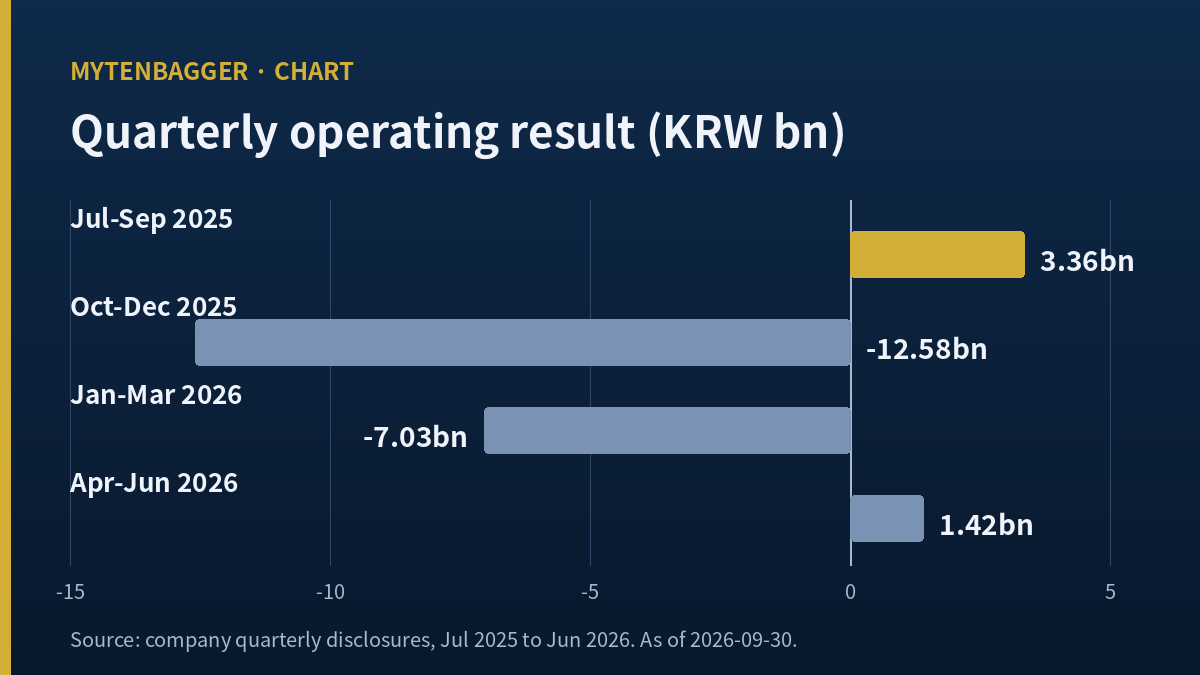
A single quarter can flatter or punish any equipment maker, because one large customer shipment moves the whole line. So I added the last four reported quarters together. All figures below are consolidated, in KRW bn, taken from the DART regulatory filings via the luxrix data server. The October to December line is calculated by the data provider as the full-year figure minus the nine-month figure, because Korean companies do not publish a separate fourth-quarter report.
| Period | Revenue | Operating result | Net income |
|---|---|---|---|
| Jul to Sep 2025 | 58.77 | 3.36 | 7.63 |
| Oct to Dec 2025 | 52.28 | -12.58 | -4.70 |
| Jan to Mar 2026 | 54.88 | -7.03 | -1.19 |
| Apr to Jun 2026 | 59.88 | 1.42 | 5.50 |
| Four quarters | 225.81 | -14.83 | 7.24 |
KRW bn, consolidated. The totals are my own sums of the rounded quarterly figures.
Two things stand out. The operating result is negative over the full four quarters, by about KRW 14.8bn. Net income stays positive, at about KRW 7.24bn, because interest and other non-operating income offset part of the operating loss. At the September 30 market value of roughly KRW 10.81 trillion, that net income implies a price-to-earnings multiple near 1,490 times by my calculation. A multiple that large does not describe the present. It describes a belief about 2027.
Revenue tells a similar story. The four quarters sum to KRW 225.8bn. For calendar 2025 the company reported KRW 310.7bn, which in turn was down about 24% from 2024 (luxrix annual data). The current market value is close to 48 times the trailing four quarters of sales, by my calculation.
Four calendar years of the same company
Before reading too much into four quarters, I checked whether this is simply the bottom of a normal cycle. Annual consolidated figures from DART, again via luxrix, in KRW bn:
| Year | Revenue | Operating profit | Net income |
|---|---|---|---|
| 2023 | 284.7 | 28.9 | 34.0 |
| 2024 | 409.4 | 97.2 | 106.8 |
| 2025 | 310.7 | 31.3 | 35.7 |
| Last four quarters | 225.8 | -14.8 | 7.2 |
The business has swung before. Revenue rose about 44% from 2023 to 2024 and then fell back. What is new is that the trailing four quarters sit below every calendar year in the table on both revenue and operating result. This is a deeper trough than 2023. It is not a repeat of it, and the stock has moved the opposite way.
The best annual net income in the table is 2024’s KRW 106.8bn. If I ask what net income would make today’s market value look like an ordinary growth stock at, say, 30 times earnings, the answer is about KRW 360bn a year, by my calculation. That is roughly 3.4 times the company’s best year in this table. The shares are priced as if that step is already underway.
What the April to June report said about Jusung Engineering earnings
The preliminary result for April to June came out on July 29, 2026. Korean outlet Digital Today reported revenue of KRW 59.88bn, down 24.0% from a year earlier, and operating profit of KRW 1.42bn, down 78.4%. Net income was KRW 5.50bn, up about 9%. The headline that most Korean outlets ran was that the company had returned to an operating profit after the January to March loss.
I checked the arithmetic myself. The same April to June period of 2025 showed revenue of KRW 78.79bn and operating profit of KRW 6.58bn in the luxrix quarterly data. Dividing the new figures by the old ones gives declines of 24.0% and 78.4%, so the reported percentages hold. For January through June combined, revenue fell from KRW 199.64bn to KRW 114.76bn, a drop of about 42.5%, and the operating result moved from a KRW 40.48bn profit to a KRW 5.61bn loss.
The research cost is the part that did not shrink
Incheon Ilbo, a Korean regional daily, cited the semiannual report on research spending: about KRW 45.3bn in January through June, equal to 39.45% of revenue, up from 23.0% of revenue in 2024 and 34.4% in 2025, the highest ratio of the three periods shown. I respect that choice. A company that intends to sell tandem solar equipment and next-generation memory tools has to keep spending while orders are scarce. It also explains most of the swing in the operating line. With revenue near KRW 55bn to 60bn a quarter, research alone absorbs something like KRW 20bn or more in each three-month period, and the result sits near zero.
Cash from operations for January through June was negative KRW 18.92bn in the same data set. So the operating loss was not a paper effect. Money went out.
Reported profit and cash do not always move together at Korean equipment makers. A recent entry on Exicon showed profit arriving while operating cash went out. For Jusung the operating profit is not there yet, and the operating cash is negative too. Both lines point the same way for now.
Why net income stayed positive
January through June net income was KRW 4.31bn against an operating loss of KRW 5.61bn, so roughly KRW 9.9bn came from outside the operating line, by my calculation. Interest expense for the same period was only KRW 1.89bn, so the net non-operating contribution was positive. Korean coverage in June described a net cash position at the end of March, which is consistent with interest and investment income doing that work. I treat that support as real but limited. It keeps the bottom line positive in a weak year; it cannot carry a KRW 10.8 trillion valuation.
Jusung Engineering earnings against last year’s forecasts
I wanted to see how far the sell-side had been from the actual result, so I went back to forecasts published before the rally. On October 21, 2025, Korean investment outlet Daily Invest reported two brokers’ views. Korea Investment & Securities, through research director Chae Min-sook, expected 2026 revenue of KRW 405.0bn and operating profit of KRW 115.0bn. KB Securities, through research director Lee Eui-jin, expected KRW 400.8bn and KRW 88.3bn. Both brokers then valued the shares at KRW 38,000. The September 30 close is a little over six times that figure, while the profit they expected for 2026 has so far not appeared in any reported period.
The two forecasts are worth a second look on their own. Revenue estimates were within 1% of each other, yet the operating profit estimates were about 30% apart. Korea Investment expected about 28 won of operating profit per 100 won of sales; KB expected about 22 won, by my calculation. Two careful analysts looking at the same order pipeline disagreed mainly on cost, and cost is exactly where the actual year went wrong, with research spending climbing toward 40% of revenue. I would not have guessed that from either report at the time.
With six months of 2026 reported, revenue stands at KRW 114.76bn, about 28% of the Korea Investment figure. To reach KB’s lower operating profit estimate, July through December would have to produce roughly KRW 93.9bn of operating profit, by my calculation. The same six months of 2025 produced an operating loss of about KRW 9.2bn. I cannot find a newer full-year operating profit estimate from a named broker in Korean press coverage of 2026. The April reports I found carry per-share valuations and a thesis, and one of them, the April 17 Korea Investment preview, said the numbers would be reflected in 2027.
The forecasts that existed before the rally have not come true, and the forecasts written during it do not give a 2026 profit figure.
That gap matters more to me than any single valuation. When the analysts who cover a company stop publishing the near-term profit line and move their attention a year out, the stock is being priced on a story, and I prefer to wait until the story turns into a reported quarter.
Why the price moved so far ahead of Jusung Engineering earnings
The shares rose about 680% over the twelve months to September 30, according to the Kiwoom price data in luxrix. The trigger most Korean coverage points to is solar. On April 21, 2026, Korean trade outlet The Elec reported that Chinese authorities had begun reviewing limits on exporting solar cell manufacturing technology to the United States, which put Tesla’s planned heterojunction (HJT) solar equipment purchases in doubt. The same article noted that Jusung had finished mass-production verification of its HJT process. The stock hit its daily limit that day.
The run did not go in a straight line. Korean financial daily FnTimes noted a peak of KRW 283,000 on June 12 and a close of KRW 182,400 on June 24, a fall of about 36% in under two weeks, by my calculation. The September 30 close is still about 18% below that June high. A stock that can lose more than a third of its value in eight trading sessions without any change in reported profit is being moved by expectations, and expectations can move both ways.
Korea Investment & Securities moved quickly. On April 21 it set a KRW 108,000 valuation under the title “Tesla’s unexpected appearance in a whale fight”, and on April 29 raised it to KRW 189,000, citing PECVD and ALD equipment for tandem solar cell mass production, as NewsPim’s report briefing described it. At the time the next-highest broker, BNK, was at KRW 120,000. The September 30 close sits above all of those figures.
A second push came from index money. Korea Economic TV reported that on September 10 the company’s weight in one index was raised sharply, which forced tracking ETFs to buy. That kind of demand is real, but it tells me nothing about next year’s operating profit.
For context on how the rest of Korean chip equipment looks through this same lens, my earlier entry on Wonik IPS sorted eight equipment makers by forward multiple and return on equity. Jusung could not even be placed on that chart today, because there is no published 2026 profit figure to divide by.
It is worth pausing on what “third-largest on KOSDAQ” means for a reader outside Korea. Special Times reported that on September 30 Jusung’s market value of about KRW 10.81 trillion passed EcoPro BM, the battery materials maker, at KRW 10.67 trillion, and sat just behind EcoPro at KRW 10.92 trillion. Jusung got there on trailing sales of about KRW 226bn. For a US reader, that is roughly $167m of annual sales supporting a company worth close to $8bn, at the exchange rate in the note below.
A global peer: ASM International in the same three months
The obvious global comparison is ASM International (Euronext Amsterdam: ASM), the Dutch company that leads the ALD equipment market. I am not comparing multiples here, because I could not verify like-for-like multiples for both companies on the same date. I only want to put one pair of numbers side by side in each company’s own currency, for the same April to June period.
ASM reported on July 28, 2026 that April to June revenue was EUR 1,003 million and the operating result was EUR 322.8 million. That is about 32 cents of operating result for every euro of sales. Jusung, for the same three months, turned KRW 59.88bn of sales into KRW 1.42bn of operating profit, a little over 2 won for every 100 won of sales, by my calculation. ASM also guided July to September revenue to EUR 1,100 million, plus or minus 5% at constant currency, and said it expects July to December revenue to rise more than 20% from the January to June level. In other words the leader of this equipment category is growing into a strong second part of the year, and Jusung has not yet printed a quarter that shows the same momentum in its own operating line.
I draw a narrow conclusion from this. ALD as a technology is clearly profitable at scale; the market leader proves it every quarter. What Jusung has not yet shown is that it can turn its version of the technology into that kind of operating result. The solar opportunity, if it arrives, would be a different business line with different customers, and there is no reported quarter yet that tells me what it earns.
Where my read of Jusung Engineering earnings came from
The word “turnaround” is where I went wrong first. When the July 29 preliminary result came out and every Korean headline said the company had swung back to an operating profit, I wrote it down in my notes as a turnaround. A week later I built the four-quarter table above and had to take the word back. A KRW 1.42bn profit after a KRW 7.03bn loss is a better quarter. It is not a better year, and the four-quarter sum is still negative. I kept the original note, with the correction under it, because it reminds me how quickly one headline can replace a table.
The case against my caution
- Orders came back hard in April to June. Korean press citing the semiannual report put the June-end order backlog at about three times the March-end level, with semiconductor tools making up the large majority of it. Those orders become revenue over the coming months, and one strong three-month period could turn the rolling sum positive quickly.
- The solar contract may simply not be public yet. Korea Investment’s April 29 thesis rests on tandem solar mass-production equipment. If a supply contract is signed, Korean rules require a disclosure once it passes a size threshold, and the market would reprice the stock on that day. It would not wait for a quarterly report.
- The price may be right for 2027 even if 2026 is weak. Korea Investment said in April that it would reflect the numbers in 2027. If 2027 revenue lands anywhere near the pre-rally forecasts for 2026 and the research cost stays flat in won terms, operating profit could jump in a single year, and a patient holder would have been paid for looking through 2026.
- Research spending is a choice, and it can be reversed. At 39.45% of revenue, research is unusually heavy. If management slows it once solar orders arrive, the operating line improves without any change in sales.
What would change my mind on Jusung Engineering earnings
I prefer breakpoints tied to reported numbers, because this stock moves 5% or 10% in a day often enough that price lines would be crossed every week.
- The July to September report, due by November 16, 2026, shows an operating profit above KRW 18.2bn for the three months, the level at which the four-quarter operating sum turns positive.
- Revenue for those three months clears KRW 80bn, which would show the April to June orders converting to sales on time.
- Research spending stays near 40% of revenue while revenue rises, which would tell me the cost level is fixed and the next revenue step falls mostly to profit.
- A solar equipment supply contract is disclosed, with delivery dates and a customer I can verify.
- A named Korean broker publishes a full-year 2026 or 2027 operating profit estimate I can test against reported quarters.
- On the other side: if July to September shows another operating loss despite the April to June orders, I would treat the order rebound as timing only and step further back.
The KRW 18.2bn figure is simple arithmetic. When the July to September 2026 figures are added, the same three months of 2025 drop out. The remaining three quarters in the table sum to an operating loss of about KRW 18.2bn (minus 12.58, minus 7.03, plus 1.42), so the new figure has to beat that to put the rolling total above zero. For reference, the company has not produced a quarterly operating profit that large since January to March 2025, when it earned KRW 33.9bn on KRW 120.8bn of revenue. It is possible. It would need the April to June orders to ship quickly and at a healthy price.
The first of these is also the fastest. By November 16 I will have a fifth set of figures to add to the table, and the four-quarter sum will either cross zero or it will not. Everything else on the list can wait for that one line.
Where I stand on Jusung Engineering
I am not buying at KRW 232,500, and I am not arguing that the solar story is false. My position is narrower. The market is paying for profits that no one has put a 2026 number on, while the reported operating line is still below zero over a full year. I would rather pay more later for a company whose profit line I can see than pay today for one I have to imagine. When the July to September figures arrive, I will add them to the same table and decide from there. If the rolling operating sum is still below zero at that point, this entry stays as it is; if it has crossed zero, I will write a new one.
I also want to be honest about the cost of this stance. If the solar contract is announced before November, the stock could move another leg higher in a day, and I will have watched it happen. I accept that trade-off, and I would rather explain a missed rally than a position I could not justify with a reported figure. My record in this journal is more useful to me when every position is tied to a number I can check, and at the moment the number that matters most, a full year of positive operating profit, is not in any report I can open.
Prices reflect the September 30, 2026 close of KRW 232,500 (Alpha Square and two Korean dailies agree; the Kiwoom regular-session candle shows KRW 232,000). Market value uses 46,481,121 shares. Dollar figures are approximate, at roughly KRW 1,352.8 per dollar, the Seoul closing rate on the same date. Quarterly figures are rounded to two decimals, and totals are my own sums.
Sources: Digital Today, Jul 29 preliminary result · Daily Invest, Oct 21, 2025 broker estimates · NewsPim report briefing, Apr 29 · The Elec, Apr 21 · Incheon Ilbo, Sep 6 · FnTimes, Jun 24 · ASM International Q2 2026 release · Korea Economic TV, Sep 11 · Special Times, Sep 30