Kangwon Land Stock, Two Profit Numbers Pointing Opposite Ways
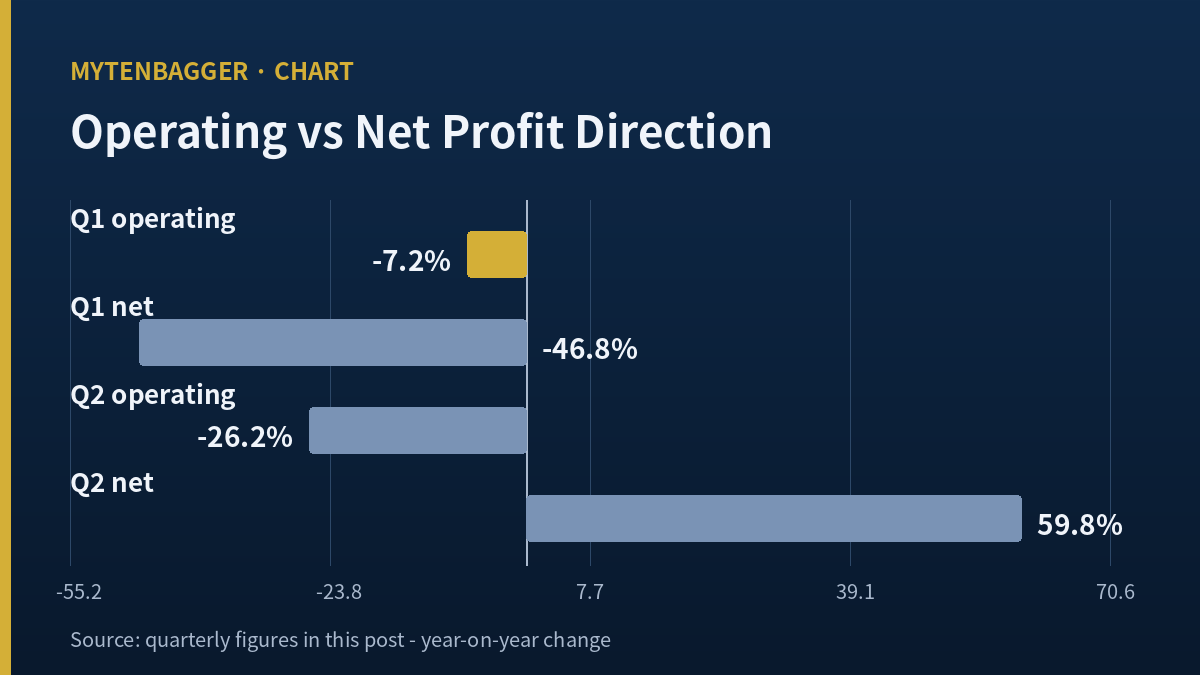
Four numbers set up everything I did with Kangwon Land stock this week. In the first quarter of 2026 the company’s operating profit was down 7.20 percent and its net profit was down 46.84 percent. In the second quarter operating profit was down 26.21 percent and net profit was up 59.76 percent. Two quarters, two profit measures, and only one of the four signs flipped.
I keep a journal of what I buy and what I decline, and this one goes in the decline column. Not because the shares look expensive. They do not. It is because I could not work out which of those two profit measures I would actually be buying.
The sign grid I drew before anything else
| 2026 | Operating profit | Net profit |
|---|---|---|
| Q1 (my subtraction) | down 7.20% | down 46.84% |
| Q2 (reported) | down 26.21% | up 59.76% |
| H1 (reported) | down 15.58% | up 1.88% |
Roll the two quarters into a half year and the reversal disappears. Everything below is me trying to find out what produced it.
Contents
First, what Kangwon Land stock actually represents
Kangwon Land trades under 035250 on the Korea Composite Stock Price Index, the main board of the Korea Exchange in Seoul. The KOSPI is the senior of the country’s two domestic boards, the junior one being KOSDAQ, and it is where the large industrial and utility names sit. Kangwon Land is unusual even inside that group. It runs the only casino in South Korea that Korean nationals are legally permitted to enter, in a former coal mining district in Gangwon Province, under a special statute written to keep money circulating in that region after the mines closed.
That single sentence is the entire investment case for most people who look at it. A legally protected position that competitors cannot enter, attached to a resort and hotel complex, throwing off a dividend. As of the August 7, 2026 close the shares were 14,690 won, roughly 10.37 dollars, giving a market value near 3.14 trillion won or about 2.22 billion dollars. The screen showed a 9.88 times earnings multiple, 0.75 times book, and a 6.47 percent dividend yield. Those are the numbers that got me to open the file.
I rebuilt the first quarter by subtraction, then checked it
The company filed second quarter results on Tuesday, August 4, 2026. Revenue of 345.55 billion won, down 4.2 percent. Operating profit of 43.18 billion won, down 26.2 percent. Net profit of 100.35 billion won, up 59.8 percent (Digital Today, reporting the filing). The cumulative half year came in at revenue of 724.48 billion won, operating profit of 112.09 billion won and net profit of 140.01 billion won.
Korean interim filings give you the quarter and the cumulative half, so the first quarter is sitting there waiting to be recovered. Subtracting gives revenue of 378.92 billion won, operating profit of 68.91 billion won and net profit of 39.66 billion won. Measured against the same treatment of the prior year, that is revenue up 3.44 percent, operating profit down 7.20 percent and net profit down 46.84 percent.
Before building anything on my own subtraction I looked for someone who had published the first quarter directly. Song Ji-won at Heungkuk Securities did, in a note dated Tuesday, May 26, 2026, and the figures were revenue of 378.9 billion won up 3.4 percent and operating profit of 68.9 billion won down 7.2 percent (as summarized by Newspim, a Korean financial outlet). My arithmetic matched to the decimal. That is the check I wanted, and it lets me treat the recovered quarter as data instead of estimate.
So the picture is this. Operating profit was negative in both quarters and the decline widened. Net profit went from a 46.84 percent fall to a 59.76 percent gain. And when the two are added together into the half year, the reversal is compressed into a 1.88 percent net gain that tells a reader almost nothing.
What lifted Kangwon Land stock earnings was not the gaming floor
The gap is documented. Second quarter pretax profit was 139.93 billion won, which exceeds operating profit by 96.75 billion won. In the same quarter a year earlier that excess was 23.2 billion won. The Korean business daily Seoul Economic Daily attributed the widening to non-operating income from financial products and noted the company held roughly 2.44 trillion won of collective investment securities as of the first quarter (Seoul Economic Daily). Digital Daily reported the same driver, describing the net profit increase as coming from valuation gains on financial assets (Digital Daily).
Two point four four trillion won is about 1.72 billion dollars. The market value of the whole company on August 7 was about 2.22 billion dollars. The fund book therefore stands at roughly 77.6 percent of the market value by my calculation. The two figures carry different as-of dates, so treat that ratio as a sense of scale and not a precise measure. Even allowing for that, a buyer of these shares is taking on a securities portfolio alongside a casino, and the portfolio is not small next to the casino.
I have seen the mirror image of this before, and I wrote it up at the time. CJ CheilJedang posted 1.23 trillion won of operating profit and still finished the year with a net loss, because non-operating asset valuations moved against it. Same structure, opposite direction. When the movement below the operating result is larger than the operating result itself, the bottom of the income statement stops describing the business and starts describing a portfolio mark. Portfolio marks reverse.
One honesty note. The two Korean outlets did not print identical net profit figures. The filing-based report gave 100.35 billion won and a 59.8 percent gain, while Digital Daily gave 97.3 billion won and a 128.7 percent gain. I could not determine which basis each was using, so every net profit figure in this piece comes from the filing-based reporting, and I am leaving the discrepancy on the page instead of quietly picking one.
The renovation only touches one of the two numbers
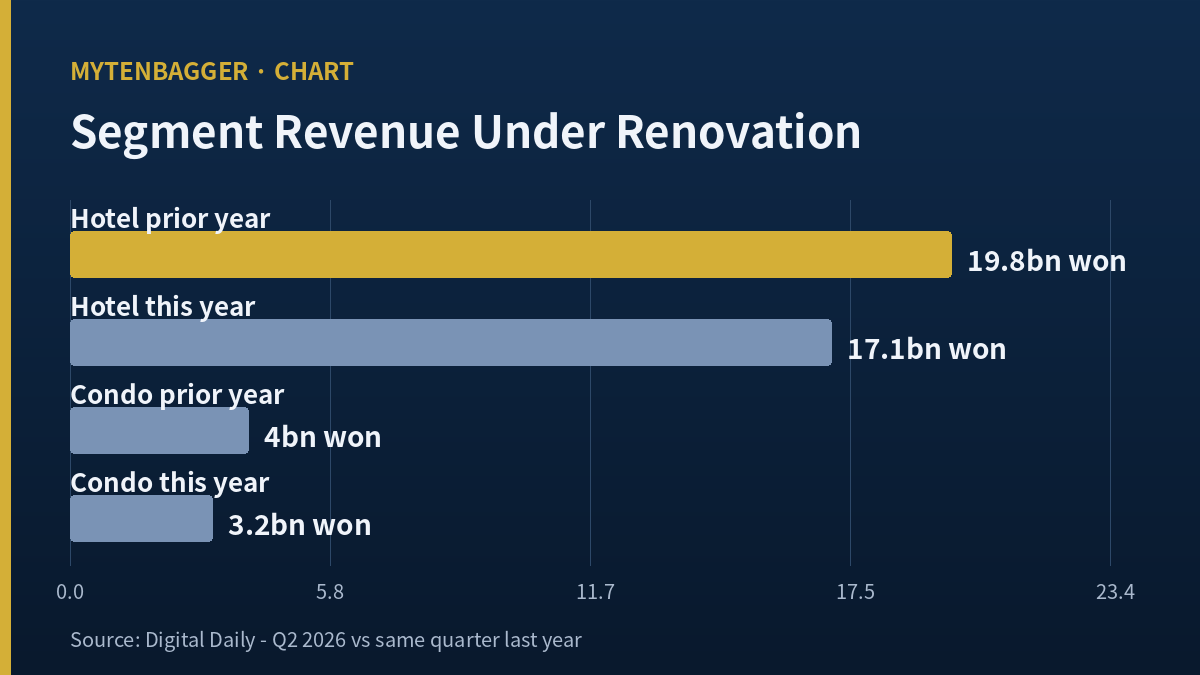
The operating decline has a stated cause. The company is renovating 477 rooms at its Grand Hotel and 280 units at its Mountain Condo. Hotel revenue fell from 19.8 billion won to 17.1 billion won, a 13.7 percent decline, and condo revenue fell from 4.0 billion won to 3.2 billion won, down 19.2 percent (Digital Daily). Kiwoom Securities split the quarter into casino revenue of 319.9 billion won, down 3.5 percent, and non-casino revenue of 25.7 billion won, down 12.3 percent (as reported by Ajunews). Those two add to 345.6 billion won, which reconciles with the filed total. I checked that myself before using either figure.
Heungkuk added the part that matters more to me. In its August 7, 2026 note the firm observed that operating costs stayed at prior year levels even as revenue shrank, with depreciation and other expenses rising (as reported by Money Today). Construction removes revenue and adds depreciation at the same time. Both effects land in one place, and that place is operating profit.
The schedule is long. Per the Kiwoom note the condo renovation completes in the fourth quarter of 2027 and the hotel in the first quarter of 2028. A second casino floor broke ground in April 2026 for completion at the end of 2027, expanding gaming floor area by roughly 1.5 times (Alphabiz, citing Heungkuk). A regional daily reported the second floor at 18,430 square meters across two basement and three above ground levels, opening in early 2028 (Kangwon Domin Ilbo, July 24, 2025).
Set the two schedules side by side. The margin compression is happening now. The floor expansion arrives at the end of 2027 and only starts producing in 2028. In between, the reported bottom line is being held up by something that has nothing to do with either.
The yield on Kangwon Land stock was calculated from last year’s payout
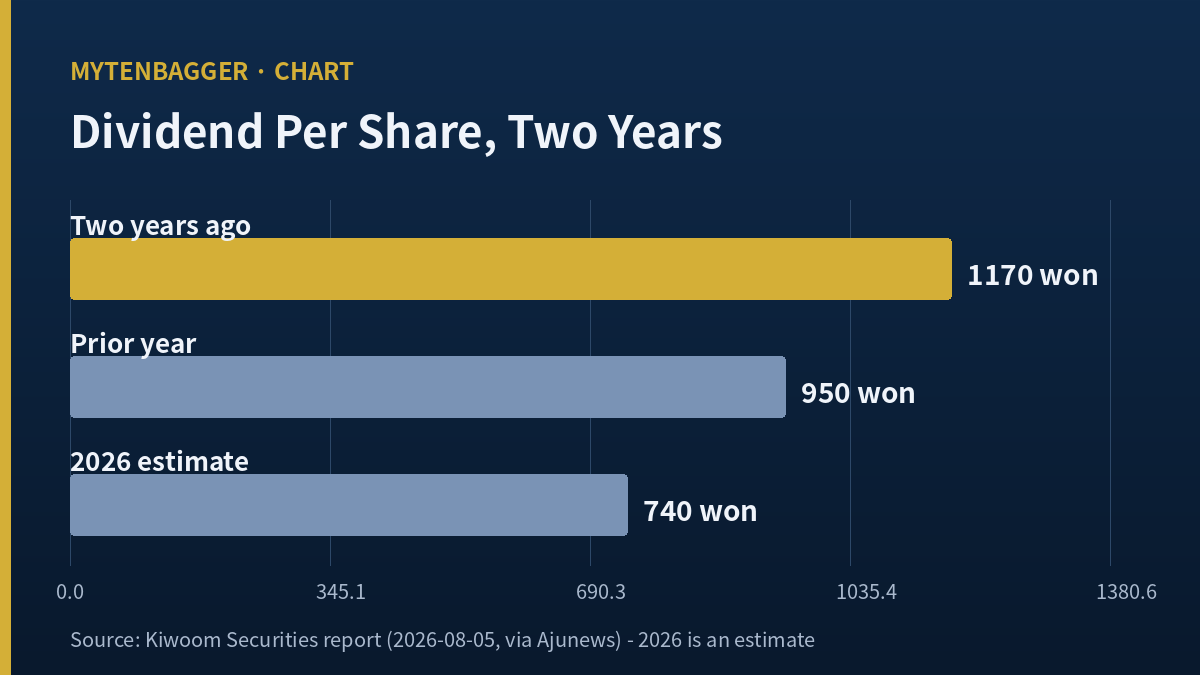
The 6.47 percent figure divides a 950 won dividend per share by the current price. That 950 won was approved at the company’s 229th board meeting on Friday, February 27, 2026, with a record date of Wednesday, April 1, 2026, and it completed a second consecutive year of hitting a 60 percent total shareholder return commitment (News1). It is a payment that has already happened.
Kiwoom’s Lim Su-jin put the 2026 expectation at 740 won per share in the August 5, 2026 note, which the firm framed as a 5.1 percent yield. That is a 22.1 percent reduction from 950 won by my calculation, and 36.8 percent below the 1,170 won paid for fiscal 2024. Against the August 7 close of 14,690 won, 740 won works out to 5.04 percent.
The company is not abandoning shareholder returns. It is changing their form. In February 2026 it bought 2.211 million of its own shares at an average of 18,084 won, spending roughly 40 billion won as part of a three year 100 billion won repurchase program running from 2024 to 2026 (Money Today). The Kiwoom note went further and referenced a planned cancellation of 7.4 percent of shares outstanding.
Apply that 7.4 percent to the 213,941,457 shares currently outstanding and about 198.1 million remain. Divide fiscal 2025 net profit of 318.2 billion won by that count and earnings per share becomes roughly 1,606 won, putting the current price at about 9.15 times instead of 9.88 times. All of that is my own calculation. An investor holding this for income and an investor holding it for per-share value are not being served by the same policy.
Yield times multiple equals payout, and Kangwon Land stock is the odd one
I run a small identity check on any vendor screen before I trust three of its fields at once. Dividend yield multiplied by the price to earnings multiple returns the payout ratio, because the price on each side cancels. If the product matches the displayed payout, the three fields were computed on the same basis. If it does not, one of them is measuring something else.
| Company | P/E | Yield | Product | Shown payout |
|---|---|---|---|---|
| Kangwon Land | 9.88 | 6.47% | 63.9% | 63.9% |
| Paradise Co | 9.92 | 1.49% | 14.8% | 14.7% |
| Grand Korea Leisure | 12.48 | 4.36% | 54.4% | 54.4% |
| Genting Singapore | 18.89 | 6.56% | 123.9% | not shown |
The three Korean names reconcile to within a tenth of a point on Kiwoom data as of the August 7, 2026 close. Genting Singapore does not, and the reason is worth stating plainly: at 18.89 times earnings and a 6.56 percent yield, per stockanalysis.com with a quote dated July 1, 2026, the implied distribution runs at about 124 percent of earnings. Two casino operators can both show a yield beginning with six and be doing entirely different things to get there. Genting Singapore is paying out more than it earns. Kangwon Land is paying out 63.9 percent of a profit measure that includes a fund revaluation.
The second observation from the same data set is the one that decided this piece. Among the three Korean operators, only Kangwon Land shows a net margin above its operating margin. Operating margins run 15.93 percent for Kangwon Land, 13.55 percent for Paradise and 12.44 percent for Grand Korea Leisure. Switch to net margins and they become 21.55 percent, 12.59 percent and 11.14 percent. The two peers fall as you go down the income statement, which is what taxes and interest normally do. Kangwon Land rises by 5.62 percentage points.
The pattern holds outside Korea too. Las Vegas Sands trades at 17.75 times trailing and 13.83 times forward earnings with a 2.62 percent yield, on 13.72 billion dollars of revenue and 1.73 billion dollars of net income over the trailing twelve months, a net margin of 12.61 percent by my calculation (stockanalysis.com, quote dated August 7, 2026). Sands also falls as you move down. Kangwon Land is the exception in every comparison I could construct, and the exception is exactly what the second quarter was made of.
Two brokerages cut their Kangwon Land stock valuations in the same week
Kiwoom’s Lim Su-jin moved from 22,000 won to 18,000 won on Wednesday, August 5, 2026, keeping a buy call, citing weak visitor counts and drop volume through July. Heungkuk’s Song Ji-won moved from 22,000 won to 20,000 won on Friday, August 7, 2026, and now expects full year hotel and condo revenue to fall roughly 16 percent. Against the 14,690 won close those two figures sit 22.5 percent and 36.1 percent higher, both by my calculation.
Both firms had been at the same 22,000 won before these notes. One took 2,000 won off, the other took 4,000 won off, in the same week, on the same set of results. That spread is itself information about how settled the forward earnings view is on this company, which is to say not very.
I am not adopting either published figure as my own view, and there is a specific reason beyond the usual one. I could not confirm whether those valuations are computed on the current share count or on a count that already reflects the 7.4 percent cancellation. If the former, the per-share arithmetic changes once the cancellation happens. Carrying an unverified basis into my own reference point is how a small error becomes a permanent one.
What pushes back on my conclusion
Four arguments run against what I decided. I spent the longest on the second one.
- Deregulation is actually arriving. Betting limits on member baccarat and certain other games were raised effective May 2025, and Heungkuk credited that change with 27.6 percent growth in member floor revenue in the first quarter of 2026 (Alphabiz and Newspim, citing the firm). Additional gaming machine approvals are proceeding in sequence. The legal position here is not the kind of advantage a competitor erodes.
- The construction has a published end date. Condo in the fourth quarter of 2027, hotel in the first quarter of 2028, second casino floor at the end of 2027 with roughly 1.5 times the gaming area. The margin damage is a scheduled cost, not an accident, and Heungkuk expects the expansion benefit to build from 2028 through higher value customers. It is possible that I am counting the cost carefully and skipping the floor space entirely.
- Foreign visitor numbers rose 20.9 percent in the quarter (Digital Daily). That is a growth channel with no relationship to the domestic regulatory ceiling, and it did not exist in the numbers a few years ago.
- The balance sheet is conservative and the price is below book. Book value multiple of 0.75, a debt to equity ratio of 23.43 percent and interest coverage of 5.54 times. On a seven item screening checklist the company passes six for a score of 86, failing only on return on equity of 8.1 percent (Kiwoom data as of the August 7, 2026 close). The shares sit 25.0 percent below the 250 day intraday high of 19,590 won and 5.5 percent above the low of 13,920 won, both measured from the closing price.
Related reading: Paradise Co took 3.6% more table revenue in July 2026 on 15.0% more drop
What would bring me back to Kangwon Land stock
I hold none of this and have no order working. The reason is not valuation. At 9.88 times earnings the shares are cheap by most screens. The reason is that I could not decide which profit measure I would be buying. If it is the operating result, that result has declined for two consecutive quarters and the construction runs into the first quarter of 2028. If it is the net result, that figure changed sign in a single quarter. The dividend is set on the net figure and the renovation only reaches the operating one.
I have filed away an earnings report before after checking nothing but the sign on the bottom line. I never asked at the time whether that sign came from the operating section or from below it. This company is where that habit would have cost me, and unlike KEPCO Engineering, where a building disposal distorted the multiple and I had to wait for four clean quarters, nothing here is hidden. The disclosure is complete. I simply had not been counting it.
Two conditions bring me back. The first is a quarter in which net profit comes in below operating profit. That would mean the earnings are being generated by the business again, and the payout ratio would be calculated on a business number. The second is a quarter of year on year operating profit growth. That is the point at which the betting limit increases and the expanded floor are contributing more than the construction is taking away.
I am also writing down the condition that would prove me wrong. If quarterly operating margin recovers to the fiscal 2025 level of 15.93 percent before the renovation finishes, then my premise that construction is eating the margin is simply incorrect, and I will reopen this and fix the premise, leaving the conclusion to follow from it. I deliberately set that threshold using the company’s own published figure so that I cannot reinterpret it in my favor later.
There is a companion piece to this one. When I looked at Coway I was waiting for a dated event to pass before I could tell what the price contained. Here there is no date to wait for. There is a measurement I want to see appear, and it can appear in any quarter the business decides to produce it.
Prices and multiples reflect the Friday, August 7, 2026 close as checked at the time of writing, using Kiwoom data with an August 7, 2026 update stamp. August 8 and 9 were a weekend with no trading, so the last business day close was used. Korean won is the reference currency throughout; dollar figures are approximate conversions at roughly 1,416.1 won per dollar, the Seoul market close on the same date as reported by Money Today. Operating cash flow, free cash flow and EBITDA fields from the vendor were excluded because their magnitudes do not reconcile with reported operating profit, and the 8.1 percent return on equity could not be reproduced from the supplied equity total, so it is quoted as displayed. Brokerage valuations are figures those firms published under their own names and are not my views.
Related reading