Hyundai Physical AI: Only One Contract Came With a Number
- The four Hyundai physical AI items announced at the San Francisco summit carry no disclosed value, volume, timeline or binding status — not one of them.
- The only document from that week with a figure on it was a disclosure by Hyundai Autoever, the group’s IT affiliate: two GPU server procurement contracts totalling ₩304.4 billion, about $209 million.
- That contract is 100% related-party, at a company already 94.9% dependent on group revenue, and it expires in seven months. So I treat this name as a meter on the narrative rather than a position, and I have not bought it.
I spent Saturday afternoon opening the summit announcements one by one, and something started to bother me. Hyundai Motor Group put out four items: a Robot Reference Platform to be jointly built with Nvidia, a Korea Robot Application Center, a self-driving foundry partnership with Waymo, and the Boston Dynamics tie-up with Google DeepMind. Not one of them contained a number.
No contract value. No volume. No schedule. No indication of whether these are memoranda or binding agreements. The single quantitative statement anywhere in the package — roughly 30,000 robots a year produced in the United States by 2028 — was a restatement of a figure already given at CES in January.
So I went the other way. Instead of reading press releases I went to the regulatory filings and asked a narrower question: did anything from this group get filed that week with a price on it? Something did.
Contents
The two filings that made me re-read Hyundai physical AI
On July 24, 2026, Hyundai Autoever disclosed a “2026 GPU Server Integrated Purchase and Supply Contract.” I nearly skipped it. The first one I saw was the Kia-facing contract at ₩138.1 billion, and my reaction was that the number was smaller than the noise around it. Then I found the second filing: a separate Hyundai Motor-facing contract at ₩166.3 billion. Two documents, same day.
| Counterparty | Value | % of recent revenue | Term |
|---|---|---|---|
| Hyundai Motor | ₩166.3bn (~$114m) | 3.9% | 2026-07-20 to 2027-02-28 |
| Kia | ₩138.1bn (~$95m) | 3.2% | 2026-07-20 to 2027-02-28 |
| Total | ₩304.4bn (~$209m) | 7.1% | Paid in two instalments |
Source: July 24, 2026 Korean regulatory disclosures and Korean-language reporting citing them. The total is my own addition of the two filings; dollar conversions use roughly ₩1,455 per dollar and are also mine.
The stated purpose is AI compute infrastructure for “physical AI, autonomous driving and smart factory” work across the group. Which means that when Euisun Chung said at the summit that Hyundai is “evolving beyond traditional automotive manufacturing into a Physical AI solution company,” this affiliate is the entity that actually buys and installs the hardware that sentence depends on.
The group makes the declaration; the IT affiliate signs the paper that has a price on it. Across four days of summit announcements, this was the only figure I could verify.
I wrote that sentence and immediately felt uneasy about it. I explain why further down.
What supports the Hyundai physical AI compute story
One — group digitalisation is already printing revenue
Hyundai Autoever’s first quarter of 2026 showed revenue of ₩935.7 billion, about $643 million, up 12.3% year on year. The segment split is where it gets informative: IT outsourcing ₩381.0 billion (+11.7%), systems integration ₩356.8 billion (+19.1%), and vehicle software ₩197.9 billion (+2.9%).
The company’s own explanation is unusually candid. Vehicle software has seen growth and profitability decline “due to US tariffs and geopolitical risk since last year,” while SI and ITO improved “on the back of accelerating group digital transformation.” In other words, what is currently carrying this business is not vehicle software but internal group IT build-out — which is precisely the line this GPU contract attaches to.
Two — the sell-side frame is specific, not hand-waving
What interested me is how the analysts covering this name connect it to robotics. Eugene Investment’s Lee Jae-il, in a May 29 note, argued the company would handle “robot operation, maintenance and control” once humanoids enter smart factories, and could act as “a bridge between Boston Dynamics and its customers.” Daishin Securities’ Kim Gwi-yeon wrote on May 20 that robot control projects would materialise as the group’s robot application center opens in the third quarter.
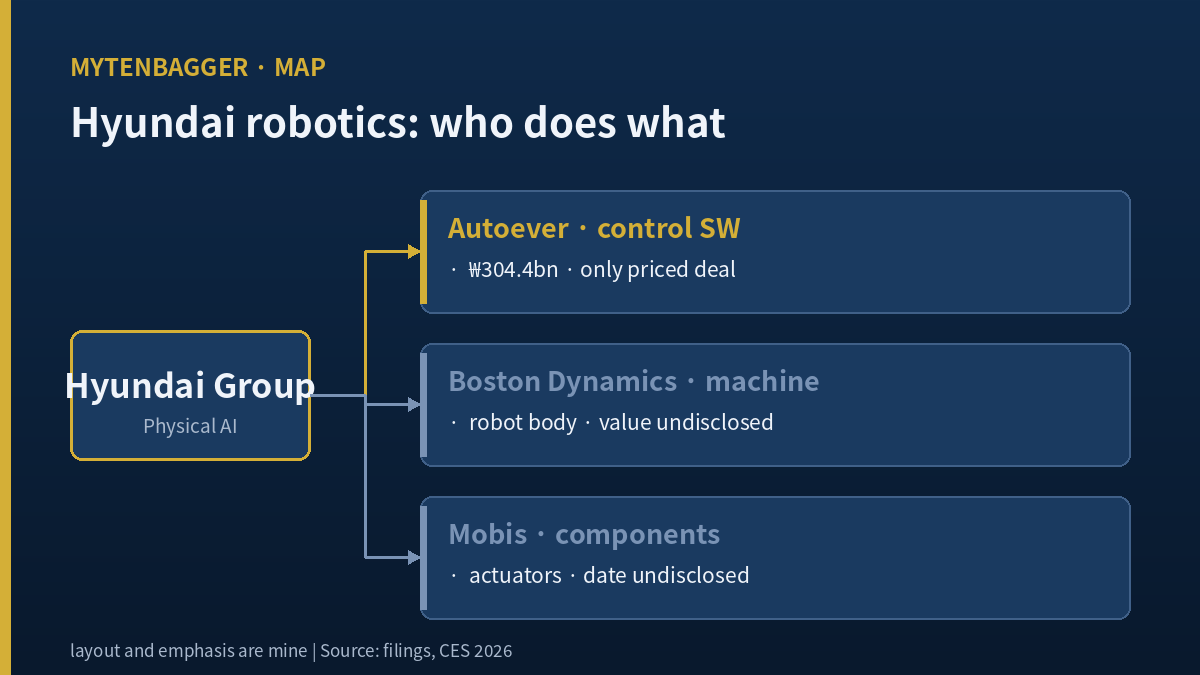
That is a view of the company as the software layer that runs robots rather than a company that builds them. It maps cleanly onto how the group is actually organised: Boston Dynamics makes the machine, Hyundai Mobis supplies actuators, and Autoever supplies the operating and control layer.
Three — it is profitable, which in this sector is unusual
A large share of Korean-listed names bundled into physical AI run operating losses, and the ones building actual robot hardware more so. Hyundai Autoever posted first-quarter operating profit of ₩21.2 billion, roughly $14.6 million. That said, it was down 20.7% year on year. Revenue up 12.3% with profit down 20.7% is not a combination I want to gloss over.
The numbers attached to Hyundai physical AI right now
Hyundai Autoever trades on the KOSPI, Korea’s main board — the KOSDAQ is the smaller-cap venue — and like most Korean mid-caps it has no ordinary US-listed ADR. On a trailing basis at the July 24 close it carried a P/E near 57x and a price-to-book near 5.6x. Profits are growing, which inflates trailing multiples, but these are not modest numbers.
The price path is the more striking part. The 52-week high is ₩1,066,000, and as of July 24 the shares sat roughly 64% below it. Yet the twelve-month return is still +143%. Anyone who bought a year ago has done very well; anyone who bought two months ago is down by half. Charts shaped like that tend to come from places where narrative ran ahead of earnings.
On the forward view, five named reports are what I could verify, and all of them predate the summit: IBK Investment’s Lee Hyun-wook at ₩880,000 on June 9; Eugene Investment’s Lee Jae-il at ₩880,000 on May 29; NH Investment’s Ha Neul at ₩770,000 on May 26; Daishin’s Kim Gwi-yeon at ₩720,000 on May 20; and Sangsangin’s Yoo Min-ki at ₩700,000 on May 15. These are third-party figures I am citing, not values I have adopted.
What bothers me is not the level but the dates. The most recent of the five is June 9. Through July, Korean auto-sector objectives were cut across the board — for Hyundai Motor itself, 19 of 20 notes published in the past month were downward revisions — and I could not find a July note on this name at all. Sangsangin’s Yoo raised his number on May 15 while simultaneously cutting his rating to neutral, citing the “sharp short-term share price rise.” The shares fell hard afterwards.
Why the Hyundai physical AI contract makes me uneasy
Here is the part I deferred. The reason ₩304.4 billion stopped feeling like good news.
The contract is 100% related-party. The counterparties are Hyundai Motor and Kia, and Hyundai Motor is the company’s largest shareholder. Related-party transactions already account for 94.9% of this company’s 2025 revenue and 94.6% in the first quarter of 2026. Within its domestic IT services business, 2025 revenue from Hyundai Motor ran ₩986.5 billion and from Kia ₩388.1 billion.
So this contract simultaneously grows revenue and deepens the company’s central structural weakness. Korean industry commentary has flagged exactly this: if new businesses also scale through affiliates, the burden of proving growth in the external market only increases. Whether this company can sell outside the group remains unproven, and the chance to prove it has been pushed back once more.
The structure matters too. The term runs to February 28, 2027 — seven months. It reads as an annual procurement cycle, and renewal is not committed anywhere. To treat this as recurring revenue, a comparable contract has to appear again next year.
The sector has already broken once
Combined market capitalisation of Korean robot-related stocks went from roughly ₩16 trillion in August 2025 to ₩49 trillion at the early-June 2026 peak, then down to ₩23 trillion as of July 20 — less than half the peak, with major names averaging −52.3% over six months.
Eugene Investment’s Yang Seung-yoon characterised it this way: the Korean robot sector has corrected roughly 50% from its high since June, and in doing so “has substantially priced in the absence of near-term momentum and concerns about commercialisation and monetisation.” He leans toward “already priced in.” Read from the other side, it means the market has started to doubt the timeline.
The parent’s own analysts moved first
Yuanta Securities’ Kim Yong-min cut Hyundai Motor’s objective from ₩690,000 to ₩570,000 on July 24 — summit day — writing that he had “lowered the target P/E for the automotive business from 15x to 10x,” and that “robotics expectations alone cannot justify a high valuation while uncertainty in the global automotive market remains.”
In fairness, the same note raised his rating from neutral to buy, because the shares had already halved. Reporting the cut without that nuance misreads the note.
His sharper line came on June 16: valuation premium arose “in the process of assessing new-business value that is not yet affecting the income statement on the basis of core-business earnings.” That is an objection to the method itself — stacking robot optionality onto an automotive P/E. Of every bearish argument I read for this piece, I think that one is the most precise.
Two clocks: engineering and labour
Skepticism about humanoid commercialisation exists on the record. Rodney Brooks — founder of iRobot and Rethink Robotics — wrote last September that “we are more than ten years away from the first profitable deployment of humanoid robots even with minimal dexterity.” IEEE Spectrum’s reporting quotes Melonee Wise, formerly chief product officer at Agility, making the demand-side version: nobody has yet found an application requiring several thousand humanoids per facility.
Korea adds a second clock that US peers do not have. The Hyundai Motor branch of the Korean Metal Workers’ Union holds that without a labour agreement, not a single robot enters the floor — and Hyundai’s collective agreement does require joint labour-management deliberation on matters affecting employment. When robots reach a Korean plant is a bargaining question as much as an engineering one.
Inside the same group, the numbers diverge
One contrast is worth putting down. In the same quarter that Hyundai Motor’s operating profit fell 20.8%, Hyundai Mobis posted ₩975.2 billion — up 12.1% — on revenue of ₩16.32 trillion (+2.4%), with net income of ₩1.06 trillion (+13.5%). Mobis’s role in the robot story is actuators, formalised at CES in January through a strategic collaboration framework to supply the next-generation Atlas at Boston Dynamics. Actuators represent a substantial share of a humanoid’s bill of materials.
But here too, value, volume and start date are all undisclosed. On its first-quarter call the company said only that specifics on robot mass production would come in the second half of 2026. Of the three group entities attached to robotics — Boston Dynamics on the machine, Mobis on components, Autoever on software — only Autoever currently has a committed figure attached to it.
Globally, price and substance have also come apart
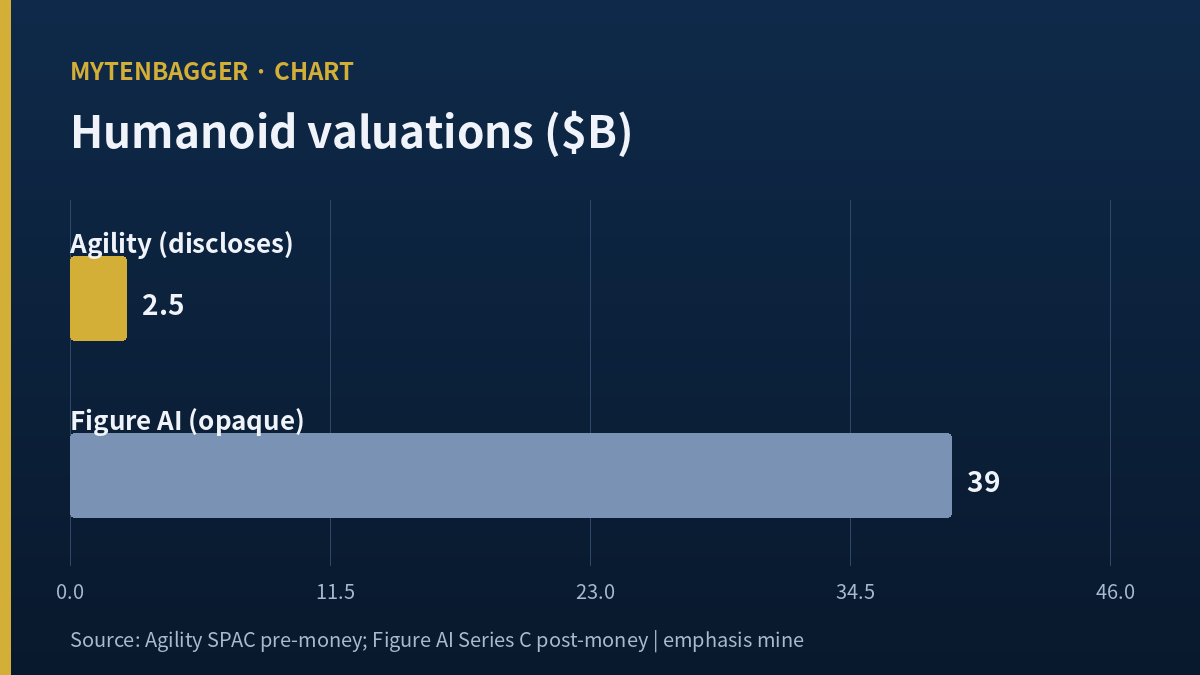
This distortion is not a Korean phenomenon. Two American humanoid companies make it plain. Agility Robotics is going public via SPAC merger at a pre-money valuation of $2.5 billion, and it has disclosed more than 65,000 hours of real-world operation, nine customer sites, and over $300 million of multi-year committed orders. Figure AI raised a Series C last September at a $39 billion post-money valuation and does not disclose deployment counts.
Figure does have real factory work behind it, to be fair: its Figure 02 ran for roughly ten months at BMW’s Spartanburg plant across some 30,000 X3 builds, and BMW began introducing Figure 03 into logistics sequencing there in late June. What neither company discloses is how many units are actually deployed. That single missing number is the difference between a pilot and a business, and it is missing on both sides of the Pacific.
The company publishing operating hours and booked orders is carrying roughly one-fifteenth the valuation. Tesla’s Optimus sits in the same category: Musk acknowledged in January that no Optimus units were performing useful work in the factory, and the second-quarter shareholder deck dropped the “mass production” language that had appeared a quarter earlier. Morgan Stanley’s Andrew Percoco, cutting Tesla to Hold in December, wrote that non-automotive initiatives including Optimus are “largely priced into the current stock value.”
Waymo is the exception that proves the shape of it — it discloses. Roughly 500,000 paid weekly trips against a fleet near 3,000 vehicles as of May, a $16 billion round at a $126 billion post-money valuation in February, and service now live in more than ten cities. Its own July blog refers to “our growing fleet of Hyundai IONIQ 5 vehicles” — but in testing with safety specialists aboard, not commercial deployment. And Waymo is not single-sourced to Hyundai: it has been running Zeekr-based vehicles commercially since May and operates its own Arizona plant with Magna.
For a US reader that is the practical takeaway. You can price Waymo’s economics indirectly and Tesla’s directly; the Hyundai leg of this is the one with the least disclosure and no US listing.
A note on who actually announced what
One attribution detail is worth stating precisely, because I expect it to get blurred. Nvidia’s own newsroom carries no independent release on the Robot Reference Platform. The announcement exists on Hyundai’s side, with Nvidia named as partner. Writing “Nvidia announced a robot platform with Hyundai” would invert the source; the accurate phrasing is that Hyundai announced it, with Nvidia as the named partner. That distinction is exactly the kind of thing that decides whether a claim survives being checked.
What Nvidia has published on its own account is different and more concrete. It released an open Isaac GR00T reference humanoid design in May, pairing a Unitree body with tactile hands and Jetson Thor compute, with availability signalled through Unitree by the end of 2026. In July it added further Jetson and IGX parts for release in the first quarter of 2027, listing Boston Dynamics among adopters — Boston Dynamics directly, not Hyundai. And the one Hyundai-related item Nvidia did announce on its own newsroom, back in October 2025, was a supply agreement for roughly 50,000 Blackwell GPUs. That is a separate matter from the robot platform, and it is the arrangement the ₩304.4 billion procurement contract most plausibly serves.
Set those side by side and the shape of the week gets clearer. The robotics headlines were partnership language with no economics disclosed. The compute headline was a real hardware commitment made nine months earlier. And the filing with a price on it was the affiliate buying servers. Robotics generated the narrative; compute generated the invoice. If you are looking for where this axis touches an income statement first, it is the second of those, not the first.
How I would verify the Hyundai physical AI thesis, in order
I stage my checkpoints. The second only matters if the first clears.
Stage one — does this contract repeat? Two things. Whether a comparable follow-on appears when the term ends in February 2027, and whether the ₩304.4 billion starts converting into recognised revenue in third-quarter results. If it stalls here, this is one-off procurement agency work and there is no basis for pricing it as anything more.
Stage two — does revenue appear from outside the group? Only relevant if stage one clears. Whether the robot application center actually opens and whether control projects originating there reach non-affiliate customers, or whether the related-party share simply climbs past 95%. The “third-quarter opening” Daishin flagged is the first observable.
A condition attached to stage two — the parent’s earnings. Hyundai Motor’s second-quarter operating profit fell 20.8% year on year, with tariff payments running near ₩900 billion a quarter. Group IT budgets ultimately come out of group profits. If the parent keeps shrinking, contracts of this size get harder to repeat annually.
If stage one gives no answer, stage two is not worth watching. If stage one clears and stage two shows a first signal, this stops being a captive IT subsidiary and becomes something that deserves a different name. It is not there yet.
So what am I doing
Nothing yet. When I ranked physical AI fourth in the opening piece of this series, my reason was that the sell-side disagreed on Hyundai Motor by a factor of 2.1. Working the axis at the name level added a second reason: the only priced contract in it happens to be entirely related-party.
That is not purely negative, though. While four declarations floated without figures, this one filing at least showed where money is physically moving. Without it I would have filed the whole axis under narrative. And I should admit that I nearly missed half of it — I saw the ₩138.1 billion contract, judged it small, and only later found the second filing. That is on me for reading quickly.
So I have decided to use this company as a meter on the summit narrative. Whether the group is genuinely spending on physical AI will not be confirmed by a chairman’s remarks; it will be confirmed by this affiliate’s next disclosure. I have February 2027 in my calendar to see whether a follow-on contract appears. Until then I am watching. I’ll come back to this entry when that date arrives.
Primary material behind this: Hyundai Motor Group’s summit release, the Mobis–Boston Dynamics collaboration announcement, Boston Dynamics on the DeepMind partnership, Waymo’s July city expansion post, Agility Robotics’ SPAC announcement, IEEE Spectrum on humanoid scaling, and Rodney Brooks on dexterity. The Korean disclosure values, segment figures and sell-side objectives above come from Korean-language filings and reports, cited by counterparty, firm, analyst and date; those renderings are mine, not English-language originals.
Related reading