Doosan Bobcat Stock: The Tariff Refund That Made the Beat
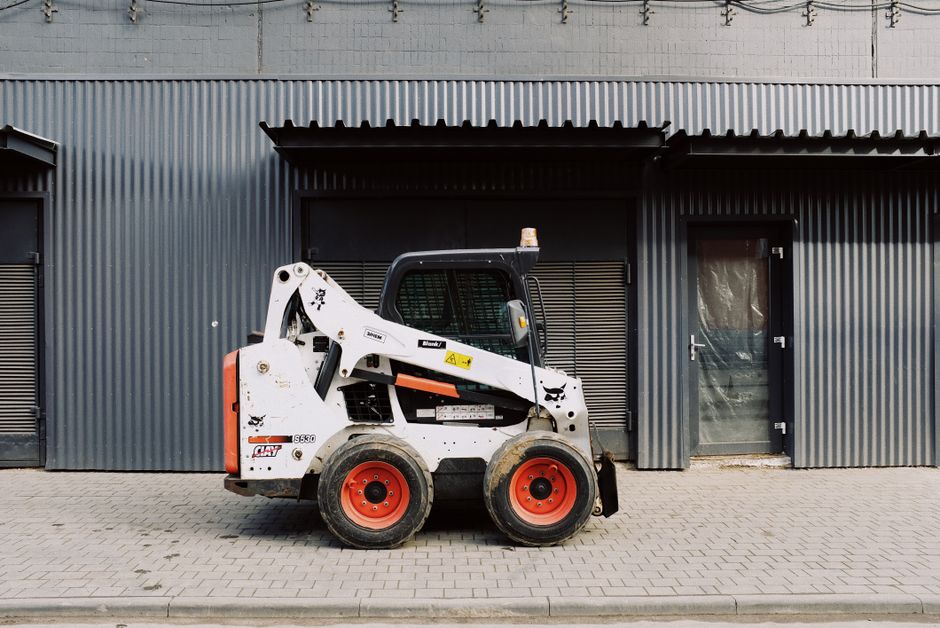
Most American readers have stood next to this company’s product without knowing it was Korean. The skid steer parked outside a jobsite fence, the compact track loader in the rental yard behind the hardware store, the mini excavator on the neighbor’s driveway: that is Bobcat. What surprises people is the ticker. Doosan Bobcat stock does not trade in New York. It trades in Seoul, in won, under the code 241560, and I buy it in won even though almost everything that determines its earnings happens in dollars.
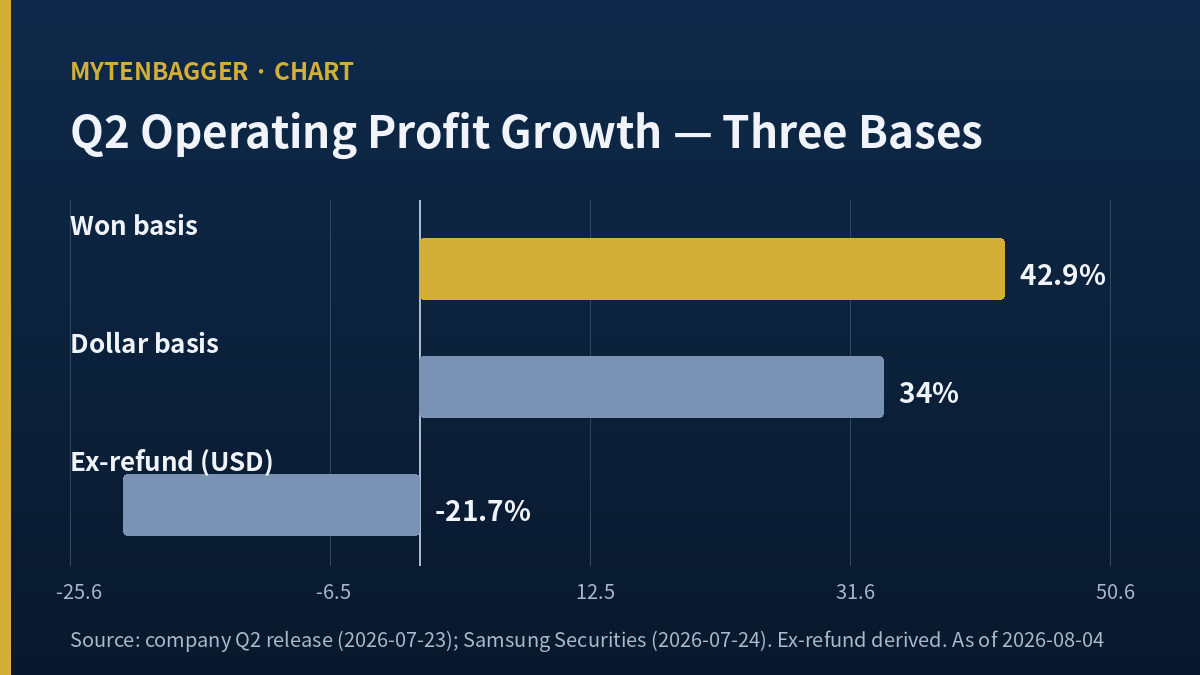
That asymmetry is the whole reason I keep the name on my watchlist and the whole reason I have not bought it. On July 23, 2026 (Thursday) the company reported second quarter operating profit of ₩291.7 billion, up 42.9% from a year earlier. The headline reads like a cyclical turn in compact equipment. I took the number apart three times, and on the third pass the sign flipped.
1. Won basis operating profit: +42.9% year on year, as the company reported it
2. Dollar basis operating profit: +34%, disclosed by the company in the same release
3. Dollar basis, minus the $81 million tariff refund: about −22%, my back calculation
Nothing in the underlying business changes between those three lines. Only the choice of what stays in the numerator does.
Contents
What Doosan Bobcat stock actually owns
A short orientation for readers who have not traded Korean equities. The KOSPI is the main board of the Korea Exchange, the senior market where the country’s large industrial and financial names list. KOSDAQ is the separate junior board, closer in character to a growth listing venue. Doosan Bobcat sits on the KOSPI, in the machinery sector, with 95,855,960 shares outstanding.
The commercial reality behind those shares is North American. More than 70% of revenue comes from North America, and the company has repeatedly leaned on the fact that it manufactures inside the United States. When reciprocal tariffs first became a live issue in April 2025, its own comment to Korean press was that it expected an advantage from having production based in the US. So the income statement is written first by American housing starts, American rental fleet replacement cycles and American customs policy, and only afterward translated into won for people like me.
At the August 3, 2026 (Monday) close of ₩60,400, or roughly $42.24, market capitalization was ₩5.79 trillion, about $4.05 billion. Trailing twelve month figures from the Kiwoom data feed put revenue at ₩8.79 trillion, near $6.15 billion, with a price to earnings ratio of 14.49, price to book of 0.80 and return on equity of 5.7%. Foreign ownership stood at 39.09% and the debt to equity ratio at 72.99%.
The refund hiding inside the second quarter beat
Start with the reported set. Second quarter revenue was ₩2.45 trillion, up 11.2% year on year, operating profit ₩291.7 billion, up 42.9%, and net profit rose 63.9%. In dollar terms the company disclosed revenue of $1.63 billion, up 4%, and operating profit of $195 million, up 34%. Management attributed the revenue gain to price increases despite some volume slipping out of the quarter on a systems check, and attributed the profit gain to a United States tariff refund, as reported by Korean business daily Ajunews on July 23, 2026.
The first quarter gives the comparison. Revenue was ₩2.25 trillion, roughly $1.57 billion at the August 3 rate, up 7.1%, with operating profit of ₩207.0 billion, near $145 million, up 3.5%, and a 9.2% operating margin, per Newspim’s April 28, 2026 report. Adding the halves gives first half revenue of ₩4.70 trillion and operating profit of ₩498.7 billion, about $349 million, for a 10.6% margin. Both of those first half figures are my own addition of two reported quarters rather than a company disclosure.
Regional detail is where the story stops sounding like a recovery. A tariff refund carried part of another Korean beat that the market sold on the day it printed — Kyungdong Navien credited North American performance and a tariff refund for profit up more than 60 per cent, and the shares closed 11.30 per cent lower. North America grew 3% in the first quarter and 3% again in the second. Europe, Middle East and Africa grew 18% then 10%. Asia, Latin America and Oceania grew 4% then fell 8%. The region carrying more than 70% of the business advanced 3%, twice in a row, while reported operating profit jumped 43%. Volume did not produce that gap.
Product mix says the same thing from another angle. In the first quarter compact equipment rose 7% and industrial vehicles rose 4% while portable power fell 18%. In the second quarter forklifts were cited as a driver of North American growth and, in the same release, as a drag on the 8% decline in Asia, Latin America and Oceania. The identical product line moved in opposite directions depending on the region. That reads less like a synchronized cycle turn and more like inventory normalizing in patches.
One reported line I am deliberately not using is the 63.9% jump in net profit, which outran the 42.9% operating gain. Something below the operating line helped as well, most plausibly financial or currency items, but the coverage I have does not break that out and I would be guessing at the composition. A number I cannot decompose is a number I cannot lean on, so it stays in the record here and out of the argument.
Three layers under the Doosan Bobcat stock headline
The company publishes results in won and in dollars side by side, which is the single most useful disclosure habit it has. Second quarter revenue grew 11.2% in won and 4% in dollars. Operating profit grew 42.9% in won and 34% in dollars. The gaps are 7.2 and 8.9 percentage points, and those gaps are currency, not commerce.
I checked whether the gap is normally that wide. In the first quarter, revenue grew 7.1% in won against 6.2% in dollars, and operating profit grew 3.5% in won against 2.6% in dollars. Both gaps were 0.9 percentage points. So within a single quarter the translation effect widened from 0.9 points to 7.2 points on revenue and 8.9 points on profit, eight to nearly ten times larger. Same machines, same dealers, very different growth rate on the Korean income statement. A reader who only ever sees the won table would not know that layer existed.
Now the second layer. Dollar operating profit for the quarter was $195 million, and $81 million of it was the tariff refund. Remove the refund and $114 million remains. Prior year operating profit works out to roughly $145.5 million, since $195 million represents 34% growth over it. Comparing $114 million against $145.5 million gives a decline of about 21.7%. That is a back calculation off two rounded disclosures rather than a reported figure, so I treat it as approximate, but the direction is not ambiguous.
Stated in one line: up 43% in won, up 34% in dollars, down roughly 22% once the one time refund comes out. I ran that arithmetic entirely in dollars on purpose. Converting the refund into won would require the average exchange rate across the quarter, which is a different number from the single reference rate I use in this piece. For what it is worth, the rate implied by the company’s own paired won and dollar figures is close to ₩1,496 per dollar, and that is the company’s translation, not mine.
The last thing worth saying about that refund is what kind of money it is. It came back because tariffs were paid. The profit was produced by policy rather than by demand or by cost discipline, and the policy has not concluded. I looked at the same exposure from the automaker side when I worked through Hyundai Motor’s tariff arithmetic. The difference here is that Hyundai carries tariffs as cost, while Bobcat carries cost in some quarters and refunds in others. The issue is amplitude rather than direction. A machinery maker can also be read from the inventory line rather than the tariff line, which is where I took Daedong: its inventory balance rose in every one of four annual observations while the North American industry was destocking.
Two Korean desks, two opposite denominators
Something unusual happened after the print. Two credible Korean sources looked at the identical $81 million and reached opposite verdicts.
Samsung Securities analyst Han Young soo wrote on July 24, 2026 (Friday) that reported operating profit exceeded market expectations by 69%, that the main cause was the $81 million tariff refund, and that excluding it the quarter was in line with expectations. He kept his Buy rating and lifted his valuation on the shares from ₩92,000 to ₩98,000, around $64.34 to $68.54, arguing that overseas construction equipment peers trade at firm multiples while Doosan Bobcat trades at a wide discount to them, and that the discount should narrow. That is via Edaily’s July 24, 2026 write up of the note.
A second Korean outlet converted the refund to ₩118.7 billion, roughly $83 million at my reference rate, and concluded that stripping it left operating profit short of a ₩205.3 billion consensus, describing the quarter as leaning on a one off refund rather than on core growth, in HuffPost Korea’s coverage.
Both statements are accurate. What separates them is the denominator. Reversing the 69% beat implies the consensus Samsung used was about ₩172.6 billion, since ₩291.7 billion divided by 1.69 lands there. The second outlet’s consensus was ₩205.3 billion. Those two consensus figures are 19% apart. Reported profit minus the converted refund is ₩173.0 billion, which sits almost exactly on ₩172.6 billion and 15.7% below ₩205.3 billion. All of those are my divisions, not quoted ratios.
So “in line” and “missed” are not competing claims about the business. They are the same subtraction measured against two different consensus numbers. This is the ordinary way a quarter ends up with contradictory reputations, and it is why I stopped using either consensus as an input. I compared against the prior year period directly instead, which is what the three layer calculation above does.
Doosan Bobcat stock against Caterpillar, Deere and Toro
The reason the name survives on my list despite all of the above is the price. Here is where it sits next to three US listed peers, all figures as displayed on August 3, 2026. A domestic peer ran into the same reading problem this quarter: HD Construction Equipment disclosed two growth rates for one quarter, and the arithmetic between them is what the filing leaves the reader to do.
| Company | Market cap | Trailing P/E | Cap ÷ revenue | Dividend yield |
|---|---|---|---|---|
| Doosan Bobcat | $4.05B | 14.49 | 0.66 | 2.81% |
| Caterpillar | $381.99B | 40.57 | 5.40 | 0.78% |
| Deere | $164.32B | 33.58 | 3.47 | 1.07% |
| Toro | $9.06B | 27.37 | 2.01 | 1.65% |
US peer figures as displayed by stockanalysis.com for Caterpillar, for Deere and for Toro on August 3, 2026. P/E figures are trailing twelve month. Cap ÷ revenue is my own division of displayed market capitalization by trailing revenue. Doosan Bobcat’s market cap and multiples come from the Kiwoom feed at the same day’s Korean close, converted at ₩1,429.8 per dollar.
On the same measure, Doosan Bobcat trades at roughly half the multiple of Toro, the cheapest of the three American names, and at about one eighth of Caterpillar on capitalization to revenue. Caterpillar’s market value is 94 times Bobcat’s while its trailing revenue is 11.5 times larger. That is the gap Samsung Securities pointed at.
Before leaving the table, one objection to my own framing. The obvious defense of the gap would be that Bobcat’s earnings are falling while the American names are compounding, so the multiples are simply pricing different trajectories. The figures on the same three source pages do not support that. Caterpillar’s trailing net income is down 5.1% and earnings per share down 2.1%. Deere’s trailing net income is down 15.4% with earnings per share down 14.6%, and its fiscal 2025 revenue fell 11.46% with earnings down 29.20%. Toro’s fiscal 2025 revenue slipped 1.6% while net earnings fell 24.54%. All three are working through their own downcycle, and all three still carry trailing multiples between 27 and 41 times. Whatever explains a 14.49 against a 27.37, it is not that one company’s profits are shrinking and the others’ are not. That leaves ownership structure, listing venue and liquidity as the candidates, which is precisely why I treat the discount as something to be tested rather than assumed away.
There is a hole in this comparison that I have not been able to fill, and I would rather name it than let the table imply more precision than it has. The same source publishes forward P/E for all three American companies, 31.90 for Caterpillar, 29.83 for Deere and 19.54 for Toro, and does not publish one for Doosan Bobcat. The trailing column is apples to apples. The forward column, which is where a cyclical recovery would actually show up, is missing on one side. So the table tells me the discount is real on past earnings; it cannot tell me how much of the discount survives once expected earnings are used. Buying a cheap trailing multiple without that second column is the exact mistake I have written about before while looking at Hyundai Mobis at 0.85 times book.
One more balance sheet note. Book value per share is ₩75,092, about $52.52, which multiplied by shares outstanding implies total equity near ₩7.20 trillion, roughly $5.03 billion. Market capitalization is therefore about 80% of book. On price position, the stock sits 24.2% below its 250 day intraday high of ₩79,700 and 16.4% above its 250 day intraday low of ₩51,900, and trades under its 20, 60 and 120 day moving averages. Twelve month return is positive 8.05% while the three month return is negative 18.6%. I put both of those numbers here on purpose, because quoting only the drawdown would flatter my own argument.
The dividend floor beneath Doosan Bobcat stock
Shareholder return is the most legible part of this company. It has published an annual dividend floor of ₩1,600 per share and a payout policy of 40% of consolidated net profit, and it pays quarterly, per Hankyung Business reporting from April 28, 2025. Quarterly dividends of ₩400 per share were declared in both the first and second quarters of 2026. Fiscal 2025 dividend per share came in at ₩1,700, about $1.19, following ₩1,350 in 2022 and ₩1,600 in 2023 and 2024.
Against the August 3 close that ₩1,700 works out to a 2.81% yield, my own division, which is higher than any of the three American peers in the table above. In a stretch where earnings quality is the open question, a pre committed dividend floor lowers the cost of waiting, and waiting is what I am doing. I made a similar point about the weight of a payout when I wrote up KT&G after its buyback cancellation, though the contrast matters: KT&G funds its distribution from Korean domestic demand, while this one funds it from North American end markets. The company sets the floor. American construction activity decides whether the floor holds.
On share count, every multiple in this piece uses 95,855,960 shares. Multiplying that by the August 3 close reproduces the ₩5.79 trillion market capitalization exactly, which is the cross check I run before trusting a per share figure. I found no event in the quarter that moved that denominator. Fixing the denominator first is the order of operations I try to keep.
Why I have not bought Doosan Bobcat stock yet
I do not own this. It is on the watchlist and nothing more. When I first laid out the multiples I leaned toward taking a position, then confirmed that close to half the quarter’s operating profit came from a policy refund and walked back from the order screen. Cheapness on its own is not enough here, because this stock has already broken that promise several times: it is below all three of the moving averages I check, down 18.6% over three months, and the low multiple is old news rather than new information.
The other side deserves its space. According to the HuffPost Korea piece cited above, the company targets 2026 revenue of ₩9.4 trillion, near $6.57 billion, up 7.4%, and operating profit of ₩800 billion, about $560 million, up 12.9%, with roughly $100 million of volume deferred into the second half. The same report carried Kiwoom Securities analyst Lee Han gyeol’s view that North American and European strength continues, that North American shipment volume grows at a double digit rate in the second half, and that the full year lands in line with the company target. Samsung Securities separately pointed to dealer inventory falling to around three months as a genuine recovery signal. First half operating profit of ₩498.7 billion covers 62.3% of the full year target, which is comfortable progress on its face.
Except that removing the ₩118.7 billion refund, as converted by the outlet cited earlier, leaves ₩380.0 billion and drops that progress to 47.5%. The bearish observation in the same coverage attaches right there: North American housing remains weak under high rates, so a sharp demand recovery is limited. A 5.7% return on equity fits that picture. This may not be an asset priced too cheaply so much as an asset that is currently earning too little on what it owns.
So I wrote down two conditions before I touch it. First, a third quarter where dollar basis operating profit grows year on year without a refund or any comparable one off doing the work. Second, confirmation that the double digit North American shipment growth the sell side describes actually appears in the company’s own regional revenue disclosure. One without the other does not move me.
And here is where my thesis fails. If both conditions are met in the third quarter and the valuation discount does not narrow anyway, then the discount was never about earnings. It would be structural, attached to ownership and to listing venue, and the entire “cheap therefore eventually converges” premise I am holding would be wrong. In that case I take the name off the list rather than average into it.
A dollar business bought in won
Back to where this started. The revenue is made in North America, the quarterly profit is shaken by American customs policy, and I read the result on a screen that has already converted everything into won. Judging this name is therefore not one question about whether compact loaders are selling. It is a question of whether anything remains after two layers, currency and policy, are peeled off the top. In the second quarter, nothing remained. In the next one, something might. I will run the same three lines again when it prints.
Prices and multiples reflect the August 3, 2026 Korean close as checked at the time of writing. This entry may appear some days after it was written, so figures can differ from live quotes and should be read as a snapshot rather than a live number. The Korean won is the reference currency here; dollar equivalents are approximate, converted at about ₩1,429.8 per dollar on the same date, except where a company disclosure or a cited outlet supplied its own dollar or won figure, in which case that figure is quoted as published. Underlying indicator data is from the Kiwoom feed at the same day’s close.
Related reading