LG Chem Stock: Why I Trust the Credit Cut Over the Cheap Math
LG Chem stock (KRX: 051910) is the puzzle I spent this week trying to solve: Korea’s flagship chemical company trading 44% below its 52-week high, at 0.59 times book, while the stake it owns in its own battery subsidiary is worth more than three times its entire market value. Meanwhile the global chemical cycle has already turned. On July 23, Dow reported second-quarter results showing a swing to a profit of roughly $800 million from a loss of about the same size a year earlier. BASF followed with a strong quarter and a raised full-year outlook, according to European press coverage. Naphtha and basic-chemical spreads, squeezed tight by Middle East supply disruption, have been a tailwind for almost every cracker operator on Earth. And yet the Seoul-listed parent of that $51 billion battery maker has posted two straight years of operating losses and just absorbed its first domestic credit downgrade in a decade. Is this the obvious catch-up trade? My answer, for now, is no — and the reason is not the chemicals. It’s the credit.
Currency note before the numbers: I quote dollars first at approximately ₩1,470 per USD, the level the won has been trading near since Korea’s late-July market break, with won figures alongside where precision matters.
Contents
The Numbers Behind LG Chem Stock’s 44% Slide
As I write this on July 30, before the Seoul open, LG Chem stock sits at about $167 per share (₩245,500). Multiply by the 70.6 million shares outstanding and the market values the whole company at roughly $11.8 billion (₩17.3 trillion). The 52-week range runs from ₩437,500 down to ₩224,000 — the stock has lost 43.9% from the top, including 43% in the past three months alone. Some of that final leg came on July 28, when the KOSPI — Korea’s main stock index, the local equivalent of the NYSE composite — fell 10.84% in a single session and triggered a circuit breaker, the market’s eighth this year. Korean press coverage of that session pointed to the Shanghai listing of Chinese memory maker CXMT as the shock that cracked an over-leveraged domestic market — margin lending had hit record levels — and foreign investors sold Korean equities heavily into the drop. A high-debt, loss-making cyclical like LG Chem is exactly the profile that gets sold hardest in that kind of deleveraging, and it was. But this chart was broken well before the crash.
One structural note for readers new to the Seoul market: Korea has been running a state-encouraged “Value-up” program since 2024, pushing listed companies to close the gap between price and book value through buybacks, cancellations, and better disclosure. It re-rated Korea’s banks and brokerages — I have covered that arc name by name — but it has largely bypassed companies like LG Chem, where the discount is not a governance choice that a buyback can fix but a balance-sheet condition. That distinction is the spine of this note.
The earnings explain it. First-quarter consolidated revenue was about $8.3 billion (₩12.25 trillion) with an operating loss of roughly $34 million (₩49.7 billion), and — the number that stopped me — a net loss of about $530 million (₩782 billion), per the company’s quarterly earnings call as transcribed by Korean electronics-industry outlet The Elec (Korean-language source). The gap between a modest operating loss and a heavy net loss tells you the damage runs below the operating line. Zoom out and the pattern hardens: operating losses of about $380 million (₩563 billion) in 2024 and $320 million (₩466 billion) in 2025, per Korean press tallies of the company’s disclosed results — LG Corp maintains an English-language newsroom where the group’s official results releases are published. Two consecutive loss-making years is where my process stops the conversation about buying. Everything after this paragraph is about what would restart it.
A $40 Billion Stake Inside a $12 Billion Company — the LG Chem Stock Puzzle
Here is why value screens keep surfacing this name. LG Chem owns 79.4% of LG Energy Solution, Korea’s largest battery maker, which itself carries a market value of about $51 billion (₩74.9 trillion). Multiply it out — my own back-of-envelope, no control premium, no discount — and the stake alone is worth roughly $40 billion (₩59.5 trillion). The parent trades at $11.8 billion. The stake is worth well over three times the whole company, and that is before you assign any value to the chemicals, the cathode-materials business, the pharma unit, or the crop-science subsidiary. On top of that, the stock trades at 0.59 times book value.
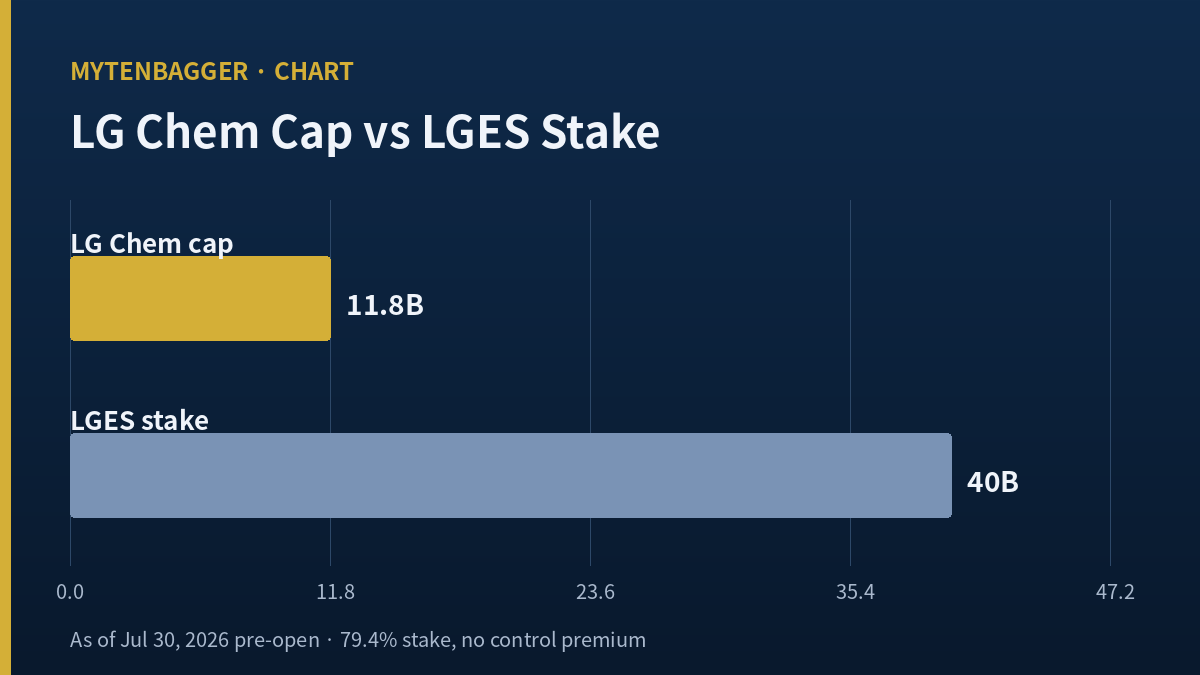
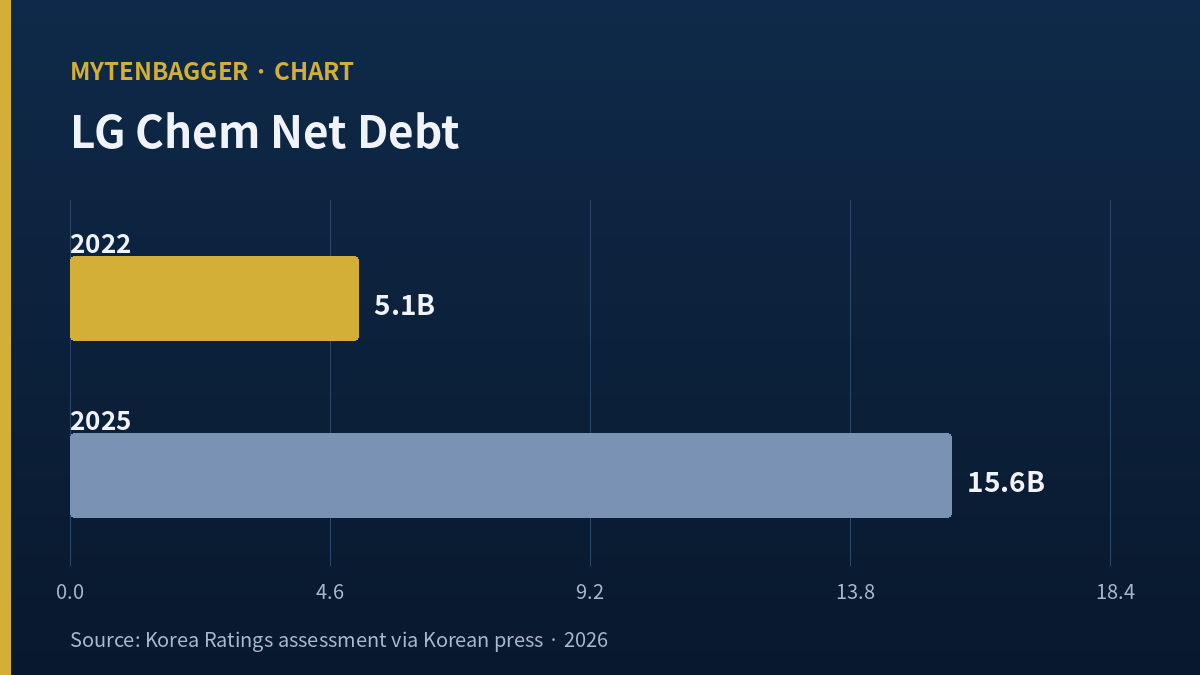
If you have read my earlier notes on Korean holding structures, you know this shape: Korean parents routinely trade at 50–70% discounts to the listed subsidiaries they control, a phenomenon tied to the “Korea discount” that the government’s Value-up program has been trying to shrink. But LG Chem is a more uncomfortable version of the trade, because this stake has a prior claimant — and it is not me. Net debt, as cited in the downgrade assessment by Korea Ratings (one of Korea’s three major domestic rating agencies) and relayed by Korean press, tripled from about $5.1 billion (₩7.5 trillion) in 2022 to $15.6 billion (₩22.9 trillion) in 2025, taking net debt to EBITDA from 2x to 4.8x. Total borrowings stood near $24 billion (₩35.7 trillion) at the end of the first quarter, per Korean financial media tallies. The battery and cathode capex that built this debt has not yet come back as cash.
So the stake is being spent. In October 2025 the company monetized 5.75 million LG Energy Solution shares — about $1.4 billion (₩2 trillion) — through a price return swap (PRS) with domestic brokerages, cutting its holding from 81.84% to 79.4%, with proceeds earmarked for debt repayment and investment in advanced materials and biotech. A quick mechanic for non-Korean readers, because the structure matters: in a PRS, the brokerages take the shares and resell them into the market over time, while LG Chem settles the difference against the reference price — it collects cash up front without the single-day price shock of a block trade, and if the shares are resold above the reference price, the spread comes back to LG Chem. That is exactly what happened: with LG Energy Solution up more than 20% from the November reference level at one point, the first swap generated a positive settlement, which is partly why the follow-on is being teed up the same way. The Seoul Economic Daily’s English edition reported in May that a second sale of similar size is being prepared for the second half of 2026, and Korean press citing the rating agency’s report says the roadmap runs toward roughly 70% ownership by 2030. That reframes the whole bull case for me. The $40 billion is not a coiled spring waiting to close the gap with the share price; it is the collateral pool that meets the debt maturities and the capex bills first. A discount can narrow two ways — the market cap can rise, or the numerator can shrink. Right now the numerator is doing the moving.
I have walked this discount aisle before, and the comparison is instructive. SK Square, which I covered at a 43.8% NAV discount, faces no comparable pressure to liquidate its SK Hynix stake; Hyosung, which I bought at a third of its stake value, pairs the discount with operating subsidiaries that pay their own way; HD KSOE holds shipbuilding stakes whose underlying earnings are inflecting upward. LG Chem’s discount is wider than the first, deeper than the second, and structurally different from all three: it is the only one where the discounted asset is explicitly scheduled to shrink as a funding source. Same-looking math, different machine. That is why screening by discount percentage alone — the way this stock keeps showing up in cheap-Korea lists — misleads more than it informs here.
The Credit Downgrade That Reframed LG Chem Stock for Me
On June 19, Korea Ratings cut LG Chem to AA (stable) from AA+ (negative) — the company’s first downgrade in ten years, as reported by Korean press including HuffPost Korea (Korean-language source). The agency’s stated logic, paraphrased: weakened earnings power makes a fast repair of the balance sheet unlikely, with China’s structural overcapacity in commodity chemicals named as the root cause. The global agencies moved earlier in the cycle — Moody’s cut both LG Chem and LG Energy Solution back in November 2025, citing strain across the secondary battery industry, per the Asia Business Daily’s English edition — so the domestic agencies, whose ratings anchor LG Chem’s won-denominated funding costs, were the last line to give way.
I treat rating agencies as lagging indicators of price but leading indicators of constraint, and the constraint is what matters here. Creditors do not care that the stake math looks cheap; they care that first-quarter operating cash flow was negative — about minus $120 million (₩176 billion) per Korean outlet Bloter’s tally — while the company talks about a decade-long R&D program of roughly $10 billion (₩15 trillion). Korean financial weekly Sisa Journal-e laid out the bear case in early July: the first-quarter chemical profit leaned on inventory-lag effects and a one-off European anti-dumping duty refund, a re-slip into petrochemical losses in the third quarter is plausible, and the R&D plan needs several hundred million dollars a year the operations do not currently generate. Every funding shortfall in that picture routes back to the same source — the battery stake. That loop, not the chemical cycle, is what the downgrade priced.
Yeosu Shutdowns and Korea’s Government-Led Cracker Consolidation
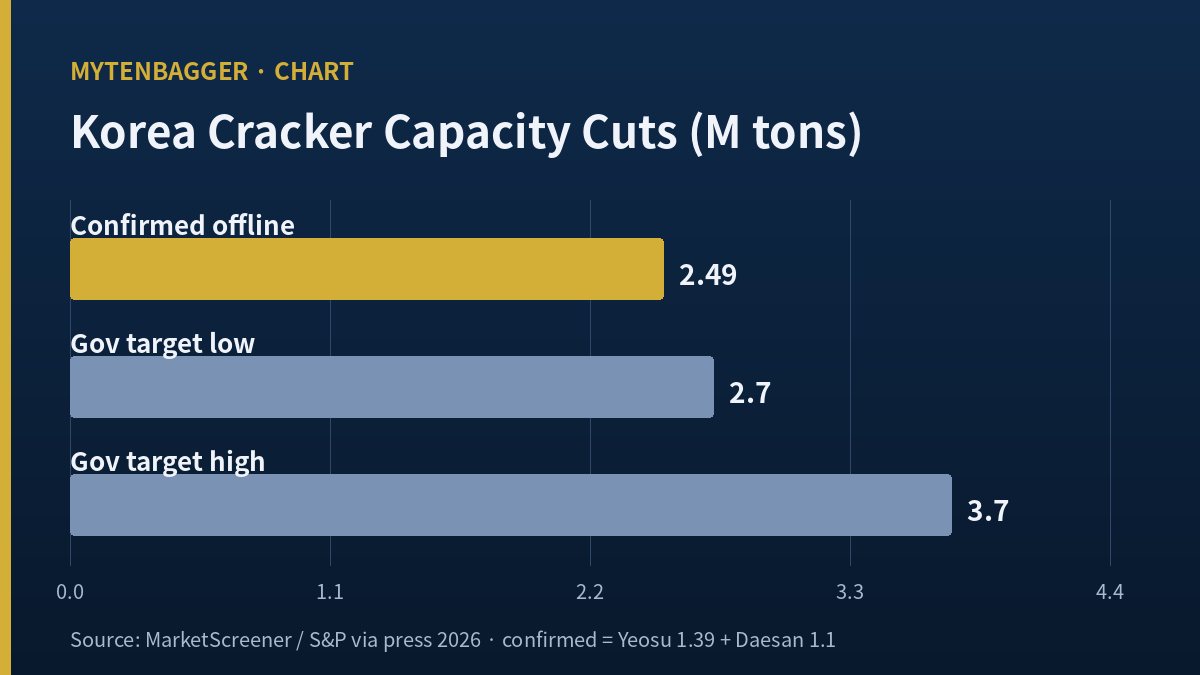
The self-help story is real, and it is bigger than one company. Korea is running a government-brokered consolidation of its petrochemical industry — something closer to an administered capacity cut than anything the US or European chemical sectors have attempted. The industry minister has said companies are on track to cut up to 3.7 million tons of cracker output, per MarketScreener’s wire coverage, and S&P Global Commodity Insights has been tracking the cracker shutdowns the guidance implies. The Yeosu complex — the country’s largest, profiled by the Korea JoongAng Daily — is the first battleground: in late July, Korean press reported the first Yeosu deal, a Lotte Chemical–Yeochun NCC combination idling about 1.39 million tons of Yeosu capacity, which together with a 1.1-million-ton cut at Daesan brings roughly 2.49 million tons offline — 67–92% of the government’s 2.7-to-3.7-million-ton target range — backed by a government support package exceeding roughly $480 million (₩700 billion).
LG Chem’s piece of this is the planned cracker integration with refiner GS Caltex. Its Yeosu No. 2 NCC has been idle since March — originally a response to naphtha supply disruption from the Middle East conflict — and Korean press reported in early July that this No. 2 plant, rather than the older No. 1, has become the designated integration asset. The company has formally submitted its restructuring plan to the government. I want to be precise about what stage this is: no signed deal, equity-structure and fair-trade-law questions still under negotiation. Permanent capacity leaving an oversupplied industry is genuinely bullish for the survivors’ spreads — that is the lesson of every commodity consolidation. But until LG Chem’s ownership share, loss allocation, and asset perimeter in the combined entity are fixed, I cannot put a number on what this is worth, and I do not buy things I cannot number.
What Korean Sell-Side Sees in LG Chem Stock — and Where I Differ
Korean brokerages are far more constructive than I am, and I will report them by name rather than wave at “analysts.” Korea Investment & Securities analyst Lee Choong-jae, in a July 9 note summarized by Newspim (Korean-language source), estimates second-quarter revenue of about $9.2 billion (₩13.5 trillion) and operating profit of roughly $205 million (₩302 billion), argues US data-center demand for battery energy storage (BESS) becomes visible in the second half, and carries a ₩520,000 objective — more than double the current price. Mirae Asset’s Lee Jin-ho raised his objective to ₩480,000 in late April on a projected second-quarter swing to profit. The broader Korean sell-side cluster, as compiled by Sisa Journal-e, runs from about $205 million to $415 million in second-quarter operating profit estimates (Samsung Securities ₩485 billion, KB ₩611 billion, NH ₩389 billion), against a market consensus near $240 million (₩353 billion). Direction is unanimous: back to black when results land in early August.
My differences are two, and neither is about direction. First, composition. If the first quarter’s chemical profit was substantially inventory lag plus a duty refund, the same forensic test applies to the second quarter — a swing to profit built on one-offs does not close my earnings dossier. Second, the profit engine underneath. LG Energy Solution’s second-quarter operating profit of about $77 million (₩113.3 billion) exists because of US advanced manufacturing production credits (AMPC) — a structure I took apart in my separate note on that stock. Strip the credits and the underlying battery operation is still under water while ESS plants ramp. Korean sell-side commentary compiled by HuffPost Korea expects the ESS line to turn profitable in the fourth quarter as ramp-up costs fade; the company’s own call promised delayed cathode projects returning to revenue in the second half. I do not dismiss any of that. I simply note that “fourth quarter” is a promise about volumes the company itself described as delayed, and I am allowed to wait for shipment numbers instead of forecasts.
Moat Check: What’s Actually Defensible Here
I type-check moats in every note, so here it is. In commodity petrochemicals, LG Chem’s cost moat is gone — naphtha crackers sit structurally uphill from ethane-based competitors in the US and Middle East, and Chinese overcapacity is severe enough that a rating agency cited it as a downgrade rationale. In cathode materials, there is real process knowledge and some customer switching cost, but high-nickel cathodes are a contested field with Chinese and Korean rivals compressing returns; I classify it as a competitive business with switching friction, not a technology moat. Life sciences and crop science are steady but small. What remains — the hardest wall this company has — is an ownership moat: 79.4% of a top-tier global battery maker. And as documented above, that wall is being dismantled brick by brick to service debt, by design, on a published schedule toward 70%. A moat that is simultaneously your funding source is a moat with a gate open. If the high-density LFP line (2027–2028 targeted mass production) and sodium-ion roadmap (2028–2030) the company sketched on its earnings call become shipping products, an operating moat could regrow. I will pay for that when I can see it, not before.
My Three Dossiers Before I Touch LG Chem Stock
I run this watch with three dossiers, in parallel, no fixed order — the variables move on different clocks. Earnings move quarterly, restructuring moves at the speed of negotiation, credit moves annually. A binary trigger would pretend they synchronize; they do not.
Dossier one, earnings. The second-quarter print lands in early August. The consensus bar is roughly $240 million in operating profit; I care less about clearing it than about what remains after I strip inventory-lag gains and any further duty refunds from the chemical segment. If the residual is positive, and stays positive when the third-quarter report arrives in late October — through the seasonal window where Sisa Journal-e’s bear case expects the chemical segment to slip back under water — this dossier closes. A bonus signal: the parent-entity P&L (excluding the battery consolidation) improving on its own, because that is the cash that actually services the parent’s debt.
Dossier two, restructuring. The GS Caltex integration converting from negotiation into an approved business-reorganization filing with a defined equity split and loss allocation — the moment planned capacity cuts become contract. The Lotte–Yeochun deal shows the template and the government’s willingness to pay; LG Chem’s version is the one that moves this stock. Progress markers along the way: fair-trade clearance of the ownership structure and any disclosed valuation of the contributed crackers.
Dossier three, credit. The company’s own guardrails from the earnings call — capex under roughly $1.4 billion (₩2 trillion) a year, net debt to EBITDA managed inside 3.5x from today’s 4.8x — showing up in reported numbers, and the second PRS tranche actually landing as debt reduction rather than evaporating into new capex. Above all: a rating agency’s outlook turning upward again. Even a shift from stable to positive at AA would do it. This is my strongest single signal, because the bond market flagged this problem before the equity market finished pricing it, and it will likely clear the all-clear first too.
Until all three close, I do not buy — not at a 70% discount to the stake value, not at 80%. As each one closes, I escalate: watch list to sizing plan to staged entry. The investor who bought near ₩437,500 is now sitting through a 44% drawdown while holding the same $40 billion stake argument I just made; the difference between us is not the math, it is the sequencing. Cheap is a fact about price. Safe is a fact about evidence. This journal entry exists so that when the evidence arrives — or when the stock runs away before my dossiers close and I have to write down the cost of my caution — I can grade my own reasoning against what I knew on July 30. That is what these entries are for.
Related reading
- Cosmo AM&T Stock Rests On One Buyer That Bought Elsewhere
- Korea Ratings Stock Trades at 4.3 Times Sales, Moody’s 10.5