Kiwoom Securities Stock Fell 30%: Why I’m Not Buying Yet
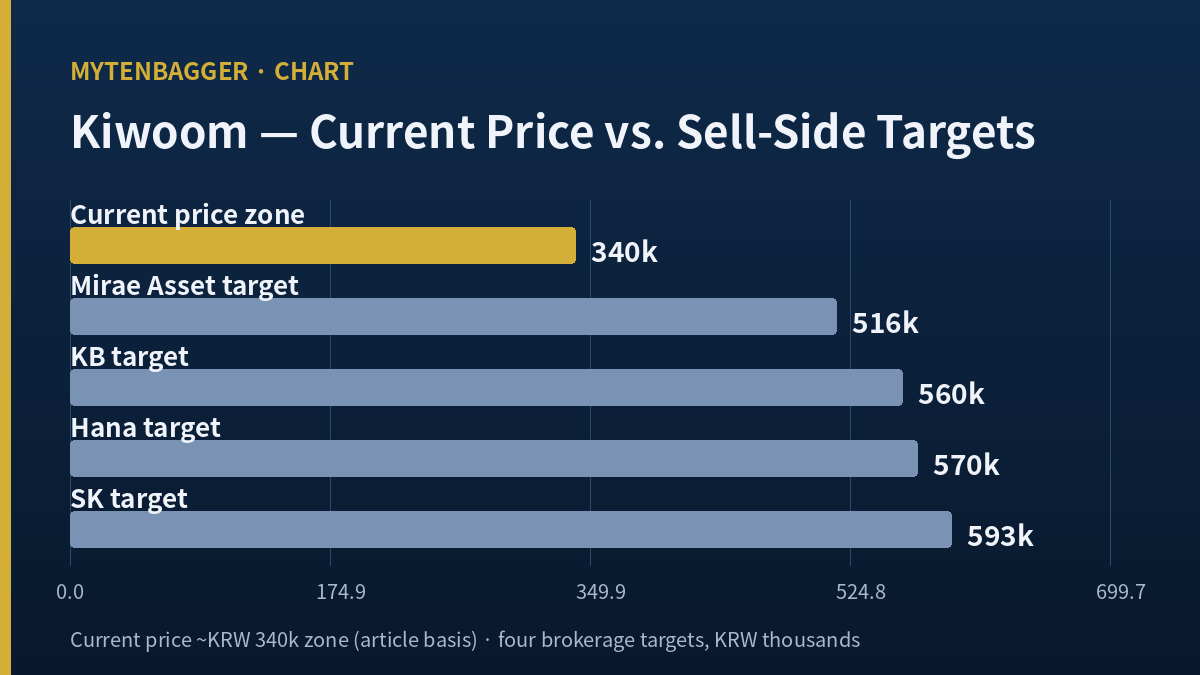
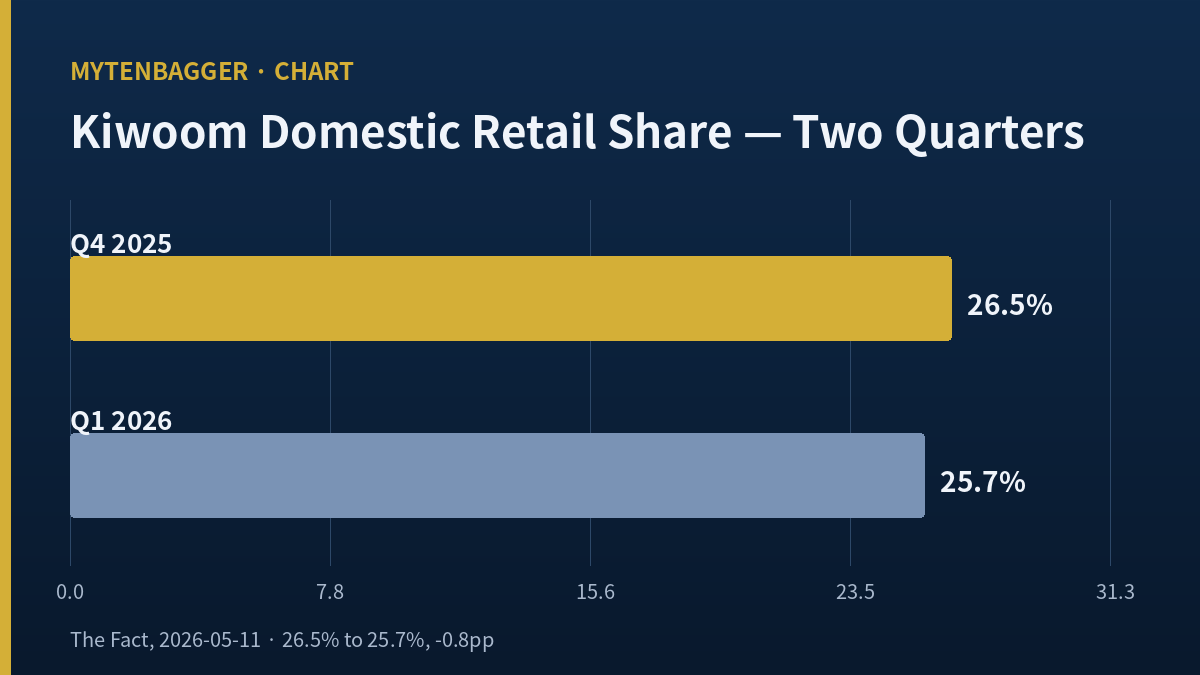
Kiwoom Securities is down more than 30% from its May high, and it fell 5.4% in a single session this week. It’s the purest expression of the trading-volume engine, so it moves most in both directions. Sell-side targets sit near ₩560,000 (~1.6x the current price), and I still haven’t bought a share. What I check before I do isn’t a volume rebound — it’s whether retail market share, which slipped from 26.5% to 25.7%, stops sliding, and whether a second engine (pensions, overseas trading) becomes real.
A few weeks ago Kiwoom Securities traded above ₩480,000 (~$348). Today it’s near ₩340,000. Roughly a third of the high is gone in under two months. I had this name penciled in as the second stock in my Korean brokerage series, and the moment I opened it up to write was right in the middle of that drop. My honest first thought was “finally cheap enough to buy.” A few days into the data, I put that thought down. This drawdown could be a dip or the start of a structural shift, and what separates the two isn’t the price — it’s the market share.
Contents
Why Kiwoom Securities fell this hard — high beta laid bare
Start with why it drops so much. Kiwoom Securities is Korea’s dominant retail-trading gateway, with the largest brokerage (commission) revenue share in the industry. That means profit swells fastest and largest when trading volume rises — and wobbles first when it cools. In the sector opener I called Korean brokers high-beta; Kiwoom is the pure form of that beta.
The numbers show it. Kiwoom’s Q1 2026 net profit was ₩476.4B (up 102.6% YoY) and operating profit ₩621.2B (up 90.9%), per The Fact (May 11, 2026). Quarterly ROE hit 27.9% (KB Securities, April 30, 2026). So why did a company posting results like that fall toward half its high? Because those results were themselves manufactured by a surge in trading volume, and the market started to doubt whether that volume had peaked. Down 5.4% yesterday, up today. Swinging like that in a single day is this stock’s character. When a wealth-management-heavy broker slips a few percent in a selloff, Kiwoom slips double digits — because its profit mix is that much more hostage to the tape. The volatility isn’t a bug; it’s the business model printed straight onto the chart.
Why I keep watching Kiwoom Securities anyway — three reasons
First: when volume turns, its earnings leverage is the sector’s highest
High beta is a weakness and a weapon. When the trading-volume cycle turns back up, Kiwoom is the firm where that upside hits the P&L fastest. Q1 brokerage revenue rose 81.1% YoY to ₩485.0B — and inside that, commissions rose 109.9% and interest income 50.7% (KB Securities, April 30, 2026). Commissions doubling is purely the result of a trading surge. The ₩143.5T May daily-turnover figure from the opener lands most directly on this company. As long as KOSPI holds in the 8,000s, Kiwoom’s ceiling on earnings power is the highest in the group.
Kiwoom is especially geared because of its cost base. Unlike traditional brokers weighed down by branch networks, it grew as a low-cost, online/mobile-first retail platform. Light fixed costs mean that when volume rises, revenue climbs while costs barely move, so the extra commissions drop almost straight to profit. That operating leverage is the engine that grows Kiwoom’s earnings fastest in a bull tape — and, for the same reason, shrinks them fastest when volume fades. The weapon and the weakness grow from one root. It’s why Q1’s operating profit could jump 90% while a heavier-cost peer’s rose far less on the same tape, and it’s why, if second-half volume reverts toward the opener’s ₩113T base case from May’s ₩143.5T, Kiwoom’s profit would give back more than the sector average. The leverage cuts both ways, on the exact same slope.
Second: the gap between price and sell-side has blown wide open
Kiwoom Securities trades at 7.8x P/E and 1.26x P/B, on a trailing-twelve-month ROE in the 18% range. Sell-side targets are in another world: KB Securities set ₩560,000, with Mirae Asset near ₩516,000, Hana around ₩570,000, and SK Securities as high as ₩593,000 — roughly 1.5-1.7x today’s price. I don’t adopt any of those targets as my own; no analyst’s number becomes my buy price. But that the gap between a record-earning company’s price and the sell-side’s eyeline has stretched this far is worth logging as a sign the market is discounting something heavily. The identity of that discount is the point of this article.
It’s worth seeing how KB got to ₩560,000, because the logic gives the game away. It put a 1.8x target P/B on ~₩312,000 of 12-month-forward book value per share, and justified that 1.8x with a “sustainable ROE” of 13.9% against a 9.3% cost of equity (KB Securities, April 30). The key is that 13.9% sustainable ROE — not the 27.9% the company just printed, but roughly half of it, taken as the normal state. Even the sell-side is separating peak from normal, and I treat that separation as the most important number on this name.
Third: a second engine — pensions and overseas trading
Kiwoom registered as a retirement-pension operator in March 2026 and launched IRP, DC, and DB products in June (The Fact, May 11, 2026). If brokerage commissions are money that only exists when trades happen, pension fees are steady income attached to customer assets. On top of that, Kiwoom is a leading channel for Korean retail investors trading US stocks. I read these two as options to change Kiwoom’s profit quality. As tape-independent recurring revenue grows, the “cyclical-stock discount” the market applies here has room to shrink. But this is a business that just started, not a set of numbers — so it’s both a reason and a breakpoint.
On the overseas side: Korean retail investment in US equities is on a structural uptrend, so overseas trading can partly backfill a thinning domestic retail base. If the pension push is “recurring revenue less hostage to the tape,” overseas trading is “a detour around the domestic share plateau.” I like that the two options have different characters — if one is slow, the other can carry. Both, though, are still possibilities; until they show up as numbers, I keep them as watch items, not as reasons to bet.
Kiwoom Securities — the core data
Below are Kiwoom’s recent results and stock metrics. Results are Q1 2026 (The Fact / KB Securities); metrics are recent financial data and DART dividend records. I cross-checked every cell against its source. USD uses ₩1,380/$.
| Metric | Value | Note |
|---|---|---|
| Q1 2026 net profit | ₩476.4B (~$345M) | +102.6% YoY, 14% above consensus |
| Q1 2026 brokerage revenue | ₩485.0B (~$351M) | +81.1% (commissions +109.9%, interest +50.7%) |
| Q1 2026 ROE (quarterly) | 27.9% | KB full-year 2026 estimate: 20.7% |
| Retail market share | 25.7% | Q4 2025 26.5% → Q1 2026 25.7% (declining) |
| P/E / P/B | 7.8x / 1.26x | ROE (TTM) ~18% |
| Dividend per share | ₩11,500 | 2024 ₩7,500 → +53%, yield ~3.7% |
Sources: results & market share = The Fact 2026-05-11 / KB Securities 2026-04-30; metrics & dividend = recent financial data & DART FY2025 | As of: July 2026 | USD at ₩1,380/$
The price path: the high was in the mid-₩480,000s in early May; it sank toward ₩300,000 by late June and now sits near ₩340,000. It’s up more than 60% over twelve months but down nearly 30% over three. This is a company that cleared ₩1T in net profit for the first time in 2025, swinging like this. I neither fear the volatility nor welcome it. What matters on this name isn’t the size of the drop — it’s where market share is heading behind the drop.
A practical note for US readers: Kiwoom Securities has no US-listed ADR. Foreign ownership is around 27% — high, but below the holdco leaders elsewhere in this series — so the stock trades more on domestic retail flows and the volume cycle than on the foreign value-up bid. For a name this volatile, that matters: the buyers who cushion a selloff here are largely domestic, and domestic retail sentiment turns fast — which is part of why the drawdown has been as sharp as it has.
One piece sits alongside the earnings story: shareholder return. Kiwoom lifted its dividend per share from ₩7,500 to ₩11,500 in 2025, a 53% jump (DART), for a yield near 3.7%. That rides the same wave as the sector — Korea’s value-up push and its 2026 mandatory treasury-share cancellation both reward brokers that raise payouts. It’s a genuine support under the stock. But on a name whose profit swings this much with the tape, a dividend is only as durable as the earnings behind it — which loops straight back to the market-share question.
What the market misses on Kiwoom Securities — the question is share, not volume
This is the part I most want to make. The market and most of the sell-side read Kiwoom as “the cheap #1 retail broker” — the logic being that when volume rebounds, this low-P/E stock rises. I only half agree. The real question, to me, is not trading volume but the direction of retail market share.
Look at the number. Kiwoom’s domestic retail market share fell from 26.5% in Q4 2025 to 25.7% in Q1 2026 (The Fact, May 11, 2026). Why? The market has narrowed toward large caps, and KOSDAQ’s share of trading — where Kiwoom was strong — fell to 23%, a record low. Kiwoom’s home turf, the churn in retail and small-cap names, has structurally thinned. That’s the scary part: even if total trading volume rises, Kiwoom’s slice of it can shrink. The whole pie growing and Kiwoom’s piece growing are two different things.
There’s a second axis under the share decline, and it’s one observers of Kiwoom’s retail dominance increasingly flag: mobile-first upstarts like Toss Securities and Kakao Pay Securities have been pulling in younger retail investors fast. The old equation “online retail = Kiwoom” is wobbling in front of lighter, simpler interfaces. The exact way Kiwoom once pushed out branch-based brokers with an online model, it could now be the one getting pushed. That is why I put market share ahead of everything as my breakpoint — it isn’t a problem that a volume rebound fixes on its own.
So Kiwoom’s re-rating rides on the second engine, not on volume. Only when tape-independent income — pensions, overseas trading — offsets the share plateau does the market’s cyclical-stock discount lift. Buy this name on volume alone and you won’t understand why good results still don’t hold the stock up.
One more thing to flag: that 27.9% Q1 ROE. It’s easy to mistake it for the company’s true earning power, but it’s a peak-quarter number, printed when trading volume exploded. Even KB marked full-year 2026 ROE down to 20.7% (KB Securities, April 30). Build a valuation on 27.9% as a sustainable ROE and you overpay. I keep the gap between that peak-quarter figure and the full-year estimate in view at all times — that’s the differentiated read I hold on this name.
For a global reference, US readers already know this shape. Kiwoom is, in effect, Korea’s Robinhood or Charles Schwab — a retail-trading franchise whose earnings ride the volume cycle and whose multiple gets discounted for that cyclicality. The names that escaped the discount did it by adding steadier, non-transaction income: Schwab leaning on net interest and asset-based fees, Robinhood adding interest, subscriptions, and retirement accounts. Kiwoom’s pension-and-overseas push is the same move. And there’s a nearer template still: Japanese brokers only re-rated once the Tokyo Stock Exchange forced a capital-efficiency reset in 2023 — and the ones that led were those that grew steadier, fee-based income rather than riding trading alone. The parallel isn’t a valuation I’m pinning — it’s a template for what has to happen before the re-rating comes.
Two scenarios I’m watching on Kiwoom Securities
The path I see as more likely — the second engine offsets the share plateau
My base case: if the trading-volume cycle holds through the second half and pension and overseas balances build meaningfully, the earnings hit from the retail-share plateau gets cushioned. Tape-independent recurring revenue grows, profit quality improves, and the market’s discount eases toward the sell-side’s eyeline. If that plays out, this drawdown ends up being a dip in hindsight. I weight this side a little more heavily — but only a little.
More concretely, the inflection is the quarter when pension balances start to show and overseas revenue visibly backfills the domestic slowdown in the reported numbers. That’s when the market starts to re-read Kiwoom as a “retail platform” rather than a “cyclical hostage to volume.” That re-read is the force that would close the wide gap between the sell-side’s eyeline and today’s price. For Kiwoom Securities to travel toward those targets, it takes a shift in profit quality, not one hot volume quarter. A single strong tape quarter lifts the stock for a few weeks; a durable second engine is what would let the market pay the 1.8x book KB’s model assumes rather than the 1.26x it pays now. The distance between those two multiples is, in effect, the whole bull case.
Where I could be wrong — if the share decline is structural
I write the other side heavily. If the retail-share decline is a structural drift rather than a temporary market skew, the story changes. A persistent large-cap-led market and a shrinking KOSDAQ keep thinning Kiwoom’s home turf, and the second engine can’t grow fast enough to keep up. Add a rollover in the volume cycle on top, and the earnings peak is already behind, and 27.9% ROE becomes a number I won’t see again. Then today’s low P/E turns out to have been a fair warning, not a bargain. I put the odds of that scenario near half, which is exactly why — however high the sell-side targets go — I still haven’t bought.
And this stock hurts most when the bear case lands. Being high beta, it falls more than the index when the market drops; layer the stock-specific negative of share loss on top, and the drawdown compounds. Kiwoom Securities falling more than 30% from its May high in two months may be the trailer for exactly that double hit. I keep the chance of those two risks overlapping in the calculation every time I look at this name. It’s also why a high sell-side target does nothing to lower my caution: those targets assume the sustainable-ROE and share picture holds, and the very thing I’m unsure about is whether it does.
My breakpoints — the conditions to start buying
Honestly: I haven’t bought a single share of Kiwoom Securities. I’m only watching. There are three conditions to start, and market share leads them.
The first thing I watch is retail market share. Whether the slide from 26.5% to 25.7% stops or reverses is the first gate. If share keeps bleeding, I don’t enter no matter how good the rest looks. Next is the reality of the second engine — whether June’s pension launch turns into actual balances, and how much overseas revenue backfills the domestic brokerage slowdown, checked quarter by quarter. Last is the settling of the drawdown — rather than reaching into a stretch where 5% down days are routine, I wait for volatility to calm and a volume floor to confirm. If share turns and the second engine starts putting up numbers, I read this drawdown as a dip and start buying in tranches. If share keeps falling, I don’t touch it however cheap it looks. The order matters: share is the fastest and most important tell, the second engine is the slower structural proof, and calm price action is just the entry timing on top. I need at least the first two pointing the same way before the third even becomes a question.
I don’t buy Kiwoom Securities on the logic of “it halved, so it’s cheap.” I read it as a name where an old engine — trading volume — needs a new one bolted on to offset a share plateau. So I’m still watching. That’s not indecision — it’s that the one variable that decides this name, retail share, hasn’t given its answer yet, and I’d rather miss the first leg of a rebound than buy into a structural slide because a chart looked cheap. Next I’ll set down Samsung Securities, which leans more on wealth management than on commissions. Would you read this drawdown as a dip, or as the signal of a share plateau?
This is the second single-name entry in my Korean brokerage series. The sector-level view is in the series opener, and the first entry covered Korea Investment Holdings.
Related reading