Hyosung Stock Trades at a Third of Its Stake Value
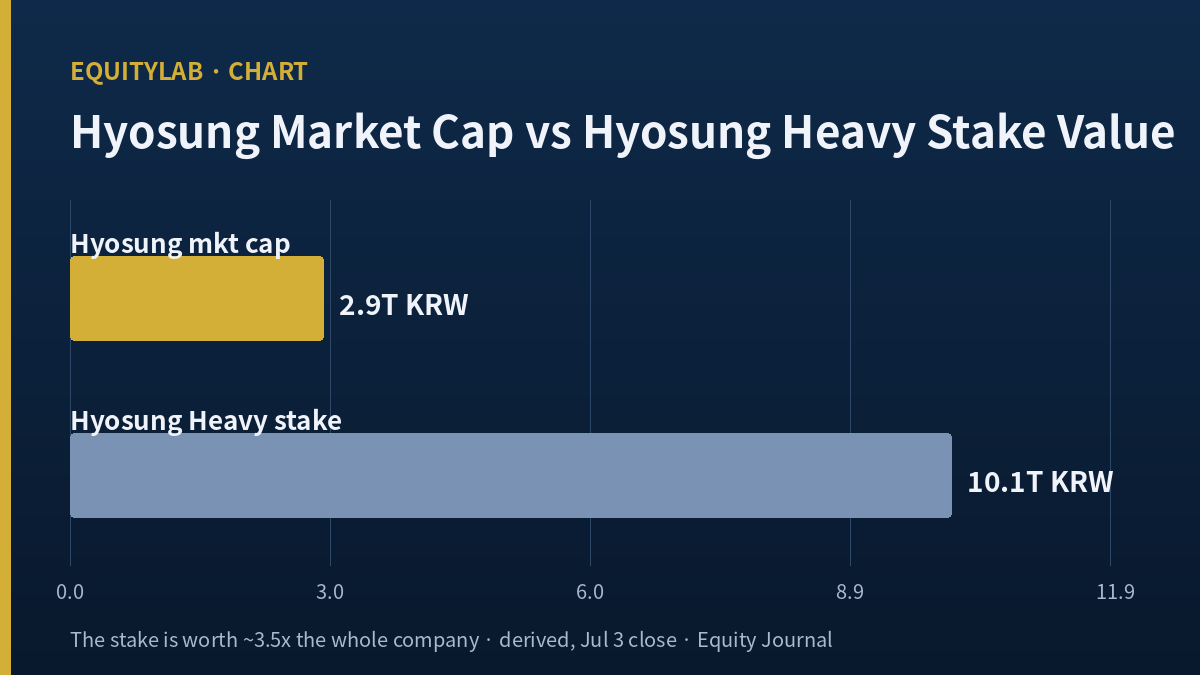
- I started scaling into Hyosung stock (KOSPI: 004800) around ₩172,000 (~$112). Hyosung’s 32.5% stake in Hyosung Heavy Industries is worth roughly ₩10.1 trillion (~$6.6B) on its own — while all of Hyosung carries a ~₩2.9 trillion (~$1.9B) market cap.
- 2026 is the first year Korea’s holding-company discount meets policy directly: a new dividend separate-taxation regime and a mandatory value-up disclosure land in the same window. Daishin Securities opened coverage in April with a ₩180,000 target while flagging the discount at a historically wide level.
- My fastest checkpoint is Hyosung Heavy’s Q2 print on July 24. If a fresh cash-injection filing toward Hyosung Chemical lands before that, I re-run the math from scratch.
Two months ago, writing my SK Square journal, I looked at a 43.8% holdco discount and wrote “watch,” not “buy.” Apply that same yardstick and this should be another pass. But in front of Hyosung stock I ran the calculator twice. The gap here wasn’t in the 40s. The market value of the Hyosung Heavy shares that Hyosung holds is more than triple the value of the entire parent company — a different kind of number. The hand that wrote “watch” put in a buy order this time, so this piece is the record of why I reversed.
Quick context for US readers: Hyosung (KOSPI: 004800) is the holding company of a Korean conglomerate — a chaebol — that was split into a holdco and several operating companies in a 2018 spin-off. If the “sum-of-the-parts trades below the parts” setup sounds familiar, it should — it’s the same structural puzzle US investors have priced in Softbank versus its Alibaba stake, or the old Yahoo-holds-Alibaba trade. Korea just runs a deeper, more chronic version of it.
Across the power-grid series I’ve now written up three operating companies — HD Hyundai Electric, LS Electric, and Hyosung Heavy Industries. One question sat in the back of my head the whole time: is buying that same engine at ~60x trailing earnings, or buying a claim on it at a 70%-plus haircut, the bet that fits my temperament? This article is my answer.
Contents
Why I bought Hyosung stock at ₩172,000 — three reasons
First, the arithmetic: a ₩10 trillion stake selling for ₩2.9 trillion
On the July 3 close, Hyosung Heavy Industries carried a market cap of about ₩31 trillion (~$20B). Hyosung is its largest shareholder, at a 32.5% stake confirmed in Korea Ratings’ November 2025 credit opinion (as of end-June 2025). Multiply it out and you get roughly ₩10.1 trillion (~$6.6B) — a simple market-cap-times-stake derivation. The same day, Hyosung stock closed at ₩172,400, for a market cap of about ₩2.9 trillion. That single stake is worth about 3.5 times the entire holding company.
The implication is blunt. The market credits less than a third of Hyosung’s Hyosung Heavy stake, and then assigns everything else — the Hyosung TNC stake, the Hyosung TNS unit that makes ATMs, the Ulsan tank terminal bought in 2025, the real estate — a value of zero or below. When Daishin Securities opened coverage on April 2 with a ₩180,000 target, its own model put 75.7% of total NAV in the Hyosung Heavy stake and applied a 72% target discount — the widest discount the market itself has priced, used conservatively. In other words, even a sell-side bull writing the constructive case can’t model the discount narrowing. That tells you what kind of name this is.
A note on multiples: P/E and P/B don’t travel well here. A holdco’s earnings are mostly equity-method income from subsidiaries, so a low trailing P/E is an artifact of accounting, not evidence of cheapness. Buying a holding company isn’t buying “cheap earnings” — it’s buying the odds that a discount moves. That’s a separate game, and I judged the odds are stacked favorably right now.
The same split reads differently from the other side of it. Orion lists its holding company under 001800 and its operating confectionery business under 271560, so a group-level headline does not map onto either ticker automatically: of the 67.5 billion won treasury cancellation announced in June 2026, only 7,344 shares were retired at the operating company — 0.0186% of its shares outstanding. Buying the holdco means pricing a discount; buying the opco means first working out which entity the press release is actually talking about.
Run SK Square back through the same yardstick and the two verdicts explain themselves. SK Square is the largest shareholder of SK Hynix at roughly a 20% stake, and when I wrote my watch journal its discount was 43.8%. Hyosung holds 32.5% of Hyosung Heavy at a derived discount in the 70s. Higher ownership, far deeper discount. The watch two months ago and the buy today aren’t a mood swing — they’re the same ruler, read twice.
Second, 2026 is the first year policy touches the Hyosung stock discount
That Korean holding companies trade at chronic, deep discounts is not news. What I weighted this time isn’t the discount itself but the fact that three layers of policy landed on it in 2026.
For US readers, one piece of background makes the rest legible. The “Korea discount” — the tendency of Korean equities to trade below global peers — is, as AllianceBernstein describes it, rooted in the chaebol structure of cross-shareholdings, low return on equity, and conflicts between controlling and minority shareholders. Holding companies are where that discount concentrates: they’re the top of the cross-shareholding pyramid, so they wear the deepest markdown. What changed in 2026 is that Seoul stopped treating this as a soft “please do better” campaign and started attaching tax and disclosure mechanics to it.
Start with dividend separate taxation. A December 23, 2025 amendment to Korea’s Special Tax Restriction Act applies a lower separate tax rate to high-dividend-company payouts starting January 1 this year. The move is not cosmetic: as Janus Henderson notes, Korea’s National Assembly approved cutting the dividend-income tax rate to 14–30% from as high as 45%, and 174 companies had disclosed value-up plans by the end of December 2025. In a market where dividends were historically taxed near punitive rates while capital gains went untaxed — the very reason chaebol families preferred to hoard rather than distribute — flipping that incentive is the structural lever. Per a Mirae Asset Securities January note, the qualifying tracks are two: an “excellent” tier at a 40%-plus payout ratio, and an “effort” tier at a 25%-plus ratio with dividends raised at least 10% year over year — either way, the payout can’t fall from the prior year, and the relief runs three years. For the first time, the post-tax return slope tilts toward companies that pay generously. Layered on top, per a Financial Services Commission February release, a qualifying high-dividend company must file a corporate value-up plan by the day after its dividend resolution at the AGM. Tax break and value-up disclosure, bundled and compelled, in the same first year. Daishin’s April note classified Hyosung as a company meeting the Act’s high-dividend criteria, and read this year as Hyosung’s first value-up disclosure. One caveat I’ll be honest about: by company IR, the 2024 cash payout ratio was 11.1%, so Daishin’s “high-dividend” designation must rest on the 2025 settlement — and I haven’t cross-checked that filing’s primary text myself. That’s a homework item I’m flagging for the next update, not burying.
Then the broader policy axis Daishin laid out in a June holding-sector note: a regulatory push to restrict dual-listing of core subsidiaries, amendment pressure on the Capital Markets Act aimed at low-P/B names, and inheritance-and-gift tax reform. All three go straight at the root of the holding-company discount. When or how far the discount narrows, nobody knows. But I can’t remember a year when the catalysts for it to narrow were this explicitly scheduled at the policy level.
Third, what you collect while you wait: the dividend
The weakness of a discount-narrowing bet is time. What carries you through it is the dividend. By company IR, Hyosung’s dividend per share ran ₩5,000 in 2020, ₩6,500 in 2021, ₩4,500 in 2022, and ₩3,000 in each of 2023 and 2024. The 2024 yield was 5.9% on a fair-value basis; against today’s ₩172,400 price, holding the ₩3,000 flat would put the yield around 1.7% (a simple back-calculation). Not a glamorous number — but a company that has never skipped a payout is telling you the holdco’s cash flow is alive. Subsidiaries earn, the holdco collects dividends, and a slice reaches me. Even in the scenario where the discount never narrows, at minimum that pipe keeps running.
The numbers behind Hyosung stock — holdco and engine
| Metric | Hyosung (004800) | Hyosung Heavy (298040) |
|---|---|---|
| July 3 close | ₩172,400 (~$112) | ₩3,323,000 (~$2,165) |
| Market cap | ~₩2.9T (~$1.9B) | ~₩31T (~$20B) |
| Off 52-week high | ~-46% (high ₩318,000) | ~-30% (high ₩4,742,000) |
| The link | holds 32.5% of Heavy | stake worth ~₩10.1T |
| Q1 2026 operating profit | equity-method driven | ₩152.3B (+48.8%) |
Sources: exchange quotes (July 3 close); Korea Ratings November 2025 credit opinion (stake); each company’s Q1 filing. Stake value and off-high figures are simple derivations. FX ~₩1,535/$.
Take the engine first. Hyosung Heavy’s full year 2025 was a record: revenue of ₩5.97 trillion and operating profit of ₩747 billion, its highest ever, with — per press reporting — North American revenue crossing ₩1 trillion and a year-end order backlog of ₩11.9 trillion, up 34% year over year. Q1 2026 held the trajectory at ₩1.36 trillion in revenue and ₩152.3 billion in operating profit, up 26.2% and 48.8% respectively. Per earnings compilations, Hyosung TNC also grew Q1 operating profit 11.4% to ₩86.2 billion. A holdco’s P&L is governed by the equity-method income of these subsidiaries, so as long as the engine turns, the holdco’s book turns with it.
The demand backdrop just got larger. On June 29, at a national briefing at the presidential office, President Lee Jae Myung unveiled three “mega-projects” anchored on semiconductors, physical AI, and AI data centers. Per CNN, the package runs to more than $576 billion over several years, with Samsung and SK Hynix each building two new fabs in the country’s southwest — and the president explicitly framed it as a push to narrow regional disparities and revive economies beyond the Seoul metro area. That regional-balance framing matters more than the headline dollar figure: this is the largest deliberate spread of industrial investment away from the capital in Korea’s modern history. Korean-language reporting fills in the scale that US wires compress — per News1 via Financial News, Samsung and SK’s combined long-term plans through 2040 reach ₩4,755 trillion, with roughly ₩896 trillion earmarked for the Honam region, ₩392 trillion for Chungcheong, and over ₩312 trillion for Yeongnam.
Here’s why a holdco investor should care about a chip-and-AI announcement. Semiconductor fabs and AI data centers don’t run on ambition; they run on electricity, and every new fab in an underbuilt region means new substations, new grid interconnection, and — the part that reaches Hyosung Heavy — ultra-high-voltage transformers. Diversifying fabs to the southwest, as the government intends, means building grid capacity where little exists today. That is transformer demand with a national mandate behind it. The first market reaction came on July 1; Hyosung Heavy spiked that day, and I already logged that move and its two-day give-back in my Hyosung Heavy journal. For the holdco, the read-through is simple: the order pipeline for the asset that is three-quarters of its NAV just got extended at the national scale, on a multi-year clock.
Two things about how the market handles Hyosung stock struck me as odd
First, the coverage asymmetry. Per Investing.com’s tally, Hyosung Heavy has 16 analysts on it as of early July, unanimously at buy, while Hyosung had 2 analysts as of late March. The same engine gets sixteen sets of eyes on the operating company and two on the holdco. A gap in attention is also a gap in price discovery. Half my reason for writing this is that the gap bothers me; the other half is that the gap might be the opportunity.
The access reality compounds it for a US investor. The operating company, Hyosung Heavy, is the one that shows up on grid-and-transformer screens and in the AI-power-demand thematic baskets that US money is chasing right now. The holdco doesn’t screen; it has to be understood. That’s precisely the kind of seat where a discount can persist longer than fundamentals justify — and precisely the kind a journal like this exists to sit in.
The cleaner way to size the engine for a US reader is the global mirror. Hyosung Heavy is a transformer-and-grid play in the same secular wave lifting GE Vernova and Siemens Energy — electrification, AI-driven power demand, and a decade of underinvested grid finally turning. Those Western names re-rated hard on that story. Hyosung Heavy participated in the operating results; the holdco that owns a third of it did not participate in the re-rating. Buying the holdco is, in effect, buying that same grid-electrification exposure at a structure the US market hasn’t learned to price.
Second, the give-back asymmetry. On the subsidiary rally of April 27, per Seoul Economic Daily reporting, Hyosung jumped 17.54% in a single session to ₩201,000. Hyosung Heavy rose 10.42% the same day, so the holdco moved more. Yet look at the path since: Hyosung has given back 46% from its 52-week high of ₩318,000, and Hyosung Heavy is down 30% from its high (both simple derivations). Up more on the way up, down more on the way down — that says the spring holdco rally was leveraged beta riding subsidiary momentum, not a re-rating of the discount. I first read that spike as the start of a re-rating; the honest read now is that the re-rating hasn’t started at all. And if the seat was never re-rated, then a price down 46% is nearer the floor of the beta than the ceiling.
Hyosung stock scenarios — the three branches I weigh
The engine turns, the discount holds (55%)
Hyosung Heavy reconfirms growth with its July 24 print, and the holdco tracks only that beta. If the 70s discount holds, Hyosung stock ends up moving as the shadow of the Heavy price. Even here I’m not underwater in my own math: the engine itself is compounding and the dividend pipe runs. What this path denies me is any payoff on the excess I paid to own the holdco. It’s the base case I weight most.
The discount actually moves (25%)
The value-up plan produces concrete execution — a buyback with cancellation, or a dividend step-up in real numbers — and separate-taxation flows rotate toward high-dividend holdcos. Since even the 72% Daishin baked into its ₩180,000 target is the market’s widest discount used conservatively, the arithmetic changes if the discount narrows even to the 60s. All three 2026 policy strands point this direction, so I can’t set the probability at zero. This is the real reason I chose the holdco door.
Chemical reaches out its hand again (20%)
The counter-case is sharp. Per Business Post reporting, Hyosung put ₩450 billion of cash into Hyosung Chemical in 2025 alone — ₩150 billion for the Ulsan tank terminal, ₩200 billion in platinum-catalyst purchases, ₩100 billion in hybrid securities — reaching ₩700 billion cumulatively since 2023. Hyosung Chemical only barely swung to a ₩277 million operating profit in Q1 while posting a ₩17.5 billion net loss. BNK Investment & Securities’ Kim Jang-won framed the Chemical problem as the swing factor for the holdco’s shareholder returns. To be fair, the Ulsan purchase cuts both ways — by the company’s own account, it’s an asset buy meant to secure stable cash flow and reduce reliance on the holding business. The direction of the cash toward Chemical, though, doesn’t change. Much of the holdco discount may be a rational price built by this support history, not a lazy market — a counter-view I take seriously. A fresh support filing would cut dividend capacity and value-up credibility at the same time. That’s the soft spot in my thesis.
What breaks my thesis
Three breakpoints, written in the order they answer. The fastest is Hyosung Heavy’s Q2 print on July 24 — the same date I set in my Hyosung Heavy journal. The scale is already there: an early-May press compilation put Street consensus for Q2 operating profit at ₩287.6 billion, with Yuanta Securities estimating ₩318 billion. If real earnings, stripped of deferred items, leave that growth track, the assumption behind the engine that is 75.7% of NAV wobbles, and the holdco bet loses three-quarters of its footing. The second breakpoint is a Hyosung Chemical filing, which can surface at any time — a hybrid-securities purchase, an asset buy, whatever moves cash from holdco to Chemical again; when it does, I re-compute dividend and value-up capacity from zero. The third, on the longest clock, is the substance of the corporate value-up plan within the year: if declarations keep repeating without concrete numbers on buybacks and dividends, I mark down that 25% discount-narrowing probability. The worst combination is all three going the same wrong way in the same quarter — and if that happens, writing the post-mortem into this journal is on me.
Same engine, different door
To recap, I’m holding one engine — Hyosung Heavy — through two doors. Through the operating-company door I own earnings growth; through the holdco door, at around ₩172,000, I bought the motion of a discount. The 44% I passed on at SK Square and the 70s here were different numbers to me, and that difference is what split watch from buy. Whether the call is right gets graded in order starting July 24. I’ll keep the scorecard in this journal.
Related reading