Korea Investment Holdings: Record Profit, IMA License, 1x Book
- I made Korea Investment Holdings the first name in my Korean brokerage series. At 6.8x P/E and 18.7% ROE it has the best value-quality balance in the group, and it just won an IMA license — a permit that requires more than ₩8T (~$5.8B) of equity capital — alongside Mirae Asset.
- Its main subsidiary, Korea Investment & Securities, earned a record ₩2.01T (~$1.5B) net profit in 2025, the first Korean brokerage ever past ₩2T (KED Global, Feb 12, 2026). Yet the stock still trades at 1.14x book.
- The catch: 41.7% of profit comes from proprietary trading. That’s upside leverage in a bull tape and the first thing to crack in a correction. My breakpoint for sizing up is tied to that profit mix and to real IMA balances.
Contents
Why Korea Investment Holdings is #1 in my series — the holdco-frame trap
When I laid out the brokerage sector, I pre-committed to an order. Number one is Korea Investment Holdings. The market files this company under “brokerage holding company,” and holdcos reflexively get a NAV discount — the parent’s market cap trades below the summed value of its subsidiary stakes. I think that reflex is loose this time, and the reason is one license: the IMA.
The IMA (comprehensive investment account) is a permit that only opens to a “super-large IB” with more than ₩8T of equity capital. In 2026, eight years after Korea introduced the super-large IB framework, the first designations finally landed — and the two firms were Mirae Asset Securities and Korea Investment & Securities. Why does it matter? It lets a non-bank broker raise funding with no maturity ceiling and lend it to corporates. In plain terms, the broker gets a quasi-bank balance sheet. The “brokerage-holdco discount” the market applies mechanically doesn’t capture that shift. That gap is my reason for putting this name first.
Start with why the discount exists at all. Korea Investment Holdings is a holding company built around Korea Investment & Securities, with financial subsidiaries spanning a savings bank, a capital (consumer-finance) arm, an asset manager, and a venture-capital unit. The market values that structure by summing the parts and then shaving a chunk off “because it’s a holdco” — citing subsidiary listing status, double-counting discounts, and governance complexity. The problem is that this mechanical haircut can’t see the moment a subsidiary’s business model changes in kind. The IMA is exactly that change in kind: the wrapper still says “holdco,” but the balance-sheet character of the broker inside it is different. I’m playing the lag between the discount on the wrapper and the change underneath.
US readers can map this onto the sum-of-the-parts or conglomerate discount they already know — the reason a holding company often trades below the summed value of its stakes. That discount is usually sticky and frequently deserved, and my argument isn’t that it shouldn’t exist. It’s narrower than that. A sum-of-the-parts model reprices the parts, but it’s slow to reprice a part whose earnings engine is changing character. When a subsidiary stops being purely a market-sensitive broker and starts carrying bank-like balance-sheet income, the “parts” being summed are no longer the same parts they were. The discount lags that shift, and that lag — not some claim that Korean holdcos deserve to trade at book — is the specific thing I’m underwriting here.
Three reasons I started buying Korea Investment Holdings
First: a record year, still at 1x book
Start with the numbers. In 2025, Korea Investment & Securities posted net operating revenue of ₩3.06T (+39%), operating profit of ₩2.34T (+76.3%), and net profit of ₩2.01T — the first Korean brokerage ever to clear ₩2T in annual net profit (KED Global, Feb 12, 2026). Commission income rose 39.6%, IB revenue rose 14.9%, and retail financial-product balances grew ₩17T in a year to ₩85T (~$62B). The growth was broad-based across desks. That last figure — ₩85T in wealth-management balances — is the one I underline for a US reader, because it’s the closest thing here to a Charles Schwab-style recurring asset base: money that sits and pays fees whether or not the tape is hot. A broker with a real wealth franchise underneath its trading desk is a different animal from a pure commission shop, and that difference is part of why I started here rather than with a pure retail broker.
And yet the holdco trades at 1.14x P/B and 6.8x P/E, on an 18.7% ROE. A company earning an 18% return on equity changing hands at 1.1x book is the market saying it doubts the earnings are durable. I think that doubt is half right and half overdone — I’ll dissect the profit mix below. What I hold onto here is simpler: a firm that just printed its best-ever year is still trading near book value. That tells me the undervaluation hasn’t fully unwound. Compare that to a US bank or broker earning an 18% ROE — it would not be sitting at 1.1x tangible book; the market would pay up for that return. The gap between what this return would earn in multiple elsewhere and what it earns in Seoul is, in one number, the “Korea discount” the value-up program is built to close.
Second: the IMA — where capital becomes the license
In the sector opener I wrote the line “capital becomes the license.” Korea Investment Holdings is the sharpest real-world version of that sentence. Short-term financing bonds unlock at ₩4T of equity; the IMA unlocks at ₩8T. The more capital you stack, the bigger the funding-and-deployment board, and the money made on that board stacks back into capital. Korea Investment & Securities, at the very top of the industry by equity, spins that compounding loop faster than anyone. The IMA designation adds a rung to the loop.
Here’s the tiering, because it makes the moat concrete. Above ₩4T of equity a firm can issue short-term financing bonds and fund up to twice its capital; above ₩8T the IMA loosens the maturity and size limits on that funding another notch. Since the super-large IB regime launched in 2017, several firms won bond licenses, but nobody cleared the IMA bar for eight years — until two firms did in 2026. That’s how high the capital threshold sat, and it means the two that cleared it first are positioned to widen the gap in corporate funding. I read that “first-mover’s head start” as a moat Korea Investment Holdings has already banked.
The mechanism matters to a US reader because it rhymes with something familiar. When a broker funds a book of corporate loans and holds it, it starts earning net interest income — the spread between what it pays to fund and what it charges to lend — which behaves far more like a bank’s earnings than like trading P&L. It’s the same reason Morgan Stanley re-rated as it leaned into wealth and lending rather than pure trading: steadier income earns a higher multiple. The IMA is Korea’s channel for a broker to build that kind of book at scale, and only two firms can use it right now.
A license doesn’t fill its own book, of course. How fast the IMA converts into actual corporate-finance assets, and how sound those assets are, is the next gate. Where that borrowed money gets lent decides the quality of both the profit and the risk — a book of good corporate credit is one thing, a reach for yield is another. I’ve put it straight into my breakpoints.
Third: shareholder return — the dividend more than doubled in a year
Korea Investment Holdings lifted its dividend per share from ₩3,980 in 2024 to ₩8,690 in 2025 (DART filings) — a 118% jump in one year, for a yield near 3.9%. As I laid out in the value-up context, Korea’s 2026 mandatory treasury-share cancellation and separate dividend taxation both tilt policy toward companies that raise payouts. A firm scaling its dividend at this pace stands in front of that tilt. I count the direction of return itself as one of my reasons — and the payout ratio isn’t stretched yet, which means there’s room to raise it further if earnings hold. That “if earnings hold” is the whole debate, and it runs through the profit-quality section next.

Korea Investment Holdings — the core data
The table sets the 2025 results of the subsidiary Korea Investment & Securities against the holdco’s stock metrics. Earnings are per KED Global’s Feb 12, 2026 report; the metrics are recent financial data and DART dividend records. I cross-checked every cell against its source. USD uses ₩1,380/$.
| Metric | Value | Note |
|---|---|---|
| 2025 net operating revenue | ₩3.06T (~$2.2B) | +39% YoY (Korea Investment & Securities) |
| 2025 operating profit | ₩2.34T (~$1.7B) | +76.3% YoY, record |
| 2025 net profit | ₩2.01T (~$1.5B) | first Korean brokerage past ₩2T |
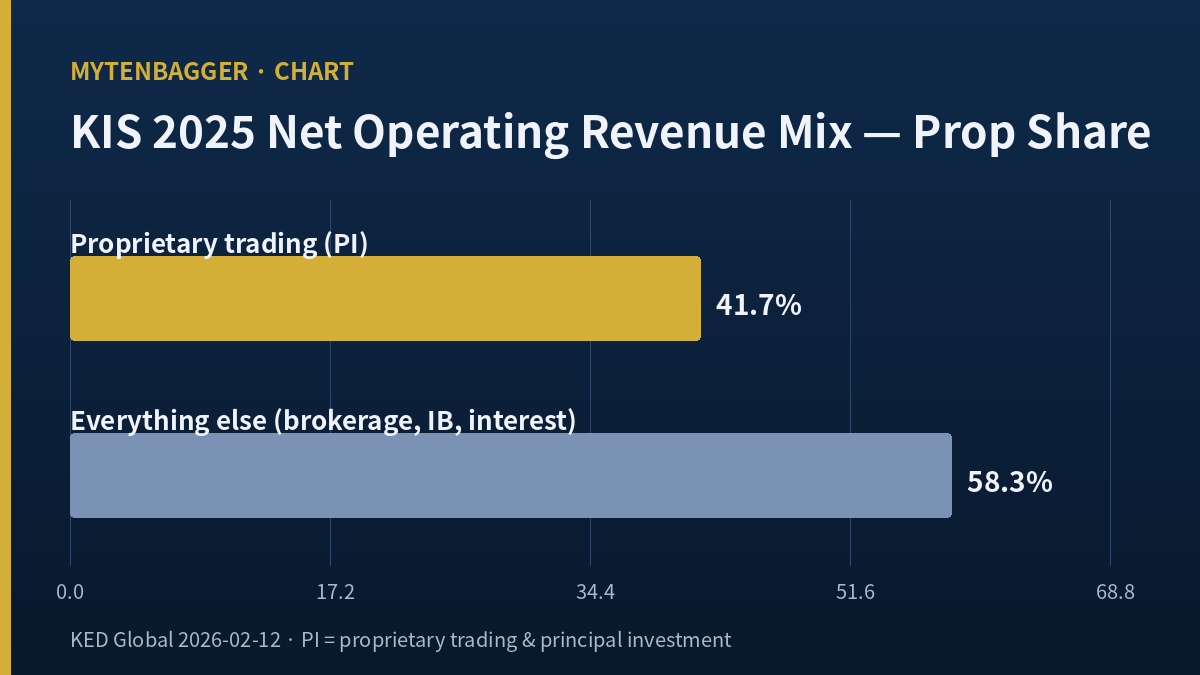
| Proprietary-trading share | 41.7% | prop net operating revenue ₩1.28T |
| Holdco P/E / P/B | 6.8x / 1.14x | ROE 18.7% |
| Dividend per share | ₩8,690 | 2024 ₩3,980 → +118%, yield ~3.9% |
Sources: results = KED Global 2026-02-12 (Korea Investment & Securities); metrics & dividend = recent financial data & DART FY2025 | As of: July 2026 | USD at ₩1,380/$
The stock itself ran to the mid-₩280,000s in early May, sank below ₩200,000 by late June, and has bounced back toward ₩240,000. It’s up more than 80% over twelve months and negative over three. The last several sessions show foreign and institutional buyers moving in together — supply-demand turning. I read this give-back as a window to watch, not a breakout to chase. Adding in tranches through the mid-₩200,000s pullback fits my temperament better than paying up at new highs. Profit quality changes over quarters, not days; there’s no reason to rush.
A quick practical note for US readers: Korea Investment Holdings has no US-listed ADR. Its foreign ownership already sits around 35% — the highest among the five brokers I’m covering — which I hold in mind two ways. It means global money already believes the value-up story on this name, and it means the stock can move on foreign flows as much as on domestic earnings. That’s a tailwind when the flow is coming in and an air-pocket when it reverses.
What the market misses on Korea Investment Holdings — the double-edge of profit quality
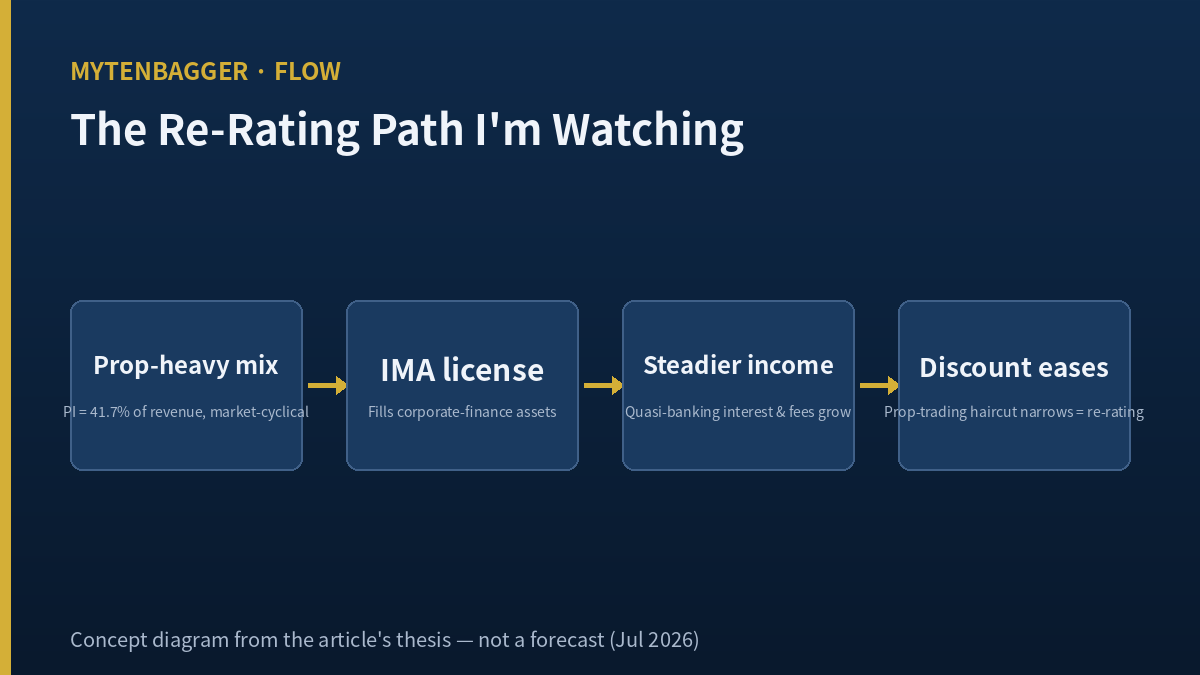
This is the part I most want to make. The market usually looks at Korea Investment Holdings and sees the surface: “6.8x P/E, cheap.” But that low multiple is itself the market’s discount on profit quality. In 2025, 41.7% of net operating revenue came from proprietary trading — profit earned by putting the firm’s own capital to work in trading and investments (KED Global, Feb 12, 2026). That’s explosive leverage in a rising market and the very first thing to wobble in a falling one.
So I hold two lenses over this name at once. One is the bull lens — “an undervalued, record-earning franchise.” The other is the caution lens — “more than 40% of profit is hostage to the tape.” You have to wear both. Buy the low multiple without knowing the prop-trading share, and you won’t understand why this “cheap” stock falls harder than most when the market turns.
This is exactly where my weight on the IMA comes from. Corporate-finance assets funded through the IMA earn more steadily than prop trading. As tape-independent profit grows, the profit-quality discount the market applies has room to shrink. That’s the re-rating path I’m watching.
For a global reference, US and Japanese readers have seen this pattern. Japanese brokers like Nomura long traded at depressed price-to-book precisely because a big slice of profit came from volatile trading — the same discount logic the market applies to Korea Investment Holdings today. The names that re-rate out of that trap are the ones that grow steadier, balance-sheet-based income — closer to how a Morgan Stanley leaned into wealth and lending to earn a higher multiple than a pure trading house. Japan’s own market only began forcing that gap to close when the Tokyo Stock Exchange started pressing sub-1x-book companies in 2023 — the playbook Korea is now running with a harder, statutory version. The IMA is Korea’s mechanism for the profit-mix half of that same shift. I’m not pinning a peer multiple on it — that’s a stock-by-stock job — but the direction is a well-worn one, and US investors have watched it pay off in Tokyo already.
Two scenarios I’m watching on Korea Investment Holdings
The path I see as more likely — profit quality improves, the discount narrows
My base case: if the trading-volume cycle holds through the second half and IMA- and bond-funded corporate assets grow steadily, the profit mix skewed toward prop trading starts to diversify. The market’s profit-quality discount eases, and the stock re-rates slowly toward a multiple that fits an 18% ROE. Sell-side sees this side too. Broad-based gains drove a record quarter into 2026, and one brokerage (iM Securities, May 21, 2026) projected 2026 net income of ₩2.5T (+23.9%) on IB and asset-management strength, with a ₩310,000 target; the consensus target sits in the ₩330,000s. I don’t adopt any of those targets as my own — no analyst’s number becomes my buy price — but I log that the consensus has moved up, and that within it the lowest target (Mirae Asset, mid-₩250,000s) is barely above today’s price. The direction is up; the conviction is not unanimous.
Where I could be wrong — the tape hits prop trading first
I write the other side with equal weight. If KOSPI takes a real correction from the 8,000s, the 41.7% of profit sitting in proprietary trading drains first. Then “record earnings” becomes a one-year peak, and the low multiple turns out to have been a fair discount, not a bargain. The 118% dividend jump is also a story that only holds while earnings do. On top of that, the holdco discount may simply never close — Korean holdco NAV discounts have been a chronic condition for well over a decade. Assuming one IMA license lifts it is my own optimism. So I carry this re-rating as a possibility, not a certainty: I weight the bull path more heavily, but I put the bear path near half, and that’s why I won’t load this name in one go, and why the size I do hold today is deliberately small.
My breakpoints — the line for sizing up
Honestly: right now I only hold a very small starter position, through the preferred shares. It’s not a core weight. Whether I move it up in the common stock depends on how three things print.
The fastest to answer is the August Q2 report. I want to see whether 2025’s earnings power carried into the first half of 2026 — and specifically how much the non-prop desks (IB, wealth, net interest) carry it, rather than trading. Next is the reality of IMA balances: whether the license fills with corporate-finance assets and whether those assets stay sound is the core evidence for the profit-quality thesis. Last is the durability of the return — whether the ₩8,690 dividend hardens into policy rather than a one-off, and whether it’s joined by treasury-cancellation filings. If profit quality and return durability confirm in the same direction, I move up into the common. If prop trading swells while IB and wealth fail to carry, I stop at the small starter. And if the tape rolls over before any of that resolves, I’d rather be early and light than early and heavy — the preferred shares I already hold are deliberately a toe in the water, not a plunge. The order of these three tells me what to do more than any single one of them: the earnings print comes first and sets the tone, the IMA balances are the slower structural proof, and the dividend is the confirmation that management intends to keep returning what it earns.
I don’t read Korea Investment Holdings as a “cheap low-P/E stock I buy because it’s cheap.” I read it as a company standing at the front edge of a change in profit quality. That’s why it’s #1 in the series: it’s the name where, if I’m right about capital becoming the license, the evidence should surface earliest and most clearly in the numbers — and if I’m wrong, the proprietary-trading share will tell me fast, in a single bad quarter. Either way I learn something quickly, which is exactly what I want from a lead-off name. Next I’ll set down Kiwoom Securities, the purest expression of the trading-volume engine. Would you read this low multiple as undervaluation, or as a fair discount?
This is the first single-name entry in my Korean brokerage series. The sector-level view — the buyback-cancellation law, the trading-value cycle, and how the five firms position — is in the series opener. Kiwoom Securities is next.
Related reading
- Samsung Securities: Why It Held While Kiwoom Fell 30%
- Lotte Chilsung Stock: Interest Takes Half the Operating Profit
- Why APR Corporation Stock Made Me Count Inventory First
- KT Stock Has Five Yardsticks for One Quarter and They Disagree